
Line up every alpaca top shipment that left Peru through July, and the one in the middle went at $28.25 a kilo.
That same figure was $22.41 in 2025. The level sat almost still and then moved by about a quarter. Any figure like that deserves one question before it goes into a budget, and it is the question that has quietly killed two other findings on this desk in the past week.
Alpaca tops leave Peru for two main destinations, and they pay differently. China buys the large majority of the volume at the cheaper end. Italy buys a smaller share at a higher price. When two destinations pay different prices, the overall figure moves whenever the balance between them shifts, even if neither destination changed what it pays.
A rise in the middle can therefore mean nothing at all. It can just mean more Italian tonnes and fewer Chinese ones. The honest test is to hold the destination still and look again.
China's share of volume rose across these years, from around 63% to around 70%.
China is the cheaper of the two. More weight on the cheap side should have pulled the middle down. The middle went up anyway, which means the mix was working against the finding and lost.
That is the strongest version of this test. A finding that survives a mix shift pushing in the opposite direction is not a mix artifact.
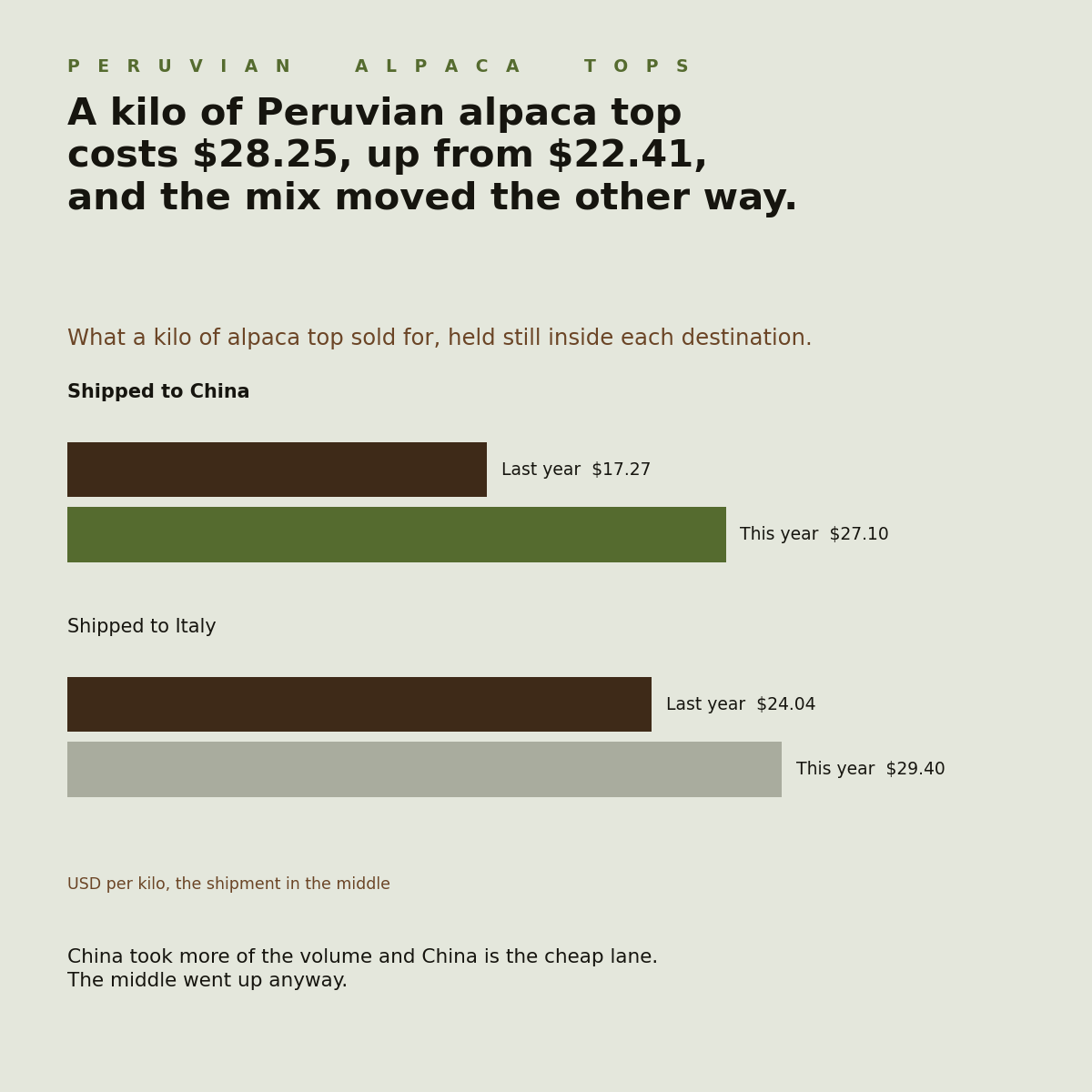
Inside China, the same figure moved from $17.27 to $27.10, and inside Italy from $24.04 to $29.40.
Both rose. The Chinese lane rose harder than the overall figure did, which is the opposite of what a mix artifact looks like.
So a Chinese spinner comparing its own two most recent seasons sees more than half again. The buyer who felt this hardest is the buyer moving the most volume.
Destination is one way to slice it. Fibre grade is the other, and the finding survives that too.
Reading the grade word out of each shipment description, baby moved up by roughly a third, and royal by a similar order. Huarizo, which sits at the coarse end and trades far cheaper, also rose. The lots whose description carries no grade word at all, which are the bulk of the trade, moved in line with the headline. Every slice points the same way.
Seven months in, the year is not closed. That matters less here than it would elsewhere, because monthly volume in this trade is unusually flat: no month carries much more than any other, so a partial year does not land inside a different season. It is why the figure is usable in August rather than next January.
The grade split is also a reading of free text. A shipment that describes its fibre precisely gets classified, and one that does not sits in the unlabelled group. That group is large, and the fact that it moved with the rest is reassuring rather than conclusive.
A collection costed on last year's fibre number is short by roughly a quarter, and by a good deal more if the yarn routes through China. That gap does not announce itself. It shows up at the invoice, after the retail price is set and the margin is committed, which is the expensive way to find out.
The cheap way is to re-cost now, while this season's contracts are still open and the number can still change what gets ordered.
Alpaca Sourcing follows Peruvian alpaca, from the fibre to the finished garment.
Sin posts
Comments
Nothing yet. Say the first thing.
Sign in to join the conversation.