
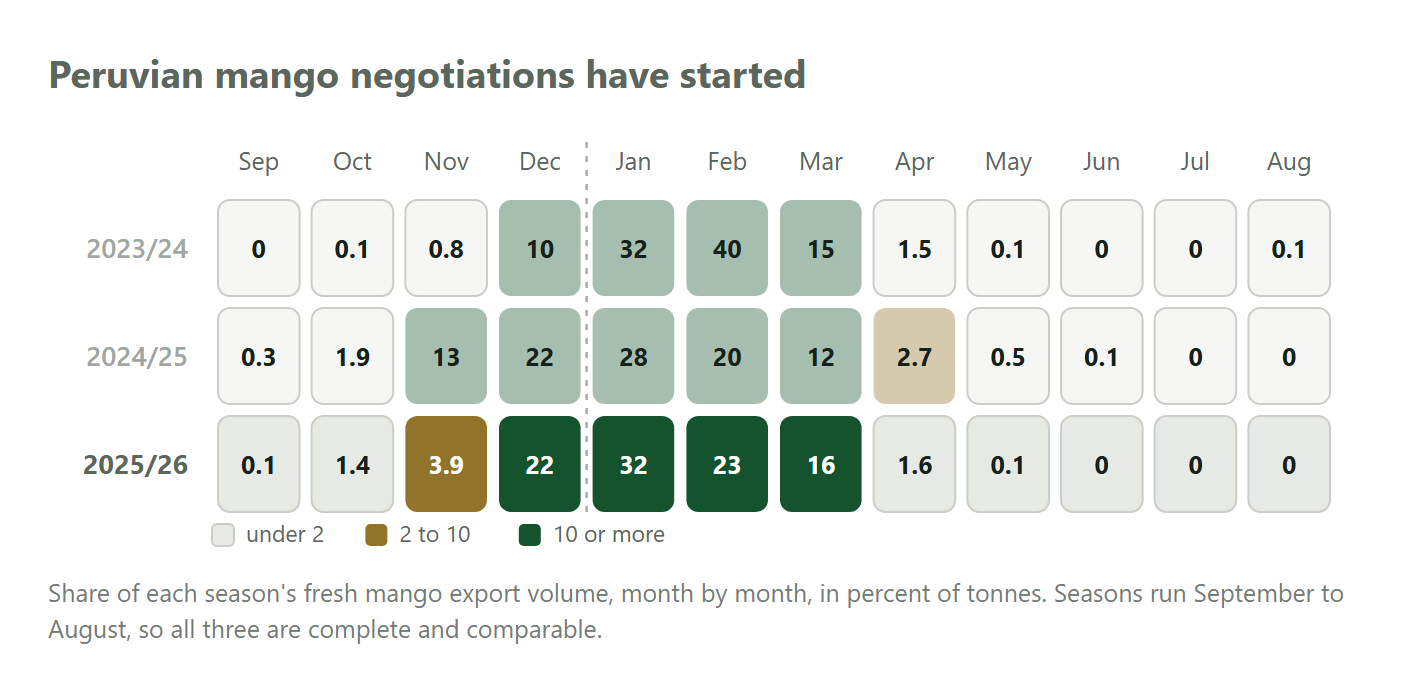
Peru ships 97% of its mango between November and March. Outside that window almost no fruit leaves.
And that window starts later: November used to hold 12.9% of the volume and last season, 2025/26, it held 3.9%. What moved is the start, because the peak stayed where it was, in January.
Two seasons do not prove a trend, but a buyer who builds his calendar on a picture taken two years ago asks for a quote a month before there is fruit.
Last season Peru shipped 233 thousand tonnes of fresh mango, against 304 thousand the season before.
The value, meanwhile, came out the same: 354 million dollars against 347. A quarter less fruit and the same money point in a single direction: the price did the work.
The kilo of fresh mango averaged $1.52 last season, against $1.14 the season before. That is a third more for the same fruit.
The useful part is knowing when it happened. The price was already up in November, at $1.89 the kilo against $1.11, before the first full week of shipping.
January is the biggest month and the one that usually brings the discount, and it closed at $1.47 against $1.03. Not one of the strong months went back to where it had been.
It was not an expensive destination pulling the average up either: the large ones all moved the same way, the United States and the Netherlands included, which take the most fruit.
The list of exporters got shorter too, with 200 shipping against 234 the season before, and the ones that moved real volume are around 180. That does not move the average, but it does move the conversation, because the exporter who is still there has less fruit to hand out and more people asking for it.
That is why some buyers have already started negotiating and holding fruit for the season ahead, with the boats still idle. A quote asked for in June is asked into an empty calendar; in January it is asked when the fruit is already committed.
Two seasons still prove nothing. But the fruit of the season ahead is already being handed out, and whoever arrives in January will buy what was left.
The Peru Mango Radar is the list behind this piece: each of the 200 exporters that shipped last season, ranked by volume, with its destinations, its average price per kilo and the buyers it ships most to. Reply with your destination and I’ll send you the scope and price for your market.
Sin posts
Comments
Nothing yet. Say the first thing.
Sign in to join the conversation.