
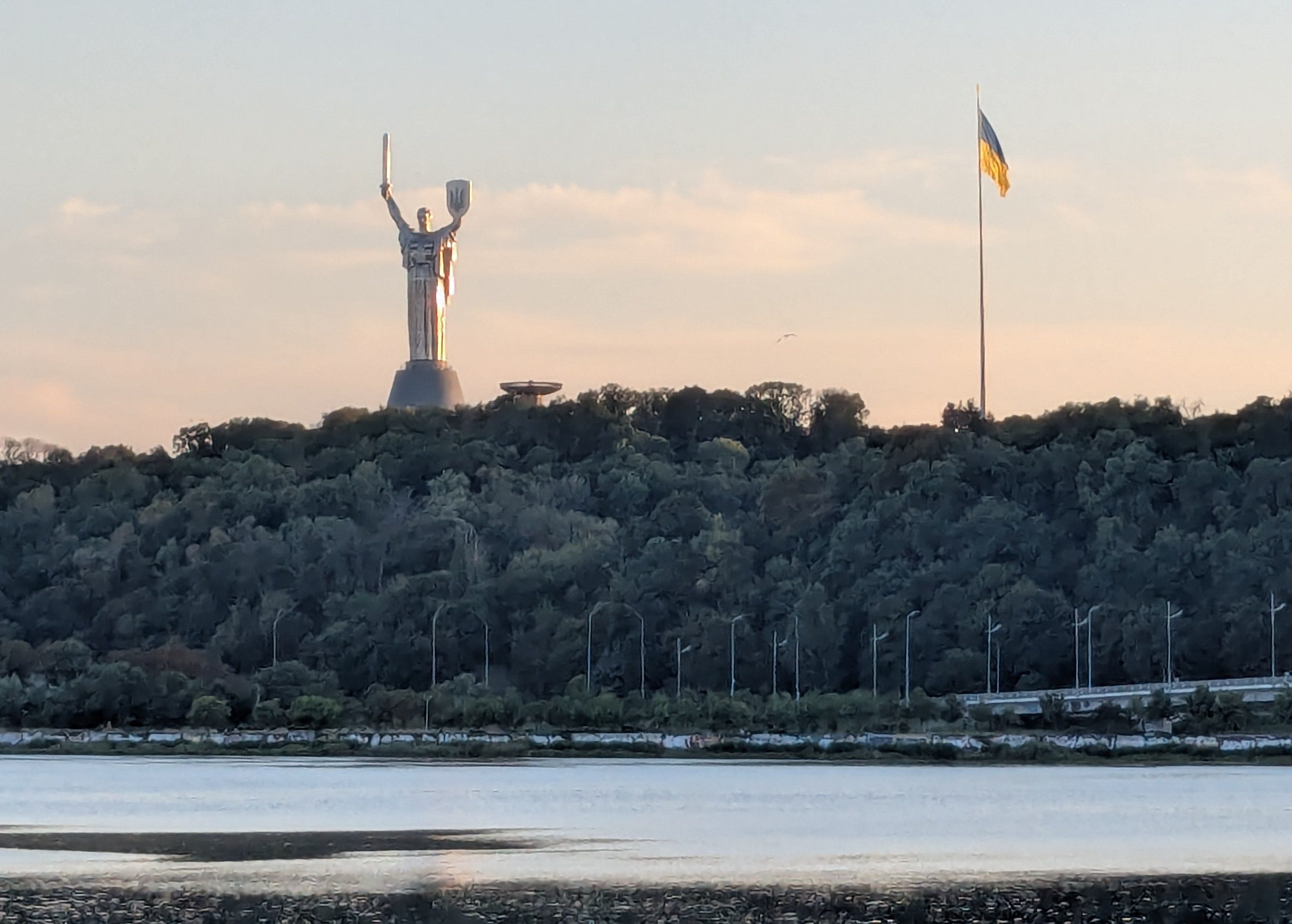
The Mother Ukraine monument and the Ukrainian flag rise above the Dnipro River in Kyiv. (c. Martin Kuz)
Volodymyr Zelensky sacked the country’s top general today in response to swelling street protests across Ukraine that erupted after the president fired Defense Minister Mykhailo Fedorov a week ago. The axing of Gen. Oleksandr Syrskyi marks a seismic triumph for the military’s new generation over an entrenched, Soviet-style command culture and strategic vision — and further inspires hope that the global institution of democracy might not be dead.
As I wrote last week, Zelensky’s abrupt decision to dismiss Fedorov, 35, so soon after appointing him in January threatens to halt the momentum that the Ukrainian army has reclaimed in recent months after more than two years of bloody battlefield stasis. To his many detractors, Syrskyi, 60, who ascended to commander in chief in early 2024, represented the grim face of that stasis. Critics inside and outside the ranks scorned him as a blinkered tactician whose mulish adherence to attritional combat resulted in lost ground and high casualties in Bakhmut, Pokrovosk and other cities, earning him the nickname “The Butcher.”
In contrast, under Fedorov, Ukraine emerged as a drone superpower. His emphasis on the dominant weapon in warfare’s new era enabled Ukraine to offset Russia’s manpower superiority along the 750-mile front line and inflict long-range destruction across Russia and occupied Crimea. The almost daily videos of enemy targets set ablaze this spring and summer — warships and military depots, oil tankers and refineries — boosted the popularity of the tech-savvy Fedorov and the spirits of war-weary Ukrainians.
Zelensky authorized the young defense minister to reform and modernize the military. Fedorov launched data-informed initiatives to address stubborn problems in recruiting and training, corruption in weapons procurement and systemic disorder within assault units. His full-press approach brought him into inevitable conflict with Syrskyi, who graduated from a Soviet Union military academy in 1986, five years before Fedorov was born.
As the infighting reached a crescendo, Zelensky sided with Syrskyi — an enraging surprise to young Ukrainians in particular, who took their fury to the streets starting last Thursday to deliver their own stinging surprise to the president. The initial demand of protesters for Zelensky to reinstate Fedorov soon gained an addendum when they began calling for Syrskyi’s removal, a reaction to reports that the general worked to thwart Fedorov and his reforms.
In Kyiv, Lviv, Kharkiv and other cities, thousands of people, most under 40, carried handmade signs with pointed slogans — “Hands Off Fedorov!” and “Syrskyi Out!” — that doubled as chants. Their youth illuminated the generational divide between the two adversaries, and if Zelensky expected their wrath to burn out over the weekend, the opposite happened as the rallies grew in size this week.
A former comedian who played the president in a popular TV series before he ran for and won the office in 2019, Zelensky, 48, appeared to finally read the room today. Bowing to public pressure, he fired Syrskyi less than a week after he had done likewise to Fedorov — the second time in a year that the president has backpedaled in the face of mass protests. Last July, after he sought to strip the independence of the country’s two primary anti-corruption agencies, widespread criticism forced Zelensky to restore the autonomy of both.
The suspension of elections under martial law deprives Ukrainians of nearly all leverage to counter the government’s policy decisions and personnel moves to which they object. Protests serve as the lone nonviolent alternative for attempting to bring about change.
Their willingness to fill the streets even in wartime — even at risk of missile attacks — shows a devotion to and belief in democratic principles that should shame the older, allegedly democratic nations that persist in lecturing Ukraine about its unworthiness to join the EU and NATO. A glance around European capitals — not to mention America’s — reveals far-right parties on the rise or already in power from Berlin, London, Paris and D.C. to Rome, Belgrade, Bratislava and Zagreb.
In that context, and despite Zelensky’s lamentable, autocratic habit of sidelining some of Ukraine’s most adept civilian and military officials over the course of the war, the protests prove the strength of Ukraine’s democracy, which turns 35 next month. Chastened by the outcry, the president announced he will replace Syrskyi with Maj. Gen. Mykhailo Drapatyi, 43, a respected and decorated commander who last week gambled with his own career when he went public in support of the ousted Fedorov. “Silence does not protect the army,” he wrote in a long post on social media. “It only allows mistakes to accumulate.”
The odds of Fedorov returning to his old job or accepting another role in government remain unknown; Zelensky apparently has offered him “a prominent position.” Regardless, the former defense minister hailed Drapatyi’s selection as “a breath of fresh air and a new source of hope.” The same description befits the people of Ukraine, whose brave defense of their motherland extends to protecting its liberty from the president’s worst instincts.
Etc.
— My sincere thanks for reading. If you’re a free subscriber and find Reporting on Ukraine worth your time, I hope you’ll consider upgrading to paid. You can also support my self-funded coverage here. Thank you.
Comments
Nothing yet. Say the first thing.
Sign in to join the conversation.