
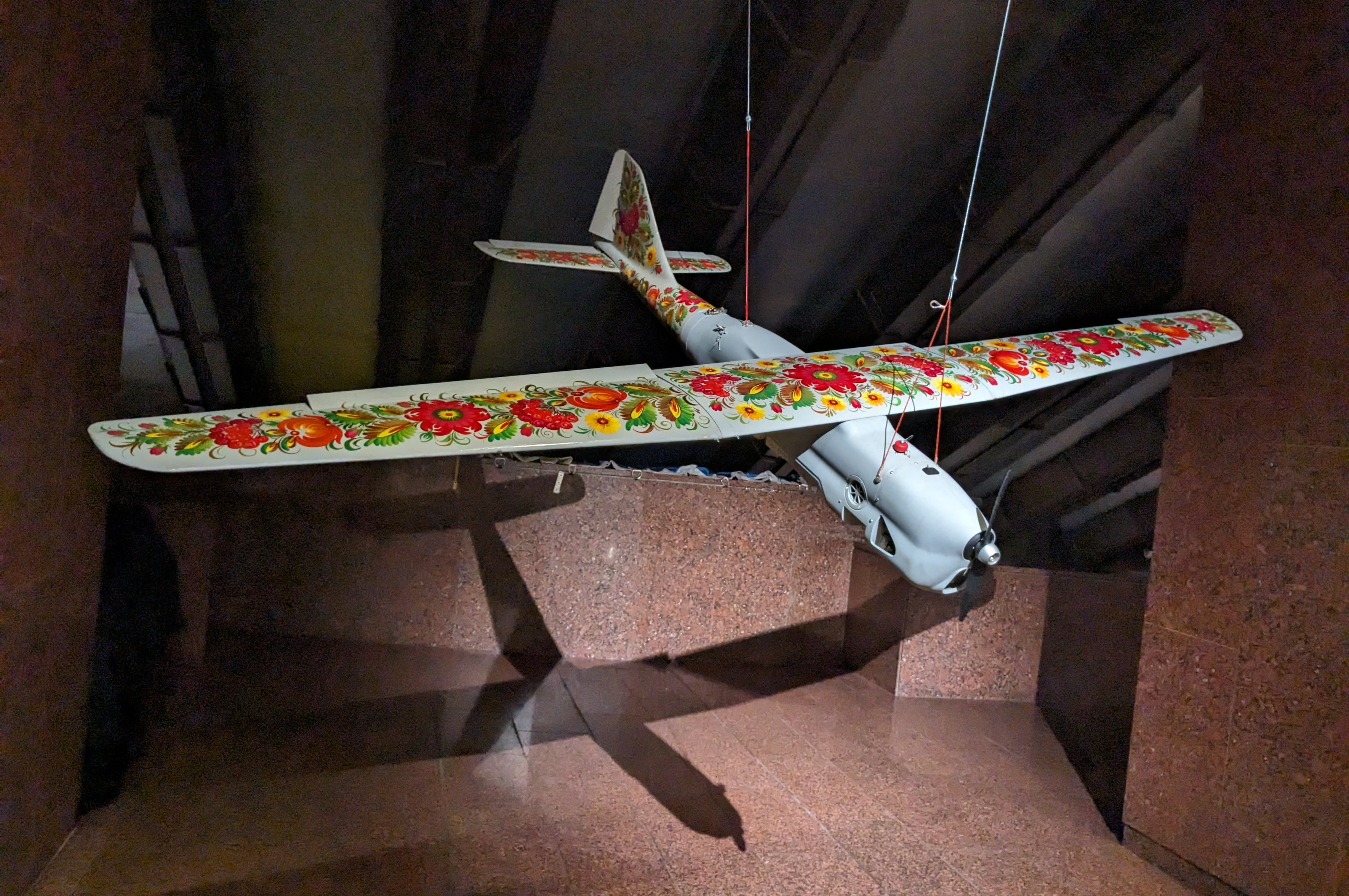
A drone hangs inside a war museum in Kyiv. During Mykhailo Fedorov’s brief tenure as defense minister, Ukraine achieved the status of drone superpower. (c. Martin Kuz)
Mass protests ignited across Ukraine on Thursday in the aftermath of Volodymyr Zelensky’s abrupt decision to oust his defense minister earlier this week. The president appointed Mykhailo Fedorov only in January, and in the ensuing months, the country achieved the status of drone superpower, displaying a sustained capacity to bring the war to Russia. His removal jeopardizes the momentum that Ukraine’s military has regained this spring and summer after more than two years of battlefield stagnation.
Innovative and charismatic, Fedorov, 35, broke with his predecessors as he embraced more offensive-minded strategies. He countered Russia’s huge manpower advantage with rapid expansion of Ukraine’s drone and robot programs, initiatives he had nurtured in his prior role as digital transformation minister.
His tech-savvy approach helped Ukrainian ground forces stabilize the front line and reclaim slices of territory in the east and south, with legions of drone operators hunting enemy soldiers across the 20-mile-wide “kill zone” separating the two armies. He further aided the military’s cause when he persuaded Elon Musk to block the Starlink access of Russian troops inside Ukraine, hampering their communication and movements.
Much of that progress went unseen by the wider world — unlike the spectacular results of Fedorov’s heavy emphasis on long-range strikes against an array of Russian targets. The list ranged from warships and tankers in the Black Sea and Sea of Azov to oil refineries, fuel depots and military sites across Russia and occupied Crimea. The waves of devastating drone and missile attacks have disrupted daily life in Russia with temporary airport closures, sporadic power outages and nationwide gas shortages.
Videos of black smoke billowing above Moscow, Crimea and elsewhere have rallied Ukraine’s national mood even as Russia’s nonstop bombing of cities and villages killed nearly 300 civilians in June, more than in any month since April 2022. The cautious sense of optimism that arose from Fedorov’s success during his brief tenure explains the widespread outrage over his dismissal — a forced departure that threatens to deflate troop morale and fracture military unity in the war’s fifth year.
I contacted a handful of Ukrainian soldiers and veterans to gauge reaction to the Fedorov news. Every one of them lamented his firing.1 “Good things have been happening since he started,” said Kostya, 30, an infantry soldier deployed to the eastern region of Kharkiv. “It was a situation of ‘If it’s not broken, don’t fix it.’ Now we wonder what comes next. Not the best decision by the president.”
Given broad authority by Zelensky to modernize the military, Fedorov wound up a victim of its old guard and old-fashioned infighting. He sought to reform recruiting and training, update and streamline methods of weapons procurement and crack down on corruption in the ministry and among private defense firms. Before long, his campaign drew him into sharp conflict with Oleksandr Syrskyi, Ukraine’s top general since early 2024, and his coterie of senior leaders.
A product of the Soviet Union’s calcified, top-down command culture, Syrskyi, 60, bears an unflattering reputation inside and outside the ranks for what critics describe as his meat-grinder mindset toward warfare. Troops refer to him as “The Butcher” for his apparent indifference to infantry casualties, and until Fedorov arrived as defense minister, he spent most of his time managing the army’s incremental retreat.
Talking to reporters Thursday in Kyiv, Fedorov — born in 1991, the same year as Ukraine gained independence — revealed that he had urged Zelensky to replace Syrskyi. He asserted that the general impeded tech initiatives to enhance combat efficiency and resisted data-informed strategies to lower costs and casualties while tolerating chaos and abuse within units and valuing loyalty above competency in senior officers.
“Instead of figuring out how to defeat Russia asymmetrically — which is the commander in chief’s job — he figured out how to split the country,” Fedorov said.
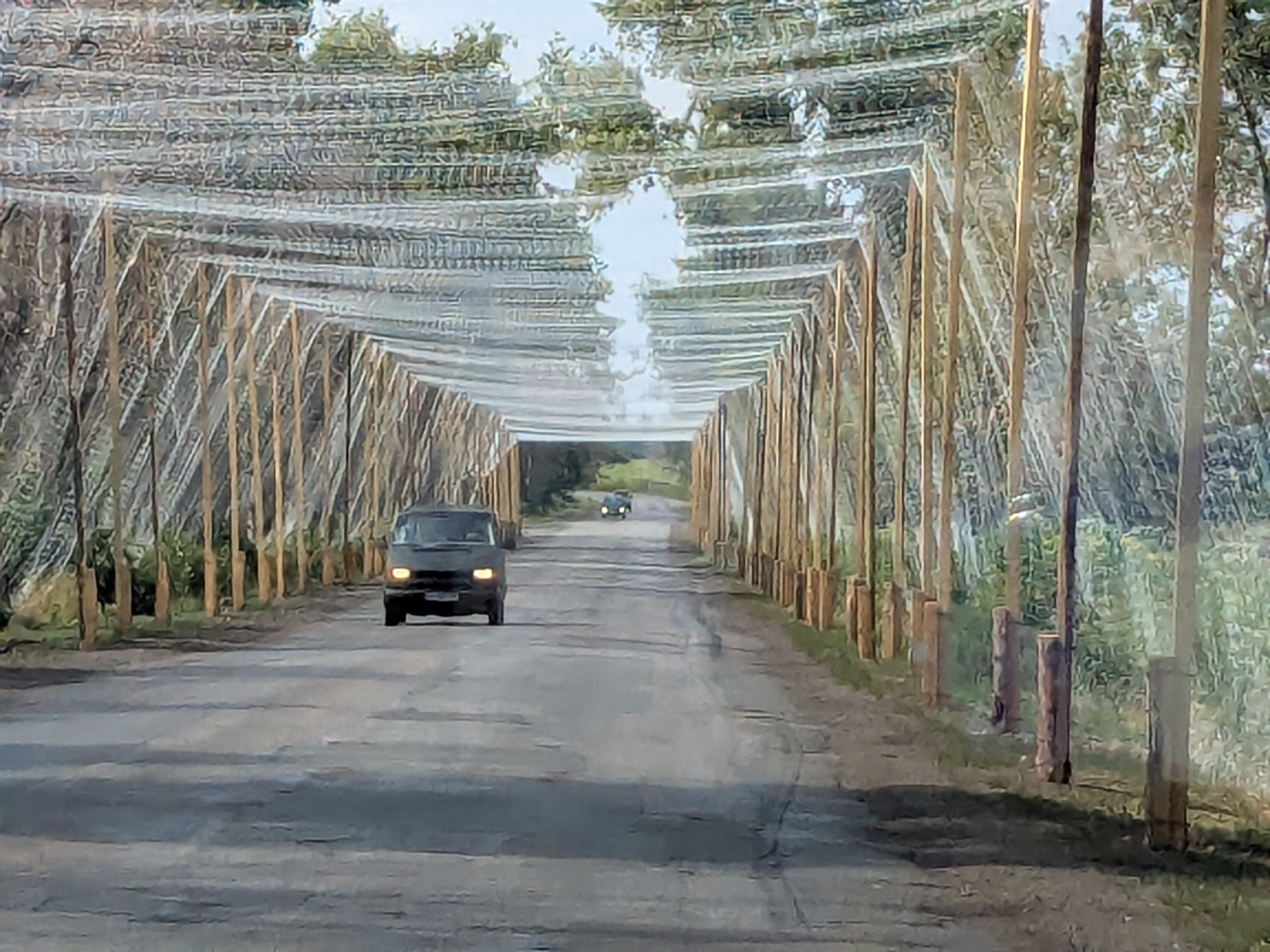
Anti-drone netting covers roads near front line areas in eastern and southern Ukraine to reduce the risk of attacks on military and civilian vehicles. (c. Martin Kuz)
Zelensky admitted during a press conference Thursday that tensions had simmered between his defense minister and commanding general. “I would very much like to see unity. The sides have not found it. And the problem lies not only with the sides, but with me as well,” he said. “But things are as they are. And in such a situation, you have a choice: either one side or the other.”
I asked Ihor, 28, a member of a drone unit in the southern region of Zaporizhzhia, for his thoughts on the president’s solution to the generational clash of wills. He replied without hesitation that Zelensky, 48, sided with the wrong man. “My personal opinion is that this is a big mistake,” Ihor said. He offered an analogy to illustrate the difference between Syrskyi and Fedorov in temperament and strategic vision. “It’s like the drill sergeant from a Stanley Kubrick movie and Tony Stark. It’s not only about firing a good guy. It’s also about our understanding that the president chose the drill sergeant.”
The dominant theory in Kyiv holds that Zelensky regards Fedorov — who has emerged as one of Ukraine’s most popular public officials — as a potential political rival if/when the lifting of martial law allows new elections to take place. Similar speculation percolated two years ago after Zelensky jettisoned Syrskyi’s predecessor, Valerii Zaluzhnyi, a revered, almost folkloric figure in Ukraine for the tactical prowess and imagination he showed in the war’s early stages.
Fedorov attracted powerful enemies in the defense establishment for his brash anti-corruption crusade. Within the ranks, he faced criticism after announcing a raft of military service reforms — fixed contracts, better pay, easier unit transfers — intended to entice new recruits and lure back some of the 200,000 soldiers who have deserted.
The changes irked experienced soldiers like Ihor, who joined in 2022, for failing to redress most of their long-standing complaints related to indefinite service, low pay, troop mistreatment and unit disorganization. But grievances aside, he said, few wanted Fedorov ousted. “Most military personnel supported him because those (new) contracts and other things were maybe only 10 percent of his implemented ideas. The other 90 percent of his ideas were good.”
Protests over Zelensky’s decision continued today in Kyiv and other cities. The uproar marks only the second time that demonstrations have erupted in Ukraine since Russia’s full-scale invasion began in February 2022. People filled the streets last July after the president sought to defang the government’s corruption watchdogs. The public outcry forced him to reverse course. There appears little chance he will backtrack on Fedorov.
Zelensky’s sacking of his well-liked defense minister at a moment of battlefield resurgence for Ukraine suggests that the former TV star’s reluctance to share the spotlight — and power — remains as acute as when he dismissed Zaluzhnyi two years ago. Whatever Syrskyi’s flaws as a commander, and irrespective of whether he poses an obstacle to the country’s defense, his low-key, deferential style has enabled him to stay in the president’s orbit.
The upheaval over Fedorov will magnify scrutiny of the military’s manpower deficiency, recruiting and mobilization struggles, troop abuse by commanders and other persistent problems. The fate of his reforms — including several more he planned to unveil later this year — is now unclear, and fissures among senior officers have already come into view.
Col. Pavlo Yelizarov, the deputy commander of the air force and a Fedorov appointee, resigned in protest Thursday. In a social media post, he wrote that the minister’s removal represents “a great evil for the country’s defense capability.”
The discord hands Russian dictator Vladimir Putin an unexpected gift “right when Ukraine was finally getting some hope,” said Artem, 36, an army veteran who works for a company that produces drone systems. He told me that his many friends in uniform, even if they disagreed with some of Fedorov’s moves, appreciated his efforts to cultivate professionalism across the armed forces and to dismantle the rigidity in command structure and combat strategy that they believe Syrskyi embodies.
“He was trying to make us more modern and less Soviet,” Artem said. “With him gone, Putin is clapping.”
Etc.
— My sincere thanks for reading. If you’re a free subscriber and find Reporting on Ukraine worth your time, I hope you’ll consider upgrading to paid. You can also support my self-funded coverage here. Thank you.
In line with military protocol, and in order to solicit candid opinions, I have changed the names of the service members interviewed.
Comments
Nothing yet. Say the first thing.
Sign in to join the conversation.