
Every large organisation that has seriously attempted to build a customer decisioning capability has encountered roughly the same set of problems. How do you arbitrate competing business objectives in real time when the retention team wants to suppress offers and the growth team wants to push them? How do you stop decisioning logic from accumulating into an unauditable tangle of rules that nobody fully owns? How do you measure whether the engine is improving customer outcomes, rather than simply optimising for the metric that was easiest to instrument?
These are hard problems. They are also solved problems - imperfectly, in pockets, inside individual organisations that have been working on decisioning long enough to hit the edges and find their way back. A telco has a governance model worth studying. A bank has cracked a measurement framework that most organisations are still struggling to define. A retailer built an arbitration logic that elegantly handles conflicting objectives across twelve channels.
But none of that knowledge travels. It stays inside the organisation that earned it, locked behind competitive sensitivity and the simple fact that there is nowhere obvious to share it. The next organisation starts from scratch. And the one after that.
This is the defining characteristic of a discipline without a community of practice: the same hard lessons get learned, expensively and repeatedly, by practitioners who will never find each other.
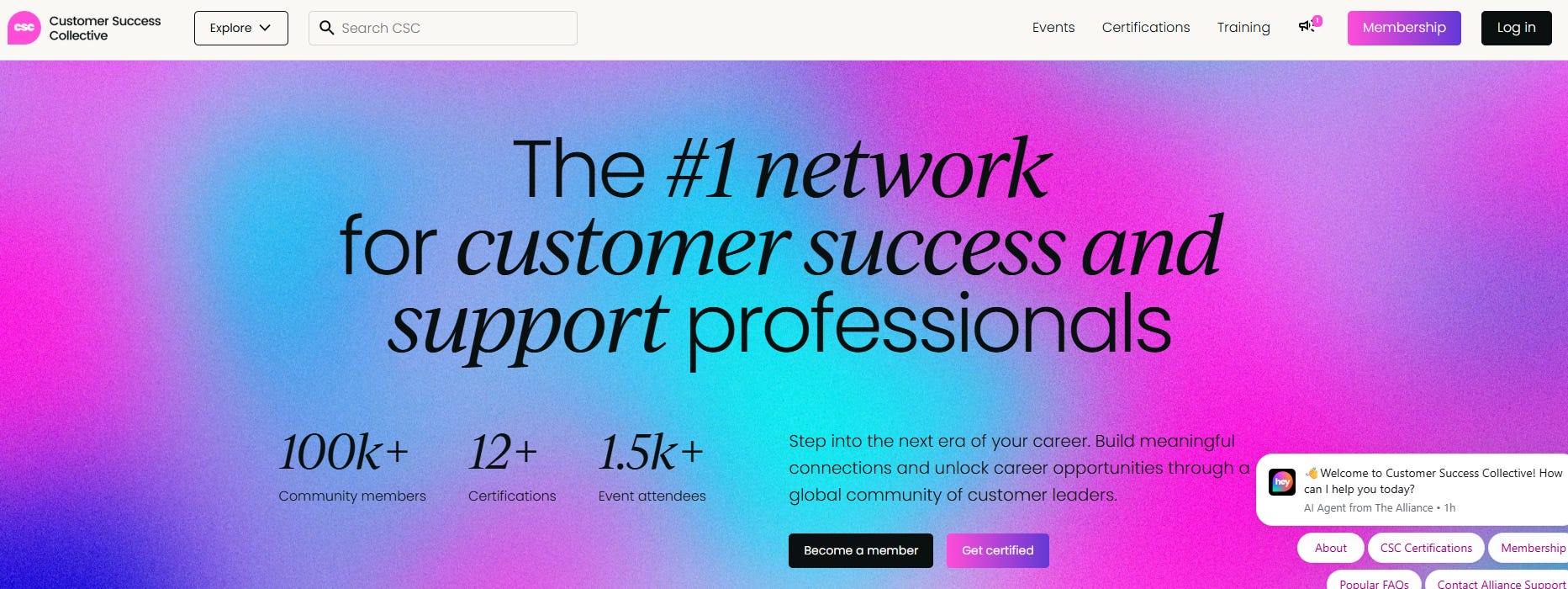
Cast an eye across the professional community landscape in marketing and technology, and you will find thriving ecosystems for almost every adjacent discipline. Customer Success has its Collective - over 10,000 practitioners exchanging frameworks and career advice daily. Marketing Operations has Marketing Ops and Revenue Ops forum. CX professionals gather at Forrester’s annual summit and a dozen regional events structured around their specific craft. Even the broader MarTech space, which covers an almost impossibly wide territory, has found community - built precisely because practitioners wanted a space to talk about real issues, away from sponsor booths and product pitches.
Customer Decisioning has no equivalent. No dedicated forum. No practitioner-led Slack workspace. No annual gathering where the people actually building and governing decisioning logic can compare architectures, debate governance models, or share what genuinely works at scale. This is a structural problem that compounds every other challenge the discipline already faces.
There are Zero dedicated practitioner forums, certifications, or annual summits for customer decisioning as a discipline.
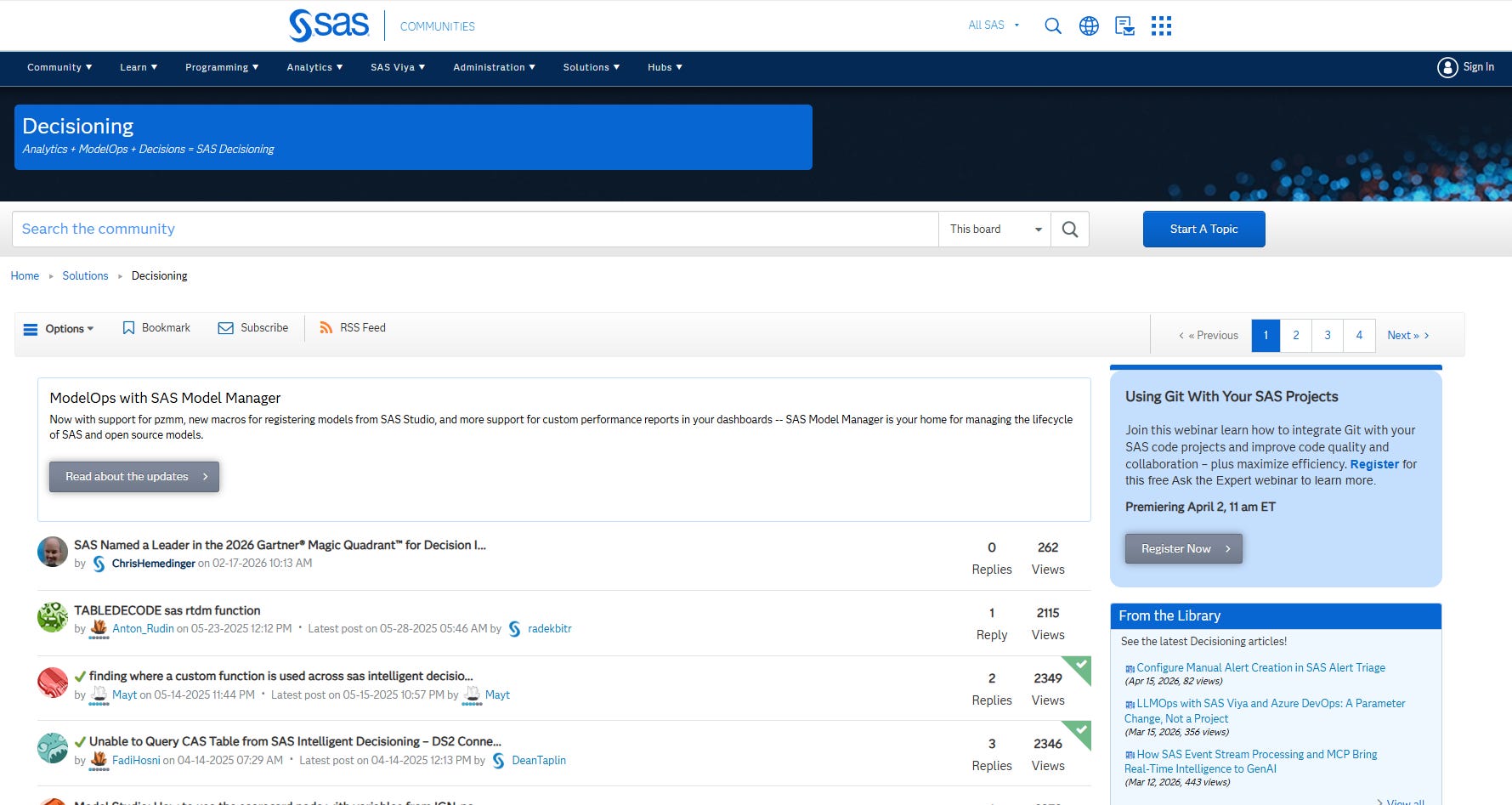
What passes for a decisioning community at present is, in most cases, a vendor community dressed in practitioner clothing. SAS has a Customer Decisioning community. Pega has its community platform for Customer Decision Hub users. Salesforce has Trailhead. Braze has its community. Adobe has its summit. Each is genuinely useful - within its own walls.
But there is a critical difference between a vendor community and a discipline community. A “Pega Decisioning Architect” knows how to configure the Customer Decision Hub. A “Salesforce Einstein specialist” knows how to wire up Einstein Personalization. What neither community produces is a practitioner who can think about decisioning as a discipline - independently of the platform they happen to be working in today, or the one their organisation might adopt tomorrow.
The knowledge that accumulates inside vendor communities is, by design, platform specific. When Braze describes BrazeAI Decisioning Studio as a “decisioning layer above existing platforms,” it is also designing the evaluation framework through which buyers understand decisioning itself. Brands that rely on vendor-produced content are being led, by definition, toward vendor-preferred architectures. That is not a criticism - it is simply the nature of vendor content. But it means practitioners are left building discipline knowledge inside a framework that was never designed to serve the discipline.
A software engineer deepening their understanding of distributed systems does not rely solely on AWS documentation, even if AWS is their cloud provider. A finance professional does not build their understanding of capital structure through their bank’s thought leadership. These disciplines have independent bodies of knowledge and communities that exist above the product layer. Decisioning does not yet have that.
The absence of an independent practitioner community has real operational consequences that show up, repeatedly, inside organisations attempting to build and scale decisioning capability.
Knowledge stays local and reinvention is the default. Every organisation is solving roughly the same hard problems: arbitrating competing objectives, governing accumulating logic, measuring genuine customer impact. But without a community in which answers can travel, every team starts from scratch. Frameworks that took three years to develop in one organisation could save another organisation two of those years - if there were somewhere to share them.
The talent pipeline is thin and has no professional home. Gartner research has identified marketing data and analytics and marketing technology as among the top capability gap areas cited by CMOs. Decisioning sits at the intersection of both, requiring fluency in data, AI, business logic, and customer strategy simultaneously. Yet there are no platform-neutral professional pathways into the discipline - no curriculum, no certification that belongs to the field rather than to a vendor. Without a community, there is no visible career path, and without a visible career path, the talent the field needs do not know it has a home.
The discipline keeps getting fragmented into features. AI decisioning has been around for a long time, with SAS and Pega pioneering the idea that statistical modelling can determine the best decision to drive customer outcomes. Yet today, “decisioning” is applied to almost anything involving an algorithm making a selection - from channel optimisation inside a single MAP to full cross-channel arbitration across a centralised decision hub. Without a community that can hold a shared definition and interrogate vendor claims against practitioner reality, “decisioning” continues to mean whatever each platform needs it to mean in the next product announcement.
Consider what the data science community looked like before it coalesced. Individual analysts existed in every large organisation, solving similar problems in isolation. No shared standards, no discipline-level frameworks, no community of practice. Then Kaggle, DataCamp, the open-source Python ecosystem, and dozens of practitioner forums created the conditions for knowledge to travel. The discipline professionalised. Vocabulary stabilised. Career pathways emerged. Today, a data scientist moving between organisations carries portable, discipline-level knowledge - not just familiarity with whichever tool their last employer happened to use.
The decisioning space is at an earlier stage of the same trajectory. A 2025 Gartner survey of 413 marketing technology leaders found that while 89% of martech leaders with AI agent initiatives expect significant business benefits, many are hindered by a lack of technical stack and talent readiness. Decisioning is a significant part of that readiness gap - and unlike infrastructure challenges, it cannot be solved by buying another platform.
Why does a community not yet exist, when the discipline is clearly large enough and the need is clearly real?
Decisioning sits awkwardly between existing professional identities. It is too technical for most marketing teams and too customer-facing for most data science teams. The people doing it well hold roles with titles that vary enormously across organisations - CDP strategist, personalisation lead, AI decisioning architect, customer engagement director - which makes the community hard to identify, let alone convene.
Vendor ecosystems have also filled the vacuum just enough to reduce the urgency. When a practitioner can find reasonable answers to their immediate platform questions in a vendor forum, the absence of a platform-neutral alternative feels like a minor inconvenience. It is only when they need to think above the platform - about architecture, governance, measurement, or organisational design - that the absence becomes acute.
These are not permanent conditions. They are the characteristics of a discipline in early formation - the same characteristics that existed in data science, in customer success, in marketing operations before those communities were built. The difference is that in those fields, someone eventually decided the formation period had gone on long enough.
Governance frameworks that should be approaching industry-standard are being reinvented from scratch inside every organisation that reaches the necessary maturity. Measurement approaches that genuinely track decisioning impact against customer outcomes are sitting undiscovered inside organisations whose practitioners have no mechanism to share them. Talented people who have done the hard work of building decisioning capability are moving between roles carrying that knowledge in isolation, because there is no professional home that makes the discipline feel like a career.
The discipline is not waiting for permission. It is not waiting for a vendor to convene it, because a vendor-convened community will always carry a vendor agenda. It is not waiting for an analyst firm to define it, because analyst framing will always trail practitioner reality by several years.
It is waiting for the practitioners solving these problems - in isolation, in parallel, in organisations that will never compare notes without a structure that makes comparison possible - to decide that the cost of continuing alone is higher than the effort of building something together.
Decisioning is too consequential, and too genuinely hard, to keep solving in isolation.
I’d love to hear your feedback - it only takes a minute! Let me know what you think and what topics you’d like to see next. Here is the Survey Link.
If you are a Customer Decisioning leader or practitioner - whether you work for a brand or a vendor, I’d like to talk with you about an upcoming project. Please feel free to drop me an email at pawan@martechsquare.com
No posts
Comments
Nothing yet. Say the first thing.
Sign in to join the conversation.