
Every year, organisations pour millions into customer decisioning platforms with a compelling promise: the right offer, to the right customer, at the right moment, through the right channel. It is an idea that is difficult to argue with. And yet, a disheartening pattern repeats itself across industries - from retail banking to telecommunications, from insurance to retail. The technology gets deployed, the steering committees sign off, the go-live date arrives. And then, somewhere between the architecture diagram and the customer’s screen, it all quietly unravels.
This is not a technology problem. The platforms available today - from Pega and Salesforce to homegrown machine learning stacks - are genuinely powerful. The failure is almost always organisational, strategic, and human.
The most pervasive failure mode begins before a single line of code is written. Decisioning is handed to Technology. A platform is selected. Vendors are briefed. And the business - the people who understand customers, commercial objectives, and channel realities - are invited to review the PowerPoint at the end.
Customer decisioning is fundamentally a business capability, enabled by technology. It requires continuous collaboration between data scientists, CRM managers, product owners, channel teams, compliance, and frontline operations. When it is treated as a technology project, you get a technically correct system that nobody uses, nobody trusts, and nobody owns.
You cannot automate good judgement you have never defined. The machine will faithfully execute whatever logic you give it - including logic that is wrong.
Customer decisions sit at the intersection of marketing, risk, product, and operations. When accountability is shared across functions without a clear decision-maker, the system becomes a political object rather than a commercial tool. Committees make conservative decisions. Bold personalisation never gets approved. The platform drifts toward batch campaigns that could have been executed with a spreadsheet.
The pitch always includes a slide about "360-degree customer views" and "unified data assets." The reality, discovered after contract signature, is more complicated. Data is siloed across legacy systems. Identity resolution is unreliable. Real-time feeds are aspirational. Without clean, timely, and trusted data, even the most sophisticated decisioning logic produces recommendations that are irrelevant, incorrect, or - at worst - regulatory violations waiting to happen.
Teams spend months configuring eligibility rules, propensity models, and arbitration logic. Then someone asks: what is this system actually trying to achieve? Is the goal to maximise next-best-offer acceptance? Reduce churn? Increase product holdings? These objectives can conflict. Without explicit prioritisation - written down, agreed upon, and encoded into the decisioning architecture - the system optimises for whatever metric is easiest to measure, which is almost never the most important one.
Decisioning platforms generate recommendations. Someone still has to deliver them. And the channels - contact centres, mobile apps, websites, email platforms, branch systems - are often built on technology stacks that were never designed to receive real-time decisioning outputs. Integration is underestimated in every project plan, overruns every timeline, and consumes budget allocated to value-creating activities. By the time the first live decisions reach a real customer, the team is exhausted and the momentum has stalled.
Frontline staff are asked to follow recommendations from a system they do not understand, have not been trained on, and fundamentally do not trust. Sales teams override the system. Contact centre agents dismiss "next best conversation" prompts because the recommended topic feels wrong for a customer they know well. Without deliberate investment in building belief - through explanation, evidence, and early wins - adoption fails and the decisioning platform becomes shelfware with a live connection.
Decisioning is not a set-and-forget capability. It requires continuous experimentation: controlled tests, champion-challenger frameworks, rapid model refresh, and feedback loops that connect outcomes back to strategy. Most programmes launch with ambitions to run hundreds of tests per year. In practice, the team is consumed by operational maintenance and data quality firefighting. The system calcifies. The models grow stale. The business loses confidence and stops investing.
Organisations that cannot define what a successful decisioning programme looks like at twelve months - with specific metrics, baselines, and measurement methodologies agreed before go-live - will always struggle to demonstrate value. When the first executive asks "is this working?", the answer becomes a PowerPoint narrative rather than a data-driven verdict. Budgets get cut. The programme is quietly wound down or absorbed into a broader CRM initiative where its distinct capability disappears.
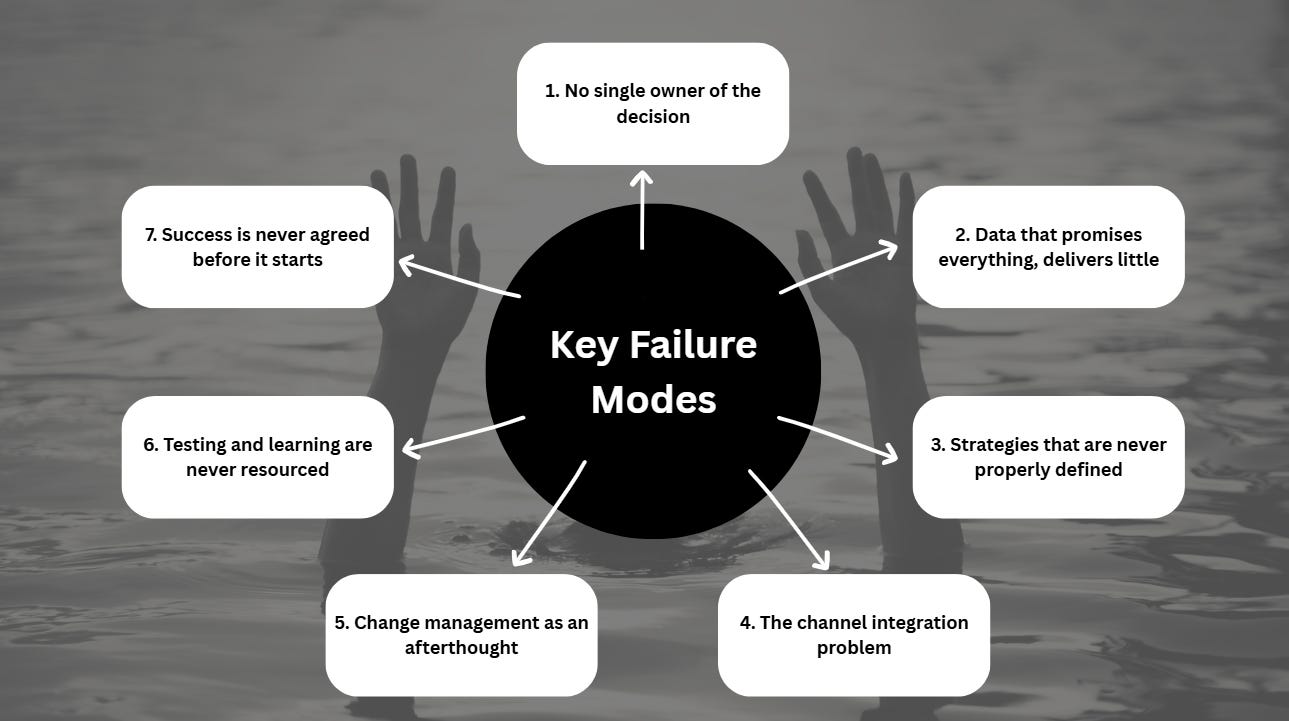
Behind most of these failure modes is generally an uncomfortable truth: organisations overestimate how ready they are and underestimate how hard this is.
Decisioning capability is not binary - it is a maturity curve. At one end, you have simple segmentation: rules-based targeting driven by demographic and transactional data. At the other, you have true real-time personalisation: propensity models refreshed continuously, multi-step journey orchestration, ethical AI guardrails, and channel-agnostic delivery at scale. The distance between these two points is enormous - technically, organisationally, and culturally.
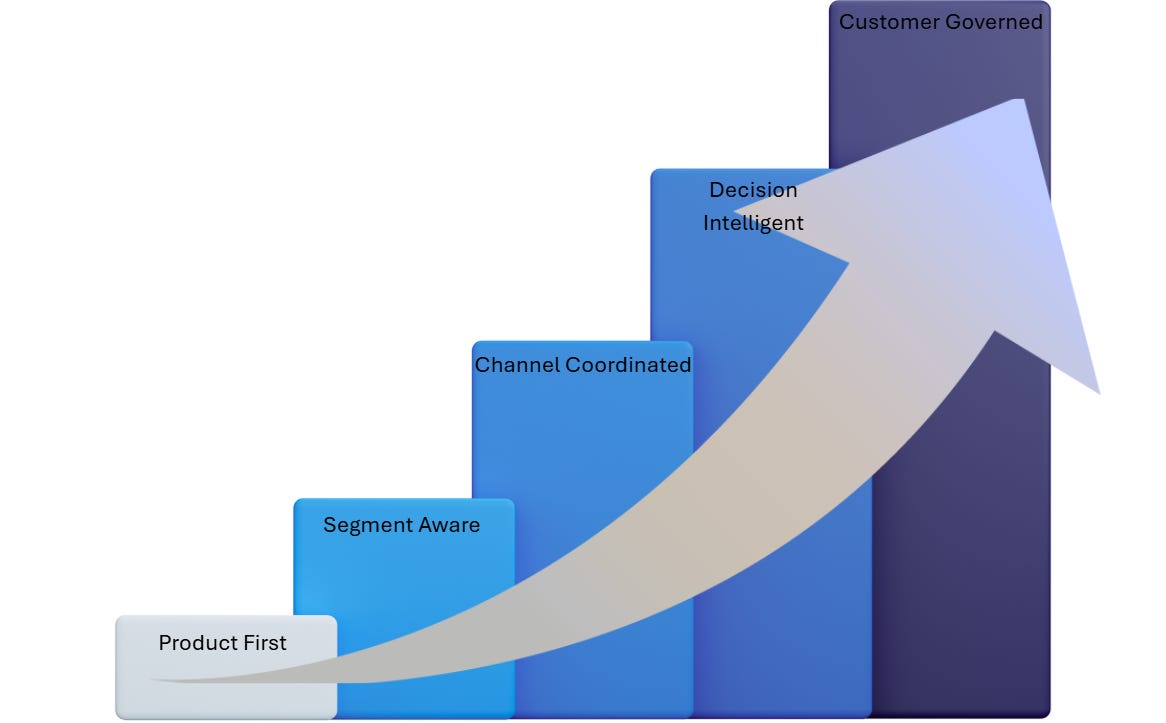
The tragedy is that organisations often try to jump from one end to the other in a single programme. They buy enterprise platforms designed for the most advanced use cases before they have the data foundations, the operating model, or the organisational muscle to exploit them. The result is a capable engine installed in a vehicle that has not been built around it.
The programmes that succeed are almost never the ones with the most sophisticated technology. They are the ones that start with a clearly defined problem, a realistic scope, a business owner with genuine accountability, and an honest assessment of what the data can actually support today.
Several years ago, I was the lead on a customer decisioning programme for a large organisation. We built the capability inside the contact centre, and by most measures it was working. Agents were following recommendations. Offer acceptance rates were climbing. The call centre leadership was genuinely invested - they had seen the early results, understood what the system was doing, and wanted more of it.
The natural next step was expansion into digital channels. That is where most of the customer volume was, and where the real scale of a centralised decisioning capability would be felt. We began the conversations. We drew the roadmap. And then we waited.
Digital had its own pressures - platform migrations, competing product priorities, and a leadership group that had not been part of the decisioning story from the start. There was no hostility. Just absence. No seat at the table, no shared objective, no reason to slow down their own programme to accommodate ours.
After a series of false starts, digital reached a decision point of their own. They needed decisioning logic. They built it themselves - channel-specific, locally owned, optimised for their own metrics. It was a rational response to the situation they were in. It was also the beginning of the end for what we had been building.
Once a channel builds its own decisioning logic, the case for centralisation weakens with every passing quarter. The models diverge. The data flows separate. Customers start receiving different recommendations depending on whether they called or clicked — not because of any deliberate strategy, but because two teams, both acting in good faith, had filled a governance vacuum in the only way available to them.
Within twenty-four months, the centralised programme had been quietly absorbed. The ambition - one decisioning engine, consistent logic, a single view of what was best for the customer at any moment - was gone.
The lesson I carry from that project is not about technology or channel complexity. It is about sponsorship. Call centre leadership was not enough. We needed someone at the C-suite level who owned the customer outcome across every channel and had the authority to hold the line when digital chose a different path. Without that anchor, the programme was always one set of competing priorities away from fragmentation.
Centralised decisioning is, by definition, a cross-functional capability. The sponsorship model has to match the scope of the problem - or the scope of the problem will eventually match the sponsorship.
Successful decisioning transformations share common characteristics worth studying.
They begin small and prove value fast. Rather than transforming every customer interaction simultaneously, they identify two or three high-value decision points - a retention offer at cancellation, a next-product recommendation following a service call - and do these exceptionally well. Early wins build credibility, unlock further investment, and teach the organisation how to operate a live decisioning capability before complexity is added.
They invest as heavily in the operating model as in the technology. A dedicated decisioning team - combining analytical, commercial, and technical skills under clear ownership - is non-negotiable. Not a centre of excellence that meets monthly, but a standing capability that manages the system continuously, with the authority to test, learn, and change.
They treat data as a programme in its own right. Before selecting a platform, they are honest about what data exists, what quality it is in, and what investment is required to make it fit for purpose - rather than assuming the data problem will solve itself once the platform is live.
And they build trust deliberately - with frontline teams, with compliance, with customers. Explainability is not an optional feature. Black-box models that cannot be interrogated will always be overridden by humans who do not understand them.
The technology is the easy part. The organisational transformation required to operationalise decisioning - to build the data, the processes, the skills, the culture, and the governance to make real-time decisions at scale, every day, across every channel - is a multi-year endeavour that requires sustained leadership commitment and genuine organisational courage.
The programmes that fail do so because they mistake the destination for the journey. They believe that deploying the platform is the achievement. It is not. The platform is the starting gun. The real work - the work of building a decisioning organisation - begins the moment the system goes live.
The ones willing to do that work will find it one of the most rewarding transformations they have undertaken. The rest will add another expensive case study to an already long list of cautionary tales.
I’d love to hear your feedback - it only takes a minute! Let me know what you think and what topics you’d like to see next. Here is the Survey Link.
If you are a Customer Decisioning leader or practitioner - whether you work for a brand or a vendor, I’d like to talk with you about an upcoming project. Please feel free to drop me an email at pawan@martechsquare.com
No posts
Comments
Nothing yet. Say the first thing.
Sign in to join the conversation.