
I followed dozens of posts coming out of Adobe Summit last week in Las Vegas. I cross-referenced them with what Salesforce has been shipping across its Agentforce and Agent Fabric announcements, which also dropped this same week. By the time I had read through enough of it, something became clear that the individual coverage pieces - each focused on a specific feature - were not quite joining up. Adobe and Salesforce, from different directions, are making the same structural claim that the platform wants to own the layer where your brand decides what to do next for every customer. Not the execution layer - that has always belonged to this platform. The middle layer - where decisions happen, where judgement lives.
Adobe’s headline announcement at Summit 2026 (April 20–22) was the retirement of Experience Cloud as an umbrella brand, replaced by Adobe CX Enterprise - an end-to-end agentic AI system built around three pillars: Brand Visibility, Customer Engagement, and Content Supply Chain. Underneath all three sits a new Adobe AI Platform with two intelligence systems: Adobe Brand Intelligence, which governs brand consistency across AI-powered channels, and the CX Engagement Intelligence System, which handles optimisation across audiences, channels, and customer journeys.
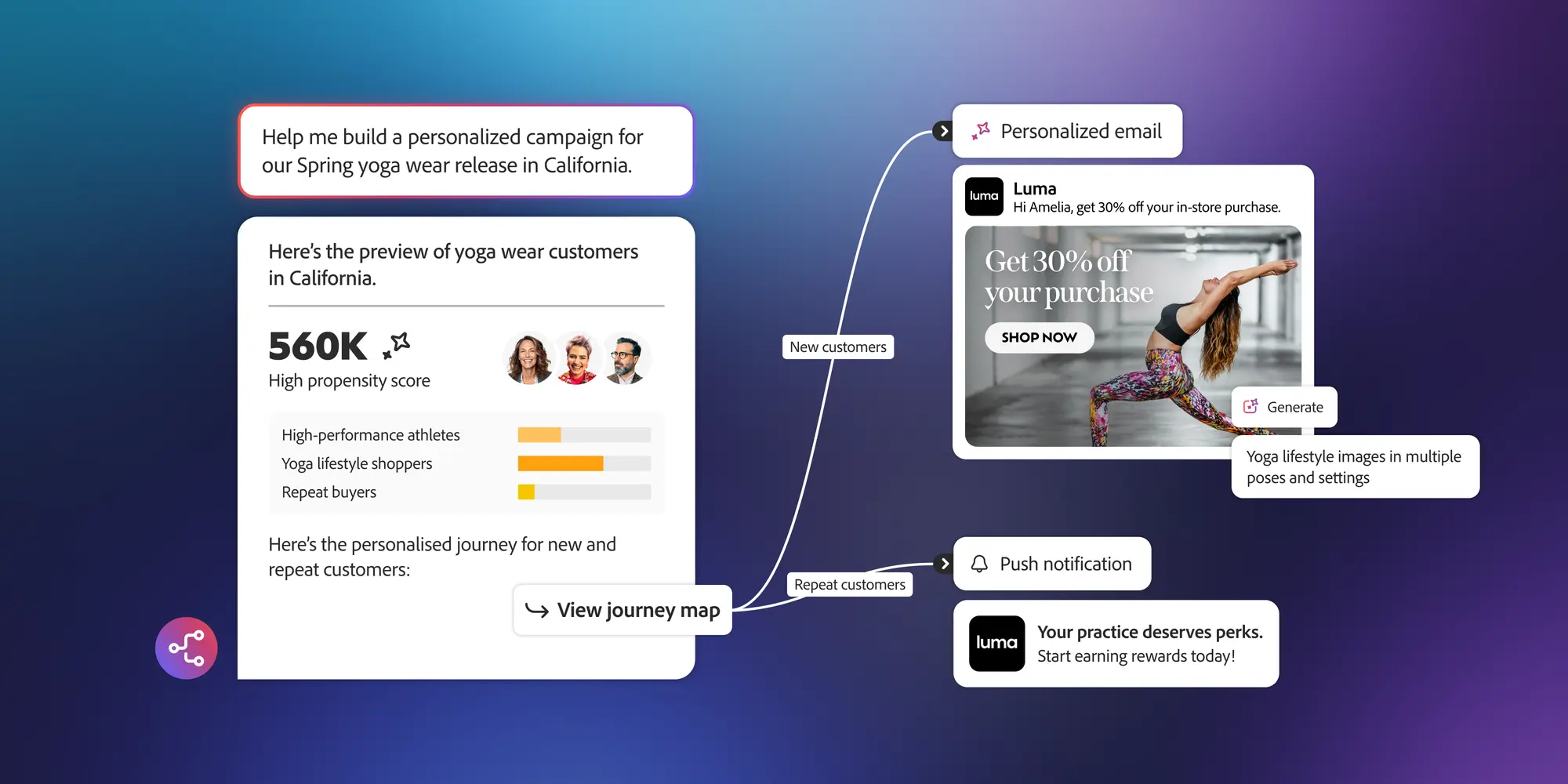
The piece of the announcement that deserves the most scrutiny is CX Enterprise Coworker - the new agentic orchestration tier that sits above the individual AI agents. The Coworker is oriented around outcomes, not instructions. Adobe’s own example: a marketing team sets an objective - say, a 3% lift in cross-sell performance. The Coworker assembles the relevant agents, builds an audience, pulls creative assets, constructs a plan, and waits for human sign-off. Once approved, it executes and tracks. The operational coordination across Real-Time CDP, Customer Journey Analytics, and Journey Optimizer happens automatically.
This is not the same as a journey builder. A journey builder executes the logic you define. CX Enterprise Coworker proposes the logic. That is a different category of product. To their credit, Adobe is being relatively honest about the governance complexity this introduces - they announced two distinct levels of human oversight depending on the use case, and their own research, released at Summit, found that 75% of organisations cite data integration and quality as their top AI implementation challenge, with 71% citing talent gaps and 68% citing unclear ROI. It is unusual, and welcome, to see a vendor acknowledge the readiness gap in the same breath as the product announcement.
Meanwhile, Salesforce - which has been making this same argument since Dreamforce 2024 - this week announced a major expansion of Agent Fabric: a control plane for multi-vendor AI agents that introduces deterministic orchestration, centralised LLM governance, and automated agent discovery across platforms including Amazon Bedrock, Microsoft Foundry, and MCP servers. Agent Broker - the component that handles fixed handoff rules between agents - enters beta this month. The practical implication: Salesforce is not just building agents for Salesforce environments. It is building the governance infrastructure for every agent, regardless of origin, that touches a customer interaction.
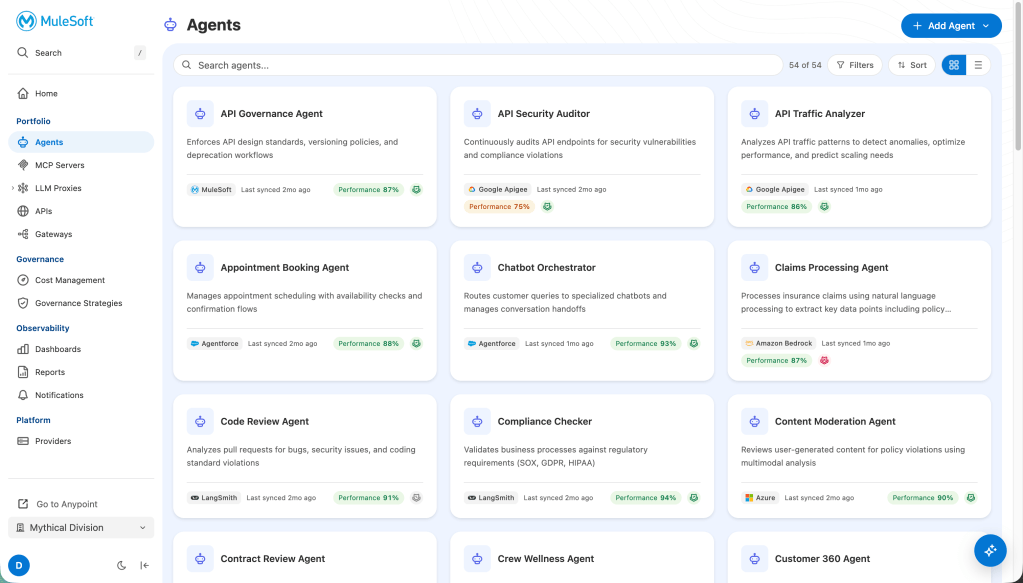
Adobe proposes the logic. Salesforce governs the agents that execute it. Together, they are describing a world in which the platform layer and the decisioning layer are the same thing.
The branding is different but both Adobe and Salesforce are building toward a model in which a unified data layer feeds an AI reasoning layer, which produces actions across channels - and where the platform, not the marketing team, is the primary author of the decision logic. Adobe calls its reasoning layer the CX Engagement Intelligence System. Salesforce calls it the Atlas Reasoning Engine. The names are different. The ambition is identical.
This matters at scale. The Adobe Experience Platform - which serves as the data backbone of CX Enterprise - already processes over 35 trillion segment evaluations per day. That is not a number that admits of human review. At that volume, the agents are not assisting decision-making - they are decision-making, constrained by whatever objectives and guardrails the organisation has pre-defined. And Salesforce’s own research, published this February, found that 75% of marketers are using AI primarily to send more one-way, generic campaigns - not to improve the quality of customer decisions.
Bobby Jania, Salesforce’s Agentforce Marketing CMO, said: “We are using the most powerful technology in history to send more one-way spam, faster.”
The read of both sets of announcements is that the platforms are trying to solve a problem organisations have created themselves. The data is siloed. The decisioning logic is fragmented across journey builders, business rules nobody fully remembers, and manual segment configurations that reflect business priorities from three years ago. The platform is offering to replace all of that with something more coherent, more adaptive, and more autonomous. The offer is genuinely attractive. The question is what it costs.
The word “takeover” is deliberate. It is not hostile - nobody is forcing anything. But when a platform moves from executing your decisions to proposing and optimising them, the transfer of authority is real, even if it happens gradually and with good intentions.
In the old model, the intelligence sat with the marketing team. They defined the segments, the rules, the suppression logic, the offer hierarchy. The platform faithfully executed. The knowledge lived, imperfectly, in the heads of experienced practitioners and in journey builder configurations.
In the model both Adobe and Salesforce are building toward, the knowledge migrates into the platform. The CX Enterprise Coworker learns from approval and rejection patterns to build a continuously updating model of what on-brand looks like. Agentforce’s Journey Decisioning Agents select channel, timing, and content based on live behavioural signals, not pre-configured rules. Over time, the platform accumulates a model of your customers and your brand that is more comprehensive than any individual on your team holds. That is genuinely useful. It is also, quietly, how dependency deepens.
The structural risk is not that the AI makes a catastrophically wrong decision. It is that it makes systematically sub-optimal decisions - optimising for a proxy metric rather than the outcome that actually matters or encoding a historical bias in its training data into every future interaction - and the organisation lacks the decisioning architecture to detect, interrogate, or correct it. 52% of organisations now cite agentic AI capabilities as an active criterion in platform purchase decisions, according to Futurum Group’s 1H 2026 survey. Many of those buying decisions are being made without a clear view of what happens when the agent is wrong at scale.
Neither Adobe nor Salesforce is your adversary here. The problem they are solving - fragmented data, manual decisioning that can’t scale, one-way campaigns that customers have stopped responding to - is real. The technology they are building is impressive. The architectural ambition is, on its own terms, coherent.
The better question is whether your organisation is arriving at this conversation with a prior view of what good customer decisioning looks like, or whether you are implicitly outsourcing that question to the platform. There is a meaningful difference between choosing a platform to implement your decisioning architecture and choosing a platform and hoping it supplies one.
Adobe’s announcement at Summit included something that most coverage buried: the acknowledgement that organisations are not universally ready for autonomous agents, and that human oversight tiers are being built into the architecture as a result. That is an honest position. It suggests that the vendors themselves recognise that the governance question is not solved - that having a Coworker or a Journey Decisioning Agent is not the same as having a principled view of who owns the decisions those agents make, under what conditions they get overridden, and what success looks like in terms that go beyond engagement metrics.
Salesforce’s Agent Fabric announcement, which centralises LLM governance across the entire multi-agent architecture, is a step toward answering that question at the infrastructure level. But infrastructure governance is not the same as decision governance. Knowing which model was used, at what cost, with which token allocation, does not tell you whether the decision was right for the customer.
The gap between those two things - infrastructure governance and decision governance - is where most organisations will find themselves exposed.
Metrics shape behaviour. An AI agent optimising for what it can measure will always win against what it cannot. The organisations that define the measurement framework before the platform does will be the ones who retain meaningful control.
The platform wars of the early 2010s were fought over data. Whoever held the single customer record held the leverage. Many organisations are still paying for the architectural choices they made in that era - in technical debt, in integration costs, in the institutional knowledge that walked out with the consultant who built the original MAP configuration.
This round will be settled on decisioning. Adobe called it CX Enterprise. Salesforce called it Agentforce. They are both, in their different ways, describing an ambition to be the place where your brand’s intelligence lives - where what happens next for every customer gets determined. That is worth taking seriously, and worth engaging with on your terms rather than theirs.
Adobe’s CEO Shantanu Narayen closed his final Summit with a line that landed better than most keynote closings tend to: “If you can fully connect the dots between today and where you want to go, the ambition probably isn’t ambitious enough.” It is good advice for vendors. It applies equally to the organisations buying from them.

I’d love to hear your feedback - it only takes a minute! Let me know what you think and what topics you’d like to see next. Here is the Survey Link.
If you are a Customer Decisioning leader or practitioner - whether you work for a brand or a vendor, I’d like to talk with you about an upcoming project. Please feel free to drop me an email at pawan@martechsquare.com
No posts
Comments
Nothing yet. Say the first thing.
Sign in to join the conversation.