
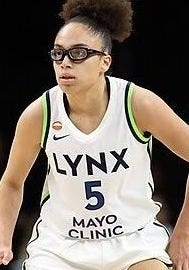
Olivia Miles is the one with the black-framed glasses. Everyone in the WNBA should get a pair. Preferably with heavy tint on the sides of the frames, to block out the periphery, to hide the talking points and the race cards and the general distemper that has drowned out what should be the WNBA’s overture. The basketball itself, once you don your tunnel-vision goggles, is just fine. Particularly when Miles is handling it.
The rookie point guard for the Minnesota Lynx was a lifeguard on Saturday, hanging around until it was time to drag her teammates to safety. The Las Vegas Aces had cut Minnesota’s lead to 74-73 in the fourth quarter. Miles promptly found Napheesha Collier for a 3-pointer. Then she did it again. When the Aces relied on their championship pedigree to cut the lead to five, Miles drove for a layup. Then she did it again.
Miles wound up with 23 points, eight assists and four rebounds, and the Lynx won on the road, 92-87, and improved their WNBA-best record to 29-7. As a rookie Miles is seventh in the league in assists and eighth in scoring, and she’s shooting 49.6 percent from the floor, 40.2 percent from the 3-point line, and 87.3 percent from the foul line, periously close to the 50-40-90 holy grail for shooters. She appears destined for Rookie of the Year, and even though her numbers fall short of Caitlin Clark’s and A’ja Wilson’s, she’s getting MVP noise as well.
The Lynx feel deprived because they haven’t won a championship in nine seasons. Between 2011 and 2017 they won four. Cheryl Reeve coached all four of those teams, and she has won 364 games, most in league history. Those were the days of Maya Moore, Seimone Augustus, Sylvia Fowles and point guard Lindsay Whalen, now a Lynx assistant coach. While Clark often came up from Iowa to appreciate Moore, Miles was Whalen’s biggest fan. “You’re going to get really tired of me,” she told Whalen the day she was drafted. “I’m going to have a lot of questions.”
Reeve is also Minnesota’s general manager. The Lynx had the No. 2 pick in the 2026 draft. Dallas had the first pick and chose Connecticut’s Azzi Fudd, who is the partner of Wings’ star Paige Bueckers. Fudd was also an entirely logical first pick. But when reporters wondered how the relationship would affect the Wings’ daily life, team officials blocked that line of questioning. The WNBA loves to silence anything short of “What does this win say about your character?,” but in this case the internet was already in full riot. Anyway, when Dallas picked Fudd, Minnesota could pick Miles. “She’s not just a point guard, she’s a connector of people,” Reeve said at the time. Now she calls Miles a “generational talent.”
It’s not outlandish to call Miles the truest point guard in either men’s or women’s basketball, only because the best point guards, like Clark and Jalen Brunson, would just as soon shoot. If she has a comparison, it’s probably John Stockton, without the malice. Miles’ arrival in Minnesota meant Courtney Williams could return to shooting guard, and that Natasha Howard could get the ball in useful spots inside, and thus everything improved. There’s a lot of simplicity and very little Showtime in Miles’ game. She moves the ball ahead on the fastbreak, and she’s content to find Collier and Kayla McBride, who scored 43 against Dallas last Sunday with 10 three-pointers. Passing is her jab, and shooting is her uppercut, something she’s not at all reluctant to use if most other options are covered. On June 4, she hit eight of 11 threes against Golden State.
Her unofficial nickname is “The Spectacle,” a play on her glasses and her entertainment value. But Miles has prospered by avoiding the spectacle, or whatever you call the acid rain of opinion that has plagued the league since Clark showed up last year. That plague has also bought a life-changing Collective Bargaining Agreement and record TV ratings, thanks mostly to Clark, who leads the WNBA in assists on behalf of Indiana, and got to 1,500 points and 500 assists quicker than anyone in league annals.
But Clark’s roughhouse treatment from a few rivals, including those who clearly didn’t like her in college, has spun into narratives that follow the political fault line. People who never watched a second of WNBA games and wouldn’t know Sheryl Swoopes from Sheryl Crow now attack the league’s existence, and grandstanding NBA washouts like Enes Kanter Freedom and Royce White threaten to declare themselves women and join up.
Then Indiana’s Sophie Cunningham, a Fever substitute whose own triple-doubles consist of clicks, videos and fouls, opined that transsexuals shouldn’t invade women’s sports. She also said it didn’t mean she was anti-trans. Fair enough. But those who applauded the progressive statements of Doc Rivers, LeBron James and Steve Kerr over the years went after Cunningham with shut-up-and-dribble fury.
If any of this nonsense persuades a curious sports fan to discover the WNBA, then it’s probably worth it in some cumulative way. The league keeps expanding and the talent keeps filling the space. Atlanta’s Rhyne Howard is the WNBA leader in the disparate categories of 3-pointers made and steals. Indiana’s Kelsey Mitchell hits 43.4 percent of her 3-pointers. Wilson, going for her fifth MVP, leads in scoring (25.9), goes to the foul line 7.7 times per game and hits 85.4 percent of her tries. And the rookie class of Miles, Fudd, Flau’jae Johnson (Seattle) and Kiki Rice (Toronto) is just another ascending wave, with more to follow.
Remember when Houston won the first four WNBA titles and folded eight years later, or when Detroit won the 2006 title and was forced into self-exile to Tulsa three years later? The WNBA was down to 12 teams. By 2030 it will have 18, including a replacement in Detroit.
Miles grew up in Summit, N.J., and played soccer as well as basketball. She was far more shot-hungry in soccer than basketball, but said soccer gave her the field vision that she uses today. She said she would have gone to Princeton if coach Courtney Banghart had not left for North Carolina, but went to Notre Dame instead, where she and Hannah Hidalgo formed a marauding backcourt. Miles yearned to run her own team, so after she recovered from an ACL injury and earned two Notre Dame degrees, she irked some Irish fans by transferring to TCU, which had knocked Notre Dame out of the NCAA regionals. Miles became Big 12 Player of the Year in 2026, and the Horned Frogs reached the regional final.
Now Miles has won every Rookie of the Month award, and Wilson, who by no means is giving up her torch, addressed her directly at an All-Star Game press conference. “For real, you’re a star,” Wilson told Miles. “Not just because of your game, but the way you carry yourself off the court. I love how unapologetic you are. The more you play, you’re going to find more ways to get to your spots and crush it.”
Miles seemed stunned by the testimonial and merely touched her heart. Since then, somehow, she has widened the Spectacle, within the frame.
l
Comments
Nothing yet. Say the first thing.
Sign in to join the conversation.