
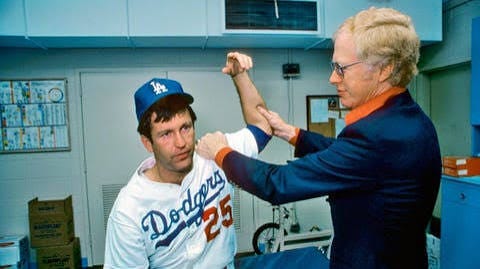
Tommy John was already having a bad day. National League manager Yogi Berra had left him off the All-Star team, even though he was 13-3 with a 2.50 ERA, and Andy Messersmith and Don Sutton, his Dodger teammates, were going. John never hid anything under a bushel. “I guess I didn’t kiss the right behind,” John said. “Yogi Berra picks All-Stars like he manages. Pitifully.”
But he also had a game to pitch, against Montreal. He was leading 4-0 in the third inning when he threw an 0-and-1 pitch to Hal Breeden. It took a strange, high path to the plate, and on the mound John was mystified, and also in pain. “I felt like I’d left my left arm somewhere else,” he said. “It just flew away, independent of the rest of me.”
John tried another pitch, but his left arm had not returned from orbit, and the ball sailed as the first one had. He walked off the mound at Dodger Stadium. It was July 17, 1974.
There was no real concern at first, although John went on the 21-day disabled list. It was just a matter of diagnostics. John’s wife Sally was pregnant with their daughter Tamara. As he waited for the elbow to calm down, he promised he’d pitch again before Sept. 10, the due date. As it turned out, Tamara was walking before her father pitched another game.
What happened in the interim was the most consequential medical development in the history of pitching, one that salvaged or enabled several thousand of careers. Dr. Frank Jobe performed it in September, and now more people know John from the surgery than from his pitching career, which was formidable. He pitched for 14 years after the operation, won 20 games in three different seasons and threw 101 complete games. He died of bladder cancer Sunday, at 83. Four days earlier, Cincinnati’s Hunter Greene had become the 41st major league player, and 40th pitcher, to have the surgery in 2026 alone.
More than half of the arms that undergo Tommy John surgeries belong to high school, college, minor league and amateur pitchers. Over 2,600 major leaguers have had it. Ex-Dodger pitcher Hong-chih Kou had it four times. The Braves’ Jonny Venters had three Tommy Johns. Shohei Ohtani is pitching after two TJs. John Smoltz was a successful starting pitcher with the Braves, did the Tommy John, came back as a premier closer, and got into the Hall of Fame because of it. Cade Horton had it when he was pitching for Oklahoma, became a top-of-rotation pitcher for the Cubs, and had it again this year.
Nothing is guaranteed, but a clear majority of pitchers regain their previous velocity. Justin Verlander won the Cy Young Award when he was 39, post-TJ. Chris Sale, Tarik Skubal, Sandy Alcantara and Jacob deGrom overcame the surgery to win their Cy Youngs. Bryce Harper got it when he was an outfielder and was back in business in five months, at least eight fewer months than the average rehab time for pitchers.
None of this was known when Jobe opened up John’s arm and realized he was entering the land of the unprecedented. The surgery involves taking a tendon from another place in the body and tying it into the shattered joint. It had never been done to an elbow. John was in no position to grant permission at the time, so Jobe went into John’s right wrist to find the tendon to transplant. That’s why John was a bit perplexed when he woke up to see bandages on the right hand.
“Can I get listed as a righthander, too?” he asked later.
Jobe, who died in 2014, had the stoic bedside manner. Inwardly, he doubted John had even a one percent chance to pitch again. John tackled the process head-on, increasing his running program to 10 miles a day, optimistically shooting to return near the end of the 1975 season, even advising the Dodgers to run a contest for fans to guess his return date. But 1975 came and went with no real progress. The elbow seemed workable, but John kept having numbness in his fingers. For a franchise which lost Sandy Koufax too soon, that was haunting.
At spring training in 1976, John hit 88 mph when throwing to teammate Jimmy Wynn. “You’re all the way back,” Wynn said.
The big night was April 16, in Atlanta, and John got the first two outs on ground balls, and 10 of 15 outs overall. That meant something, because the sinker was always his best friend. He got through five innings and lost, 3-1. He was in the rotation the rest of the season and went 10-10 with a 3.09 ERA.
John went on to win 288 games overall with a 3.34 ERA and a 1.283 WHIP, which of course no one had heard of back then. No pitcher in baseball’s post-1900 age has won more games and failed to enter the Hall of Fame except for Roger Clemens. At least we know why Clemens isn’t in, as lame as those reasons might be. One skeptic wrote that John never led his league in anything significant. Mike Mussina is in Cooperstown after leading the A.L. in wins once and in innings-pitched once, and never winning 20 games in a season, and he had a 3.68 ERA. Besides, wasn’t it important that John led the league and, indeed, the whole of baseball in the preservation and elongation of pitchers’ careers? How many billions of dollars have pitchers made, once they returned to the mound with new elbows? Before TJ surgery, such injuries sent most pitchers back to the farm or the local hardware store.
But it wasn’t just the baseball writers who whiffed this one, after 15 years of eligibility. The Veterans Committee, which uplifted Jeff Kent into the Hall this year, has had no time for John either. The process is consumed by numbers these days, with WAR and OPS (for hitters) as the main vehicles. There is no room to consider a player’s impact on the history of the game, the things that he paid forward, the tickets that fans bought to see him, the memories he spread.
That said, you can debate whether John was courageous or just desperate. He risked losing any left-arm function, but he knew baseball would be impossible without it. It’s Jobe who gets squeezed out here, because even though general managers, owners, and ballplayers are considered, scouts and coaches and doctors are not. The Tommy John surgery was only a fraction of Jobe’s handiwork throughout sports.
The proper and most innovative solution would have a shared plaque, with John and Jobe as an entry, but there are procedures to follow here, you know, or at least there were until Carlos Beltran’s induction. In any event, John had no trouble leading his own campaign.
It was a bumpy life, all told. John somehow pitched for powerful Yankee, Dodger and Angel teams and never won a World Series. The nation gave him its heart in 1981, when his two-year-old son Travis fell out the window of a New Jersey beach house, fractured his skull and was in a coma for almost two weeks. Travis recovered in time to throw out the first pitch of an October playoff game, and Tommy and Sally were featured on every channel. The two would divorce later, and their 28-year-old Taylor, who suffered from depression, died at Tamara’s suburban Chicago home after an overdose of prescription drugs. Taylor had performed on Broadway in Les Miserables when he was a child, and his version of the Star-Spangled Banner was often played at ballparks.
And John fought a stuttering problem that persuaded high school officials in Terre Haute, Ind. to cancel his speech at graduation, even though he was a valedictorian.
Certainly John deserves a spot in the orthopedist’s Hall. Because of the surgery, young pitchers see no downside in throwing as hard as they often as they can. That leads to more busted elbows and more anesthesia, for an operation that’s almost become as routine as an appendectomy. The speedboats, mansions and Range Rovers that John has provided the men and women of medicine are nearly immeasurable.
But John’s true legacy will be species recovery, Because of he and Jobe, new herds of 38-year-old pitchers roam the grass like buffalo.
Comments
Nothing yet. Say the first thing.
Sign in to join the conversation.