
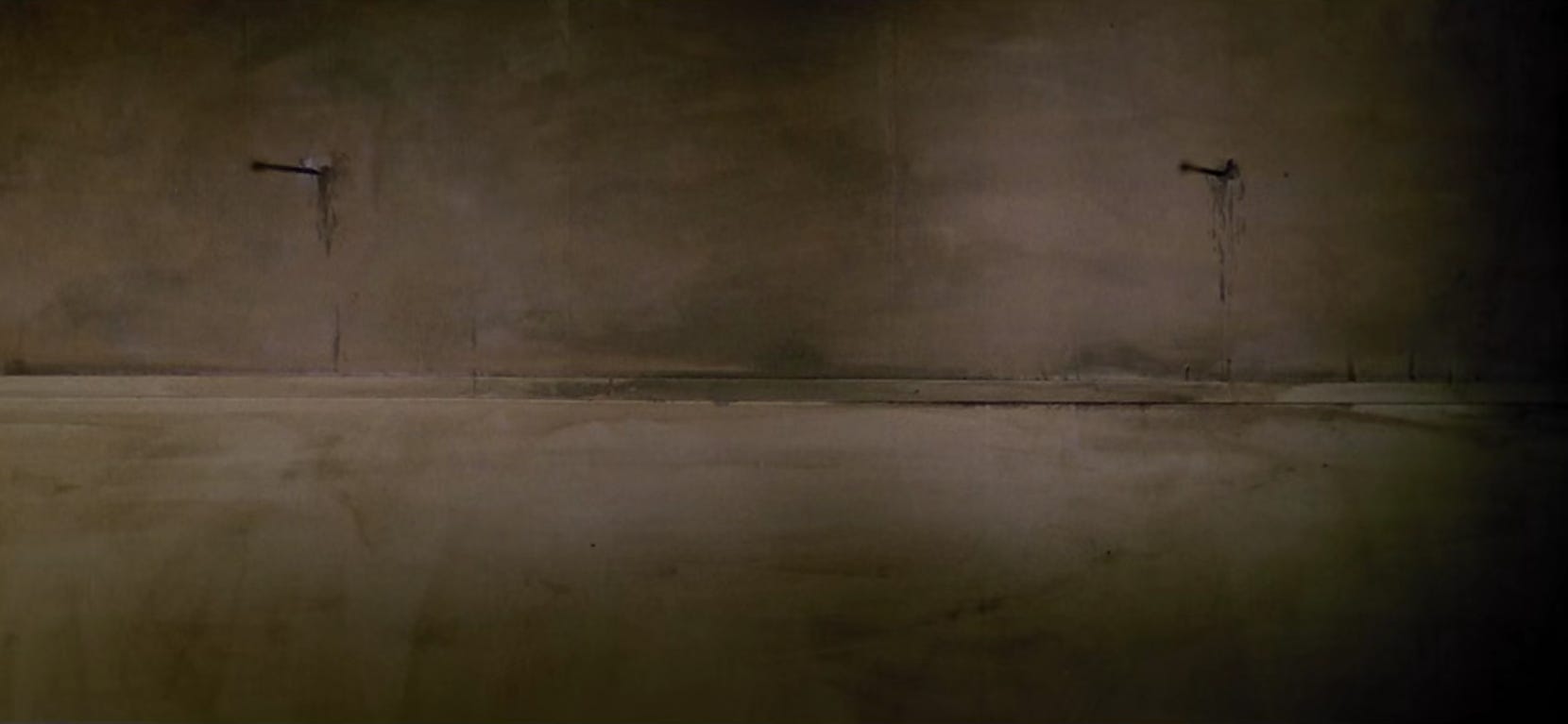
Before the start of my discipleship I went on a missionary trip to the Philippines. I wasn’t there to convert the Filipinos, as they were already extremely Catholic, but to try and de-syncretize their Christianity from its intense Pagan sympathies. I recall specifically this one remote village called Alitagtag where they deified not just the wounds of the crucified Christ (an almost commonplace sight in my travels) but the very nails that penetrated his hands and feet. Ironically, the deeper into the jungle that I went the more mystical this relationship with the divine flesh became. Exactly like so: Alapan, 15 miles outside Manila -> the severed feet and hands of Christ; Malabag, 50 miles outside Manila -> the vacant wounds of Christ; Magallanes, 80 miles outside Manila -> the blood of Christ curdling in the stale air of the fallen Earth.
In Malabag each wound had a name and was worshiped as its own respective deity, except the side wound which was acknowledged but unnamed. Between Malabag and Magallanes was also where the Tagalog dialect became too provincial for my interpreter to manage so he abandoned me. Thus, the sight of the four old, blood-encrusted nails sunk against a slab in Alitagtag, 100 miles outside Manila, may very well have been a hallucination on my part. It resonated as true, however, so it is ripe and truthful material for me to interrogate the question of reversion in its relation to bodies.
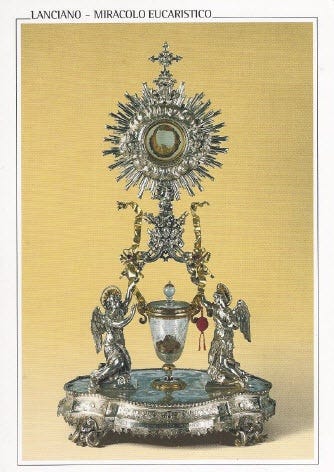
First I should clarify what I meant by my earlier parenthetical, about wounds. In the town of Lanciano, Italy, in their Church of St. Francis, you can find a small brown and yellow organ composed of five globules. The organ is held in an ornate reliquary and is said to have been transfigured from a plate of bread and wine by a Basilian monk in the first century. For the Miracle of Lanciano, as it were, the familiar words “this is my body and this is my blood” are taken literally. This eucharist has its fans throughout the rest of Italy. In the northern town of Giuseppe a human heart, ostensibly that of Saint Francis of Assisi, is held in a glass case where it pumps blood autonomously every fifth day of every fourth month of the year. In Vincenzo, further south, they have a silver petri dish of the same biotic culture that populated as stigmata on (you guessed it) St. Francis, festering permanently.
From The Penguin Dictionary of Saints entry:
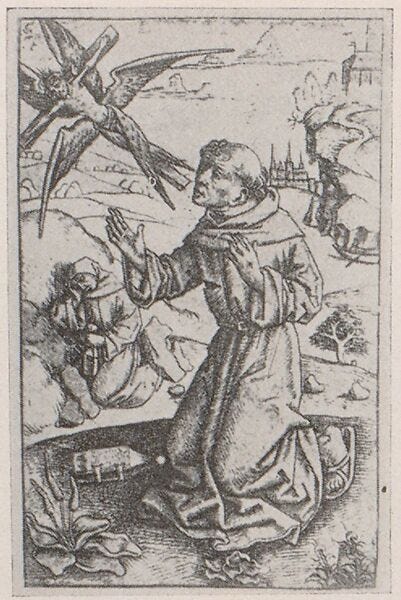
In 1224, while he was praying on Monte La Verna in the Apennines, there appeared on St. Francis’s body scars corresponding to the five wounds of the crucified Christ (the phenomenon known as ‘stigmatization’). They never left him, and were one of the sources of the physical pain and weakness he suffered increasingly until he welcomed ’Sister Death’ two years later.1
Francis is a common namesake because he demonstrated how human flesh can behave autonomously and, more importantly, revert upon itself. The five wounds that manifested on him acted as both symbolic mirror-images to those of Christ’s and as evidence to the body’s capacity to return to a truer, semi-celestial state. Christ thereby becomes a sort of Vitruvian Man, mimicked in degenerate, irradiated forms.
This all bumps up against Neoplatonic dogma that “it is not in the nature of any body to revert upon itself” (prop. 15) but supersedes it on the basis that we meet Christ in our likenesses as men. Jesus, as role model and ur-model, was a body that reverted upon itself. Knowing Christ––knowing God––is tantamount to self-knowledge, marking the narrow path towards this selfsame transcendence (prop. 83).2 So our own bodily reversions are really private entrances of void: absence, separation, aneurysm.
The floating quality of emptied flesh (absence) gives rise to separation. The Holy Prepuce, the severed wound of circumcision, brings the ephemerality of the without into the permanence of fetish. In the apocryphal Gospel of James, Jesus’s foreskin is preserved in an essential oil and protected by Mary Magdalene. Then the prepuce was purportedly passed all the way down to the bishop of Cambrai around the time of the First Crusade, who, during mass, watched in awe as it autonomously stained its linen blanket with penile blood. Again, the miracle lies not in its preservation but in another kind of a rage against time: fleshly inversion.
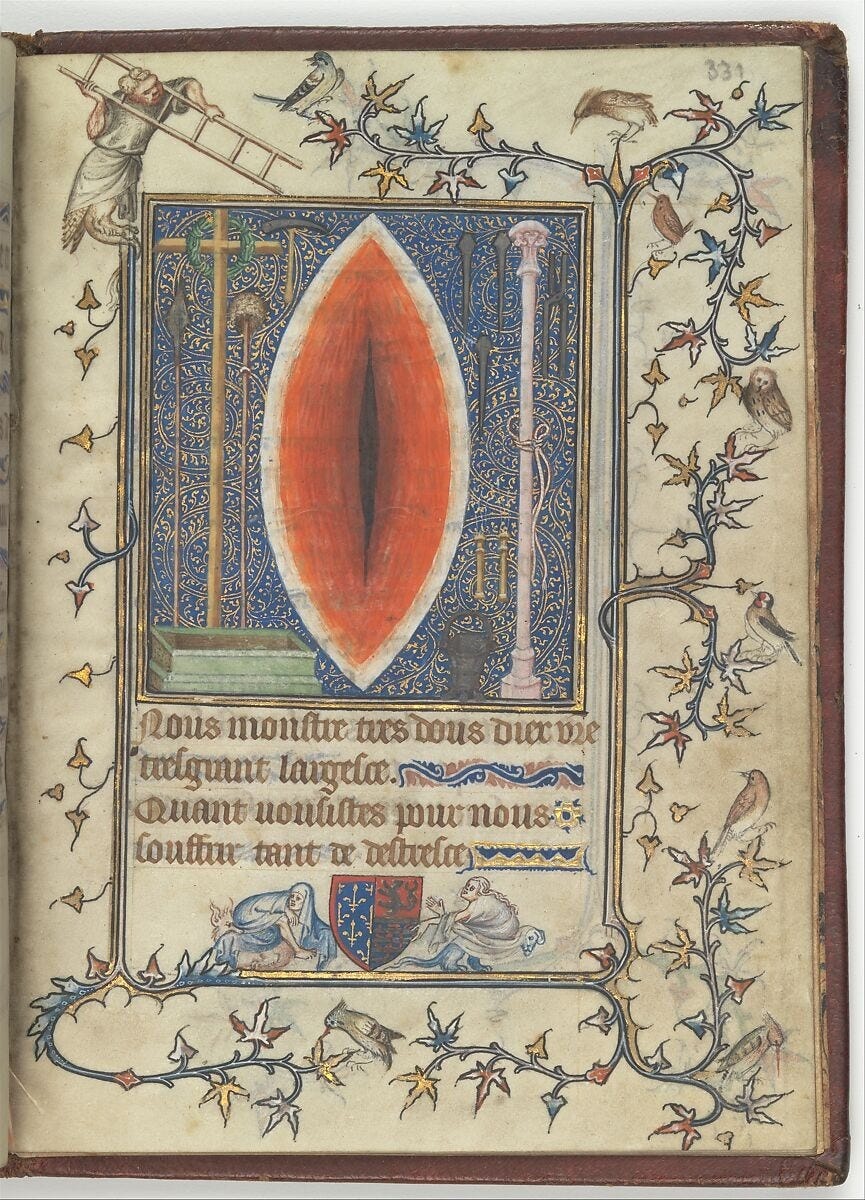
Make no mistake, the fact that there were a dozen holy prepuces circulating in medieval markets at the same time doesn’t negate its ritual quality as eucharist. Like the yonic illustration of Christ’s side wound in the illuminated Prayer Book of Bonne of Luxembourg, absence envelops into itself as in a portal that distends. The Holy Prepuce once presented itself as a wedding ring by Christ in a vision of Saint Catherine of Siena. A ring, as in a circle, as in another invitation of void. God then appears to her and exchanges her heart with a pure one, one that is qualified in separation. Matrimony becomes a relinquishing…
‘...in so far as I feel anything at all, it seems to me my heart has been taken away altogether. The Lord did indeed appear to me, opened my left side, took my heart out and went away.’
…and a consequent interpossession.
‘Dearest daughter, as I took your heart away from you the other day, now, you see, I am giving you mine, so that you can go on living with it for ever.’3
, Marcantonio Raimondi (Italian, Argini (?) ca. 1480–before 1534 Bologna (?)), Engraving")
To now think that St. Catherine’s head is severed and relegated to a reliquary in her native Tuscan home feels far less macabre than the mere image may suggest. Even her heart bore resonances in the beyond. This maladjustment may well have led to her deadly stroke at 38 and, theologically-speaking, bridges the tyranny of the physical to the floating persistence of separation. In other words, her discrete martyrdom proved that a surrender to the void is not always painless. And as her encased, mummified head may suggest, it is also, at times, indistinguishable from horror.
Point being, void is necessarily supernatural. The aneurysm in our own hearts must exist for the free passage of God’s breath. To Simone Weil’s point that God created the universe but “consents not to command it,” our concern is not with His creatures but with their cause. To be present only in the physical brings suffering to the fore when otherworldly protuberances arise. Wounds, hearts, heads and prepuces; feet, hands, nails and globules. Objects are things of persistence: of the world and without.
To speak on aneurysm is to meditate on where objects lose their physical semblance. This happens from within their own properties or lack thereof. After Saint Philip Neri died by hemorrhage, the coroners found a gap the size of a fist between his ribs and his significantly enlarged artery. They attributed this to his frequent, rapturous states of prayer during which blood would flow rapidly to his heart and cause it to swell. Not unlike the autonomous heart of Giuseppe or the miracle at Cambrai, it is the blood, the organs at their finest divisibility, that decide to invert and to discern their proper cause.
Donald Attwater, The Penguin Dictionary of Saints (Penguin, 1965), p. 137.
Proclus, The Elements of Theology, trans. E.R. Dodds (Oxford University Press, 1963), pp. 17, 77–79.
Raymond of Capua, The Life of St. Catherine of Siena, trans. George Lamb (Harvill Press, 1960), p. 164.
No posts
Comments
Nothing yet. Say the first thing.
Sign in to join the conversation.