
To recap from last time, voids manifest on bodies in three different ways: absence (as in wounds and stigmata), separation (transplantation, dismemberment) and aneurysm (implosion, explosion). This all sounds very icky, yes, but we cannot hide behind the notion of abjection here. Voids are ultimately a call to action and an invocation to speak.
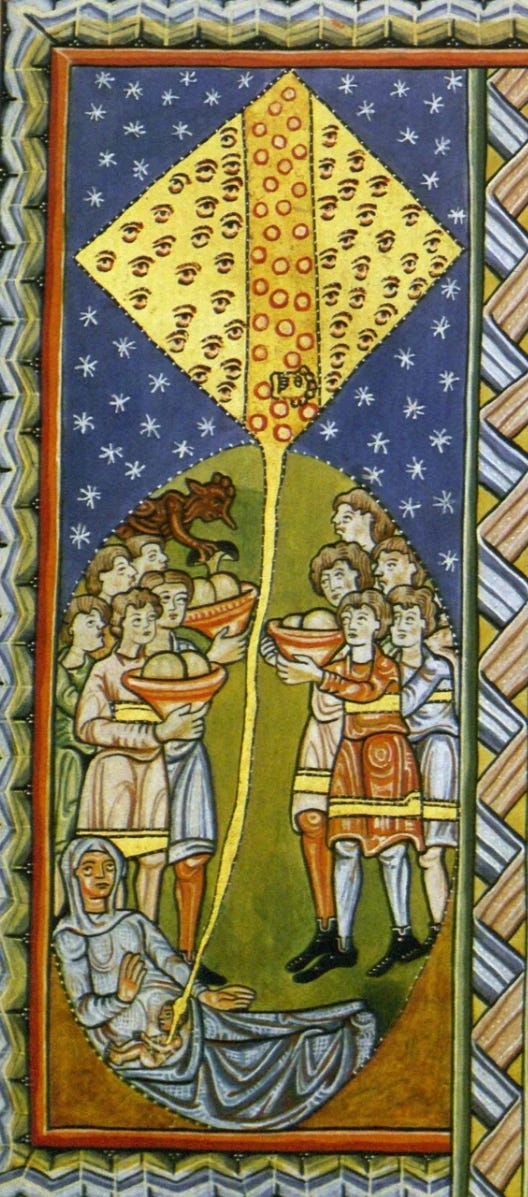
The line between apparent body horror and the willful organization of cells is mediated by Saint Hildegard of Bingen in her illuminated work Scivias. The fourth vision in the cycle of which likens ensouled bodies to cheese curdled from God’s milk, to varying degrees of success. Peter Sloterdijk comments on this vision as St. Bingen lamenting her own chronic illness as “weak cheese” longing for its cause.1 The behavior of curdling, of cellular intermingling, upholds hope as the primal characteristic of a universe now shown to be weirder than ever previously imagined.
About hope, her elucidation of the paralysis required by her visions is reminiscent of Weilian religious attention:
I have never fallen prey to ecstasy in the visions, but I see them wide awake, day and night. And I am constantly fettered by sickness, and often in the grip of pain so intense that it threatens to kill me, but God has sustained me until now. The light which I see thus is not spatial, but it is far, far brighter than a cloud which carries the sun. I can measure neither height, nor length, nor breadth in it; and I call it ‘the reflection of the living Light.’
About the cosmically weird, glimpses of reflections of this “living Light” are provided throughout the Scivias visions:
You see the most great and serene splendor, flaming, as it were, with many eyes, with four corners pointing towards the four parts of the world… [it is] presented to you in this image of great loftiness and profundity… an image full of eyes on all sides, in which, because of those eyes, I could discern no human form.2
On simpler terms, think about physical pain. Say you have a migraine. At the outset, you are stuck and must accept that the next several hours will be unbearable. But that you must bear it means that resentment and blame cannot help you. Pain as merely pain is easier. Even a hangover feels OK until you have to shuffle off to work and self-hatred overflows. When Peter Abelard was castrated by goons sent by his lover Heloise’s uncle, he describes the anguish he felt upon returning to the seminary like so, “my pupils tormented me with their unbearable weeping and wailing until I suffered more from their sympathy than from the pain of my wound.”3
Thus, St. Bingen’s maladies invite her to lie still and allow the formless beyond to take over. I’m reminded of Henry Pimber in the William H. Gass novel Omensetter’s Luck, which is set in the fictional town of Gilean, Ohio during the Puritan era. Pimber, who is the focal point of his own section in the book, feels threatened by the titular newcomer Brackett Omensetter and his otherworldly friendliness. That is, until, as if by an act of God, he falls ill with lockjaw and is rendered immobile. The inanimate takes over…
Once to petrify and die had been his wish; simply to petrify had been his fear; but he had been a stone with eyes and seen as a stone sees: the world as the world is really, without the least prejudice of heart or artifice of mind, and he had come into such truth as only a stone can stand.
…and his awe of Omensetter is articulated, in the Augustinian second-person.
‘Remember that first evening when you came? You were a stranger, bare to heaven really, and your soul dwelled in your tongue when you spoke to me, as if I were a friend and not a stranger, as if I were an ear of your own.’
When Pimber gets back on his feet he, in full denial of the body, kills himself by jumping down a well. The body is an obstruction to divine love, which the soul may only curdle once its carnal confines are permitted to be breached from within. The body is also, however, a negating agent. Every glimmer of truth may be inverted by matter and its certitude re-transfigured. Following Pimber’s section is one for the degenerate pastor Jethro Furber, an influential figure in the town. He, by contrast, allows his resent for Omensetter to overflow. Pouring forth is a constant stream of serpent-tongued prose that makes up the brunt of the book. This evil style in prose is a signature of Gass’s and something that he takes a pink-cheeked delight in. It is markedly image-ridden, not brief, and relates incessantly to carnal impulses. Reversion towards the source, for Furber, points not up towards logos but downwards into earth. He preaches, “There is everywhere in nature a partiality for the earlier condition, and an instinctive urge to return to it… We do on occasion forget, of course, the clay we’re made of.”4
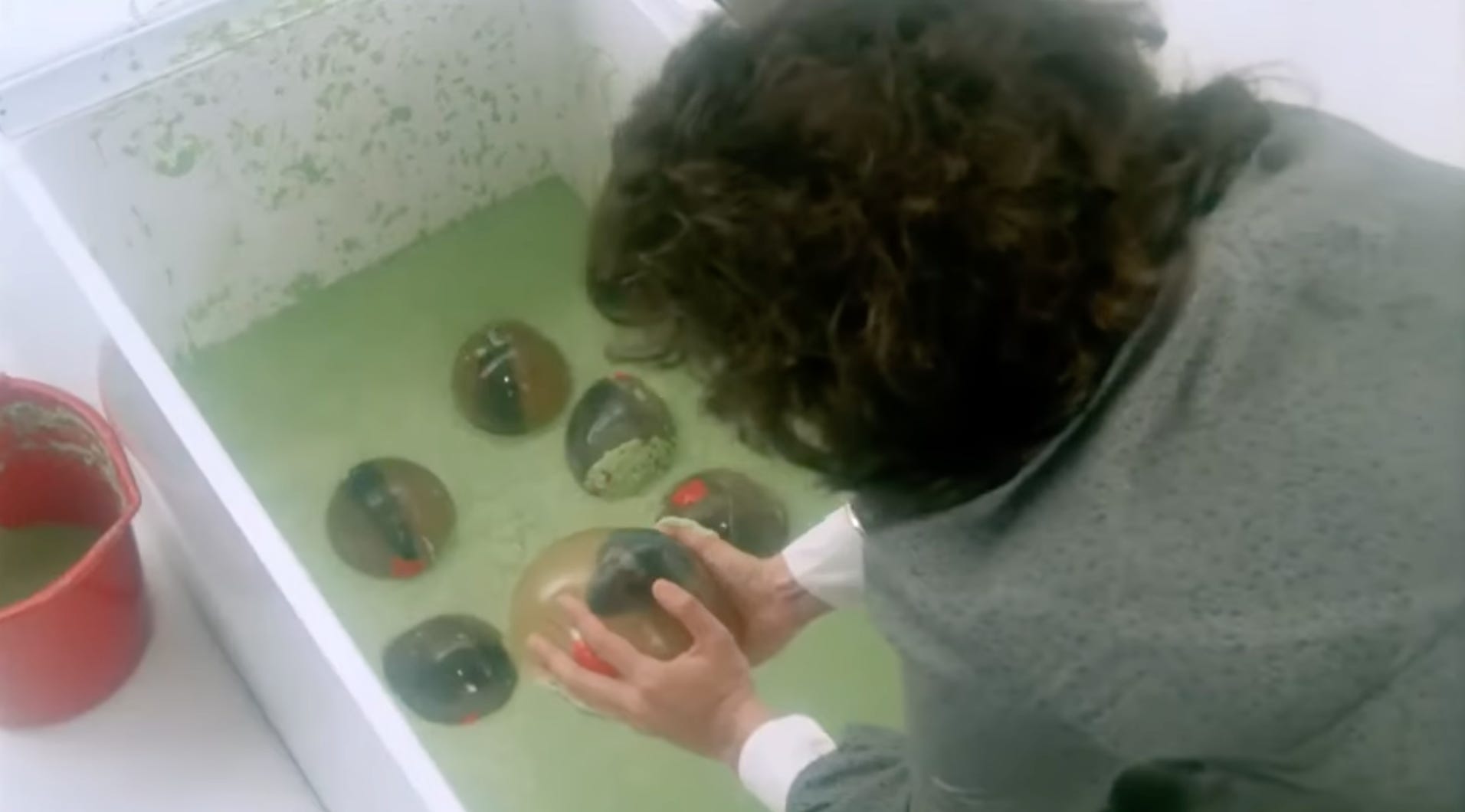
In the spectacular inaugurating scene of the film Xtro (1982), a father and son are playing in the yard of their home in the English countryside when a beam of white light suddenly bursts from a branch that dad tosses into the air. The cosmic light eclipses the sun and causes dad to vanish, only to reappear two years later as a shape-shifting monster taking on the semblance of his former self. The son, who was ever since haunted by the experience, welcomes his father unreservedly. The mom, since remarried and living in London, is disturbed by this sudden protuberance of the past. Her suspicions are vindicated when dad’s vestiges from the beyond come to be revealed. He eats snake eggs, drinks the spinal fluid of the son and son’s baby-sitter, and eventually turns the whole family into sticky orbs before morphing back into a freak and transporting him and son back into space.
The sense of abandonment by God in the Scivias elicits an otherworldly light for St. Bingen, while in Xtro it is the light that prompts the void. It is precisely this element of a beyond filtering in from a slip of the material veil where an invocation may take place. The question is, how will you speak? It depends first on what your definition of the beyond is. Beyond what? What is your given world to be surpassed? It is a concept without predicate that no less begs for one. But for every consolation of the indoors that a Henry Pimber prefigures, there is a Jethro Furber, a pilot in outsideness. Where William Carlos Williams incurs, “Outside / outside myself / there is a world,”5 the old Latin adage answers, nec te quaesiveris extra: “do not seek outside yourself.”
In Kojève, it is by grappling with death that people first interrogate the beyond, the terrain where “the I interacts with the non-I.”6 Partnered with his general disinterest in familial bonds, this is what Jesus meant by “let the dead bury their own dead.” When mourning prompts an emptiness in you, do not underestimate the power that mirror-images have in filling that void. They are as good as ghosts. This is a hard part of doctrine to accept but anything that leaves us susceptible to the rags of time has to ultimately be forgotten.
In Xtro, the apparent death of dad is where this same question first gets prompted and then proceeds to play out quite literally. When dad disappears, non-dad takes his place, interrupting and fragmenting his original image. Non-dad not only kidnaps the body of the son but also all the happy notions that son finds comfort in. At one point, he entertains him by bringing all his toys to life. A jack-in-the-box becomes a wizard dwarf and a toy soldier becomes an allied troop. They proceed to kill an old woman who lives in the upstairs flat. To this end, the image of youth, as well as all things parochial, pastoral and familial, falter in the presence of their antitheses in the beyond. The dead bury us.
Peter Sloterdijk, Bubbles: Spheres Volume I, trans. Wieland Hoban (Semiotext(e), 2011), p. 336.
Hildegard of Bingen, Scivias, trans. Columba Hart and Jane Bishop (Paulist Press, 1990). The first quote is from her autobiographical preface; the second describes a vision from Book I.
Peter Abelard and Heloise, The Letters of Abelard and Heloise, trans. Betty Radice (Penguin Classics, 1974), p. 75.
William H. Gass, Omensetter’s Luck (Penguin Books, 1966), p. 66, p. 72, p. 219 respectively.
William Carlos Williams, The Doctor Stories (New Directions, 1984), p. x.
Alexandre Kojève, Atheism, trans. Jeff Love (Columbia University Press, 2018), p. 19.
No posts
Comments
Nothing yet. Say the first thing.
Sign in to join the conversation.