
Thank you to everyone who read January’s essay! I got some kind words back that I won’t hesitate to mention.
“Loved, so weird and interesting” - Noa
“good” - Michael
“liked it” - Emilie on behalf of Ian
Even though I published that essay in February it was formally January’s essay, which makes this essay, published in March, February’s essay. Expect another one this month which will be formally be known as March’s essay.
Once prior to the beginning of my discipleship I was in Sudan on a missionary trip and learned that the tribespeople there had no concept of months. They just had a dry season and a wet season. I had a whole truck of Bibles for them but was so shocked when my interpreter told me this that I had him drive us back to Juba to buy a case of calendars. When we returned I demonstrated the months of the year and the real seasons: Winter, Spring, Summer and Fall. One tribesman named Leni Basso asked if we were currently in the dry season and I said no, it’s Winter, and I pointed to the picture of a snowman on the calendar page for December.
I promised to come back and teach them to read but when I eventually did the village was totally desolate aside from a stray few goats lying in the shade of a baobab. I ventured a mile outward to find a boy herding some other goats. He knew a little English. When I asked him where everyone went he said “town” and I understood. I unloaded the truckload of Bibles before him and said, “The thirst you once treated with palm wine shall from now on be quenched by the Word.”
Years later Leni Basso added me on LinkedIn and tried to sell me $8,000 worth of sandals on behalf of a multi-level marketing company based in Cairo.
A people revere whatever it is that can be said to be their central cause. There is a reason why monotheism was born in the desert, where horizons encircle and desperation envelops. Take a people out of that and, while their God remains, their history vanishes. Put God away and they’ll need their history back. Who will put it back?
The present moment is not a question of the problem of atheism but of agnosticism. People will look for God in everything and when God is hidden from them, they look to authority for their cause. Take constellations: before the Enlightenment people saw the stars as divine because they existed before them with no affect. The stars could not be reached, changed, measured or reconstituted, so they were believed to possess some kind of influence on us, however mysterious. Plotinus talks about this in Ennead II.iii. Proposition 98 in Proclus’s Elements of Theology elaborates on their shared notion of cause:
Every cause which is separate from its effects exists at once everywhere and nowhere.
When Newton proved that every action is equal to the reaction it provokes, the cosmos were disenchanted and their authority was replaced by the science that stripped them of right. Alexandre Kojève talks about this in The Notion of Authority. He ascertains that authority is active and is always held over that which can react to it, whereas divinity allows no possibility of reaction. The former spurs change while the latter is change. Without a notion of divinity, there is nothing above human authority, which is to say there is nothing outside of this world. In On Atheism, Kojève explains that the only commonality between the human being and the world is people and that the world is a human world insofar as it lets itself be known. He uses the moon as an example, as it seems strange and ominous until it becomes something we can interact with.
Seeing other people outside myself, I stop perceiving the world as something that is completely strange.
The world is close to me because, in the end, it makes itself known to me.
There then exists the possibility that the moon may become a person. This is the maximum authority in agnostic society with science being its principle of divination.
But if mere explanatory variables have usurped the position previously held by God, and God still exists so long as love and mystery do, what is this authority at all but a political fabrication?
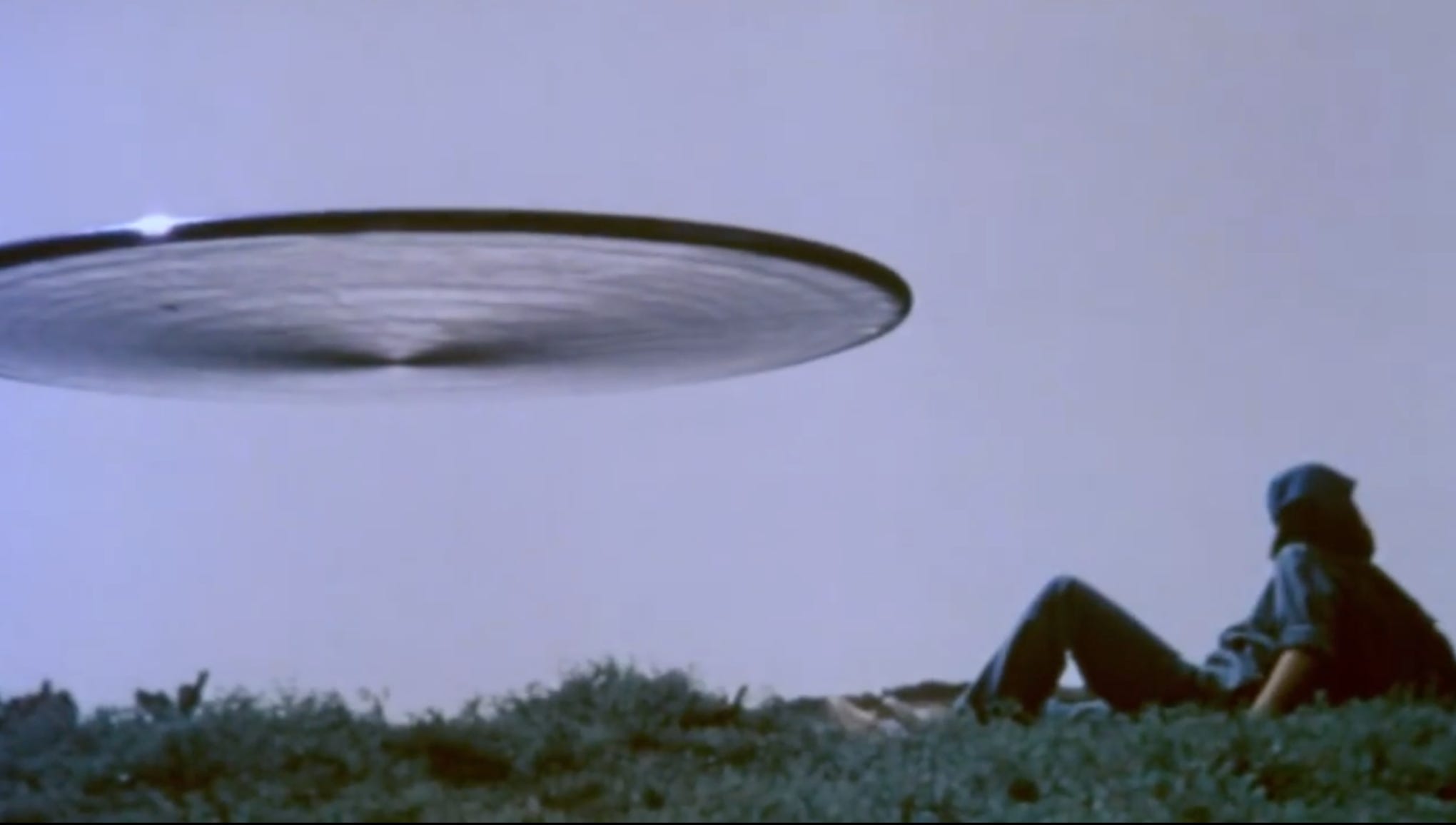
Take Foes, a science fiction film from 1977. It exists in two versions, a director’s cut and a theatrical cut. Both revolve around a UFO that mysteriously appears near a small island and inflicts psychokinetic turmoil on a pair of lighthouse keepers. The director’s cut leaves it at that, focusing mainly on mood and visual effects, while the theatrical cut adds exposition detailing that the UFO is an alien spaceship visiting Earth for sake of scientific observation, harming the characters unknowingly. One version inhabits a sense of the beyond and the other succumbs to sci-fi cliché. The dividing line here is so thin because nowhere is the question of “maximum authority” and all its spiritual malapropisms more evident than within the spirit of science fiction.
Sci-fi, at its worst, is a genre that claims to be based in the hard facts of the universe but exegetes in the pseudo-religious realm (Fr. Seraphim Rose talks about this). Take the Eastern mysticism that is the crux of the Star Wars franchise: anytime a character should reasonably be portrayed by a wise or wily Asian guy, a mossy alien is there instead. Frank Herbert’s Dune does the same for Neoplatonic Islam. Even the technocratic fantasy that is Star Trek reaches its zenith in the spiritual beyond beheld in Star Trek: The Motion Picture. You get the point.
Foes, on the other hand, strikes a precarious balance within the genre. It was released exactly 30 years after the first flying saucer was spotted near Mount Rainier in Washington. It also derives its title from a nickname for UFOs among enthusiasts. At its core, it is devoted single-mindedly to evoking the ambiguity and menace surrounding UFOology, so its contrivances are not hypocrisies but apophatic rifts into the beyond. Director John Coats (who is known primarily for his VFX work) achieved this by studying the physical phenomena described in UFO encounters and reflecting it in the appearance of the flying saucer, which ranges from a sheen like vibrant aluminum to spectacular patterns of light.
Midway through the film two scuba divers happen upon the island to find one of the lighthouse keepers scorched to death and the other severely injured. They continue to be pursued by the spacecraft. Losing all hope in face of the entity, it begins to divide into three shafts of light emitting strange, animalistic noises. One diver becomes entranced by the light while the second tries to shoot at it. The surviving lighthouse keeper envisions a black sun as she covers her ears to shield from the noise. Upon returning to the mainland, the second diver begins to recall a dark void lying at the center of the shaft of light that he saw. The first diver is found washed up on the beach, dead, the following morning.
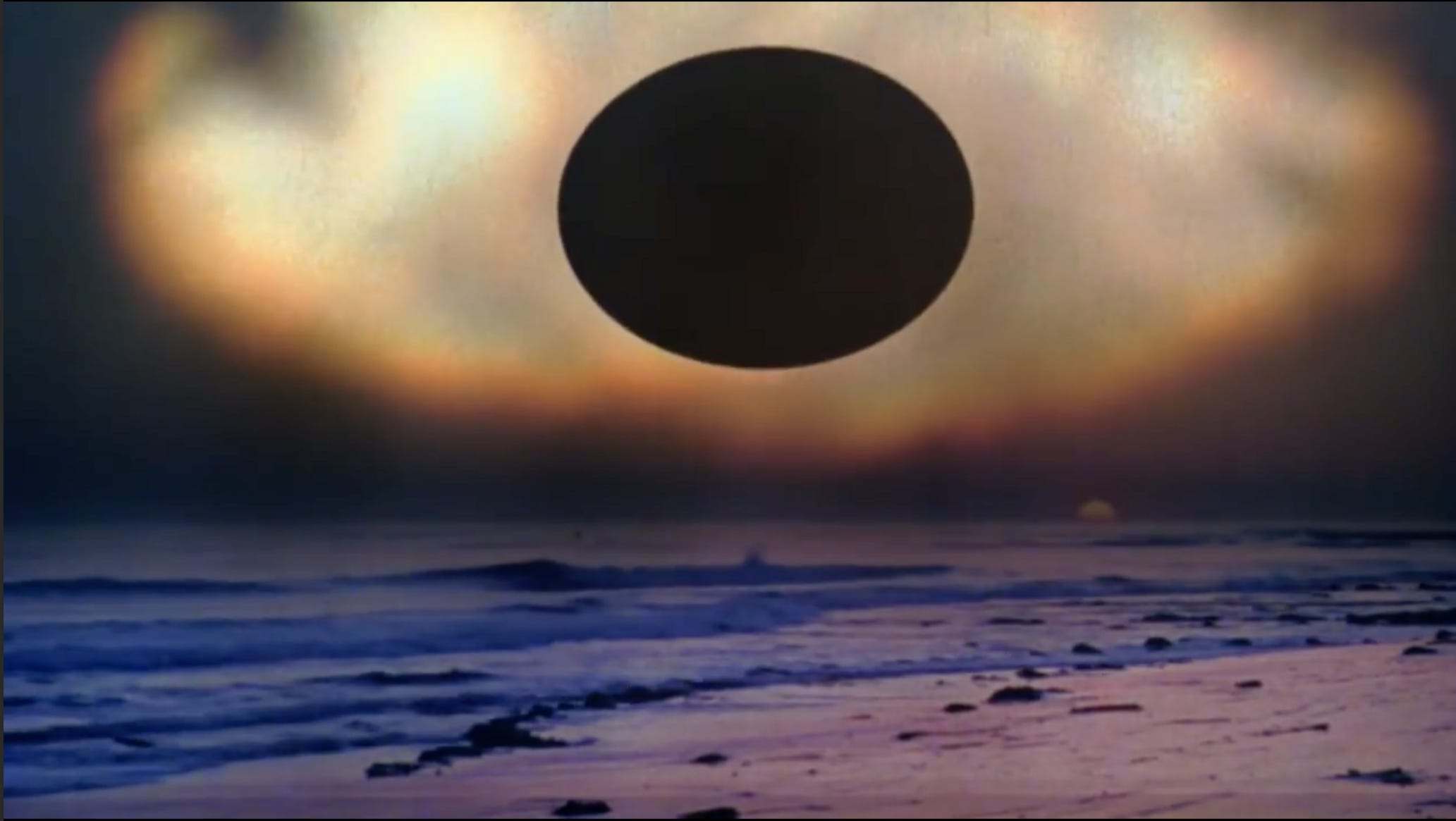
Although early encounters with nocturnal lights and daylight discs were reported by reasonable, regular people in genuine shock from their experiences, the phenomenon of UFOs soon became absorbed by occult and new age groups. Today we can’t disassociate the two, but why? UFOs can’t be said to be supernatural any more than they can be explained by science. Whether they are aliens or Jungian archetypes run amok is irrelevant, the significance comes from the presence of a void. A cause without affect. They allow themselves to be seen but they cannot be known. Not by science nor by magic.
Communion is a film from 1989 based on the book by Whitley Strieber, whose accounts of alien visitations made “anal probes” and “lost time” common parlance within the community. While the adaptation doesn’t leave psychoanalysis off the table, its interests lay mostly with the other, less sensational bit, which appears frequently in accounts of real UFO “survivors” unable to recall just exactly when their experience took place. Christopher Walken in the role as Streiber remembers his abduction with alarming certainty, everything from the aliens’ sizes and shapes to the nature of their experiments is recalled viscerally and closely. Everything except from the time and the place, which is left vague.
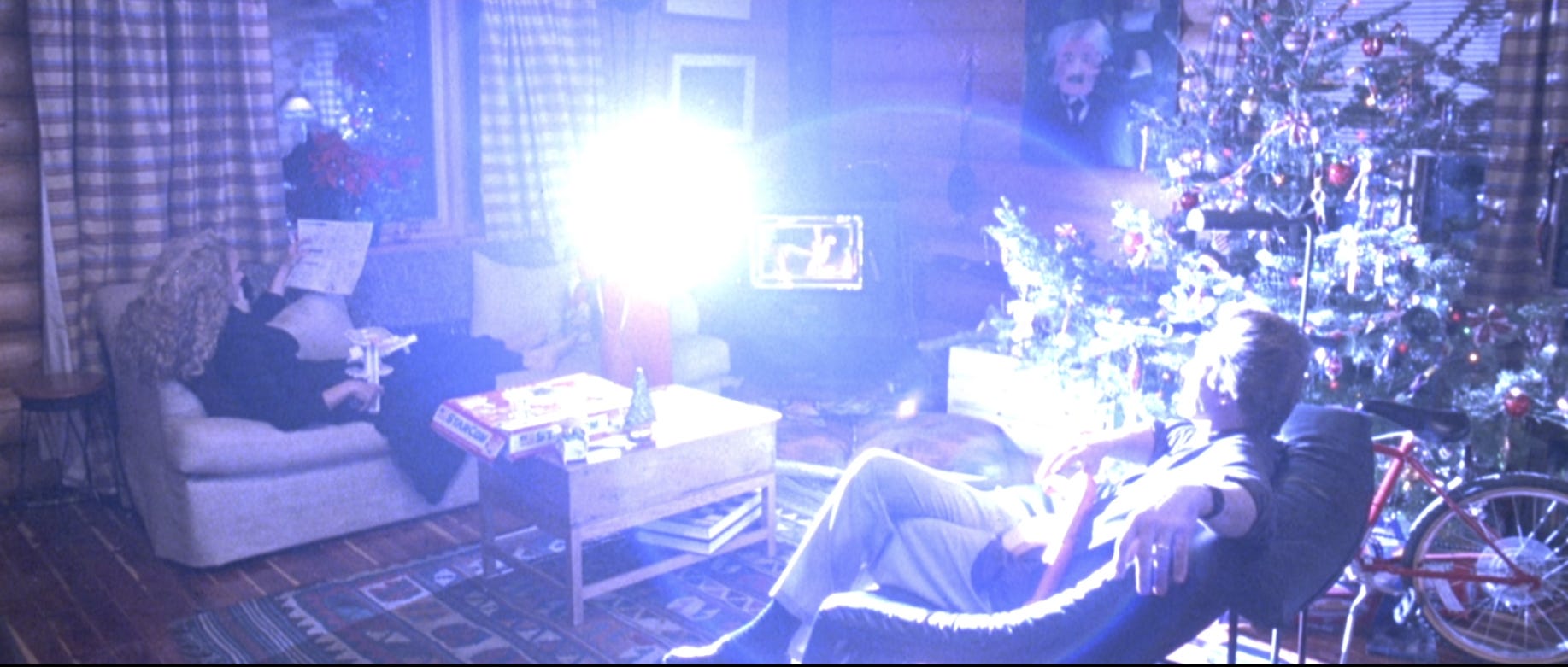
It also must be said that Whitley Strieber never said that his kidnappers are extraterrestrials of any kind. Their appearances are derived more from traditional African masks and the wall paintings of ancient Egypt than anything out of an Edgar Rice Burroughs novel. In the film, Walken goes in search of their spacecraft only to find a ball of light standing in a field, which, upon him entering it, looks from the inside like a basement of a facilities building. Walken’s hypnotherapist associates his descriptions of the visitors to folk tales of trolls and gnomes but Walken dismisses them, saying repeatedly, “That’s not it.”
The protestations of an hysteric are exactly this, rejecting all semblances or images of the alien because it’s “not it.” Only the (capital-O) Other itself is desired. The not-I is the only thing that will do, it is the “it” in question (as Lacan would say). That Strieber-Walken’s encounters with this Other took place outside the spatiotemporal realm only gilds the lily. Just as 19th-century Spiritism correlated psychic phenomena with physical manifestations, UFOology elevates its native 20th century narcissisms to a level comparable only in the divine.
I don’t want to give off the perception that UFOs are the important thing here. It’s outer space in general that I am scrutinizing, as it’s a permanent fascination with Satan-worshipers of all kinds. All scientific projection is denied by the fact—the objective fact—that there is truly nothing out there. As I might have already implied, authority manifests by recognition. So when there is nothing to reflect, illusions must impose. If late capitalism should reveal to us anything it’s that profit is no longer an imperative sufficient for our stage of empire. Planetary-scale ego is at stake, reified by total moral trespass, accommodated only by the night of the world. Our glimpse into the void causes us to blink.
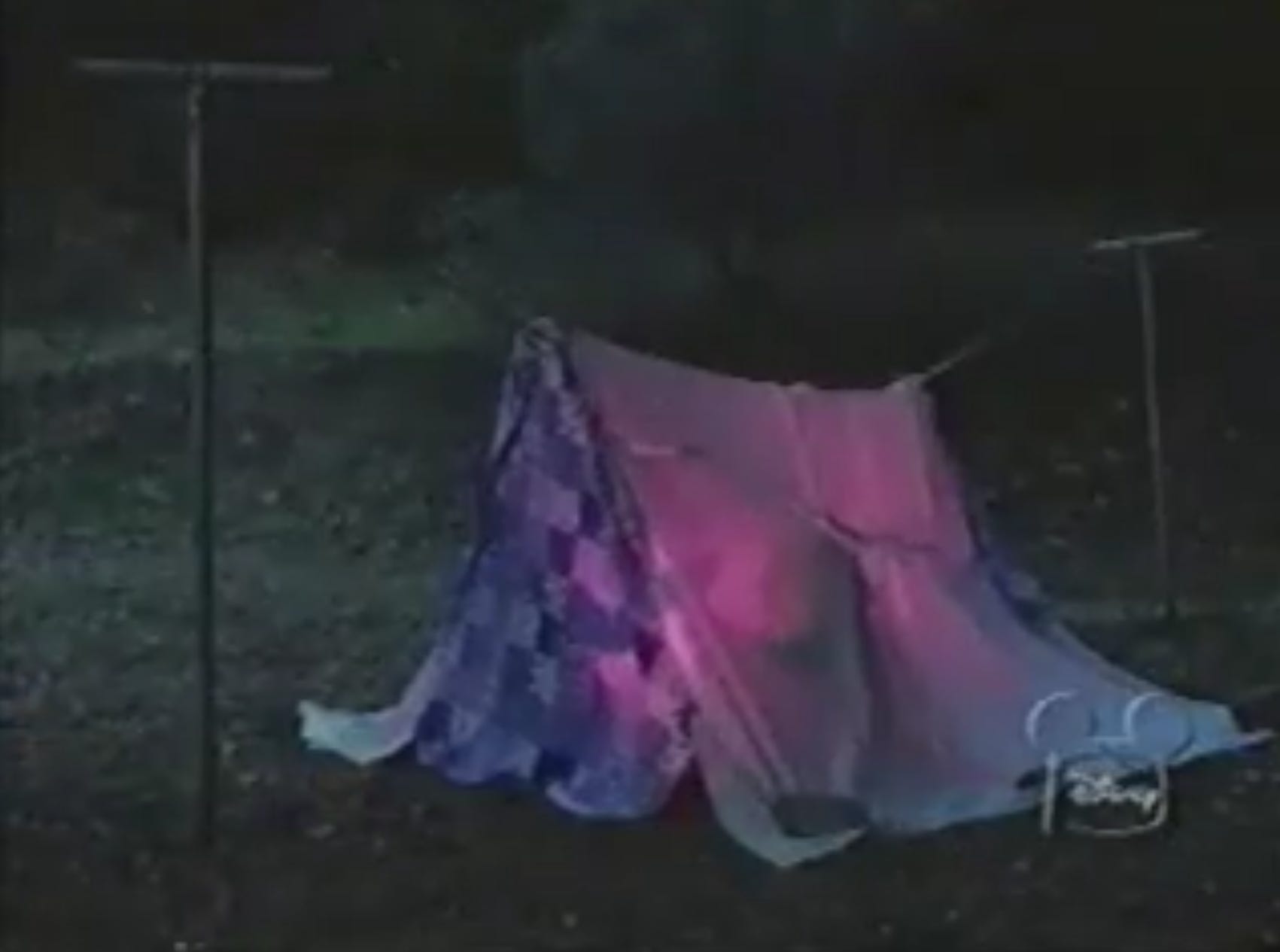
The Disney film Escape to Witch Mountain is a good allegory for this. I watched the 1995 TV movie version because it was free on YouTube, wherein young Scientologist Elisabeth Moss acts circles around her on-screen twin brother. The two are separated at birth but reunite in their adolescence at an orphanage and discover that they share telepathic abilities. A Theosophist millionaire adopts them for a secret plan to use their psychic abilities to extract uranium from the titular Witch Mountain. When the magic kids become wise to this they make their titular escape with the help of a fellow telepath, who reveals that they are aliens and he is a kind of bodhisattva alien helping other “fallen” aliens make it back to their home planet.
When the twins finally make it to the peak of the mountain where their ascension should take place, the brother expresses misgivings, to which Moss says, “don’t be afraid, nothing bad can happen.” With this I personally disagree because most people should absolutely be afraid of outer space as there is nothing out there that is good at all. You should also be suspicious of rhetoric like this that tries to persuade you differently. Witch Mountain’s particular analogy of science and Spiritism can be derived from the parapsychology research popular in the time of the original novel’s publication. It is not just a sci-fi trope but also an active interest in UFO myth-making and its constituent political dealings.
In the 1970s, on behalf of Stanford University and the CIA, Scientologist Harold E. Puthoff and Theosophist Russell Targ formed the Stargate Project in an expensive attempt to test the viability of remote viewing for military intelligence purposes. They failed, of course, but central to their failure was one 25-year-old Israeli Uri Geller, who, in being subject to intense study for his apparent telepathic powers, became key to a greater purpose. When brought under hypnosis, Geller spoke about being visited by extraterrestrial henads who struck him with a beam of light and activated his gift of bending spoons with his mind. It was Croatian-born parapsychologist Andrija Puharić who originally recruited Geller and became infatuated with him upon hearing this, as Puharić himself reported being contacted by a set of nine similar entities.
“The Nine,” as they are called, were demons encountered during a seance that Puharić held at his Round Table Foundation laboratory in Glen Cove, Maine, with various members of the American aristocracy present. Of which were Ruth Paine, who was a one-time hostess of Lee and Marina Oswald, Mary Bancroft, who was a mistress of Allen Dulles, and Arthur Young, who invented the Bell Helicopter. At Bell Aerospace Young met Michael Paine, Ruth’s husband, when Walter Dornberger served as the company’s Vice President. It was Dulles’s OSS that recruited and “de-Nazified” Dornberger for use in America’s space program, along with countless other Nazis such as one Wernher von Braun, who had also been a guest at Puharić’s Maine laboratory around the time of the seance. The content of which was negligible and of a generic new age-y character novel to certain people of consequence in 1952. In 1963, John F. Kennedy was assassinated and the tulpa that was American exceptionalism took its due course. In 1970, Puharić began recruiting children across the continental United States for his Space Kids program. He eventually found his ego ideal in Geller, who has since repudiated him.
Both Dornberger and von Braun both worked at Peenemünde together building the V-1 and V-2 rockets that were later re-commissioned by the U.S. Navy for the purpose of space exploration. Ironic, as von Braun’s vision for the rocket originally stemmed from the futurist Raketenrummel fad that enraptured Germany during his teens. Around this same time one Rudolf Hess, Private Secretary to the Führer, was accompanying Hitler on speaking engagements across Germany. Five years prior, Hess was detained alongside Hitler after the failed Beer Hall Putsch. During their years in Landsberg Prison together, he helped him write Mein Kampf. Hess, in addition to being one of Hitler’s closest confidants and a decorated pilot, was a noted believer in the esoteric pagan ideology of the Nazi regime. This is contrary to, say, Albert Speer, whose inspiration by supernatural forces served as a front for political aims. The same goes for the technocratic Dornberger. Even von Braun’s adoption of the ideology translated neatly into the cosmic Evangelism of the American empire. Hess, by contrast, was no kind of careerist. Hess was a dyed-in-the-wool Nazi.
In 1941, after years of gradually being sidelined by the führer, Hess ventured to initiate peace talks with the United Kingdom. He feared the worst for Germany and believed that the British Empire should unite with the Nazis against their common enemy in the Jews. He charted an independent flight to the UK but was promptly shot down and captured in Scotland. News of this quickly spread first within England (Churchill referred to the plan as one of “lunatic benevolence”) then to Germany, causing Hitler to strip Hess of all his party offices and ordering that he be shot on sight if he should return. In addition to slandering him as crazy in the press, the Nazis introduced Aktion Hess, a political initiative to scapegoat esotericism and distance themselves from the prewar Nazi thought that Hess embodied.
When Hess returned to Germany Hitler was already dead and the Nuremberg trials were underway. Dornberger and von Braun had surrendered to the West. Speer narrowly evaded the death penalty and was sentenced to twenty years at Spandau. Hess pretended to have amnesia to avoid denouncing the regime. He was sentenced to life. While at Spandau Speer wrote the manuscript for two autobiographies. The books, which became bestsellers upon his release, framed him as a visionary artist at odds with a mad patron regime. Hess, kept in a solitary cell devoid of contact with Speer or any of the five other Nazis held at Spandau, spent these overlapping twenty years writing letters of encouragement to various dispossessed fascists. The prison staff routinely intercepted these letters, which caused them to grow impatient with Hess and his lack of plausible deniability.
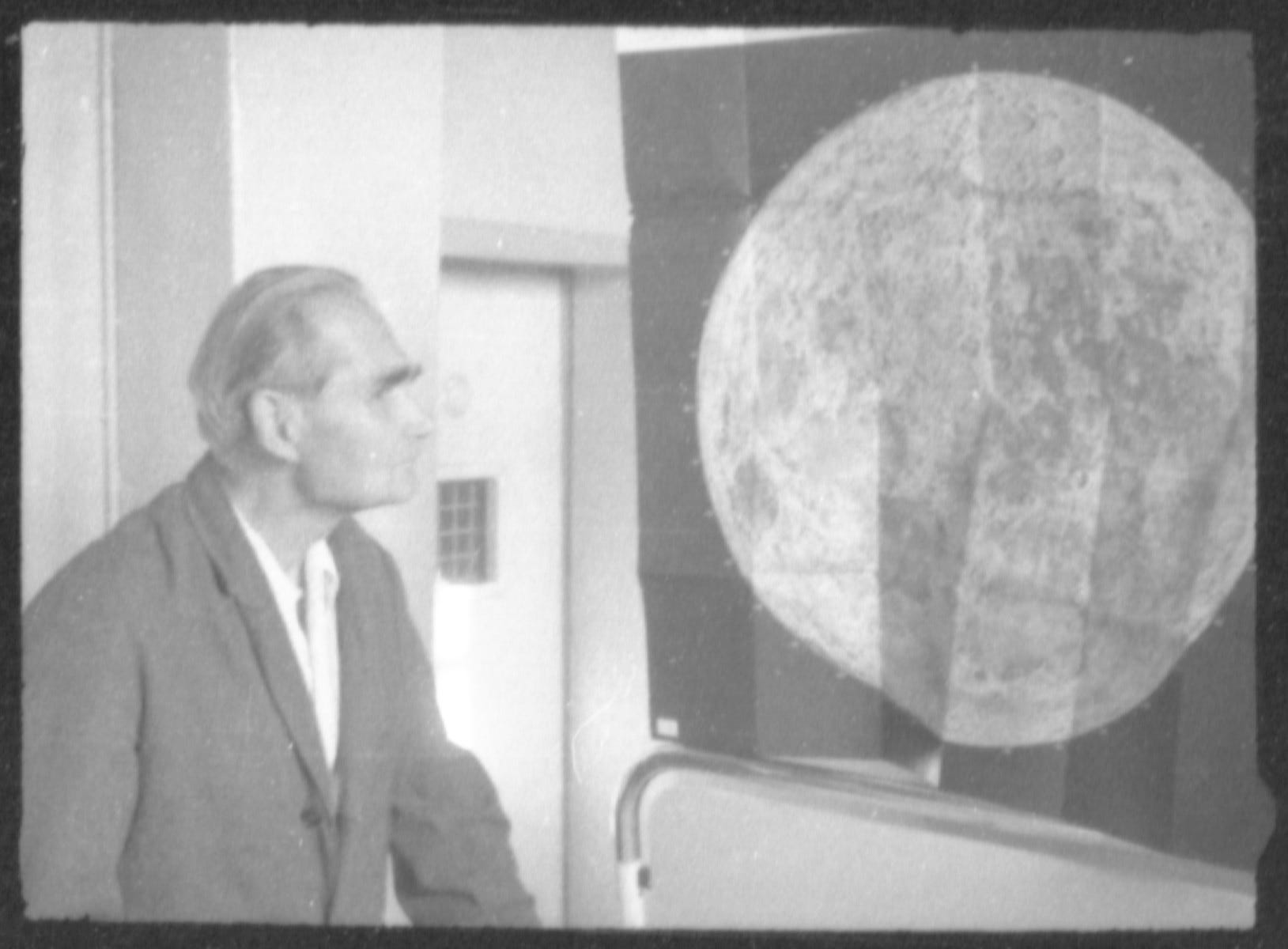
When Speer was released in 1966, von Braun was heading the development of the Saturn IB and Saturn V rockets for the Apollo program. Three years later, the moon landing took place. A still-imprisoned Hess heard about it and asked his captors to bring him a poster of the moon to decorate the wall of his cell. They obliged. Hess continued to collect moon ephemera and books about space travel for the remaining eighteen years of his confinement, during which he was their sole inmate. In 1987, he died by suicide. To prevent it from becoming a neo-Nazi shrine, Spandau was promptly demolished and turned into a shopping mall.
No posts
Comments
Nothing yet. Say the first thing.
Sign in to join the conversation.