
I was in a peer supervision session with some coaches who are learning Solution Focus (SF) the other day. (In SF the ‘professionals’ are still peer learners – that’s an important element of our stance.) One of the group brought along a tough case with a client who ‘wanted a happy life’ (and wasn’t currently experiencing that). It brought to mind one of my favourite books: Obliquity by John Kay.
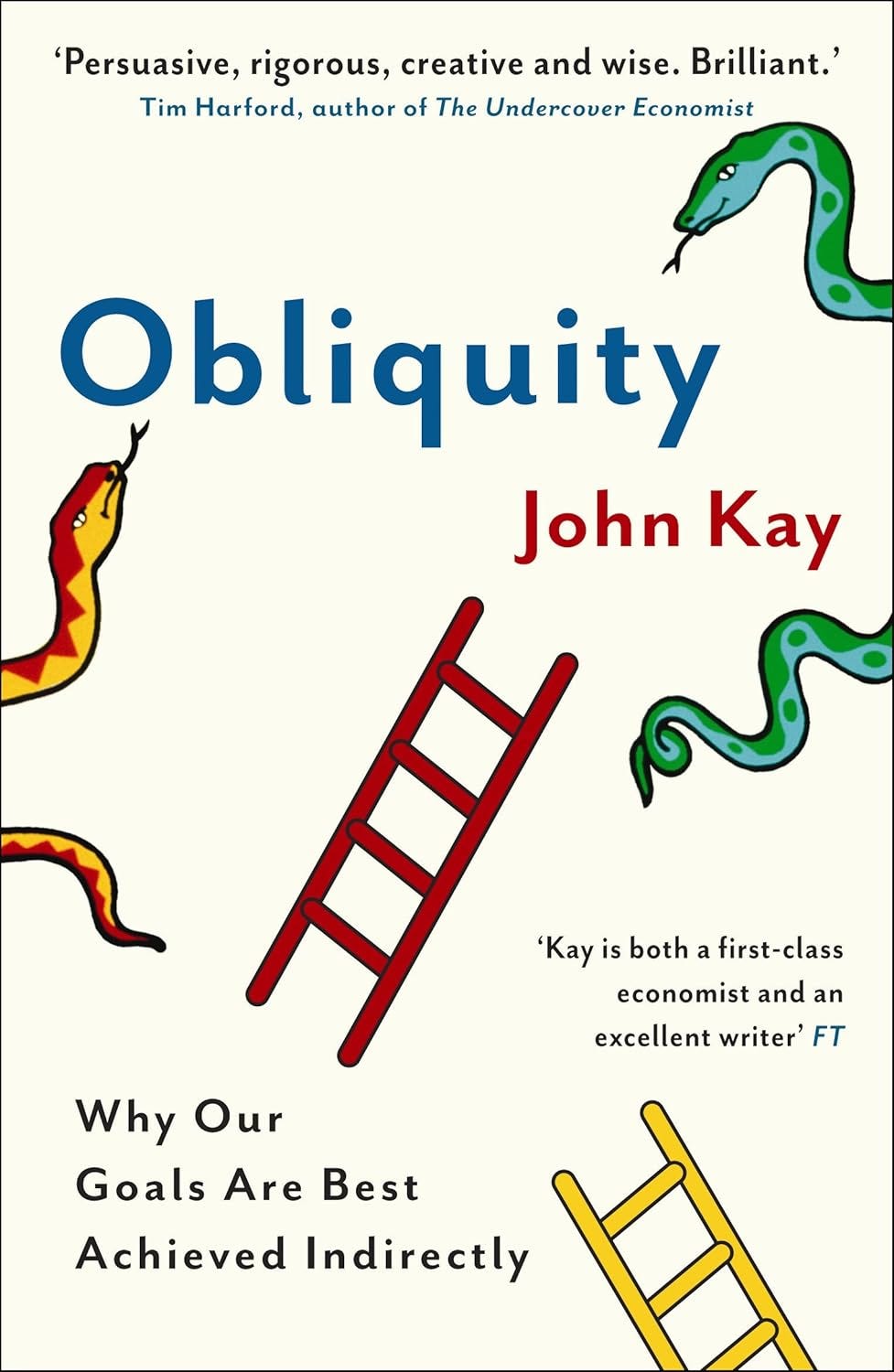
The book’s subtitle gives a strong hint as to the message. “Why our goals are best achieved indirectly.” I would qualify that slightly to say ‘some of our goals’. In this week’s article I will explore what John Kay means by obliquity, look at what kinds of goals are best achieved indirectly (and which not) and examine how SF is already bringing these ideas into action.
But first, what can happen when a huge company tried to make oblique goals into explicit targets; the story of ICI.
I mentioned ICI briefly a couple of articles ago when I was writing about ‘to be or not to be’ and the importance of not seeing the impermanent as permanent. When I was a young man, ICI were the giants of British industry, for most of their life the largest manufacturer in Britain. Formed in 1926 with the merger of four leading chemical companies, they made a huge range of industrial chemical products including fertiliser, insecticides, dyestuffs, paints, non-ferrous metals, plastics, food ingredients, fragrances and flavourings. During the second world war they made munitions and were involved in the atomic bomb research project. After the war they expanded successfully into pharmaceuticals. And all this they sold to the British empire and the world.

The company’s success continued through the 1970s and 1980s. Their charismatic chairman John Harvey-Jones became a well-known face on British TV with his Troubleshooter series, visiting struggling firms and telling them what to do (with varying degrees of success). Such was the reputation of ICI, there could hardly be a better source of wisdom. (I watched the show keenly as I was getting interested in management at the time, prior to my MBA degree.)
And yet everything was not totally rosy. The firm’s traditional products and markets were seen by analysts as old-fashioned and slow-growing (and therefore unprofitable). The market wanted to see ICI getting involved in newer and sexier products. There were also takeover bids, including an audacious one from the Hanson group, renowned as asset-strippers who wanted to split the company up.
ICI saw off the takeover and responded by floating their pharmaceutical division as a separate business, Zeneca. In an attempt to pacify the markets, the management of the rump ICI issued a new mission statement in 1997:
“The ICI Group’s vision to be the industry leader in creating value for customers and shareholders through market leadership, technological edge and a world competitive cost base.”
Sounds good, doesn’t it? Lots of buzz words. Here’s the thing… there’s nothing about chemistry in there. The company had previously operated (highly profitably) on the basis of ‘better industry through chemistry’. Now they were simply looking at sectors through the basis of whether they had existing leadership, some kind of technological edge and an efficient operation. And guess what… that’s a defensive strategy trying to cling on to previous advantage, rather than seeking innovation.
It all unravelled in a decade. Finding they couldn’t maintain their three key advantages, the company sold off division after division before finally selling their last operation (Dulux paints) to AkzoNobel in 2007. The greatest force in British industry was destroyed – by making ‘creating shareholder value’ a direct goal rather than an indirect, oblique one. Rather than building up their business by focusing on chemistry, they had started to focus on pounds. Profit, it seems, is not a good direct goal, but rather a welcome side-effect of a well-run business satisfying its customers.
John Kay has many more examples in Obliquity – companies who thought their advantage was impregnable and took their eyes off the ball to focus on profit and growth rather than what they were actually good at. Boing lost out to Airbus in the airliner market. Merck fell behind Johnson & Johnson in drugs. Even Jack Welch, for so longer the icon of American management, came to the conclusion (after he retired) that
Shareholder value is the dumbest idea in the world.
Profit and shareholder value are two goals best approached obliquely, according to John Kay. Happiness is another. Kay observes that:
Happiness is not achieved through the frequent repetition of pleasurable experiences, and that is why ‘the pursuit of happiness’ is a peculiar phrase.
Kay goes on to muse that happiness is not to be found in a big red Ferrari or some other material goal. In developed countries the proportion of people who say they are happy has remained stable even though incomes have grown considerably. (It’s different where people are really struggling to stay alive.) Happiness, says Kay, is where you find it, not where you look for it. It’s usually oblique rather than direct.
John Kay gives a handy table towards the end of the book about how to work with oblique goals. Here are some of his proposals:
Outcomes arise through complex processes whose totality no one fully grasps
Decisions recognise that only limited knowledge of the world is available (so uncertainty is part of the process)
Good outcomes are often derived from continuous (but often unsuccessful) adaptations to continuously changing circumstances
The oblique often emerges spontaneously
Consistency is a minor (and often dangerous) virtue.
The usual rules of process rationality and logic don’t work well in this kind of space. (And yes, those who have read my ideas on working with complex systems will have heard this kind of statements before.)
So, what are we to do? If happiness, shareholder value and so on are not open to analysis and directness, are we stymied from doing anything at all? Not in the least. And, as you might be expecting, Solution Focus offers some good practical possibilities.
The first thing is to beware treating oblique goals as direct! One way to make progress is to ‘back-cast’; look for the pre-cursors or building blocks which are steps along the way. I have written about this in my articles on the User’s Guide To The Future. And, of course, beware the lure of the big red Ferrari. I think that most oblique goals can be experienced (at some level) in the here and now. So thinking that you’ll be happy when you’ve retired is a council of despair, whereas thinking about how you can be happier this afternoon is a more useful step.
The fact that happiness is an elusive playmate does not mean that we can’t learn from experience. A key part of getting more familiar with oblique routes is to notice when things are better. So, if one finds a sudden (and perhaps unexpected) moment of happiness, it’s a good idea to notice it. Firstly, we can enjoy it all the more for having noticed it. Secondly, we can become more aware of the kinds of things that help us in that direction. It won’t be as simple as ‘do X and get Y’, but the learning and awareness that comes from noticing is a key part of becoming more familiar with the terrain.
“Life happens in detail.” So said Janet Beavin Bavelas (1940-2022), a key architect of conversational microanalysis and a leading figure in the Interactional View upon which SF is based. When I interviewed her in 2013, she was keen to point out that even the tiniest detail (a raised eyebrow, a pause) can take a conversation, and potentially all that happens after it, in a new direction. So when we are noticing, we should also take account of the tiny details which seems to be playing some kind of role. Some of these may well be helpful in making new experiments and explorations into better futures.

Happiness (or whatever) isn’t just a solo creation. Although you may be the one feeling it at that instant, there will be others involved too – both in the present (who are contribution and playing a part) and in the past (who have helped you get to the point of being able to live in this way). So when I am feeling happy playing with an informal jazz band in Edinburgh’s Grassmarket (as I did during the pandemic) I can notice the roles of the other musicians, the crowd, the sunny weather, even the excellent beer. And, looking even more widely, I can revel in those who showed me the jazz way decades earlier – my first clarinet teacher ‘Hout’, Richard and John who supported my first faltering steps to playing When You’re Smiling, alto sax legend Lee Konitz who showed me the huge range of improvising available using a 1-10 scale (1 is the tune, 10 is as ‘out’ as possible… now do a solo at 3, followed by another solo at 6). So many people to be grateful to, who got me to where I am.
The Dalai Lama is widely quoted as saying that the recipe for happiness is simple – find what makes you happy and do more of it, find out what makes you unhappy and stop doing that. While that’s definitely a broad-brush approach, I think there is a great deal of wisdom in it. It’s worth noting that he is talking about ‘doing’ things rather than ‘being’ – the topic of one of my recent articles here. How do you ‘do’ happiness. And for that matter, how does your organization ‘do’ profit and value?
I will not be going to many SF conferences this year (having done a pretty full sweep last year), but I will be at the SOLWorld University on 14-18 October at the Land An Zee centre in the Netherlands. As the organisers say, this promises to be a truly special gathering—a chance to explore, learn, connect and relax in a beautiful setting with good company and inspiring conversations. There are just a few places left as I understand it. Come and join us! More details and registration at https://www.eventbrite.co.uk/e/solworld-university-2026-ignited-by-sfio-tickets-1968240786175.

Comments
Nothing yet. Say the first thing.
Sign in to join the conversation.