
A couple of weeks ago, we heard President Donald Trump’s latest State Of The Union address. It was the longest on record at 1 hour and 48 minutes. Commentator (and Nobel economics laureate) Paul Krugman noted “So little truth, so much time”.
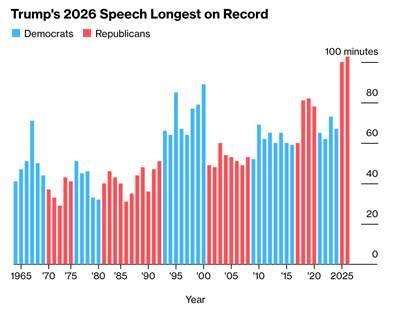
The Economist commented on the following day:
On a momentous question, whether America will again attack Iran and if so why, the president offered only a muddle. On the fourth anniversary of Russia’s invasion of Ukraine he had no new vision for ending the war. He had nothing to say about the challenge posed by China or the promise and peril of artificial intelligence. This speech is likely to be remembered only for its length, but its effect will be to further shrink the significance of the state-of-the-union address. (Excerpt From “Donald Trump’s unworthy state of the union” The Economist https://www.economist.com/united-states/2026/02/25/donald-trumps-unworthy-state-of-the-union)
We now know more about attacks on Iran, where the President blindsided most of his allies by springing into action. That it took some allies a few days to catch up should come as no surprise to him – but he expects instant loyalty rather than argued rationality. But let’s go back to the art of the long speech.
Trump is by no means the first to pull the trick of speaking for a long time as a substitute for substance rather than as a sign of it. Back in the day Fidel Castro, then president of Cuba, used to speak for hours with the time carefully measured and reported; his 1960 speech to the UN General Assembly (269 minutes, well over four hours) has gone down in history. Soviet era leaders likewise spoke for hours, same in North Korea. In these cases, the time was surely a measure of their power (how long can I make you listen to this waffle?) rather than substance.
I think this is an (extreme) example of a more general phenomenon; mistaking the length or size of something for its importance.
During my early career in management consulting I was often asked to facilitate workshops to discuss key issues within an organisation. I was struck by how often those commissioning me would fall into the trap of equating a big problem with a long workshop – in one memorable case four days duration!
I would argue, more confidently as time went on, that these two things are not connected in a logical way. I was exploring Solution Focus at the time, which starts from the premise that the problem and solution may well not be connected. So however the problem might be stated, it was more important to look at what was wanted and then start to focus on that. However, the grip of the big problem-long time equivalence had many people strongly in its grip.
There is another aspect to this. Over time, this can morph into the ‘understanding’ that a long time must surely mean a big problem. ‘We had a very long talk about it’ implies that it must be important. I am arguing here not against long things per se, but to be careful with how time is used.
Back in the mid-20th century when the ideas of psychoanalysis were pervasive, the idea of a ‘flight to health’ gained credibility. This was where clients, faced with the prospect of long-term therapy, suddenly experienced dramatic improvements in their symptoms. The practitioners viewed this as a denial or defence mechanism to avoid the actual treatment, and so ignored the improvements in their position for which only long-term, ‘deep’, painful talking could make a lasting improvement.
This is part of the pernicious idea put about by (often self-interested) people that there can be ‘no pain, no gain’. This is an idea put about by purveyors of pain looking to trap people into long-term relationships which mostly help the purveyor, not the customer. After all, they are very often being paid by the hour! You have to put up with the pain in order to get the gain, apparently.
Of course some things do need work over time. But the trick is to develop ways to enjoy the journey as well as look forward to the destination. Get into the rhythm of eating more fruit every day, rather than reluctantly take dietary supplements, that sort of thing.
The Solution Focus stance is very clearly that briefer is better. We want efficiency in our work as well as effectiveness (which is in part what this blog is about). These two things are not the same, as I wrote here back in 2023. Effectiveness is that something works. Efficiency is that it works quickly (or at least starts to work quickly, given encouragement to carry on). Not wasting people’s time is important to us.
What about situations which are multi-dimensional and complex? When working with Solution Focus, our goal is not to have everything under control but rather to have some next steps which all (or most) agree are leading in the right direction. That way we have things to do (now) which will (probably) help. The advantages of this are:
Rapid feedback, which can lead to
Quick adjustment if needed
We should start seeing progress right away.
Beware those who say it will be months before any visible progress can be seen. This is a route to inaction and disappointment. The power of tiny signs of progress in showing that we are on the right path is very strong – which is why we ask about them often towards the end of an SF conversation.
I am currently enjoying Laurence Freedman’s book On Strategists And Strategy. Laurence has had a long, fruitful and varied career as a modern military historian, was on the Iraq war UK government inquiry (known as ‘Chilcot’) and held leading positions at the top UK foreign affairs thinktank Chatham House. He currently writes on Substack in partnership with his son Sam, who is an expert in UK government matters; Laurence writes about foreign policy and international conflict. It’s one of the very few Substacks to which I pay money to subscribe – the articles are long, well-argued and always have something you didn’t know beforehand.
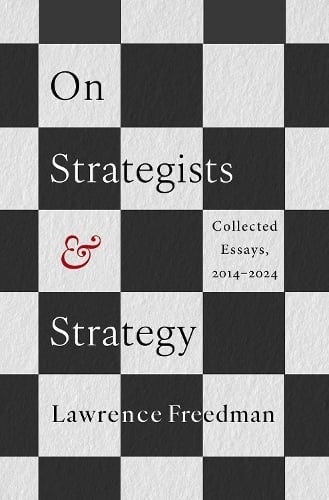
Freedman writes about how the split between (long-term and overarching) strategy and (local small moves) tactics came from the military in the 19th century. When I was a lad doing my MBA degree this was a key distinction. Indeed, I worked (and met Jenny) in the Strategic Planning Unit of Nuclear Electric, the UK’s nuclear power generator at the time. Then Henry Mintzberg’s excellent book The Rise and Fall of Strategic Planning appeared in 1994 and people began to realise that the distinction between strategy and tactics was not so clear cut.
In an essay entitled In Praise Of Tactics in the book, Freedman writes:
We look forward strategically but move forward tactically
(Freedman, Lawrence. On Strategists and Strategy: Collected Essays, 2014-2024 (p. 77). Oxford University Press. Kindle Edition.)
I think this is an excellent summary. It’s vital to look ahead with the big picture in mind, aware of side effects and possible consequences. But in the end, what we do ends up as tactics – small actions (perhaps with great consequence) that move things along.
Of course, it’s possible to get too wound up in tactics and forget strategy – if it was even considered at all. I refer readers back to my opening remarks about Donald Trump and his apparently off-the-cuff decision to attack Iran with apparent total lack of strategy (albeit effective tactics). Members of his administration are at odds about why they did it and what their aims are. But at least (according to news as I write) they have hit a lot of targets. Hmm… It reminds me of the moment in Casablanca where Chief of Police Renard is updating Major Strasse:
My men are treating it as a very serious crime. They are rounding up twice the usual number of suspects.
Renard’s sly humour aside, this is mistaking doing something you can do for something that might be useful in the long term.
Don’t confuse length with logic. Do think big picture as well as detail, zooming out to see the wider consequences before zooming in on tactical actions. And remember, as always, the power of small steps to shape the next stage of developments. Assuming you knew what you wanted them to be.
My old mate Chris Corrigan continues his inspiring work with complex settings and situations. He has a new extended blog out on The Ecology of Dialogic Containers and Making Change which is well worth reading.
He is also going to be offering his Working in Complexity Inside and Out online course with Caitlin Frost again in the Autumn/Fall of 2026. He writes:
Caitlin and I are offering our Complexity Inside and Out program in the fall, online from October 1 to December 10. We are updating and adding new content to this course which serves as an introduction to complexity in organizations, communities and in ourselves. Come and learn theory, personal practice, and approaches to facilitation, evaluation, and design that help us work with complexity, and build resilience and community

Comments
Nothing yet. Say the first thing.
Sign in to join the conversation.