
I dropped in to the Jazz Bar in Edinburgh last weekend. My friend Marie was going to see pianist Dave Milligan (quite well-known locally ) who was performing in the informal Saturday afternoon slot. It’s free to get in, and can be quite popular; shoppers (and indeed spouses of shoppers) seeking refuge alongside jazz enthusiasts. I took my alto sax along on the off-chance that I might get a sit-in. Sitting-in is part of the jazz tradition; it’s a participative art form so asking to play on a couple of numbers is quite normal, particularly if it’s a low-key performance. The musicians onstage don’t have to let you join in, but it’s quite normal to ask.
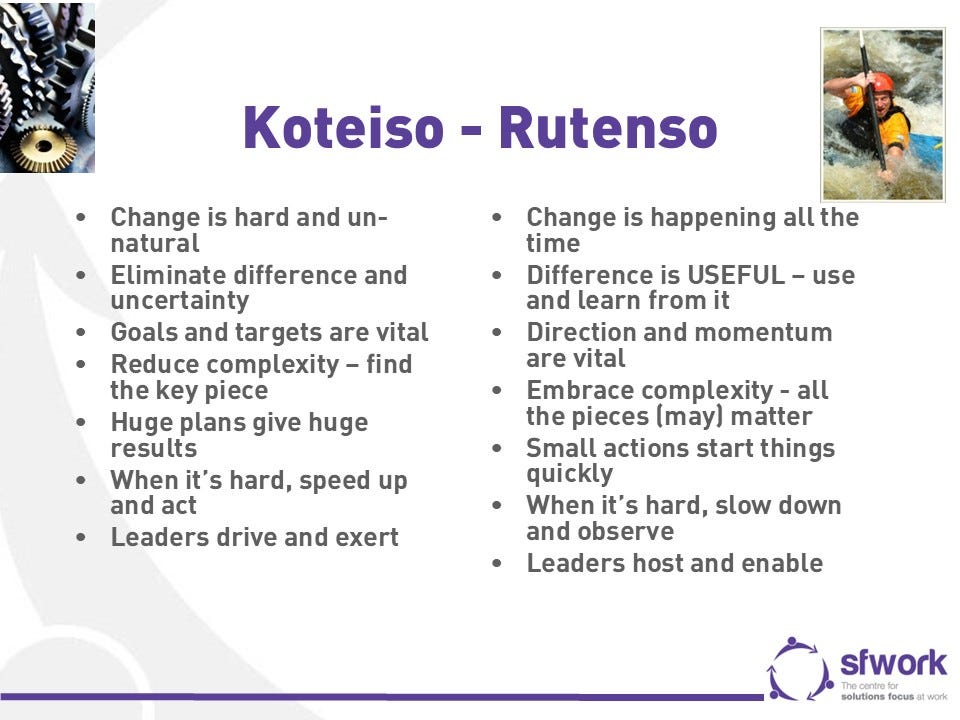
I had a good chat with Marie, then Dave said he was taking a short break. I went over to the bar, said hello, established a few credentials by mentioning some of the tunes he’d played (and a couple he had quoted from along the way), and asked if I might sit in. We established what I would like to play (If I Were A Bell by Frank Loesser from the musical Guys & Dolls, a jazz standard much loved by Miles Davis and many others), and I went up to the stage. I opened my sax case, there was my sax but… the neck sling was missing. Argh! It is impossible to play anything heavier than a soprano sax without a strap around your neck to support the weight. So – game over. What a let-down - and a reminder of a key part of my own philosophy.
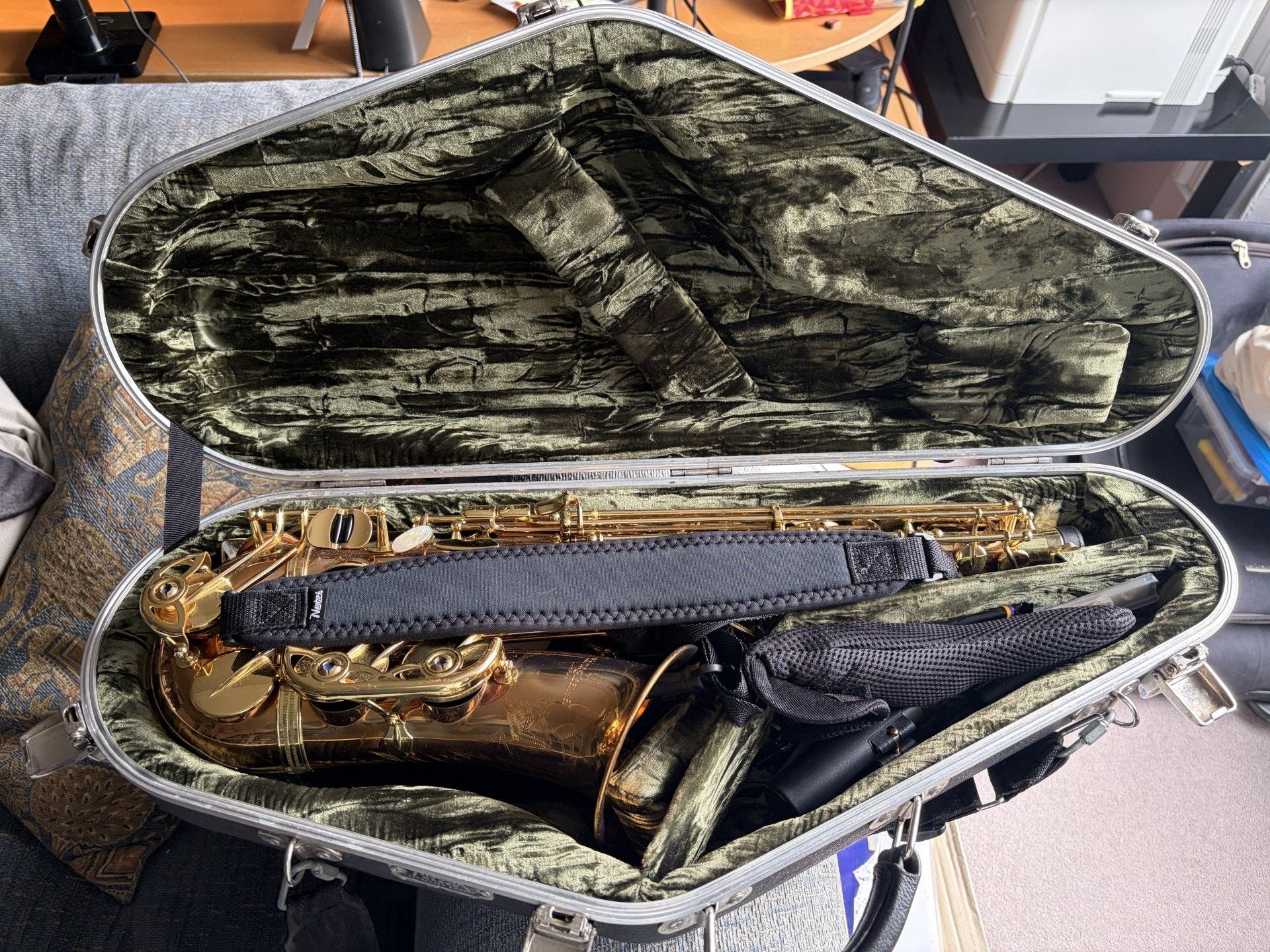
I have written here before about ‘rutenso’, the art of working with constant change. I coined this made-up Japanese word when looking for a ‘big picture’ for Solutions Focus and its emergent way of working. Most management (and indeed engineering and other logical approaches) are founded on assumptions of stability. I called this ‘koteiso’, another Japanese neologism. We can contract the two routes to building change by comparing them.
My jazz bar experience above is an example of the fourth principle of rutenso: Look widely, all the pieces (may) matter. This is contrasted with the fourth principle of koteiso: Reduce complexity – find the key piece.
Readers with longish memories may remember that ‘and all the pieces matter’ was the tagline for TV show The Wire (2002-2008). Set in Baltimore, this cop/crime/political drama broke new ground by having ambiguous plots and characters. It wasn’t clear who were the ‘goodies’ and the ‘baddies’. David Simon, the show’s creator, said that in real life everyone was compromised in some way. Episodes explored how everything is connected, how small differences may turn out to be important (or irrelevant – it’s impossible to tell), in a realistic version of an American city based on actual experiences. And, by the way, it also introduced two English actors as real stars – Idris Elba as Stringer Bell and Dominic West as cop Jimmy McNulty. “Which cast member of The Wire went to school at Eton College?” is an excellent trivia question.

The assumptions of koteiso can lead to looking for ‘what is the key piece here’? What is the most important thing? What one thing would make all the difference? If only we could get this one thing right, everything else would fall into place.
The risk of this is that it leads to ‘magic bullet’ thinking. If only we had this… If only we could do it without that… Here’s the thing – you don’t have this, and you can’t do it without that. And even if you could, there will be other elements in play which will produce new and unconsidered unintended consequences. This whole line of thinking is a dead-end paved with red herrings.
The rutenso philosophy is a way of working with complexity; multi-layered and richly intertwined with many elements all pulling in different directions. In those kinds of situations (and let’s face it, this is normal in actual organisations, politics and societies), trying to find the magic bullet is hopeless. We have to work with things as they are, which is messy, confusing, sometimes infuriating – and where all the pieces may matter.
This is not some kind of hippy-dippy flower powered morphic resonance ‘field of everything’ idea. It’s when one thing is connected to another, which is connected to another, and so on. John Muir, the Scot known as the father of the US National Parks, out it very well:
“When we try to pick out something by itself, we find it hitched to everything else in the universe.”
Nothing exists in isolation. (And if it did, how would we ever know about it?) Everything is part of a wider web of interaction and co-dependency. (I will be coming back to this in the last Substack before the summer holidays…)
So how does this connect with my Jazz Bar experience? What is the key piece in a saxophone performance? The saxophone, obviously. I had the saxophone. But there is so much else involved… the skill built up over many years, the opportunity to go along to an informal show with a good friend, the sitting-in tradition in jazz, the negotiation about whether and what to play, the instrument being in good condition, the reed not being broken (or having a spare reed to hand), my teeth being in good-enough state, not being incapably drunk. And the neck sling. There are so many elements it can seem like a surprise that anything planned ever happens at all.
And yet it does. What made this particular event so notable for me is that I have never, in 50 years of music, found myself with everything in place apart from the neck sling. Apart from once. I was at a conference in Croatia, and was invited to play tenor sax with a local band. A sax was brought along for me to play but… it didn’t have a neck sling. All seemed lost until the organisers said they had an alto sax (with its own sling) that I could use if I wanted. Never having tried the instrument before, I played a few exploratory notes – and in a kind of Damascene conversion realised that this was the horn for me. For 40 years I had been playing the wrong size of saxophone! And all because of a missing neck sling.
This all reminds me of a splendid Zen teaching story I first heard on an NLP course in the early 1990s. It’s a very useful caution against jumping to conclusions. There are many versions of this story online – this one comes from mindfulness.com.
There once was an old Zen farmer. Every day, the farmer used his horse to help work his fields and keep his farm healthy.
But one day, the horse ran away. All the villagers came by and said, “We’re so sorry to hear this. This is such bad luck.”
But the farmer responded, “Bad luck. Good luck. Who knows?”
The villagers were confused but decided to ignore him. A few weeks went by and then one afternoon, while the farmer was working outside, he looked up and saw his horse running toward him. But the horse was not alone. The horse was returning to him with a whole herd of horses. So now the farmer had 10 horses to help work his fields.
All the villagers came by to congratulate the farmer and said, “Wow! This is such good luck!”
But the farmer responded, “Good luck. Bad luck. Who knows?
A few weeks later, the farmer’s son came over to visit and help his father work on the farm. While trying to tame one of the horses, the farmer’s son fell and broke his leg.
The villagers came by to commiserate and said, “How awful. This is such bad luck.”
Just as he did the first time, the farmer responded, “Bad luck. Good luck. Who knows?”
A month later, the farmer’s son was still recovering. He wasn’t able to walk or do any manual labour to help his father around the farm.
A regiment of the army came marching through town conscripting every able-bodied young man to join them. When the regiment came to the farmer’s house and saw the young boy’s broken leg, they marched past and left him where he lay.
Of course, all the villagers came by and said, “Amazing! This is such good luck. You’re so fortunate.”
And you know the farmer’s response by now…
“Bad luck. Good luck. Who knows?”
I was frustrated at the Jazz Bar when things unexpectedly didn’t work out. It’s a lesson in three parts, all of which are good advice when organising effectively AND humanely.
Take care that everything is in place, whether it seems key or not
Unexpectedness can lead to useful things as well as inconvenience (perhaps both at the same time)
It can be very hard to spot the difference between these two results at the time, or even later.
I am leading an in-person two-day workshop in Munich on 18-19 June 2026 for my very good friends Matthias Varga von Kibed and Insa Sparrer. This year the topic is Solution Focus 2.0 applied to groups and teams, along with Host Leadership. This is part of a longer series of trainings in SF but can also be booked individually. We will be working in English with some German translation. Full details and registration here https://syst.info/de/seminar/loesungsfokussierung-20-insbesondere-fuer-teamarbeit-und-anwendungen-der-host-leadership-0.
Comments
Nothing yet. Say the first thing.
Sign in to join the conversation.