
The UK news this week has been dominated by the current leadership crisis in the ruling Labour party. After a dreadful set of results in the local elections and Scottish & Welsh parliaments, there is expected to be leadership challenge to prime minister Sir Kier Starmer. The charge is that he and his administration show no vision, there is a lack of progress and he is adopting a strategy of ‘timid incrementalism’, making small changes which don’t feel anywhere near enough to his supporters, let along his opponents.

Starmer is not alone in finding himself buffeted by events. In many of the world’s leading democracies (including France, Germany, Canada), previously dominant mainstream parties of both centre left and centre right are under attack from insurgent populist groupings who promise (ill-advisedly, I fear) dramatically simple solutions to complex international change.
This week I want to highlight Disruptive Delivery (free download), a 2025 report from the Tony Blair Institute which offers an interesting and useful perspective. It doesn’t go far enough – but when combined with Solutions Focus, it could give an important key to both why things look stuck and how to unstick them.
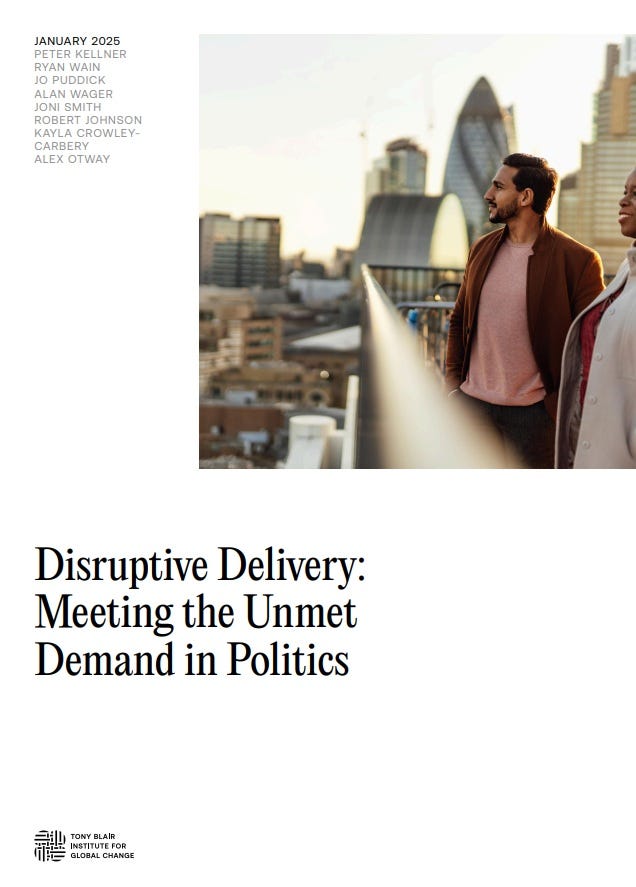
The Tony Blair Institute (TBI) was set up by the former British prime minister Tony Blair to (quote from their website)
help governments and leaders get things done. We do it by advising on strategy, policy and delivery, unlocking the power of technology across all three. As a not-for-profit, we can work in the most challenging contexts and on the most transformative projects because our focus is on leaders rather than profits. And as a non-partisan organisation, we can bring the best of our expertise to leaders who want to translate their ambition into meaningful action for their people.
Tony Blair resigned as prime minister in 2007. He was still a relatively young man and eschewed the conventional route of a peerage and an elder statesman role. He was perhaps the last prime minister to really assemble a working majority in the country (as opposed to in parliament, winning three general elections in a row between 1997 and 2005. He made some dreadful mistakes, both in office (leading the UK into the Iraq war) and afterwards (Donald Trump’s ‘Board of Peace’ is still apparently nailed to the drawing board). But he and his organisation are producing worthwhile research and ideas.
Disruptive Delivery researched current perceptions in six leading democracies (UK, USA, German, France, Canada and Australia). It found (unsurprisingly) that there is a lack of satisfaction with governments across the board. More interestingly, it also found that the old left/right spectrum doesn’t seem relevant anymore. The report identifies a new division in political views: Insiders vs Outsiders.
The Outsiders feel alienated from the political system. They distrust experts, and want strong, ‘common-sense’ leadership (implemented at pace). The Insiders believe in evidence-based change, value open debate, and are wary of radical insurgency. Both groups are present across all demographics and countries, with similar proportions (about 26% Outsiders, 27% Insiders, 47% mixed).
The document argues that only by embracing disruptive, transformative delivery can mainstream parties survive and thrive in the face of growing fragmentation and distrust. But here’s the thing. BOTH groups want to see dramatically improved progress and delivery. (They differ on delivery of what, of course. But everyone thinks that things are stuck now.) And, everyone is concerned that the next generation will not, for the first time in a century or more, be better off than their parents.
The key driver of dissatisfaction seems to me to be the lack of noticeable change. Take the current situation in the UK. Sir Keir Starmer has (not wrongly) chosen a lot of policies that will take years to come through – more house building, reforming the energy market, getting a bit closer to the European Union, reforming health and social care, increasing vocational training… these things will take more than the five-year duration of a Parliament so come to fruition. They are all well worth doing – but there is so far little to show. Starmer’s own background as a lawyer may feed into this too – the processes may be visible to those involved, but from here nothing seems to be going on.
That these worthy goals are long-term is only part of the reason for lack of visible change. Whitehall (the UK Civil Service) has a long tradition of taking things slowly and carefully. The normal method of public policy formulation and implementation is that there should be careful thought, discussions, conversations, consultations, stakeholder meetings, revisions, White Papers, proposals, disagreements, pilots (which can be abandoned without any learning being carried forward). It all happens in a fuzz of careful consideration, much-to-be-said-on-all-sides, with the absolute goal of not making any mistakes. Of course, the easiest way to not make a mistake is not to do anything…
What I think we need is some properly disruptive delivery; change that is felt by those it benefits and is noticed by all. There is an unusual source for this idea: Donald J Trump.
One of the key assumptions in Solutions Focus (SF) practice is that ‘all change happens from someone’s perspective’. In one way that sounds uncontroversial; if we don’t see or experience a difference, then nothing has changed for us. However, one point that can easily be overlooked is that SF basically foregoes the ‘third person’ view, the neutral overseeing perspective which might be a scientific researcher, an overall statistic or even God. In order to be meaningful, change has to be experienced by the people involved.
This reminds me of an encounter reported by Professor Anand Menon, director of the UK In A Change Europe thinktank. Menon was debating the possibility of Brexit in Newcastle in 2016. When he said that Brexit could reduce Gross Domestic Product (GDP), a woman in the audience replied “That’s your bloody GDP, not ours!”. The third person ‘facts’ were that GDP had been increasing for the past decade. As far as the audience member was concerned, her life wasn’t getting any better and she was still broke. Menon spoke about this exchange many times, and it seems to have shown him an important distinction between economic data and real people’s experiences.
In SF work we break things down into (visible) tiny signs and (actionable) small steps. My User’s Guide To The Future is at least one way to do this. But we can crank it up in a disruptive way by paying attention to, of all people, President Trump.
Think back to the start of President Trump’s second term of office in January 2025. What did he do on day one? Issued 26 executive orders, covering topics from drilling oil in Alaska to the death penalty. From my position as a responsible and careful consultant, I would say that a lot of this is quite performative, and I really don’t like most of them. But – his supporters love it. They don’t care if many of the things end of being rescinded or stalled – because they like to see their priorities writ large and shouted about. They would rather have a leader who shared their values than one who actually increased their GDP, lowered their gas prices or enhanced their international reputation.
A bit like the woman in Newcastle, I have come to think that in politics at least, actual evidence is coming second to demonstrations of shared values. It may be that we ‘insiders’ (in the terms of the TBI report) have failed to properly question and challenge their crackpot policies, but there is no doubt that Trump gets support for being seen to act rather than necessarily for the result of the actions.
Solutions Focus is about taking small steps along a newly coherent direction. SF processes are a combination of thinking very big (“a miracle happens…” and very small (“what’s the first tiny sign you would notice…?”). The tiny signs and small steps in SF are often disruptive of the (problem-ridden) status quo. But they are do-able, usually within days rather than weeks or months. And maybe the ‘penalty’ for a misstep is less than we might suppose? Better to be seen acting than stuck in a miasma of trying to please everyone and ending up pleasing nobody at all.
As I mentioned last time, I will be leading a face-to-face seminar in Munich on Thursday-Friday 18-19 June 2026. We will be learning about my work with Solutions Focus 2.0 applied to groups and team, and also Host Leadership. Full details and registration here https://syst.info/de/seminar/loesungsfokussierung-20-insbesondere-fuer-teamarbeit-und-anwendungen-der-host-leadership-0.
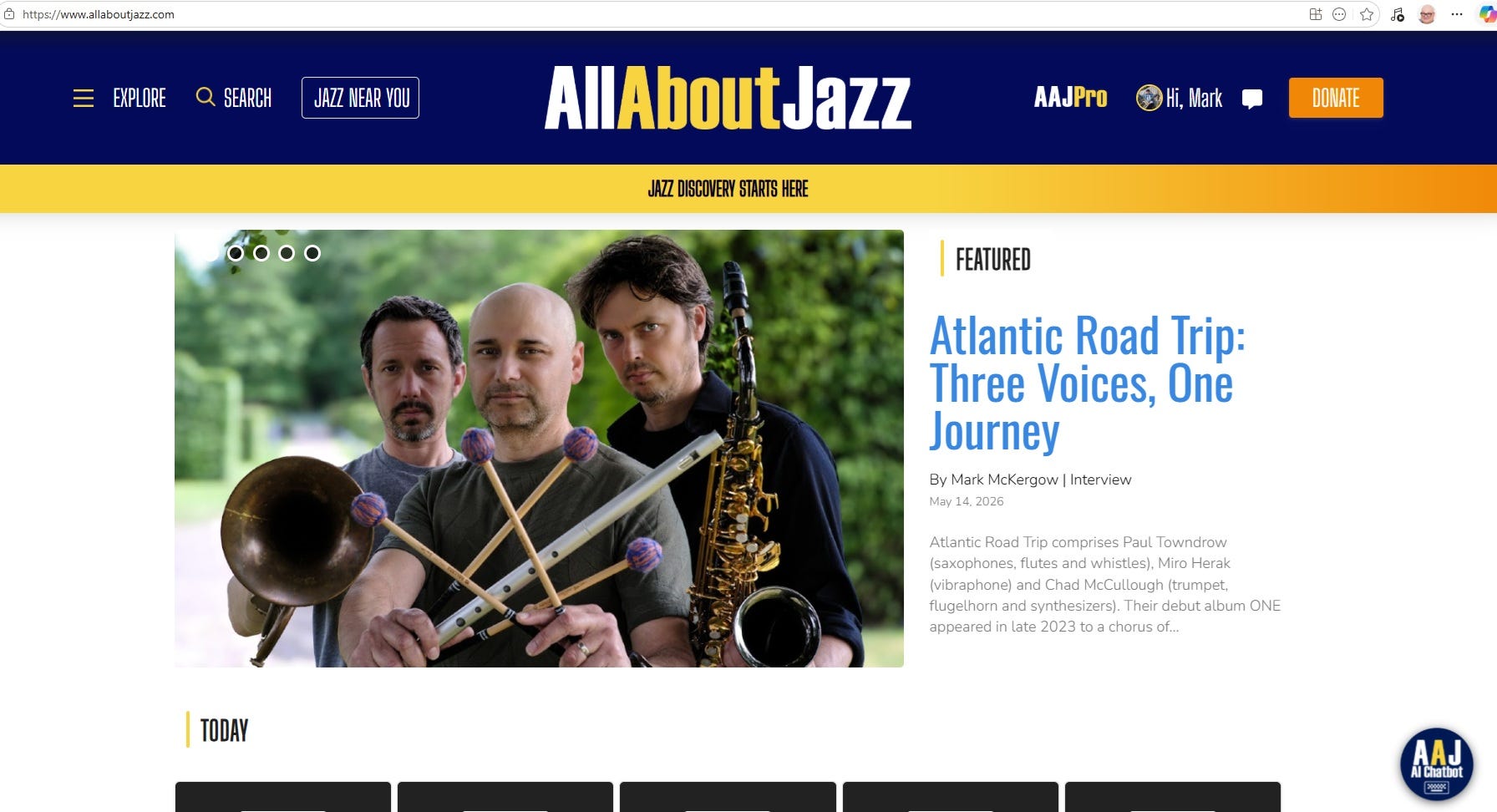
I have just started writing for the influential US-based website All About Jazz. It was exciting to discover this morning that my interview with genre-defying trio Atlantic Road Trip is the top featured piece on the front page! You can read the interview here and also sign up for free weekly jazz updates. Nice!
Comments
Nothing yet. Say the first thing.
Sign in to join the conversation.