
We are very alert to the power of words and conversation here at Steps To A Humanity Of Organisation. I am delighted to point you towards a new book, An Invitation to Safety Conversations by Daniel Hummerdahl. Daniel works in the safety field with Southpac Inc in Brisbane, Australia, where they are very keen on new paradigms of safety management and leadership, and I delivered a workshop on Host Leadership some years ago. I have featured his work here before – the article on Micro-Experiments is one of the top ten most-read posts.
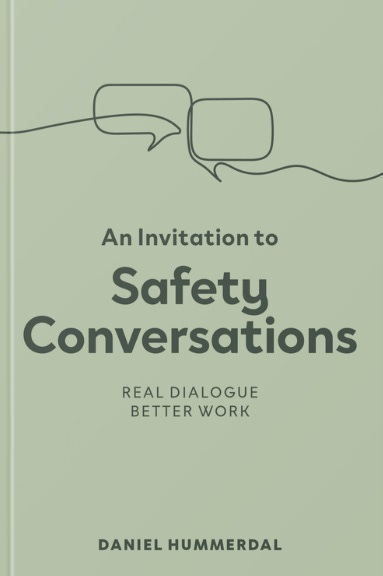
The book is very practical. The broad aim is to show how to craft workplace conversations away from “How do I get you to do X?” and towards “How do we improve X?”. The difference looks small but is actually profound- a shift from what Daniel calls compliance theatre to genuine partnership. The book looks at six kinds of conversation – appreciative conversations, possibility conversations and so on, with practical examples, stories from the field and tips for small yet vital conversational nudges. It’s a fine piece of work and well worth your attention. There is also a book website at
https://www.safetyconversations.com/.
Towards the end of the book, summing up, Daniel offers an excellent summary of how conversations about change – as opposed to arguments and ritualised exchanges – are started and built. I think this is a first-class insight and I would like to share it here (interspersed with my own observations).
When leadership is exercised through conversation, things change. Honesty increases, people stop competing for authority, collective intelligence emerges, and responsibility grows because people experience themselves as contributors. “We” forms where there was fracture.
Conversational leadership begins with a simple but profound shift: leaders pay attention. They notice when the current trajectory isn’t sustainable, when the story on the dashboard doesn’t match the story on the ground, when frustrations are showing up in too many places at once, and when people are quietly adapting their way around a constraint that no one has named.
Noticing becomes leadership’s first act. It calls out drift. It says, “We can’t keep moving in this direction. We need to talk about this together.”
Noticing – and encouraging others to notice – is key here as it is in my work on Solutions Focus (SF). It is, among other things, a great way to get out of your head (“why won’t they do this, chunter chunter…”) and into what IS happening and how to go about influencing it. In particular, noticing small things can be a great way into talking about how they happen and how they can happen better.
Once a leader recognises that a conversation is needed, the work unfolds through six movements. These aren’t steps to follow mechanically but ways of creating conditions where understanding can form.
Conversational leadership begins with bringing the right people together, or going to see the right people, and naming a real purpose. This isn’t with answers, a slogan, or a corporate vision statement, but with a genuine question about work, tension, or possibility.
This is a great insight. Conversations which start with ‘how’ (how could we do this better?) are so different from conversations starting ‘why’ (why on earth can’t you do this right?”. Notice from an SF perspective that it’s good to phrase the initial question to point towards ‘better’ rather than ‘worse’, as in the two short examples above.
Leaders who rely on conversation do not fill the room with their expertise. They shape the conditions in which other people’s expertise can surface. They pay attention to pace, openness, conditions for honesty, energy, and flow. They set the tone, not the script.
This is where “we” begins to form. Not because the leader declares it, but because the conditions allow it. When people feel connected enough to think aloud, when their perspective is genuinely sought, when the conversation isn’t predetermined, then partnership becomes possible.
I love this phrase ‘shape the conditions’. Rather than try to impose an answer, a good conversational leader will make sure that not only is a good productive question on the table but also that the space is supportive and that people feel able to speak their minds and contribute fully. This may, in some workplaces, be a new sensation and so it can be built towards rather than simply expected at the outset.
Insights rarely arrive as neat conclusions. Instead, they show up in fragments: a story here, a frustration there, a contradictory experience from another corner of the organisation. Conversational leaders listen for these fragments and connect them. They help people see how their work fits with others, and they make tensions visible. They bring the system into the room so that people can reason together.
Helping people see the relationships between what they are doing and the work of others is key here. As we say in SF, ‘the action is in the interaction’. Talk about how people know that it’s safe to do X, say, gets them looking at the externalities and connections with others. My own preference is usually to bring the parts together and see how the parties make their own conclusions. Connecting the fragments is best done by those involved in the first instance.
Real conversation sometimes brings discomfort. Perhaps someone raises a difficult truth, a long-held frustration appears, or a vulnerability surfaces unexpectedly. Conversational leaders steady the room. They give the moment space without rushing, minimising, or fixing. They help people stay with the truth long enough for insight to emerge.
This is courage in action. Not the courage to enforce standards or have “tough conversations” about compliance, but the courage to stay present when reality doesn’t fit the preferred narrative. To let “them” become visible as people navigating real constraints, not problems to solve.
This is perhaps one of the hardest things to achieve in practice. In the SF world we talk about ‘going slow to go fast’. Giving the space for new things to land, acknowledging that this may not be comfortable but it is important, taking a breath, resisting trying to sort it out in the next thirty seconds – this is all something that comes with practice and experience to the conversational leader.
Leaders who listen well draw attention to what is emerging. They name small insights people might overlook, they reflect back patterns or themes the group is discovering, and they help the group see its own intelligence.
“I’m hearing that this issue shows up differently in three parts of the operation. What does that tell us?” This kind of noticing helps shared understanding form. It helps “we” see what “we” know together.
Notice that this is a ‘soft’ and ‘gentle’ process, not a ka-boom moment. Often it can be phrased, as in Daniel’s example, as a question. “I wonder if what we’re seeing here is that this might be connected to…” employs a number of linguistic softeners which makes the conclusion a tentative offer (needing confirmation) rather than a triumphant conclusion (inviting rebuttal). And yes, it’s about “we” again.
Conversational leadership ends in a way that preserves momentum, naming what has shifted, identifying what still needs exploration, or acknowledging the clarity that has begun to form.
I love this final movement. It might be about jointly stating the new clarity, it might be about finding some small next steps we can take, and/or it might be agreeing to reconvene at a (specific) later time to take things forward. As a manager or consultant, I always wanted the next thing in the diary before we closed up – if it’s not there, you have to go through the efforts to restart the conversation, more effort that you need. This connects to Jonathan Powell’s ‘bicycle theory’ of change: keep the bike moving, even if it’s temporarily pointing in the wrong direction.
Daniel concludes this section by asking:
Have you noticed what’s absent from these six movements? It’s control. You’re not controlling the content, the conclusions, or the outcomes. What you’re creating are conditions where “we” can form, where people can think together across difference, hierarchy, and distance.
This is the fundamental shift conversational leadership requires: from controlling outcomes to creating conditions, from maintaining us/them through authority to building “we” through relationship.
The book contains with a very nice example of all these six movements in action – well worth a read too.

These six movements for a conversational leader drawn on a huge amount of wisdom and experience. They are a great distillation which can start to be put into practice. Daniel has also produced a Safety Conversations guide, a pdf which you can download free. As with his previous Micro-Experiments guide, it is very well designed as well as useful and inspiring.
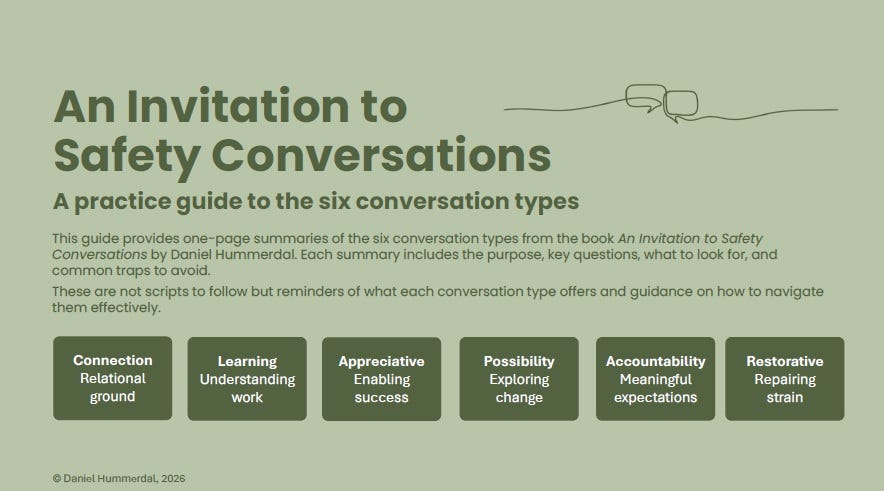
Daniel Hummerdahl is definitely a mate - we at the early stages of working on a ‘Host Leadership toolbox’ of small and simple things that a leader or manager could put into place quickly as a way to get started as a host leader. If you download his Safety Conversations Guide (above), he is also now sending occasional emails with tips and ideas about engaging people in such transformational conversations - well worth getting!
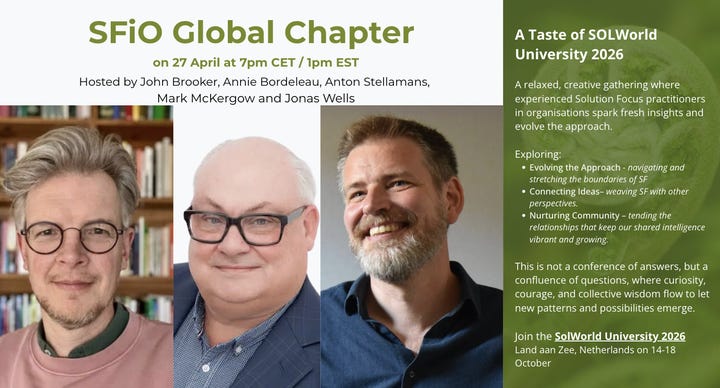
I will be participating in a SFiO (Solution Focus in Organisations) global chapter meeting on Monday 27 April at 6pm UK. As a prelude to the SOLWorld University taking place in the Netherlands in October, we will be tackling some ‘big questions’ together in small groups. Free to join, all welcome (aimed at SF practitioners with some experience). More information and sign up here.
Comments
Nothing yet. Say the first thing.
Sign in to join the conversation.