
Jenny and I went to a very interesting event in Edinburgh last week. Former Obama speechwriter Terry Szuplat had been invited by the David Hume Institute and Edinburgh International Conference Centre, and was speaking on Say It Well: Find Your Voice, Speak Your Mind, Inspire Any Audience. Moreover, he was not charging for his time, and so the event was offered free of charge, drawing a packed audience of hundreds.

Terry was deputy chief speechwriter to president Barack Obama in the area of foreign policy for the latter’s full eight-year term 2009-2017. He spoke very well (unsurprisingly), with lots of personal stories about his time in the White House (in a windowless basement office, mostly), his experiences with the president (who was unafraid of getting out his yellow legal paper pad and writing the speech HE thought he should be giving) and the inevitable last-minute edits and on-the-fly switches of emphasis which characterise such important and sensitive work.
Terry’s main advice to speakers was to tell a story only YOU can tell. Base it on your personal experience. Yes, word-smithing is important, as is having a compelling message which connects with your audience. But the most important thing is to say stuff that only you can say. He illustrated this with Canadian soccer player Alphonso Davies’ message to FIFA when they were planning the 2026 World Cup; in less than one minute he told his story and how important it was for Canada to be involved. Of course, they won the bid, with their American and Mexican neighbours.
Terry took questions for about half an hour after his talk. One particular question emerged: Was Adolf Hitler a good communicator? After all, he could clearly rouse an audience into acclaim and action. Terry said that he had been asked this many times – and also asked it in terms of living leaders (audience laughter). He concurred that Hitler could move hugh audiences – but to what end? He briefly mentioned that his book contained some strong tips about what not to do, as well as what to do, as a humane speaker who is seeking a better world for all. The point is to be a uniter - rally your audience to your cause – but don’t be a demagogue.
As you probably know, a demagogue is (according to the Cambridge Dictionary)
a person, especially a political leader, who wins support by exciting the emotions of ordinary people rather than by having good or morally right ideas
Demagogues gain their effectiveness from acts which divide rather than unite. Terry Szuplat pointed us to his book for the precise details of how to divide or unite, and here they are. Any leader or manager in an organisation seeking to be both effective and humane would do well to know these and find alternative ways to get their messages across.
Terry gives us five things to watch out for in spotting a demagogue in action. Here they are, with my own thoughts on what else you can do in make a better uniting case:
While we can object to the goals and strategies of others, it’s best not to question their motives. Remember that you may well want to recruit their supporters to your own cause. So rather than questioning their motives aloud (“they only want to make money for their mates”, say), it might be better to acknowledge that while they may have noble motivation, this is not the way to go about it. “They are clearly focused on profitable action… How much of it are WE all likely to see?”. If you have strong factual evidence, put this forward rather than general name-calling. By the way, I have found that those on the demagogue side hate to be acknowledged as potentially useful to the ‘others’ – it undermines their entire position.
Yes, you may think that the other person is a liar, a self-centred bigoted narcissist who is deluded and deranged. But saying that out loud in public is to give your blessing to debate on those terms (and therefore encourage others to talk about you in the same way). Telling them or their supporters that out loud may win you cheers from your own people, but you won’t win them over. Much better to debate their ideas rather than their character. For myself, I have been guilty of this in the past. Around Brexit, I simply could not see how leaving the EU would be beneficial to us in the UK in any meaningful way. (OK, we got blue passports.) I still don’t. But telling Brexiters that they are deranged empire-nostalgic halfwits isn’t going to win them over, even if they still seem impervious to facts.
Polarising language is about them and us. It’s about right and wrong, left and right, science and superstition, and so on. Life would be much easier in some ways if it was like that – but it isn’t. Life is full of complexity (as readers of this Substack will know by now). Demagogues talk like everything is zero-sum, a gain for ‘them’ must be a loss for ‘us’. An immigrant coming from Somalia (say) is going somehow to take your job and at the same time be a burden on the state. (Never mind that they may end up being a brain surgeon or firefighter.) This kind of talk is a sure-fire sign of a demagogue at work. I think that in the UK context, one of the reasons why the Brexit debate has been so toxic for so long is that we were split into two tribes, Leave and Remain, with totally different world views and each failing to understand the other. It is so easy to keep that going, so that as we approach the tenth anniversary of the vote the differences are very much alive.
This is where the ‘us-them’ really comes to the fore. Here is a paragraph from Terry Szuplat’s book:
If someone tends to speak of people who agree with them as “us” and others—especially different racial, religious, ethnic, sexual, or gender groups—as “them,” they’re a demagogue who otherizes. If they describe groups like these as “sinister,” “wicked,” or “evil,” they’re a demagogue who demonizes. If they refer to other people as less than human—“vermin,” “animals,” or “hordes”—they’re a demagogue who dehumanizes. Beware, too, when a speaker characterizes their opponents or their ideas as a “virus” or “poison,” which usually is followed by an ominous pledge to “eradicate” them.
Szuplat, Terry. Say It Well: Find Your Voice, Speak Your Mind, Inspire Any Audience (pp. 106-107). Ebury Publishing. Kindle Edition.(US spellings left in as this is a direct quote from the book.)
This has been around for ever, of course, but its arrival in mainstream politics in the past decade or two is a very unwelcome development. As I write this, news is arriving of US Vice President JD Vance arriving in Hungary to ‘other’ the European Union (who have a legitimate interest in democracy on the continent) for ‘interfering’ in the upcoming elections there, while committing the same sin himself as a complete outsider. In the past he would have been expected to be embarrassed by this obvious error, but no longer. Indeed, it is worn as a badge of pride.
And finally… when people used to urge their supporters to ‘fight for their beliefs’, it was usually taken metaphorically. Nowadays it seems to be a real encouragement – witness the 6 January attack on the US Capital, seemingly urged on by a defeated president who used the words ‘fight’ or ‘fighting’ some 20 times in the speech he gave beforehand. Iin the UK we saw Brexit supporters bringing gallows outside parliament to threaten MPs as they voted on tough decisions. And when there is violence, it must be rejected by all responsible voices. “There’s a lot to be said on both sides” isn’t going to cut it. My views on “a civilisation could die tonight” should be clear to you by now.
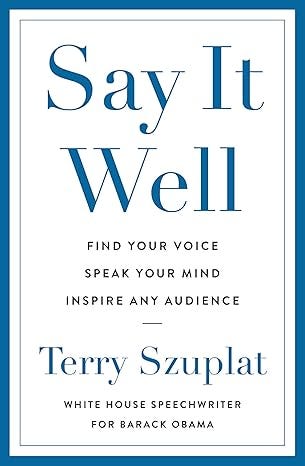
This Substack is about how to organise both effectively and humanely. Occasionally I look at what happens when, by acting inhumanely, organisations and nations lose out. This is one of those pieces. I hope I have given some good advice from Terry Szuplat on how to spot a demagogue, and how not to fall into that trap.
I was very impressed by Terry Szuplat. He came to Scotland at the invitation of local organisations, did not charge for his time, did workshops in schools and invited the school students to his major lecture (they had excellent seats at the front). He also invited the whole audience to connect with him on Linkedin! I did, and he accepted later the same day. I will be sharing this article on Linkedin (as I always do) and will tag him. I suggest you give him a follow as well.
And by the way, if you are on Linkedin and are not yet connected with me, please do so! https://www.linkedin.com/in/markmckergow/
Comments
Nothing yet. Say the first thing.
Sign in to join the conversation.