
Comparatives and superlatives in English are reasonably simple things. Tall, taller, tallest. Thirsty, thirstier, thirstiest. You add an -er to make the comparative, and you add an -est to make a superlative.
Or, at least, that’s how it works for words of one, and sometimes two syllables. Once you’re at three syllables you have to use ‘more’ and ‘most’. A word can be polysyllabic, but you can’t be polysyllabicer.
The general rule is that if a two-syllable word ends with a Y you can add the -er. Happier, angrier, sunnier, shinier. But for most other words it sounds amusingly wrong. Yellower might be all right, but: distanter, complexer, communister? None of these work, which is why Alice in Wonderland’s ‘Curiouser and curiouser’ sounds so curious.
But what of the monosyllabic adjective ‘nigh’?
You’ve probably heard the word. Occasionally you’ll see a chap wandering down the street with a placard saying ‘THE END IS NIGH’.
If you were to see the same chap the next day, then, logically, his placard should say ‘THE END IS NIGHER’. Twenty-four hours nigher, to be exact. And yet I doubt you have ever seen the word nigher.
Except that you definitely have; it’s just not spelled like that.
It’s one of the commonest words in the English language.
Close your eyes for thirty seconds and see if you can work out the comparative of nigh.
Did you get it?
The comparative of nigh is near.
And now, can you think of the superlative of nigh? I’ll give you a clue: it’s not nearest, which is a late-coming parvenue of a word. But it is a word you know. The superlative of nigh is…
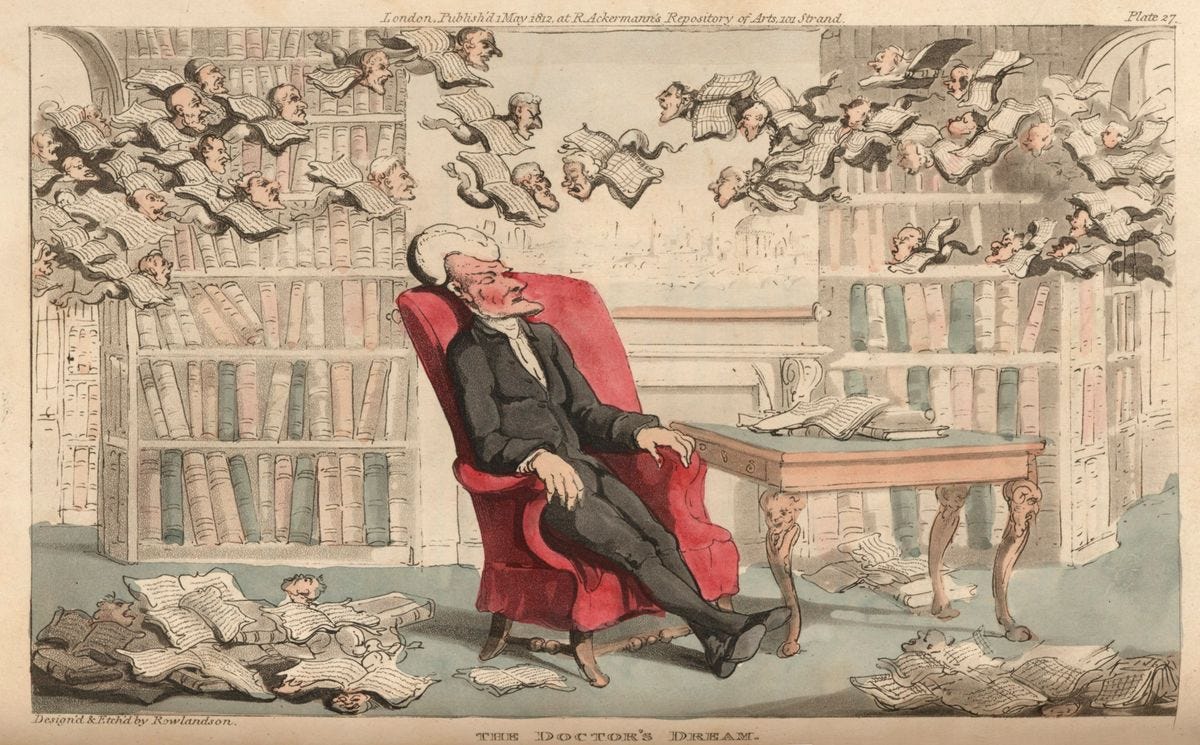
next.
And if you think about it, a chap parading down the street with a placard saying ‘THE END IS NEXT’, would be a trifle ominous. You might want to inform your nearest and dearest, or your next of kin. They are, etymologically, the same thing.
Of course, nearer is a perfectly cromulent word, if you want to use it and be all modern, but it’s not the original. In the same way that the original superlative of late isn’t latest, it’s last.
That’s the form that came first.
Which brings me, with inexorable inevitability, to the question of first.
The word fore exists in Modern English, but only just. Something can be brought to the fore, and you can shout it on golf courses if you like. But it’s the derivatives that thrive. There’s before (just as you can be behind, beside, or, as in last Friday’s post, between). And then there’s foreward and lots of compound words like foreshadow and foresee.
But to make the comparative you have to hack through a thicket of Old English and proto German stuff, add an M, and get former.
And what is the most fore? Well, you can go two ways. You can keep the M, and get formest, and then you can get confused, change the E to an O and make it foremost, which has, etymologically speaking, nothing to do with most.
Or you can stick with fore and the -st, and the slur it a bit, and you end up with first, because the first is really the fore-est, just as the nigh-est is really the next.
The first thing is the before-est thing possible.
Fore is practically dead now, leaving us only its children. There are lots of words like that. Rather used to be the comparative of rathe, which meant readily. But nobody is rathe anymore. And we’d rather, and more readily, forget the that word ever existed.
But better than that, indeed the best of the lost words is the Old English boot (spellings vary), which was a noun or adjective meaning good. Boot died, but the comparative survived as better, and the superlative survived as best.
Well, boot nearly died. It was still loitering around in Shakespeare’s time. When Will wrote:
When, in disgrace with fortune and men’s eyes,
I all alone beweep my outcast state,
And trouble deaf heaven with my bootless cries,
And look upon myself and curse my fate
He was not lamenting his lack of footwear, it was just that his cries did him no good at all. But the word was rare by then, and tended to mean something like remedy. Today, it only survives in the phrase to boot, meaning extra or into the bargain. As in ‘I bought five shirts, and a cravat to boot.’
In fact, you can sum up the last two posts with the words ‘Next best to first is second’, and every words is, when you ruminate on it, a little weird.
It all goes from bad to worse. And I shall write about bad next.
No posts
Comments
Nothing yet. Say the first thing.
Sign in to join the conversation.