
Making adjectives out of numbers is easy. You just put a th on the end.
If you put a ‘th’ on the end of four, you get fourth. That’s the adjective. Seven-seventh, nine-ninth, hundred-hundredth. It’s simple. Third is a little odd, but you can still guess how it got there from three (via thrid).
But there is no twoth. Two does not form an adjective*.
Well, it sort of does. There are plenty of two-related words in English. There’s twice, which is pretty obvious, and twain. Then there’s twin, and between, because if you’re between you’re by two things. And there’s twelve, which literally means two-left as in left over after counting to ten (just as eleven means one-left).
Less obviously, there’s twine, which is a cord made of two strings, and twill which uses two threads, and twig which you get when a branch forks into two parts. There’s even twist, which was originally the two flat parts of a hinge, then it started to mean anything that turns, and then it became a verb and was kidnapped by Chubby Checker.

But there was never a twoth, not even in Old English. Instead, they used the word other. But they were a bit lackadaisical about it and other stopped being the adjective for two and started to just mean ‘other’ in the sense that we use it today. This left a gaping gap in the English language that was filled by the word second.
Second is first recorded in English in the year 1297, which is surprisingly late. But it caught on very quickly because, unlike other, it was nice and precise. It came from the Latin secundus meaning following, from the verb sequor. So it’s cognate with sequel and sequence and consequence. And, looked at one way, you could say that a second was the opposite of a non-sequitur, which does not follow.
Speaking of non-sequiturs…
Days have been divided into 24 hours since at least the Ancient Egyptians. But if you divide an hour by sixty you get a minute.
If you divide it by sixty a second time, you get a second.
That’s where the word comes from.
A minute is a pars minuta prima (first small part) and a second is the pars minuta secunda (second small part).
Why sixty? Well sixty is very nice for mathematics. It’s divisible by 2, 3, 4, 5 and 6, 10, 15, 20 and 30. The ancient Babylonians had noticed this, and, though they generally counted in tens, their number system treated 60 as we would treat 100.

The astronomer Ptolemy used 60 as well for dividing up the hours into minutes. But nobody divided a second time until about 1000 AD, when a fellow called Al-Biruni, in what’s now Uzbekistan did it, because he wanted to understand Jewish months.
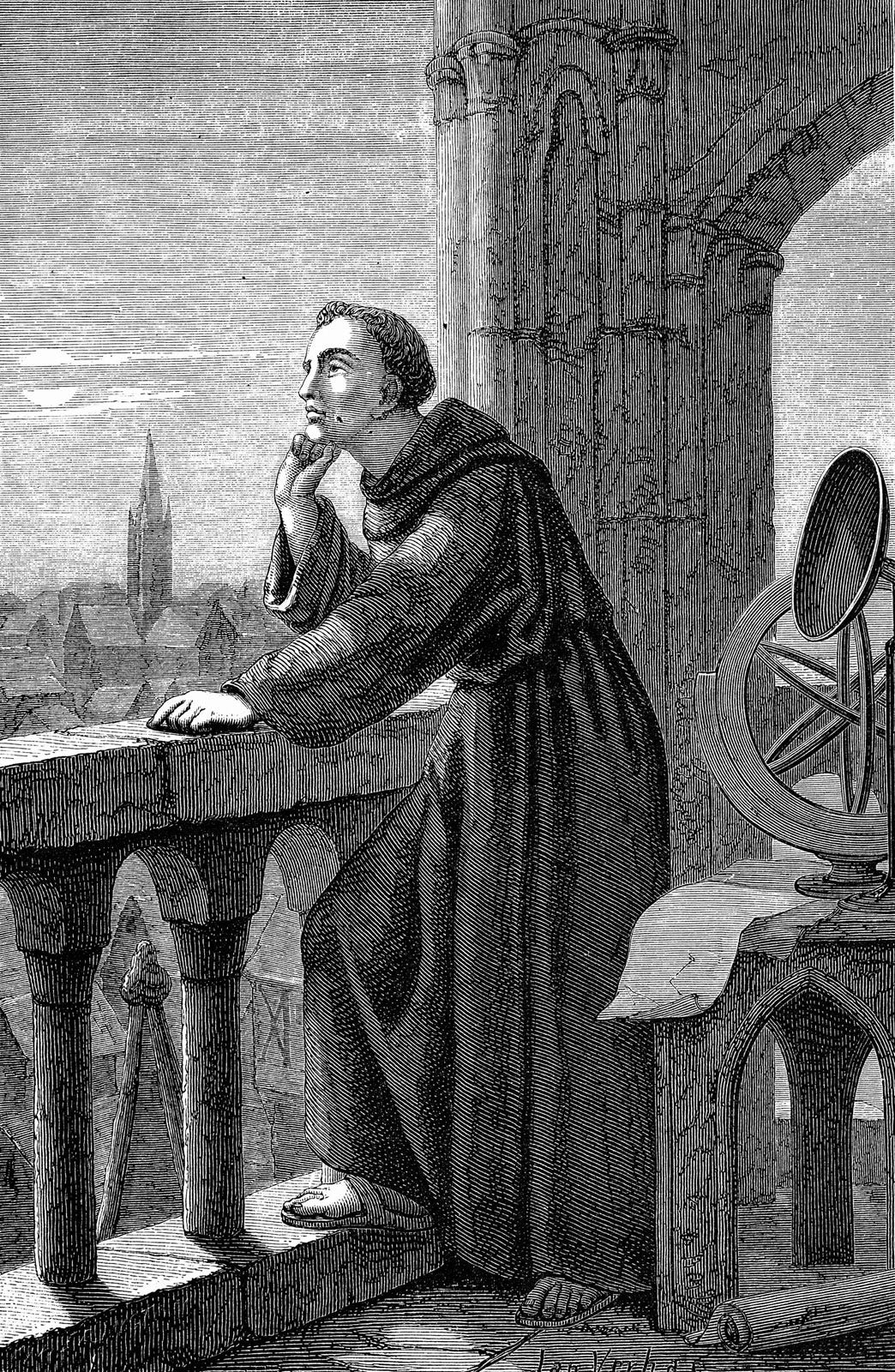
Then, in the 13th century, an Englishman called Roger Bacon had the same idea, apparently independently, because he was trying to work out the exact length of a year. Bacon had hours, minutes, seconds, thirds and fourths, which makes him sound like a greedy boy at suppertime.
The thirds and fourths did not survive, but the seconds did, and they first pop up in Chaucer in his utterly gripping Treatise on the Astrolabe. If you’re tempted to read that in full, you’ve made a horrible mistake.
And that is the story of how the second became the second.
First is a different tale. But I think I’ll write about that next week.
*Various humorists have used twoth in a whimsical this-word-should-exist way. And sometimes little children naturally say towth. Wiktionary seems to claim that twoth once existed, but it doesn’t provide any evidence, and I can’t find a twoth anywhere, and nor can the OED.
No posts
Comments
Nothing yet. Say the first thing.
Sign in to join the conversation.