
A few weeks ago, Acta Pharmaceutica Sinica B published a paper I co-authored with Falko Seger and Stephanie Seneff: Lipid nanoparticles as active biointerfaces: From membrane interaction to systemic dysregulation.
What we argue is straightforward: the lipid nanoparticles used in mRNA COVID vaccines are not inert delivery “bubbles.” As I keep emphasizing the LNPs are supramolecular assemblies that actively integrate into cellular membranes, disrupt the phosphatidylinositol cycle (the master regulatory system for membrane signaling) and trigger cascading dysfunction across multiple pathways: NF-κB, MAPK, JAK/STAT, mTORC1/2. We call this lipid-nanoparticle-driven membrane dysfunction, or L-DMD.
We review the data that empty LNPs (or minimally loaded LNPs) produce the same or very similar inflammatory signatures. This is not about the spike protein. It’s about the delivery platform itself. (Note: comparing empty LNPs to those with mRNA do show the mRNA loaded LNPs may be slightly more inflammatory but not significantly so)
So now I would like to work through 4 questions that naturally arise from our paper and, in fact, are commonly asked with regard to the mRNA-LNP vaccines themselves. I will try to answer these through the L-DMD framework.
I have thought about this a lot.
LNPs interact with biological membranes.
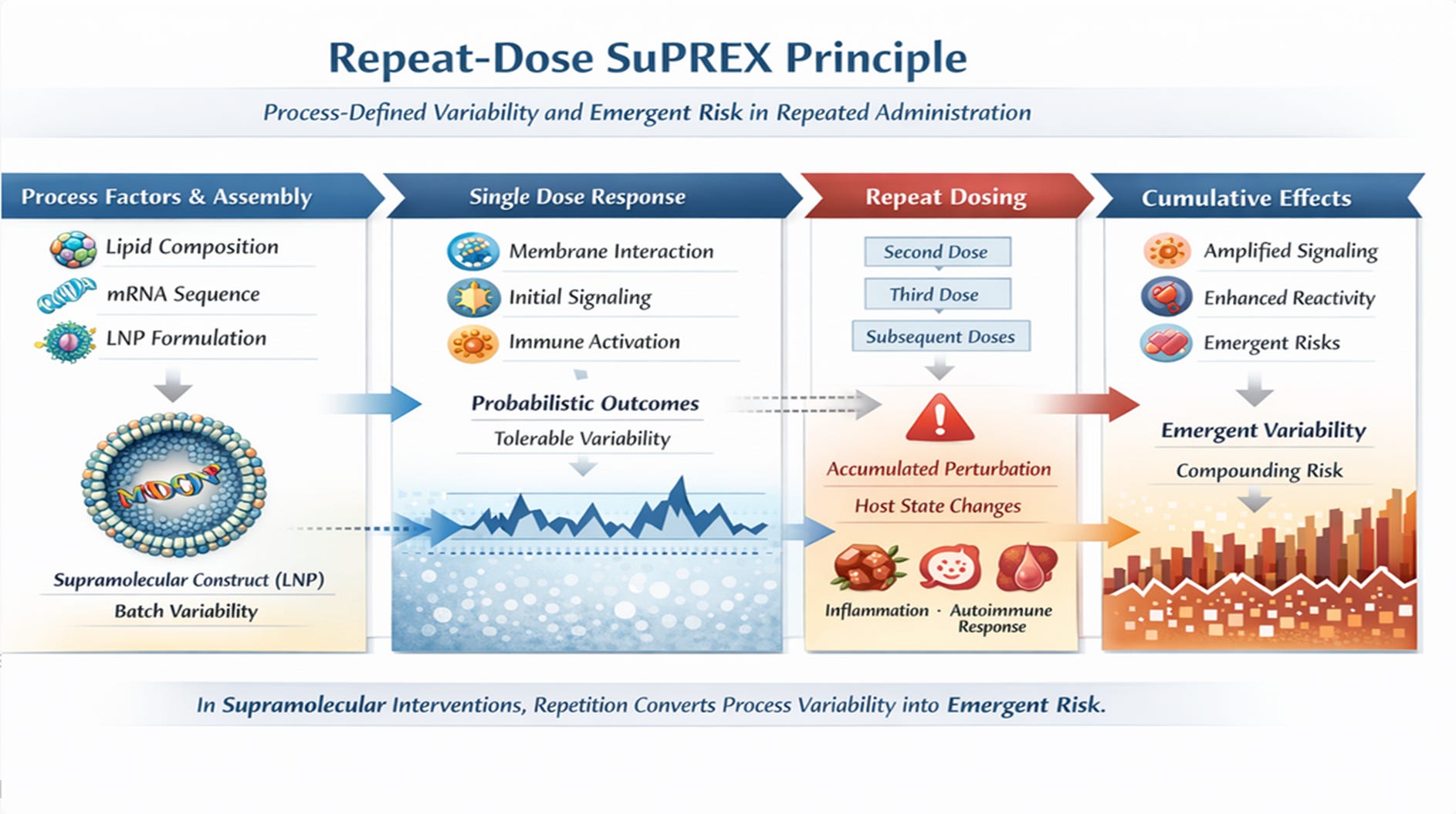
Membrane perturbation is not necessarily an all-or-none phenomenon; it is a threshold phenomenon (in keeping with the SuPREX pharmacology)
Not all exposures may produce clinically meaningful dysfunction.
Is there a tipping point?
Does membrane repair keep pace with repeated exposure?
Is cumulative exposure important?
Are repeated doses fundamentally different from isolated exposure?
Many serious adverse events appeared after repeated vaccination.
This is compatible with, but does not prove, a cumulative membrane model.
First dose: Your immune system is naive. No anti-PEG antibodies (well, except for those with pre-existing anti-PEG antibodies, where the risk of CARPA is present. See my substack on that here). The LNPs circulate, are taken up by cells, and the ESCRT machinery (your cells’ membrane repair system) handles endosomal ruptures with little trouble. Most people are fine.
Second dose: Anti-PEG IgM titers are now building. Your body has learned that PEGylated particles are foreign. Clearance accelerates (the accelerated blood clearance (ABC) phenomenon). More LNPs get dumped into the liver and spleen in a shorter window of time. The ESCRT (Endosomal Sorting Complexes Required for Transport) system is stressed but still coping. Some people start to have problems, but most don’t.
Third dose: This is where things often change. Anti-PEG titers are high. The ABC phenomenon is in full effect. LNPs are being opsonized and cleared rapidly, concentrating the lipids in the reticular endothelial system (RES) organs (i.e Kupffer cells in the liver, spleen, lymph nodes, bone marrow). Meanwhile, ionizable lipids from doses one and two may not have been fully cleared. You’re layering fresh LNPs on top of incompletely cleared lipids.
The ESCRT machinery has limits. It’s a finite-capacity system. At some threshold, say dose 3, cumulative membrane damage overwhelms the repair capacity. Unrepaired endosomal ruptures triggers galectin recruitment, NLRP3 inflammasome activation, and lysosomal dysfunction. This was clearly shown by Omo-Lamai in 20241(and still a preprint, funny that).
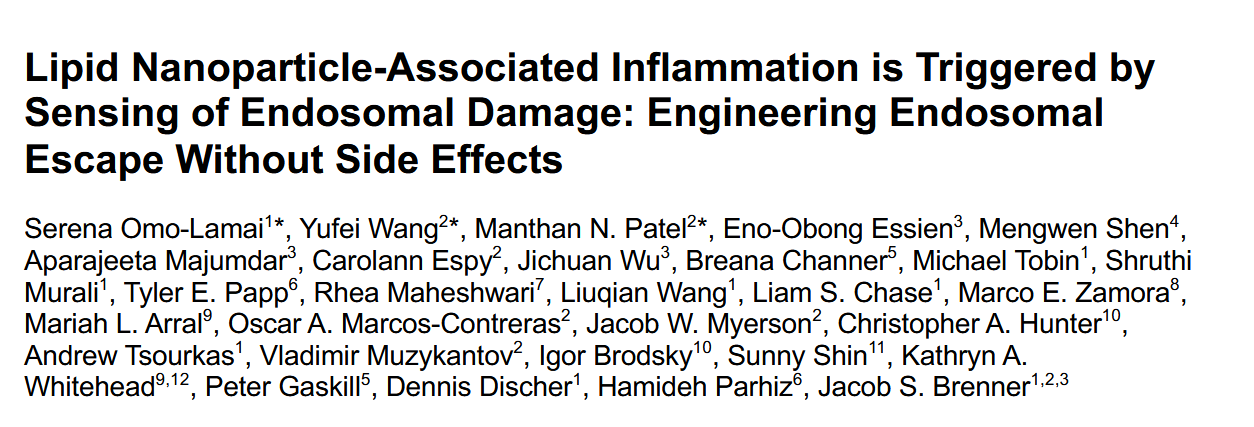
The proteomics data from Hickey et al.2 included in our paper show ESCRT suppression at 1 month post-dose 3. That’s likely the effect of a system pushed past its compensatory threshold.
The clinical pattern matches. Myocarditis in young males occurred predominantly after dose two, but the severe and persistent cases cluster after dose three. The patient communities, people who were fine after doses one and two, overwhelmingly trace their decline to the third shot. And then there is the Canadian natural experiment, in which public health officials extended the dosing interval to 8–16 weeks due to supply constraints, thereby inadvertently testing this threshold model. Myocarditis rates dropped significantly with longer intervals.3 If the damage were purely an immune reaction to spike protein, the interval shouldn't matter. But if it's the cumulative LNP membrane burden that exceeds ESCRT repair capacity, the interval matters much more. Give the system time to clear the lipids and restore membrane integrity, and the next dose is less likely to push it over the edge. The data supports the threshold model, not the official story. And maybe this is why yearly dosing appears to be more tolerable than q3-4 months or even q6 months.
It’s a threshold phenomenon. But WHERE your personal threshold sits depends on the factors in Question 2.
Here’s a visual for this threshold phenomenon I developed.
In my opinion, this is one of the most fascinating and difficult questions. For drugs, we consider which organs typically clear them, as well as liver or kidney dysfunction, age, weight, obesity, or CYP450 polymorphisms. But there was no clear pattern on who had serious adverse events and who did not. It is all over the place. LNPs don't have a clearance pathway in the conventional sense. They don't get oxidized by CYP3A4 and excreted in urine. They form protein coronas. They distribute stochastically through lymphatics. They integrate into cell membranes. They get processed by ESCRT complexes and accumulate in lysosomes. They get exported in exosomes. They are oily particles forming a complex liquid.
So what are the potential variables that determine susceptibility?
Mitochondrial reserve
ESCRT capacity
Lysosomal enzyme activity
Membrane composition
Age
Prior exposure to cationic amphiphilic drugs
Genetic susceptibility
anti-PEG titers
Biodistribution differences (anatomy, dose preparation and administration, manufacturing variability especially size and charge)
All of these variables are completely invisible to standard lab medicine. You can have perfect liver enzymes, perfect kidney function, perfect BMI, perfect cholesterol, and still be walking around with a mitochondrial genome that gives you 20% less respiratory reserve. And live a normal life.
Mori et al. showed that mitochondrial vulnerability determines LNP-induced myocarditis in mice using empty LNPs. Same LNPs, same dose, same route BUT different outcome based entirely on mitochondrial genetics. That’s a demonstration that host factors invisible to standard medicine determine the response.
Now extrapolate. If mitochondrial genetics matter, so do:
ESCRT component polymorphisms
Lysosomal enzyme variants (including carrier status for storage diseases)
Phosphoinositide cycle enzyme variants
CYP isoforms involved in ionizable lipid metabolism
Baseline anti-PEG antibody titers from environmental exposure
And possibly prior membrane stress from long term use of cationic amphiphilic drugs (such as HCQ, amiodarone, antipsychotics, fluoxetine, sertraline, some antihistamines)
Each of these is a roll of the genetic and environmental dice. Most people have enough reserve across all these systems to handle one or two doses. But some people, which you can’t identify with standard labs, are walking around with multiple vulnerabilities that only become apparent when the LNP hits the membrane. That is my working hypothesis for the variability in response. So more than just batch differences or IV administration, though those play a role, especially the early batches which I discuss here.
This suggests that host biology may be just as important as the nanoparticle itself.
For instance, I’ve been thinking about lysosomal vulnerabilities for a long time, too. Fabry disease, Gaucher disease, and Niemann-Pick disease are all lysosomal storage disorders in which the degradative machinery is already compromised. LNPs end up in lysosomes. If your lysosomes are already swollen with undigested substrate, adding ionizable lipids is pouring water into a flooded basement. I called it a “traffic jam” in the paper. What is interesting is that there’s almost no published data on mRNA-LNP outcomes in these patients. I find that very weird. Why?
Although lysosomal storage disorders (LSD) are individually rare, pathogenic variants in lysosomal genes are collectively much more common (some estimates are that 1.5% or more4 of people have a pathogenic variant in an LSD gene but are clinically normal). So could partial lysosomal dysfunction, even in clinically unaffected carriers, reduce your capacity to process lipid nanoparticles? To my knowledge, this possibility has not been examined despite the knowledge that LNPs are degraded in lysosomes.5
In fact, improving endosomal escape efficiency (so that fewer LNPs remain in lysosomes for degradation), enhances drug bioavailability, allowing for reduced dosages.6 This is also an effective strategy for mitigating potential safety concerns associated with mRNA-LNPs. This strategy was employed by the saRNA vaccines.
Could certain drugs increase susceptibility? Examples would be drugs which are cationic amphiphilic drugs (CADs). These are drugs that have two properties: a basic amine that gets protonated and trapped in acidic lysosomes, and a hydrophobic ring system that allows it to intercalate (insert) into phospholipid bilayers. Once trapped in lysosomes, they bind to phospholipids and inhibit the enzymes that degrade them. The result is phospholipidosis: swollen lysosomes filled with undigested membrane material, with unclear toxicity. Though high doses over a long time can result in problems. Here is a Cryo-EM image of typical zebra bodies of phospholipidosis.
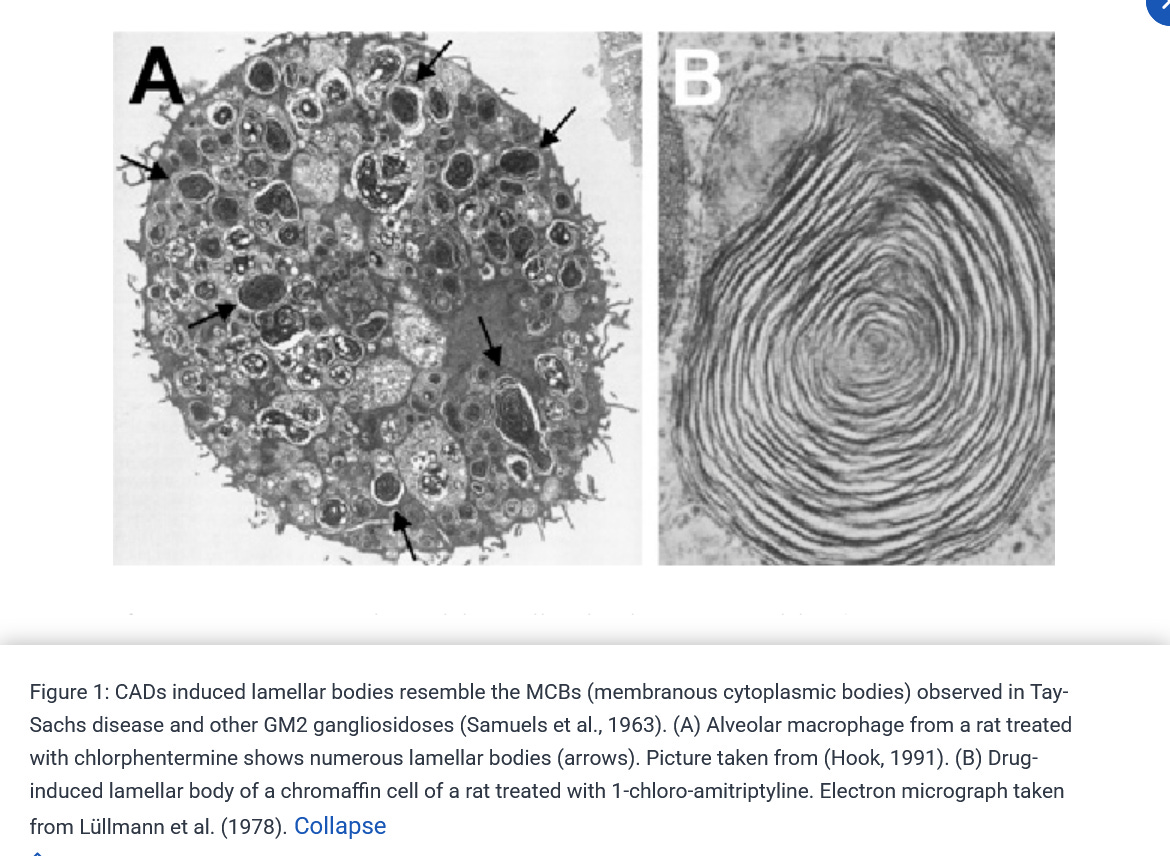
The ionizable lipids in LNPs share these structural features. Tertiary amine headgroups. Hydrophobic tails. Protonation in acidifying endosomes. CAD drugs such as hydroxychloroquine, amiodarone, fluoxetine, sertraline, and imipramine induce phospholipidosis, which resembles the pathology of lysosomal storage diseases. Millions of people take these drugs. If you’re on certain SSRI and you get an mRNA-LNP vaccine, your lysosomes are already stressed. Maybe the LNP hit is synergistic? Has anyone looked?
Statins deplete CoQ10 and alter lipid raft composition. Antipsychotics like clozapine are both cationic amphiphiles and CYP1A2 substrates, and our paper documents clozapine toxicity post-vaccination via CYP suppression. NRTIs cause mitochondrial toxicity. Valproic acid inhibits beta-oxidation.
Any single hit might be subclinical and recoverable. Two or three drugs together, plus multiple doses, well maybe that’s when L-DMD crosses from compensated to decompensated. Nobody screened for any of this. Should we? Is this a viable theory?
Patients on chronic HCQ for SLE experienced flares post-vaccination7 (14.4% experiencing flares) and 4.4% severe flares (nephritis in three and vasculitis in one). The flare rate was higher in vaccinated patients than unvaccinated controls.
Keep in mind that imipramine, and other CAD drugs have been used to improve endosomal escape.8 This would imply a context-dependent effect of CADs on the vaccine. Chronic use might cause more issues with your lysosomes if there is pre-existing “flooding” (ie the SLE example) but may be beneficial shortly AFTER or during to increase endosomal escape. Maybe? It would help clear lipids while also releasing more mRNA into the cytosol.
Just my working theory. Any input appreciated.
This may be the most difficult question of all, and this is where Falko and I differ a bit.
Falko’s view is that L-DMD is essentially a one-way ratchet. The ionizable lipids are designed to resist degradation despite being labelled “biodegradable.” Once they integrate into membranes, the cell may be unable to selectively remove them, and they don’t match any endogenous lipid recognition motifs or transfer proteins. The ESCRT suppression creates a vicious cycle: each dose degrades the repair capacity needed to handle the existing burden. And probably most importantly, the epigenetic reprogramming, trained immunity, and altered NF-κB set points could outlast the lipids themselves.
He might be right for some people. The progressive decline trajectory is real. But I think humans are more resilient on average than the worst-case model predicts.
Membrane turnover is constant. A hepatocyte replaces its entire complement of membranes many times over in months. The liver is a detoxification powerhouse with CYPs, peroxisomal oxidation, biliary excretion. Once the acute inflammatory phase resolves and PPAR signaling recovers, xenobiotic metabolism should ramp back up. The drug interaction cases were transient, over about 2-3 weeks for example. And clinically, some people do recover. Pericarditis resolves. Fatigue lifts. POTS-like symptoms improve over 6–18 months in many9, though few recover completely. If L-DMD were strictly irreversible, you wouldn’t see any recovery trajectories.
In truth, we both think there is a spectrum:
Full recovery: Young, metabolically healthy, no drug interactions, good CYP function. Membrane turnover outpaces lipid integration.
Partial recovery with residual dysfunction: Some metabolic compromise, maybe statins or an SSRI or other vulnerabilities. Lipids clear slowly. A new, lower baseline is established.
Progressive decline: Pre-existing mitochondrial disease, lysosomal storage disorder variants, multiple CADs, boosting. Other unknown factors. Cumulative burden exceeds clearance.
The problem is that nobody has done the longitudinal lipidomics to find out. Nobody has tracked ionizable lipid concentrations in tissue membranes over a 12-month period. Nobody has measured ESCRT function before and after vaccination. The studies that would answer this question don’t exist. Five years in, that tells you everything. If the LNP SuPREX is not considered to have pharmacological activity, then these questions aren’t even asked.
We simply don’t know.
Long-term
lipidomics
phosphoinositide measurements
membrane turnover
ESCRT recovery
clinical follow-up
appropriate specialized lab markers
drug histories
As a pharmacist, this is the question that intrigues me most.
We have decades of data on cationic amphiphilic drugs that disrupt membranes. They’re not harmless. But they work as individual molecules. Each molecule partitions into the membrane, disrupts packing, and partitions back out when plasma levels drop. It’s stochastic, concentration-dependent, and reversible. The membrane sees individual molecules arriving and departing according to basic partition coefficients. No cooperativity. No emergent behavior.
LNPs are fundamentally different. They are supramolecular assemblies. Thousands of lipids pre-organized into a metastable particle. When that particle contacts a cell membrane, it delivers a concentrated ball of ionizable lipids, cholesterol, and helper phospholipids to a localized patch of the membrane, and it does so all at once. The local concentration at the contact site is orders of magnitude higher than that from free-drug diffusion.
PLUS, the ionizable lipids don’t act alone. They arrive with cholesterol and helper lipids that simultaneously remodel the microdomain architecture. The pH-triggered phase transition in the endosome, the so-called proton-sponge effect, the formation of the hexagonal phase, and the creation of pores are collective behaviours of many lipids in close proximity. A dispersed drug molecule cannot do this.
Then there’s the biocorona. LNPs don’t just bind plasma proteins. They exchange lipids and apolipoproteins with endogenous lipoproteins, forming hybrid LNP-lipoprotein assemblies that are entirely new biological entities. A cationic amphiphilic drug doesn’t turn into a pseudo-LDL chimeric particle. An LNP does.
And the exosome relay has no drug equivalent. LNPs, their lipid components and mRNA, and the spike protein are packaged into exosomes and biodistribute to distant cells for potential re-delivery. The membrane perturbation propagates to cells that never encountered the original LNP particle in the first place. That’s a supramolecular amplification mechanism which does not exist for single-molecule or monomeric drugs.
The regulators treated LNPs as excipients.10 They’re not excipients as we discussed in our Policy Brief to the ACIP. They’re biologically active assemblies that participate in membrane biology. The delivery system is the drug.
Our paper provides a mechanistic framework for understanding what happens when ionizable lipids meet cellular membranes. The PI cycle is the central regulatory hub. The ESCRT machinery is the first line of defence. When the cumulative burden exceeds the repair capacity based on threshold dynamics, the downstream consequences cascade through NF-κB, MAPK, JAK/STAT, and mTOR signaling.
The paper doesn’t answer every question. In fact, it asks more questions than it answers. The recovery question is unresolved. The individual susceptibility factors need prospective study. The long-term population-level consequences are still unfolding.
But the core finding is difficult to dismiss: empty LNPs produce virtually the same inflammatory signatures as loaded ones. The platform itself, independent of the spike protein and mRNA, is bioactive in ways that were never adequately characterized prior to population-wide deployment. That’s what the omics data shows. That’s what the regulatory filings contain if you know how to read them. And that’s what our paper documents, in a peer-reviewed journal, with the receipts.
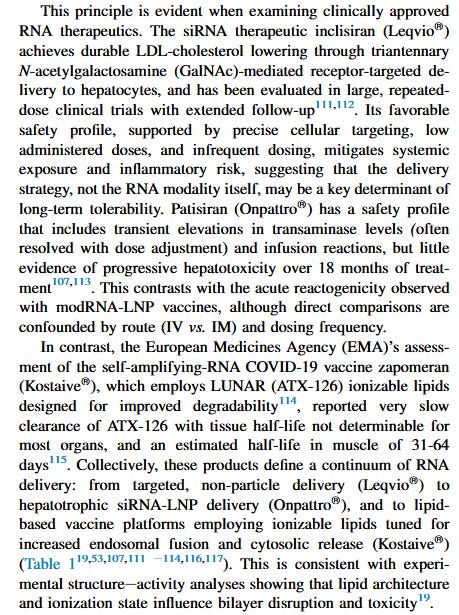
When I assembled Table 1, I wasn’t really trying to compare vaccines. I was comparing delivery systems. What happens as membrane engagement increases?
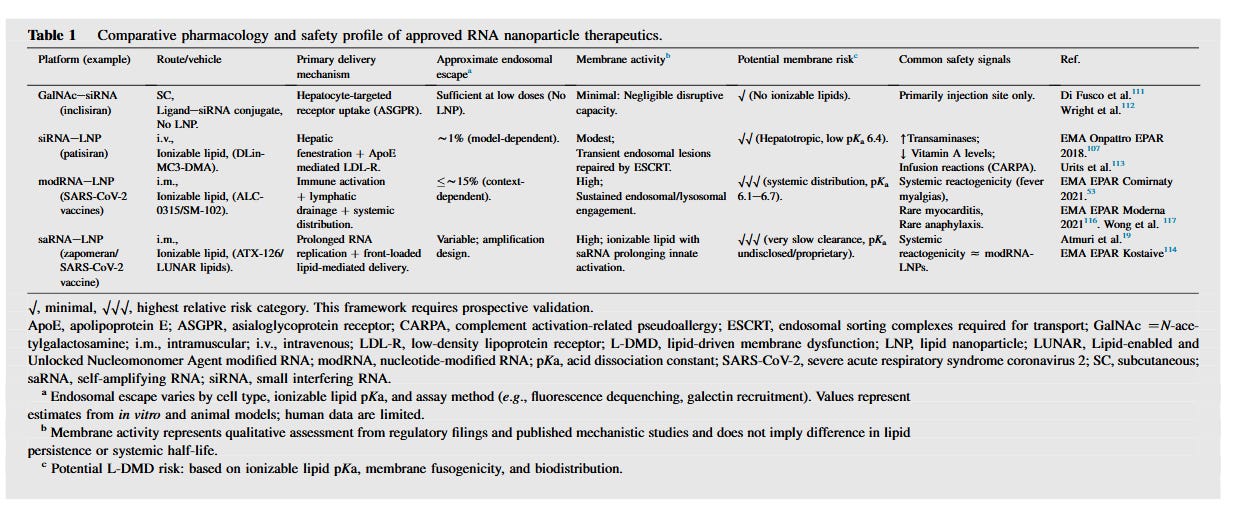
PS. For those really interested, the Atmuri paper (ref 19) is gold.11
Our review proposed that lipid nanoparticles are biologically active supramolecular biointerfaces rather than inert carriers.
Whether that framework and the effects on the PIP cycle are ultimately proven correct will depend on future experiments.
In my opinion, the questions posed above are among the most important to answer.
If they are answered well, they won’t simply improve RNA therapeutics; they may fundamentally change how we think about nanoparticle pharmacology.
I don’t have a lab, a university, or frankly the ability to do these experiments. One was already done in 2020, as Genervter Bürger documented on Substack. How did we miss it?
Regardless, I hope this article helps in understanding the real, unresolved issues with LNPs and mRNA-LNP vaccines.
As always, continue to pray the rosary. It really made a difference in my life.
Thanks for reading Maria Gutschi! This post is public so feel free to share it.
https://www.biorxiv.org/content/10.1101/2024.04.16.589801v1
https://www.frontiersin.org/journals/immunology/articles/10.3389/fimmu.2024.1502458/full
https://jamanetwork.com/journals/jamanetworkopen/fullarticle/2793551
https://www.sciencedirect.com/science/article/pii/S2214426917301209?via%3Dihub
https://www.sciencedirect.com/science/article/abs/pii/S0169409X23001436#preview-section-references
https://www.mdpi.com/2076-393X/12/10/1148
https://www.tandfonline.com/doi/full/10.1080/25785826.2023.2300163#abstract
https://www.sciencedirect.com/science/article/abs/pii/S0168365922005144?via%3Dihub
https://link.springer.com/article/10.1007/s00415-025-13518-x
https://www.researchgate.net/publication/395452411_Rethinking_Lipid_Nanoparticles_LNPs_Biological_Activity_Safety_and_Policy_Implications_for_modRNA_Therapeutics?channel=doi&linkId=68c4795a508ac7086f5985f6&showFulltext=true
https://www.sciencedirect.com/science/article/pii/S2329050125001809
No posts
Comments
Nothing yet. Say the first thing.
Sign in to join the conversation.