

Image from ChatGPT as per my suggestions
I will never forget the forty-year-old trucker. He was driving through Winnipeg where is where I had just started after graduating with a brand new PharmD from the US. He was previously healthy. Admitted with a pneumonia and responding well. Then a massive saddle pulmonary embolus. Dead before anyone could do a damn thing right there in the ICU. His poor wife in another city, a thousand miles away. That’s the kind of thing that stays with you.
That was unfractionated heparin. Standard DVT prophylaxis. Five thousand units. Sub-Q. Every eight hours. And it failed. Constantly. Trauma patients threw massive clots. DVTs were routine. PEs were common. We all knew the numbers, but numbers don’t haunt you. Widows do.
Then there was HIT. Heparin-induced thrombocytopenia. The immune system generates antibodies against the heparin-platelet factor 4 complex, which paradoxically activates platelets and triggers thrombosis. Translation: the very drug you’re using to prevent clots can cause them. The ICU had lived through this. It was a genuine clinical nightmare, and we had no good alternative. Not yet.
So when I arrived at the Ottawa Civic Hospital ICU in late 1992/early 1993 and learned they were using snake venom for DVT prophylaxis, I understood why. They were desperate. A hematologist named Dr. JB had brought in Ancrod, a defibrinogenating enzyme derived from the Malayan pit viper. No heparin. No HIT. On paper, it looked like deliverance.
The question was whether the cure was worse than the disease.
It was. But proving it would take nearly two years, cost a twenty-three-year-old his hip, and nearly cost me my career.
I had applied at the hospital with a stellar CV. Undergrad at University of Toronto. PharmD from one of the best schools in North America. About five years in Winnipeg, known for its expertise in infectious diseases, and most of that in intensive care. The director of pharmacy wanted to hire me, stat. But he didn’t have a position available. So he pitched me to the administration and the ICU, citing precedents in Winnipeg and elsewhere, as well as the benefits of an embedded pharmacist.
Part of the hiring process was an interview with the ICU physicians and head nurse. What was supposed to be an interview turned into an interrogation. They only relented because the director of pharmacy put me on for a year with a condition: I had to save my salary in drug costs, or the position would be terminated.
I don’t know any other pharmacist who had to earn their job that way. Not one.
The head of the ICU, a Scottish intensivist named McIntyre, said to my face: “What can a young pharmacist possibly teach me? An intensivist with thirty years of experience?”
I said, “I guess we’ll find out.”
My first week, the ICU team had to give their twice-yearly lecture to the internal medicine residents. They’d forgotten to arrange it. McIntyre’s eyes landed on me.
“Why don’t you do it, Maria?”
It was a test. Maybe they hoped I’d refuse, and I felt that if I said no, it would have been the end of me. No credibility for years. Maybe they hoped I’d fail. Actually, I think they did hope I’d fail. I said yes, on one condition: I choose the topic.
“Go ahead.”
“I’m going to talk about cephalosporins and principles in prescribing antimicrobials.”
They agreed. But they made sure a physician was in the room who could catch my errors. I was not trusted to present alone.
I started my talk. The room was packed. Every single ICU attending was sitting in the back row. And one by one, I watched their jaws physically drop. I had never seen a real live jaw drop before. Holy Toledo!
One doc who had voted yes for me started smiling ear to ear. His bet had paid off. The physician assigned to monitor me was someone I’d worked with in Winnipeg during his ID fellowship. He was smiling too. The only correction he made was a small clarification.
That lecture saved me. If I hadn’t done it, and done it well, I would have had no credibility for years. I knew that. So I made sure they couldn’t ignore what I knew.
But credibility isn’t the same as acceptance. The daily slog was just beginning.
I went home crying every day for eight months. Every evening I’d replay every conversation in my head, wondering whether I really was that incompetent. What had I done to set them off? Why did they seem to hate me? Why was I told everything was my fault?
To make matters worse, the ICU’s drug distribution system was a mess. Medications were constantly missing or delayed. Their tube system was slow and antiquated. I had no control over the system itself, but somehow it became my responsibility to fix every problem. I spent my days running up and down between the pharmacy and the ICU, sometimes several times an hour, just to get medications to patients. Even when they could wait. Just to keep the nurses and the ward clerk happy.
Every trip downstairs was time I wasn’t reviewing charts, thinking through difficult cases, or doing the clinical work I’d been hired to do. The more I acted as a courier, the less opportunity I had to demonstrate the expertise the ICU had doubted I possessed in the first place.
The ward clerk treated me terribly. Many of the nurses wanted me gone because they thought I would interfere with the nursing-physician relationship. The ICU had made it clear I wasn’t welcome, and the daily experience confirmed it.
I was the lowest of the low: a young female pharmacist in a world of physicians who had never worked with an embedded pharmacist before. They didn’t know what to do with me. Mostly, they wanted me to disappear.
The ward clerk was eventually fired, partly because of her treatment of me. That’s how overt the hostility was. This wasn’t subtle tension. This was a coordinated message: you don’t belong here.
Looking back, I knew I was fighting for the very idea that a pharmacist belonged in the ICU. If I failed, or became emotional, complained, or simply walked away, it wouldn’t have been interpreted as my failure alone. It would have been seen as proof that the experiment itself had failed. The next pharmacist might never get the opportunity. My assistant director kept telling me I had to succeed, or the entire fledgling pharmacy clinical program would be at risk. She thought I was incompetent too.
The inventory management was a disaster. Half-open vials everywhere. Massive ward stock because the drug distribution system was terrible. Nurses wasted enormous amounts; honestly, they really do. It’s not their job to think about it, and frankly they didn’t care and can’t be made to care.
I fixed it. By the end of the year, I had saved $458,000 in drug costs. In 1993. Can you imagine what that would be today?
That bought me something. Not respect really, at least not yet. But survival. My position was no longer conditional. I had met the hospital administration terms.
What I didn’t know was that the real fight hadn’t even started. And it would be about the snake venom.
Ancrod is a defibrinogenating enzyme derived from the venom of the Malayan pit viper (Calloselasma rhodostoma). It cleaves fibrinogen, depleting it from circulation, producing an anticoagulant effect through a mechanism fundamentally different from heparin, warfarin, or LMWH. No heparin. No HIT. Elegant on paper.

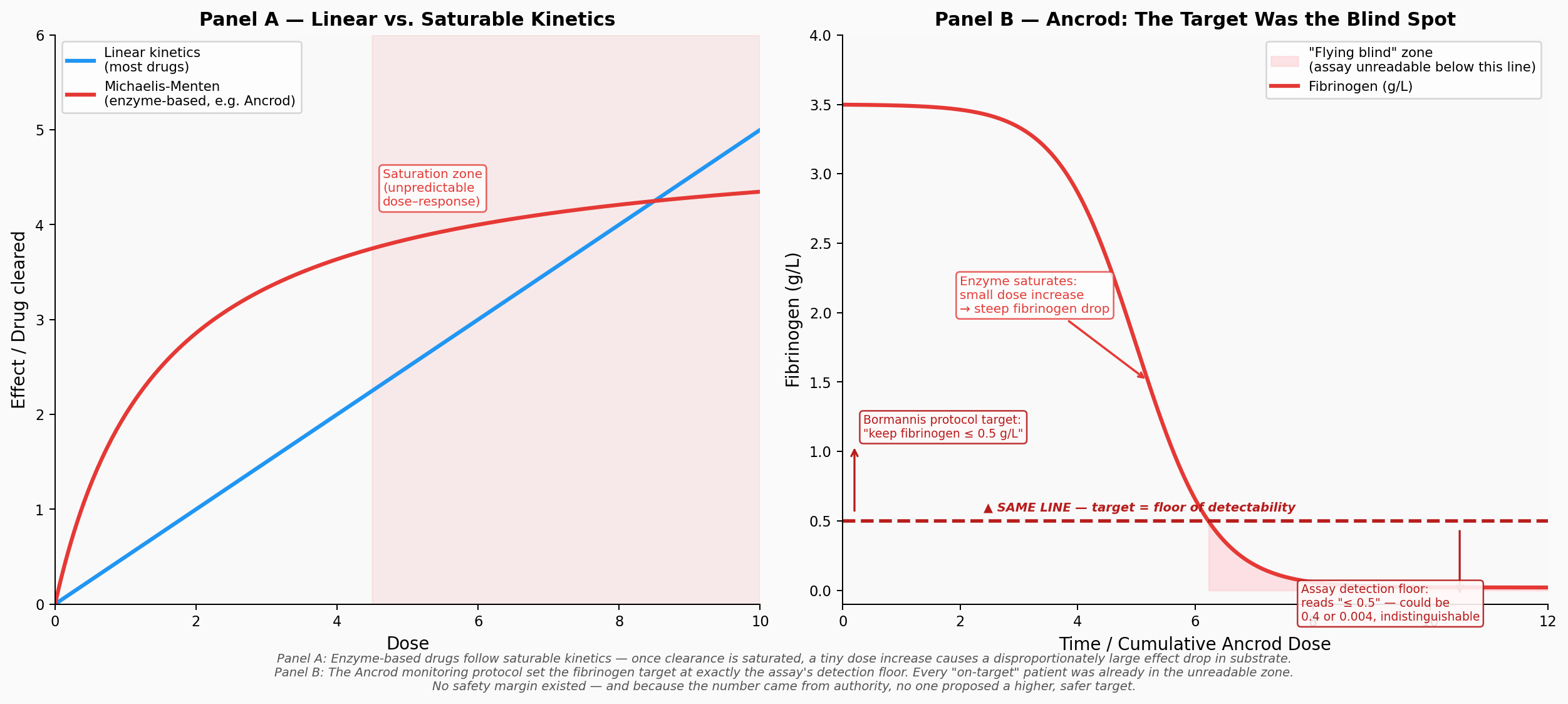
But the mechanism is enzymatic. And enzymes follow Michaelis-Menten kinetics.
Most drugs follow linear kinetics: give more drug, get a proportional increase in effect. Physicians and pharmacists alike build their clinical intuitions around this. It’s the default assumption because it describes the majority of drugs they use. But enzyme-based drugs are different. Once you saturate the clearance pathways, the relationship between dose and effect ceases to be linear. Small dose increases produce massive, unpredictable drops in substrate and in this case, fibrinogen. The curve doesn’t climb steadily. It flattens, then falls off a cliff.
When I tried to explain this, I watched it not land. The nurses didn’t have a background in pharmacokinetics. Many of the physicians didn’t either. It didn’t fit their heuristics. Most drugs don’t work this way. Their mental models simply couldn’t incorporate what I was telling them. This was not out of stupidity or stubbornness, but because they’d never needed that category before. A category error.
But what really disturbed me was that the target and the floor were the same number.
The protocol called for keeping fibrinogen below 0.5 g/L. Below that threshold, everyone was happy. The patient was not at risk for a clot.
But here was the real problem I identified: the lab assay’s detection limit was also 0.5 g/L. Anything below that threshold was reported identically i.e. “≤ 0.5 g/L.” The assay could not tell you whether your patient’s fibrinogen was 0.4 or 0.004. One means aggressive anticoagulation. One means you have essentially no clotting capacity left. The assay treated them the same. There was no margin built in.
So with Michaelis-Menten kinetics doing what Michaelis-Menten kinetics do, a patient sitting at 0.4 could crash to 0.004 with a tiny dose adjustment, and nobody would know until they started bleeding.
Dr. JB was the hematologist who brought Ancrod into the ICU. He was feared. He taught medical students and would put them through the wringer. He was the kind of attending who, if you didn’t know the answer immediately, made you feel small. He was considered brilliant. Intimidating. Unquestionable. My anaesthetist husband had been intimidated by him in med school.
He brought Ancrod in under investigational status. But there was no formal trial. He wasn’t part of a formal study. No inclusion and exclusion criteria. No individual patient consent, and as most ICU patients were intubated and ventilated, they were unable to consent. It was implied consent. The protocol was poorly documented. There was nothing written out for me to review or monitor. Dr. JB would come, write the orders, and tell people how to monitor. Mind you, this was many years ago, so this approach was not particularly unusual for the time.
A safer approach would have been to target a higher threshold, such as 0.8 g/L or 1.0 g/L, which would maintain anticoagulation while staying above the point where the assay went blind. But that would have meant telling Dr. JB his number was wrong. And when asked, he’d say the patients weren’t protected enough. They were still at risk of clots.
And the patients were oozing.
Not frank bleeding, necessarily. Just oozing. Some a little, some much more. Nurses saw it. They didn’t think it was unusual. Or maybe they’d stopped questioning it. Surgical wounds ooze, you know. When the gums oozed, well then it was a bit more serious. But not always.
There was a case that crystallized everything for me. A twenty-three-year-old boy. Motorcycle accident. Fractured pelvis. Destroyed one or both legs. They did an above-knee amputation. He was critically ill and at very high risk for clots due to his fractured pelvis. They put him on Ancrod.
His stumps started oozing. Badly. He had to go back to the OR. They didn’t stop the Ancrod.
I wasn’t as vocal as I would be now. I was new. I was still finding my way. I would say, quietly, “Maybe we should decrease the Ancrod. Maybe we should stop it.”
They didn’t.
They had to disarticulate him at the hip. He would never use a prosthetic. Never walk again.
On rounds, one of the attendings said: “That was really unfortunate because he will never be able to use a prosthesis.”
I was thinking: Holy Toledo. This was the Ancrod. This was an overdose.
One surgeon on the ICU team was suspicious. Dr. JB kept saying it was a surgical bleed. The surgeon knew it wasn’t. He believed me. But he didn’t run the show. He couldn’t stop it alone.
I couldn’t stop it either. Not yet. But after that case, I stopped wondering whether I was imagining things.
But I was isolated. I was always doubting myself. I’m just this new pharmacist, surrounded by experienced physicians. Maybe I’m wrong. Maybe I’m dreaming in Technicolor. No one believes me. All my explanations and efforts to mitigate Ancrod fell on deaf ears.
So I called my mentors in Winnipeg, an ICU doc and a hematologist with extensive ICU experience. I hadn’t worked with them in four years.
They answered immediately. Not “Maria who?” Not “we’ll get back to you.” Immediately.
I laid out everything: the Ancrod, the dosing, the oozing, the kinetics. And I asked them, “Am I imagining this?” “Am I wrong about Ancrod?”
“No, Maria. You are right. These are serious issues. This is a problem with Ancrod. I asked for advice on how to handle this administratively and politically. But I had already tried some of their suggestions.
Then they told me to call the drug company. Find out what was happening elsewhere. Bring outside perspective into this closed system.
So I called the manufacturer. I explained what I was seeing. The oozing. The kinetics problem. I asked if others were reporting similar issues.
They deflected. The clinical management, they said, oh that’s not really our area. That’s how you handle it on the ground.
Then they asked where I was.
“Ottawa.”
“Oh! We have Canada’s, actually North America’s leading experts on Ancrod right there in Ottawa! Dr. JB! Why don’t you talk to him? He can tell you what to do.” My stomach dropped.
The circle was sealed. The company’s clinical authority in the country was the very person whose protocol I was trying to challenge. There was no outside. The system had closed around itself.
I figured the only way this was going to change was with data. So I enlisted a pharmacy resident doing his ICU rotation, and together with the surgeon, who thought I might have a case (because surgeons were blamed for all the oozing), and because I needed a physician on the team, we started a case-control study.
We matched Ancrod patients to controls using APACHE scores. We looked at mortality. Length of stay. Days on the ventilator. Everything we could measure. This took over a year of gathering data and chart review.
I didn’t find a significant difference in mortality. Close but not statistically significant. But length of stay? The Ancrod patients stayed six or more months longer than those without Ancrod.
I told McIntyre I wanted to present the findings to the ICU team. He couldn’t stop me from doing the research. He said, “Yeah, yeah, yeah.”
One day I walked into the ICU. McIntyre was standing there with Dr JB.
“Oh, here she is,” McIntyre said. “She’s going to attack you on Ancrod.”
And he walked away.
Gee thanks, I thought. What a way to set me up.
I was very low key. I had to be. I was still the lowest of the low. I approached things gently.
I explained my concerns: the dosing, the kinetics, the outcomes. The longer lengths of stay. The oozing. The outcomes I saw.
To his credit, Dr JB listened without interrupting. Then he said: “Okay. Give me what you have. I’ll look at it.”
Then: “But the problem is, if you take away Ancrod, what are we going to use instead? You better come up with something.”
I had anticipated this. Whenever a pharmacist recommends discontinuing a therapy that doc believes is crucial, the burden shifts entirely to you. Fine. You think this is so bad? What’s your alternative? And if your alternative fails, it’s on you.
So I had already done the work. Danaparoid, a factor Xa inhibitor, had just received approval or was about to. I talked to the drug rep. He was eager to provide some samples and a proven protocol. I don’t remember how I got approval from the Pharmacy and Therapeutics (P&T) Committee, but I think that since I had done a pharmacy study and was replacing a problematic drug, it made it easier. It was soon approved. We could use it instead.
By this point, the nurses were convinced I was right. Several physicians were too. They’d been watching the cases pile up for a year and a half plus. The ICU was ready to switch.
But they had to wait for Dr JB.
JB never came back to me directly. Of course not.
But things were happening elsewhere. European researchers were running trials on Ancrod. One of their studies came out, and it didn’t look good. Adverse events. Poor outcomes. The drug wasn’t performing the way advocates had hoped.
One of the ICU physicians came to me privately. Dr JB, he said, had reviewed everything. His own research. My data. The European results.
And JB concluded that my findings had understated the problem. It was worse than I had reported. My eyes bugged out.
He stopped Ancrod. Completely.
He never spoke to me about it. Never thanked me. Never acknowledged what I had done nor what I had endured for nearly two years. Face it, he probably had no idea.
Shortly after, he quit active hematology and went into medical education full-time.
Luckily, danaparoid worked better than expected. Little bleeding and no oozing. Easy to administer. And it prevented DVTs and pulmonary emboli. Win, win, win.
Why did I see the issue with Ancrod, while the other physicians thought it was just a surgical bleed and not a problem? This wasn’t just about my training. Or that I was smarter than anyone. That isn’t it AT ALL.
Yes, I had excellent training. Winnipeg gave me a foundation in infectious disease, in pharmacokinetics, in clinical reasoning that most pharmacists didn’t get. That training gave me the tools, knowledge of Michaelis-Menten kinetics, the research methodology, the ability to design a case-control study.
But training alone doesn’t explain why I saw what the other well-trained people in that ICU couldn’t see. Every physician in that unit had excellent training. And they were all intelligent. Dr JB had excellent training. And he was a very intelligent and cultured man. They were looking at the same fibrinogen levels, the same oozing surgical sites, the same extended lengths of stay. And they saw nothing unusual.
I saw a catastrophe unfolding in slow motion.
This is pattern recognition. It’s not something you can teach in a lecture hall. It’s a way your brain assembles disparate data points into a coherent signal before anyone else can separate it from the noise. The anomaly stands out against the background. For everyone else, it’s just background.
I’ve been told I have this implicit pattern recognition. I didn’t even know I had that ability which helped with the Ancrod experience. I was forced to confront the gap between what I perceived and what everyone around me perceived. It was Kafka land. I was in two different realities occupying the same physical space. I kept pointing at the same data, and they kept looking at me like I was speaking a foreign language. A very strange and very lonely experience.
Years later, I discovered that the philosopher and physical chemist Michael Polanyi had given this part of this phenomenon a name. Tacit knowledge. His observation was pretty simple: we know more than we can tell. Expertise often begins as recognition before it becomes explanation. The explicit reasoning comes later. That is what you see in experienced and wise clinicians. Yet I don’t think that is all of it. I only had 5 yrs max under my belt. I suspect there was something more involved. I am naturally drawn to searching for relationships rather than isolated facts; that is, not only asking what is happening, but why seemingly unconnected or disparate observations fit together. I think it is a bit of clinical imagination, if you will, or a systems thinker. The ability to propose an explanation that existing paradigms never considered (à la Thomas Kuhn, whom I read in first-year university).
But being early is not a gift. It’s a burden.
When you’re early, you’re the problem. You’re the one disrupting rounds. You’re the one who won’t let it go. You’re the one making everyone uncomfortable. You’re the “difficult” pharmacist, the “alarmist” colleague, the “conspiracy theorist” who can’t just trust the experts or just let it go.
For eight months, I went home crying every day. For nearly two years, I collected data and built my case while the protocol kept running and patients kept oozing and the twenty-three-year-old motorcyclist lost his hip. For all of it, I was alone, or nearly alone, with a few allies who supported me from the shadows but wouldn’t step into the light.
And when it was finally over, when Dr JB stopped the Ancrod, when the European data confirmed what I’d been saying, no one apologized. No one thanked me. The system simply moved on, as if the whole thing had been obvious all along.
That’s what happens when you’re early. By the time the evidence is undeniable, everyone acts as if they knew it too. Your two years of isolation get erased. Your pattern recognition gets retroactively reframed as something anyone could have seen.
The Ancrod experience was my training ground. When COVID arrived, and I looked at the vaccine data in the EPARs (another thing I learned in my career), I saw things that none of my physician colleagues or fellow pharmacists could see. The manufacturing issues. The unclear pharmacokinetics. The pro-drug aspect. And the same dismissal. I had a serious autoimmune disease. I read the manufacturing documentation. I concluded the risk was too high for me personally, and I made my own decision.
But beyond my individual situation, I recognized the dynamic. I’d lived it before. The desperation to solve the problem, a real, legitimate desperation (or so it seemed) making the solution seductive. “We have TO DO SOMETHING impulse.” The experts beyond question. The data treated as settled before it was. The people raising questions dismissed as alarmists.
But this time, I knew what was coming. The loneliness. The professional risk. The years it might take. I knew that arguing with data wouldn’t work, at least not until people were ready to see. I had learned that lesson the hard way. So I did not go on podcasts, write letters or warn many docs and pharmacists, though I did with my family and my close colleagues. What I did was dig into the data intensively, the regulatory documentation, the manufacturing data. I knew this would be needed.
But this time, I wasn’t quite as alone. There were others out there, some with the training, some with just the pattern recognition, and we found each other. It wasn’t much worse than the first time. In fact, in some ways it was better. However, I did not think it would LAST as long as it did, and how only know are my colleagues starting to “see.”
The question that I keep asking then, and still do now: Why couldn’t those physicians see it independently? Why did it require me, the lowest person on the totem pole, the pharmacist whose position was conditional (by saving money on drug costs not on safety!!), the woman they’d tried to drive out, to identify what was happening?
I think there are several answers, none of which are about corruption or malice. They’re about how human nature works.
Heuristic lock-in. Most pharmacology is linear. Physicians build their mental models around linear kinetics. When an enzyme-based drug violates those assumptions, their framework can’t process it. They literally cannot see what they don’t have categories for. It’s not stupidity; it’s a cognitive limitation we all share. A category error. I believe this is what is happening with the mRNA vaccines, imho, for many docs and clinicians. The whole pharmacological phase is not even “seen.”
The expertise trap. Dr JB was the hematologist. This was his domain. Everyone else deferred to specialization, even when their own clinical observations contradicted him. The surgeon knew it wasn’t a surgical bleed, but JB said it was, and JB was the expert. It is important to note that deference to expertise is necessary for medicine to function. But it has a dark side when the expert is wrong or does not listen to other points of view.
Medical training beats the questions out of you. A decade of hierarchy, fear of evaluations, the residency match system, attending intimidation, all of it. It produces compliance, not curiosity. By the time you have the authority to challenge someone like Dr JB, you’ve internalized that challenging authority is career suicide. The system selects for deference.
The bully sets the tone. Dr JB cultivated fear. He humiliated students. He made himself unassailable. People supported me from the shadows: Dr R, the surgeon, others, but they wouldn’t be vocal publicly (though those 2 docs did work behind the scenes). It was easier to let the expendable pharmacist take the risk. That’s not cowardice. That’s rational self-preservation in a system that punishes dissent.
No early-warning system. Medicine has no mechanism for catching problems before bodies pile up. Checklists catch procedural errors and this is important. Second opinions catch diagnostic uncertainty. But who catches the Dr JBs? Who catches the systemic blind spots?
Oftentimes it is us, pharmacists. That’s who. They told me, “Maria keeps us honest.”
And the administration tolerates us until we become inconvenient or are not at least revenue-neutral. If not, as I was told directly, you are expendable. A hospital can run without a pharmacist, but not without nurses or docs don’t you know. I don’t think administration says that anymore, lol. Too many errors otherwise.
There’s a darker postscript to this story. Over the years, the system has recognized that pharmacists play a critical safety role. But I believe it has redefined “safety” to mean “guideline compliance” rather than “independent clinical judgment.”
We’ve become the guideline police. Our job is to make sure physicians follow protocols and the guidelines. This has done much good for patient care. The weird orders, dangerous orders, no duration of therapy, no prn orders for common adverse events etc. But what happens when the guidelines are wrong? Or inappropriate? What happens when a new Ancrod appears, something unprecedented, something that doesn’t fit the existing frameworks?
The young pharmacist in my position today might be penalized for doing what I did. Stepping outside guidelines. Running an independent analysis. Challenging an established expert or consensus. It can still be done, but it’s doubtful you could do it alone.
I survived because I proved myself early with that first-week lecture, the half-million in savings, and because I was too persistent and stubborn to break. And because no one knew what to do with me. Most pharmacists aren’t given that chance. Most wouldn’t survive it if they were. I would not want to wish my Ancrod experience on any resident or pharmacist.
Looking back, I didn’t appreciate what my Winnipeg mentors had really given me. They hadn’t simply taught me pharmacology. They had trained me to think clinically and critically. Reasoning from first principles. At first, every patient had required conscious effort. I reviewed every laboratory value, every medication order, every vital sign. Over time, something changed. Patterns began to announce themselves. A fragment of conversation at the nursing station. An unusual laboratory trend. A medication that simply didn’t fit the story. Before I consciously knew why, I knew which patient I needed to see first. That tacit knowledge.
Years later, as a residency director, I found myself teaching young pharmacists the same lesson. They would tell me it was impossible to examine every detail on every patient. “Of course it is,” I’d reply. “Right now you have to look for the problems. Someday the problems will come looking for you.” Five years later, many would come back smiling. “You were right.”
During the Ancrod fight, and again during COVID, I was haunted by the possibility that I might be wrong. I told my husband: I could be wrong about everything. I might be exaggerating the risks. I can’t tell you what to do; you have to make your own assessment.
That doubt slowed me down. It made me dot every i and cross every t. I read and read and read. I went to seminars, meetings, talks. The works. I figure I have done the equivalent of one PhD, maybe two (only without the lab work unfortunately).
But I hope this is what separates me from the Dr JBs of the world. He never doubted himself. His certainty was absolute. That’s what made him dangerous. I too have made errors, serious ones and have been called out for it. It is an easy trap to fall into. ESPECIALLY when you have lots of residents following you around like ducks, which feeds the ego.
The system rewards certainty. Medicine needs clinicians who are certain. Who wants a wavering neurosurgeon telling them they don’t know how to remove your tumour or stops in mid-procedure and says I need to re-read this textbook or paper? It punishes the hesitation required to be truly careful. And then it wonders why bad things happen. So we do checklists and algorithms. They help, they really do, but when there is something new, something truly unusual yet common, this approach is a blind, a hindrance.
There will be a next time. Not necessarily a pandemic, most likely a drug, a device, an environmental exposure, something we haven’t imagined yet. And when it comes, the implicit pattern recognizers will see it first. Some of them will have the training and the scar tissue to survive. Most won’t. How do we build a system that catches the signal from others out there, like the engineer, the musician, the historian, the independent researcher and not just the credentialed insider who’s willing to endure two years of professional abuse?
I don’t have a good answer. What I know is that this isn’t a problem of institutional corruption. It’s a problem of human nature. Deference to authority, cognitive lock-in, fear of social punishment or not being part of the crowd. These are features of how human beings organize themselves. They show up in medicine, in academia, in government, in every human hierarchy ever built.
The Ancrod story had a relatively good ending. The drug was stopped, eventually, and I survived. But it shouldn’t require a pharmacist to go home crying for eight months and spend two years building a case just to stop a protocol that was obviously dangerous to anyone who really looked.
The fact that it did, and that the same pattern repeated on a massive scale during COVID, tells you that we haven’t solved the human nature problem. We probably never will. But we can at least recognize it, name it, and build systems that give the pattern recognizers a fighting chance.
One of my mentors in Winnipeg, Dr. Bruce Light, had a saying I have never forgotten:
"You can have thirty years of experience, or one year's experience thirty times. Make sure it is the former."
At the time, I thought he was talking about longevity and to keep learning. Looking back, I realize he was talking about something much deeper. Experience is not simply what happens to us and what knowledge we accumulate. It is really about what we choose to learn from what happens to us. Even the bad stuff.
I carried those words with me into every ward and ICU in the hospital, every difficult decision, every comparative drug review, and every resident I had the privilege to teach.
I hope this little blast from my past shows you many things in medicine are not new. Because, well, we are human. To improve, we must always start with ourselves first.
And that is why I always say to continue to pray the rosary.
The clinical evidence eventually caught up to what I was seeing in that ICU. These papers are worth knowing:
On Ancrod’s bleeding risks:
Sherman et al. (2000). Intravenous Ancrod for Treatment of Acute Ischemic Stroke: The STAT Study. JAMA, 283(18). DOI: 10.1001/JAMA.283.18.2395 This was the largest Ancrod RCT; found significant increase in asymptomatic intracranial hemorrhage and a trend toward more symptomatic bleeding.
Levy et al. (2009). Ancrod for acute ischemic stroke: a new dosing regimen. J Stroke Cerebrovasc Dis. DOI: 10.1016/J.JSTROKECEREBROVASDIS.2008.07.009 A Post-hoc analysis confirming that deeper defibrinogenation produced sharply higher bleeding rates. The kinetics cliff, in the data.
Tibbutt et al. (1977). Controlled trial of streptokinase and ancrod in deep vein thrombosis. Thrombosis & Haemostasis. DOI: 10.1055/S-0038-1649223 This was an early surgical trial explicitly noting that haemorrhagic complications were more serious during Ancrod treatment than controls. The signal existed from the beginning.
On why HIT with UFH was the problem Dr JB was genuinely trying to solve:
Martel et al. (2005). Risk for heparin-induced thrombocytopenia with unfractionated and low-molecular-weight heparin thromboprophylaxis: a meta-analysis. Blood. DOI: 10.1182/blood-2005-04-1546. This paper quantifies what the ICU already knew: UFH carries meaningfully higher HIT risk than LMWH.
Leizorovicz et al. (1991). Prevention of deep vein thrombosis after hip replacement: randomised comparison between unfractionated heparin and low molecular weight heparin. BMJ, 303(6802). DOI: 10.1136/BMJ.303.6802.543 Published two years before my Ottawa experience. The alternative was already in the literature. We were just waiting for it to be approved.
On what embedded pharmacists actually do:
Kaushal et al. (2008). Unit-based clinical pharmacists’ prevention of serious medication errors in pediatric inpatients. Am J Health-Syst Pharm. DOI: 10.2146/AJHP070522. A full-time unit-based pharmacist reduced serious medication errors from 29 to 6 per 1,000 patient-days. What I was doing in 1993, the evidence confirmed a decade later.
Klopotowska et al. (2010). On-ward participation of a hospital pharmacist in a Dutch ICU reduces prescribing errors and related patient harm. Critical Care. DOI: 10.1186/CC9278. Embedded pharmacist significantly reduced prescribing errors and preventable adverse events. The system eventually acknowledged what the Ottawa ICU had resisted. And this was found in every hospital system worldwide.
Thanks for reading Maria Gutschi! This post is public so feel free to share it.
No posts
Comments
Nothing yet. Say the first thing.
Sign in to join the conversation.