
I checked my phone that morning.
Reflex. The same waking gesture I - we - make every day: Unlock, scan, assess what catastrophic or comical happening will serve as the conversational glue for the day.
Three RIP posts. Before my morning tea. Before I’d said a single word out loud. Three.
I put the phone down - face-down, the universal gesture of a person who knows a feeling is incoming and would prefer to negotiate the terms - and sat with that for a moment.
And in the quiet, a thought arrived: When did my social media feed become a death notice board?
Not a morbid question, really. A curious one. Because somewhere between the “Day One of Forever” wedding photos, and the “My Heart” baby announcements, and the “I’m honoured to announce” promotion posts, something had been slowly morphing. The WhatsApp groups that once coordinated Friday plans now coordinate burial logistics with an efficiency that, in a different context, would be impressive. (Still impressive, to be honest - but I may share that thought later.)
Many of us have developed, without anyone’s instruction or consent, a whole vocabulary for condolences the way we have a vocabulary for congratulations. The phrases come almost automatically now. Pole sana. Rest well. My heart is with the family. It is well. God loved them more. Fluent. Reflexive. A language we never signed up to learn.
And somewhere in the routine of it - the scrolling, the sighing, the face-down phone - I had a thought I want to us to sit with for a moment. For a while, actually.
We’re grieving. We’re grieveing all the time. We’re just not calling it that.
My father died in 2022. In many moments, it still feels fresh, like time itself is broken and I’ve gone back to the exact moment when the hotel he was in refused to connect me to his room. I’ve written around this before - in fragments, approaching the wound the way you approach a very hot surface: Quickly, obliquely, then back. But let me say it plainly, because it’s the ground under everything that follows in this process, and we should know what we’re standing on.
He died. And when he died, I discovered something I hadn’t anticipated: Grief isn’t an event. It’s not a room you walk into and eventually walk out of, blinking in the restored light. It’s not, despite what we’re collectively encouraged to believe, a temporary condition that yields to sufficient time, sufficient therapy at a reasonable hourly rate, and the right number of journalling sessions.
Growing up, my spatial awareness was not exactly my strongest suit. I’d come home regularly with a torn shorts pocket or a snagged sweater - caught on the corner of a desk, a fence, something. My mother would repair them, in that specific way African mothers repair things: competently, efficiently, and with an expression that communicated exactly what she thought of the situation. By the end of term, those school clothes definitely didn’t look like what we’d started with. Patches where there hadn’t been patches. Stitching that matched the original fabric closely but not exactly. And I’d keep wearing them, because what Kenyan parent do you know that will buy new uniform just because the one you have got torn, especially when you haven’t outgrown them?
Grief, I think, works the same way.
The people we love don’t just live in our lives - they’re woven into us. Literally. The brain maps close attachments into the architecture of the self: Not filed separately, but integrated, threaded through the neural structure of who you are. When they die, that fabric is ripped apart, sometimes shredded. The brain spends months - often years - attempting the repair, rebuilding the self-concept around an absence, relearning a world that no longer contains someone it had spent decades weaving in.
The repair works. Somewhat. But it doesn’t come out the same as it went in. It can’t. The stitching is visible. The texture is different where the work was done. And you keep wearing it anyway, because it’s the one you have.
This is adulthood. One long wearing of a garment that is always, somewhere, in the middle of being repaired.
We grieve people, yes. But we also grieve selves.
We grieve the versions of ourselves that we outgrew without a ceremony. The one who existed at 23, full of a specific brand of confidence that hasn’t since returned in quite the same form. We grieve friendships that didn’t end in a fight - they just decelerated, and decelerated, and then one day you noticed you hadn’t spoken in a year, and the year before that had been mostly seen on Instagram, and this person who once knew the sound of your laugh now knows only the photographs you were comfortable publishing. We grieve cities we loved that have changed beyond the point of resemblance to the city we loved - like a Nairobi that once had street lights almost everywhere, now cast into shadows, potholes, and dimples. Relationships that technically continue but have become a different thing entirely. Careers we were supposed to have. Children not had, or had and lost. The person you were before the thing that changed you - whichever thing that was.
There’s a chap, a philosopher (what qualifies one to be a philosopher, by the way?), Søren Kierkegaard, who made an argument in Either/Or that I keep returning to: He wrote that no matter which path you choose in life, you’ll eventually grieve the one you didn’t take. The job accepted or declined. The city stayed in or abandoned. The relationship ended or continued. Whichever choice you make, the unchosen road becomes a ghost that follows you. Regret, he argues, isn’t a failure of decision-making. It’s the structural condition of being a free, intelligent human being. You can’t choose everything. Every door you open is a hundred doors you don’t.
Which means adulthood, honestly assessed, is a continuous accumulation of small griefs for lives you’re not living alongside the life that you actually are.
Nobody puts that in the brochure.
Here’s something I learned in the aftermath of my father’s death, whilst trying to understand why I couldn’t complete a sentence without losing the thread, why supermarkets had become emotionally hazardous, why email - simple fucking email - felt like a task requiring prior committee approval from some internal body that wasn’t currently taking questions:
The brain actually breaks.
Not metaphorically. Structurally. Grief triggers a neurological event that resembles, in clinical terms, a partial shutdown of the prefrontal cortex - the part responsible for decision-making, concentration, and being the person your friends and colleagues recognise. The amygdala - your brain’s threat-assessment department - becomes hyperreactive. Everything becomes life-or-death in magnitude. The hippocampus, which manages memory, shrinks under sustained cortisol - which also brings its own host of physical health complications and clinical presentations further down the line.
The brain, confronted with the loss of a major attachment figure, registers it not as sadness, but as a survival emergency - and reallocates its resources accordingly.
You can see this on an fMRI scan. The bereaved brain looks structurally different.
(I’ve learnt all this because I’ve been on a deep, deep dive these last few years.)
What this means in practice is that the quarterly report, the unanswered messages, the meeting that got forgotten - these aren’t evidence of negligence. Rather, they’re evidence of a system running on emergency protocols. Your system literally has just enough in it to sustain your very survival - or at least try to.
Neuroscientist Mary-Frances O’Connor describes grief as a form of learning - the brain painstakingly relearning how to exist in a world from which someone has been permanently removed. A person who was woven into your very sense of self now isn’t there. Every prediction the brain built around their presence has to be manually updated. Every hour. Every day. That is what the fog is. That is what the breaking-down-at-a-Naivas-queue moment is. What looks from the outside like inertia is, from the inside, one of the most demanding cognitive processes a human brain can undertake. It has just been ripped apart, and it’s trying to piece itself back together.
O’Connor calls it learning. I find the word as accurate as it is devastating - and I can only admit that to myself now. Even one year ago, I’d have asked you what the lesson in this is supposed to be, if grief is indeed “learning”. Today though, I have a version of an answer: The grieving process isn’t about getting over it. The “lesson” is in you learning to be a person in a world that no longer contains this person we lost.
A whole new map is being rebuilt around a fresh core absence.
And we give it 3-6 days of bereavement leave.
Ridiculous.
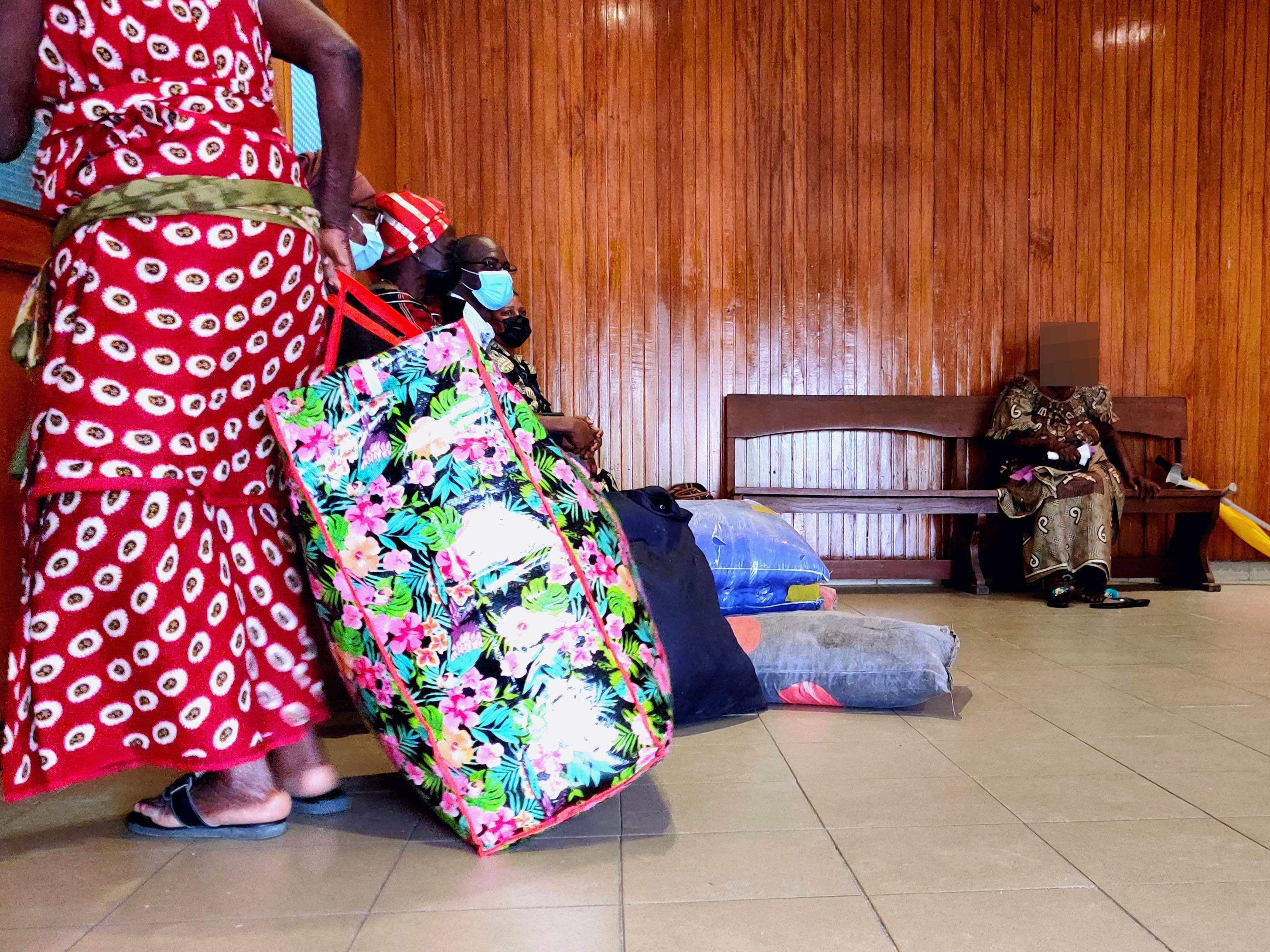
I’m going to speak from a measured point of observation here.
There’s a particular species of unprocessed grief in African men - perhaps in men generally - that we don’t discuss, because discussing it requires an admission of carrying it, which requires a kind of vulnerability that the entire architecture of our chosen socialisation was specifically designed to prevent.
I know what it is to stand outside a morgue and feel the role assigned before the grief has properly arrived. You can feel it in the handshakes - a specific handshake that carries the texture of transferred expectation, a kind of formal inheritance nobody agreed to. Your mourning gets interrupted by other people’s mourning, which you’re apparently now responsible for organising and holding. You become a container before you’ve had a moment to be emptied.
Let me be clear: This isn’t a complaint. It’s an observation. But it has consequences.
Research on men and grief is consistent and uncomfortable: Men are less likely to seek grief support, more likely to express grief through withdrawal or work or a flatness that settles over them like Rongai dust on an untouched table at the end of the day. What looks like stoicism is often just grief that has no sanctioned exit. And beneath that stoicism, in most cases: Nobody taught us. We didn’t see it modelled for us. Not really. The person who can’t sit with you in your grief likely didn’t know how to because nobody sat with them in theirs. The generation before learned silence from the generation before that, who learned it from circumstances that made silence a survival strategy. We’ve become, across generations, very skilled at performing the appearance of coping whilst not particularly coping.
The result is a population of adults - not only men, but men especially - carrying unprocessed losses that accumulate in silence until they surface as something else entirely: A rage with no legible source, a numbness, a specific quality of flatness in a person who’s been not-feeling for too long. You can recognise it if you know what you’re looking for. Which most of us don’t, because nobody taught us to look.
What an alternative looks like, I’m genuinely still working out. I suspect it starts with simply naming the thing - saying, out loud, to someone who can receive it: I’m not fine, and I haven’t been, and I don’t actually know what I need. Not as a confession. As a starting point. The men I’ve watched do this - tentatively, clumsily, in the way of people doing something for the first time without a script - have not collapsed. They’ve looked, briefly, like themselves.
That’s something. I think that’s something.
Our primary school English teacher cum Kiswahili teacher cum CRE teacher, Mrs. Amollo, used to say something that may sound terrifying for a child to hear, but stays with me to this day.
“Every day,” she’d say, “You’re one step closer to the grave.” Something very close to that - that’s how I remember it.
There’s a moment in adulthood - different for everyone, unmistakable when it arrives - when you understand something about the generational structure of mortality that you’d previously known only intellectually.
Before your parents or uncles or older acquaintances die, they stand between you and death in the queue. They’re older, they’ll go first, and their presence is a buffer - not consciously invoked, but just there. Like a wall you’ve never thought about because you’ve never needed to. Whilst they’re here, death is something that happens ahead of you in the order of things.
Then one of them goes.
And the queue shortens. One step closer.
I watched my mom grieve her own husband. I saw the specific quality of it - the way she became, in those, a wife rather than a mother. A woman in her fifties with a face that looked, in that moment, much younger and also much older at the same time, which is the paradox of grief: It ages you and reduces you simultaneously. I remember thinking I’d seen something private. Something she probably may not have wanted her sons to see.
There was a little girl in her in those moments. The brokenhearted girl who just lost a companion.
I filed it away, as you do with things you don’t yet have the vocabulary for.
Now I understand what I was seeing. I was watching her in an active process what I’m now learning: That the people you love aren’t permanent fixtures. That loving someone is, from the very beginning, an extended act of grief management - because grief is the cost we’ll all have to pay for love. That grief is, in its very nature, a long negotiation with the certainty of their eventual absence, and a decision - renewed every ordinary day, mostly unconsciously - that the love is worth the grief it’ll eventually require.
There are many traditions which hold that death isn’t an ending but a transition. The spirit moves from the visible world to the invisible, but doesn’t disappear. The ancestors remain active participants. The rituals of death aren’t merely ceremonial - they’re relational mechanisms, ways of renegotiating the terms of a relationship that continues, albeit in a changed form.
This is, I’d argue, a considerably more honest accounting of what grief actually feels like from the inside than anything the Kübler-Ross model ever produced. (A model which, by the way, Kübler-Ross herself eventually acknowledged had been catastrophically misapplied - she developed it to describe the experience of the dying, not the bereaved, and spent years quietly appalled at how rigidly it had been turned into a timetable. We added the timetable ourselves, because we all love a timetable especially when it’s convenient to us, don’t we.)

The idea that you don’t get over a significant loss - that you renegotiate your relationship with it, that the dead remain present in an altered form - is what our grandmothers knew. It’s what the neuroscience is now confirming. Our ancestors were, as in so many other respects, ahead of our time.
But this inherited wisdom was built for a particular kind of life. The communal grief architecture - the extended family, the homestead, the rituals that take days and involve everyone - was designed for a world of proximity. What happens when that architecture no longer fits the life? The Nairobi professional. The Kisumu graduate who moved for opportunity. The thirty-something receiving news of loss on a phone and attending a funeral on a WhatsApp group or a YouTube live link because the fare upcountry is what it is. What do you do with the sigweya when you’re in a studio apartment? Where does the communal wail go when you live in a building with thin walls and neighbours you’ve never met?
There’s a specific loneliness in grieving communally but not collectively. Everyone present on the group. Nobody truly there.
There’s a woman named Alua Arthur who works as a death doula. She gave a talk about this work that I’ve thought about more than almost anything else I’ve read or heard on the subject of grief. Her observation is simple, but sharp: When people - those closer to death - are asked what they’d do with more time, they don’t say they’d travel to Machu Picchu or Malaysia or the Maldives. They say they’d spend more time with the people they love. Ordinary time. Tuesday-afternoon time. The unremarkable kind that seemed, at the time, to require no particular attention.
Memento mori. Remember that you will die. It’s not a morbid exercise. It’s a clarifying one. To sit with the certainty of death isn’t an invitation to despair. It’s, properly done, a tool for precision: What do I actually want, given that I won’t have unlimited time in which to want it?
Grief does the same work, if we let it. It’s not only loss. It’s information. It tells us - with a specificity that ordinary life can’t quite produce - what we actually love, as opposed to what we’ve been performing love for. The things that surge back when we lose someone aren’t the meetings attended or the social obligations discharged or the curated version of ourselves that existed for public consumption. They’re the mundane things. Even the “annoying” things. The sound of a laugh. A particular way of saying your name. A Tuesday afternoon that seemed ordinary at the time.
An RIP post arrived whilst I was writing this.
Pole sana, I’ll type. I mean it every time.
And then I’ll sit with the only question I’ve found worth asking - not how do I stop grieving, which is the wrong question, but what is this grief trying to tell me?
Most of the time, honestly, it’s telling me the same thing. That the people I love are here, right now, in some form. That the things I love to do exist here, right now. That my photography is a present in the present. That time is moving.
That the mundane moments, the ones that seem boring today, are precisely the ones we’ll eventually wish we’d paid more attention to.
And that, perhaps, is the point of grief: Instruction to pay attention.
Comments
Nothing yet. Say the first thing.
Sign in to join the conversation.