
As you might know, I’ve recently published “Heart Rate Variability: Science and Strategies for Peak Performance”, together with Sylvain Laborde, Emma Mosley and Dan Plews.
I’ve learned a lot in the process, especially when it comes to aspects of HRV I was less familiar with (e.g., in the context of cognition). Something else I’ve enjoyed learning is the Vagal Tank Theory that Sylvain and Emma have developed (full text of their paper here).
In this blog, I want to cover the basics of their theoretical framework, and link it to practical tools we can use to assess or improve self-regulation, while keeping in mind that there are strong limitations in terms of when and how we measure and interpret HRV (i.e. the association between HRV and the autonomic nervous system response to stress is valid only under certain circumstances, we cannot simply measure HRV all the time and claim it’s a stress signal, as I’ve explained here).
What’s the Vagal Tank Theory then?
The model developed by Sylvain Laborde and Emma Mosley builds on top of the neurovisceral integration model. In particular, the neurovisceral integration model provides a framework to understand resting HRV, i.e. how the brain and the heart communicate, for example, how the regions of the brain governing cognition, emotion, autonomic control (e.g. breathing and heart rate, or things that happen without conscious control, typically) are all deeply interconnected, which eventually reflects on HRV, making it a useful proxy of many self-regulatory mechanisms and our adaptability to stress. The Vagal Tank Theory extends the neurovisceral integration model beyond the resting state, and in particular through the metaphor of a fuel tank, introduces the concepts of Resting, Reactivity and Recovery, which match what happens physiologically as we face a stressor.
I like this framework as a way to think about self-regulation and stress, even more than HRV itself (which is just a tool, albeit a very useful one, in my view).
Especially in the context of sports performance, where the stressor tends to be somewhat more controllable (at least in terms of the stimulus we provide to the body, i.e. the training plan we design and adjust), looking at the body’s self-regulatory mechanism through the lens of HRV (and this framework) can be quite effective (as research on HRV-guided training has shown us - but I think there’s more to it, as I will try to cover below).
The core of the model are the three Rs, as the authors call them, i.e., Resting, Reactivity and Recovery. Let’s get to them.
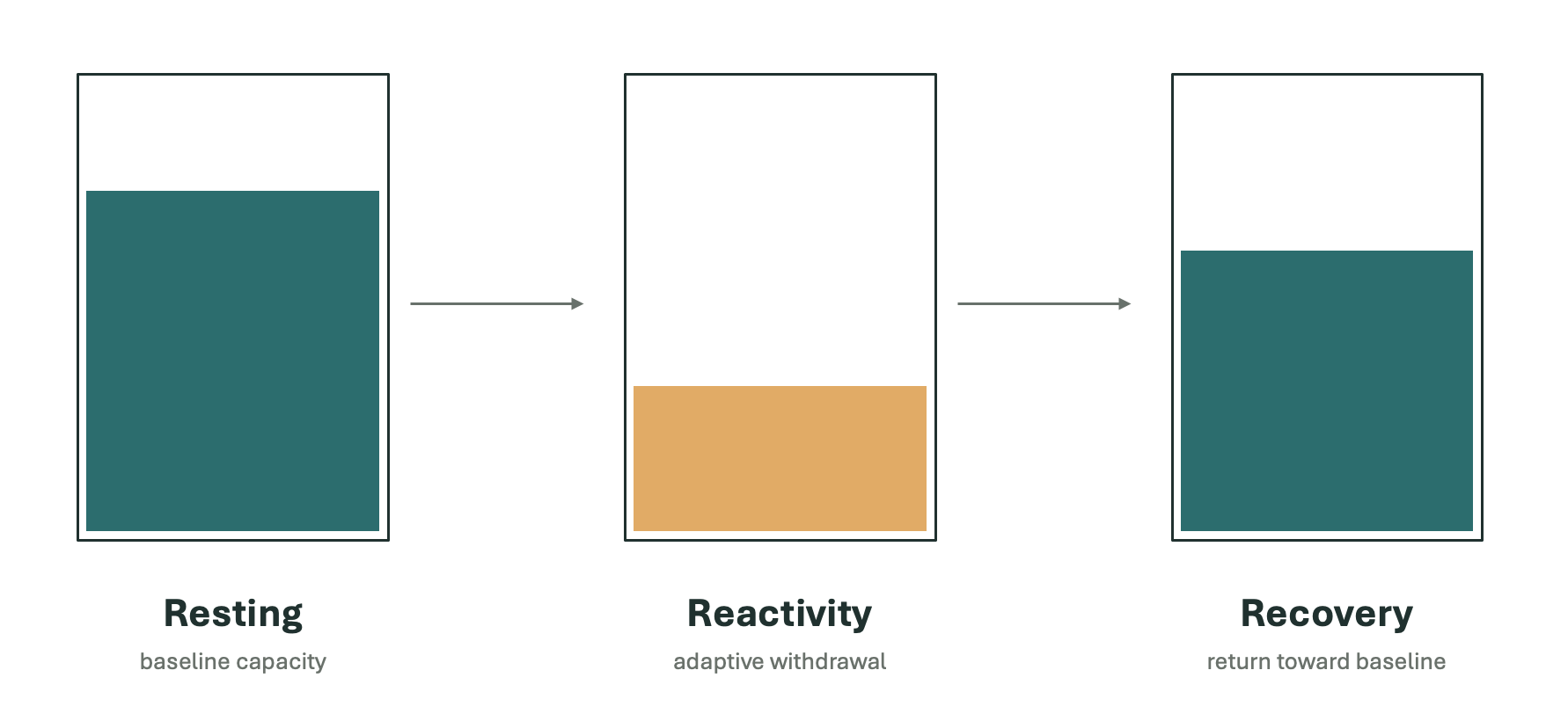
This is likely what you are familiar with the most, i.e., our morning (or night) HRV: our baseline capacity to assimilate stress. Nothing new here as we are looking at a resting state measurement (best practices here), which reflects our ability to assimilate stress on a given day. What matters is that we capture our state 1) at rest and 2) far from stressors, so that we can assess our nervous system response without confounding factors or artifacts, which would happen if we were measuring under different conditions (see here).
We typically aim for a stable resting HRV, which suggests we are responding positively to training and other life stressors. An acute/daily suppression - when feeling well - is something I would not necessarily be worried about, as (I think) a better (and healthier) way to use data is to avoid being overly reactive to the various things we measure. If the suppression remains for a few days though, it is a stronger signal that something is preventing our physiology from re-normalizing, and as such, it is probably a good idea to implement some changes, either reducing training stress, or focusing on other recovery techniques, to aid self-regulation.
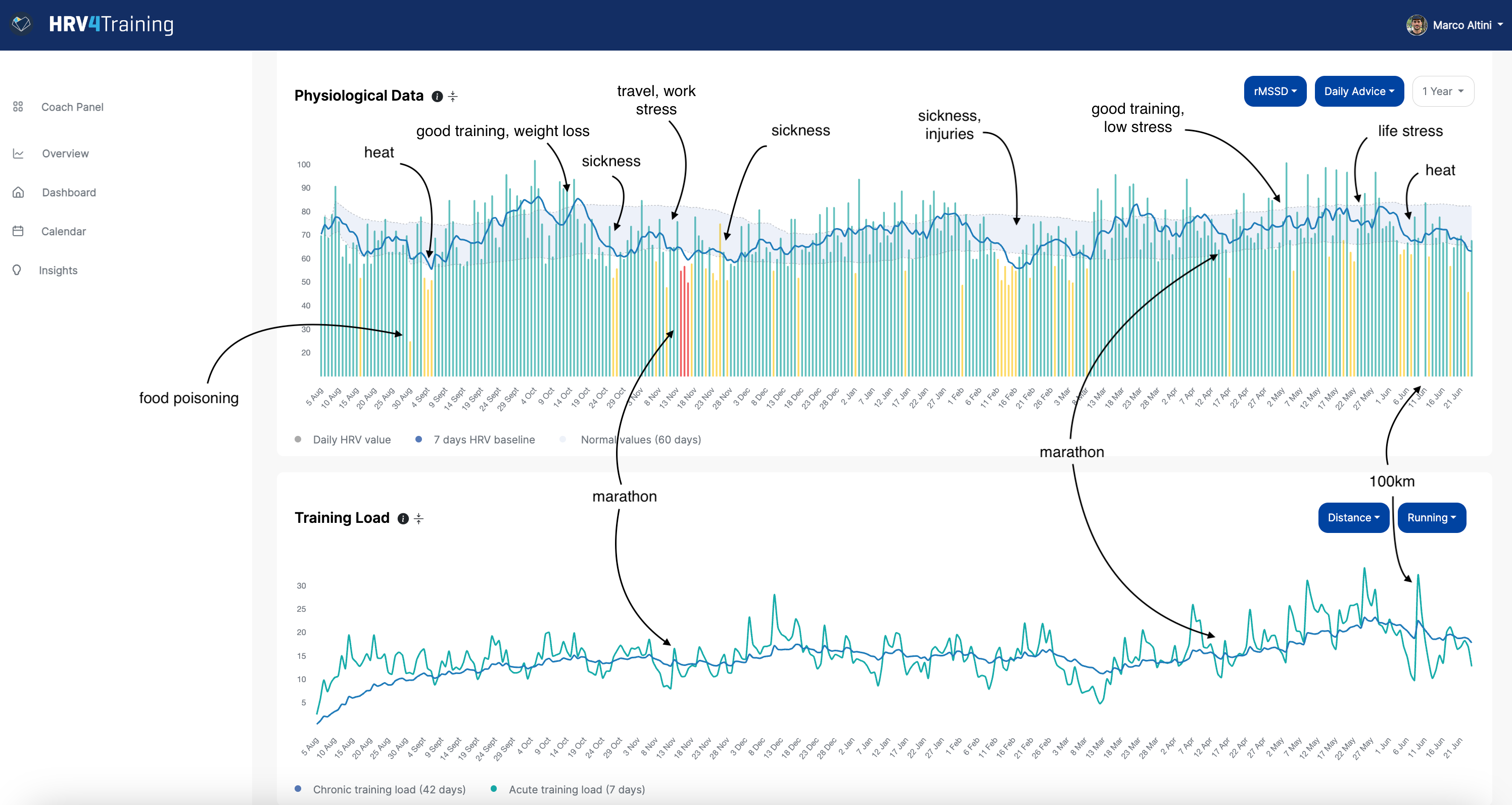
Above we can see resting HRV (morning measurements, seated, using HRV4Training and a Polar H10, because there is nothing better than ECG to measure HRV) for the past 60 days, characterized by sickness first, and then a phase of stable to high HRV (with respect to my normal range), which provides very useful feedback as I increase training load near my current limits (about ~100 miles/week): resting physiology remains stable, showing positive capacity to assimilate the load, as opposed to e.g. being overwhelmed and potentially moving towards non-functional overreaching.
Resting HRV is what you typically read about in this blog. Now on to Reactivity.
We can look at reactivity in various ways. For example, in our book we show examples of withdrawal (as in the figure above), i.e., HRV reduces as we face a stressor but we also show replenishment, i.e., HRV increases as we improve recovery with a “positive stressor” (e.g., sleep).
The first response, or the withdrawal / reduction in HRV, is the typical response when we think about a stressor, and needless to say, it is perfectly normal for our physiology to respond this way as we mobilize resources to meet the demands of whatever we are doing (training or else). In fact, a more stable HRV in this case might show a maladaptive response, as a healthy system is stable in the long term, but is not unable to respond and adjust when facing a challenge, a characteristic that is key to both health and performance. Hence, reactivity doesn’t have a optimal signature, but always depends on context. The larger the stressor, the more adaptive a large suppression can be, most likely.
A simple and effective way to look at reactivity without all the issues associated to measuring and interpreting HRV outside of the morning routine (or night data), is to think about the orthostatic stressor, or in other words, changing body position. As we change body position from lying down to sitting (or standing) up, the body needs to quickly adjust so that for example, we don’t faint because blood is pooling in the lower body. I’ve discussed here how this simple orthostatic protocol allows us to capture the stress response in ways that are not visible in night data (night data is a suboptimal protocol for athletes, as shown again in recent research, here). With this protocol, we are exploiting the reactivity of the nervous system and its impact on HRV, while assessing our Resting physiology.
Reactivity can also be seen in relation to “positive stressors”, for example taking an extra nap on a day in which our HRV is a bit lower than our normal, would likely show an increase in HRV in the acute phase.
A slow-breathing exercise could be another option to improve self-regulation and recovery, as I’ve discussed here in the context of using HRV4Biofeedback after high-intensity training (this is just speculative/experimental).
The final R stands for Recovery, which closes the loop with respect to our initial resting measurement.
Here I want to stress again how we cannot really measure recovery after an acute stressor and can only rely on assessments of resting physiology at specific times, using good protocols (either first thing in the morning, my preference, or during the night). I’m stressing this again because while the Vagal Tank Theory is great at covering how self-regulation works in the context of our stress response, we should keep in mind that this does not mean that we can measure HRV continuously to assess our recovery. There are simply too many things going on for an HRV measurement taken outside of the morning routine or the night, to be of any use in assessing our stress response - it is mostly noise (again, here is an overview of some of those things).
Recently when talking to Dan and Owain for The Physiology of Endurance Running podcast I also covered why, even under realtively controlled conditions, it is basically impossible to get a clean signal to capture post-exercise recovery, something that I tried many times as in the lab it showed to be pretty useful (i.e. to clearly separate athletes by fitness level, or to clearly separate the intensity of the training stimulus, e.g. between low intensiry or below VT1 and higher intensity, as well as the effect on autonomic activity of training duration), but again, too many confounding factors and artifacts to make any of this practically feasible even if you put your best effort (no moving, no muscle contractions of any kind, no swallowing, no talking, no drinking, no eating, self-paced breathing - which is however dynamic after exericise - and all of that, for e.g. half an hour to get anything useful - let alone if you were to collect data passively).
Alright then, what do we make of recovery? In practical terms, I think Recovery is the same as Resting, and is captured every 24 hours either in the morning or in the night, so that we can see if we have re-normalized or not. We all face stressors during the day, some we might impose (e.g. training), some are just coming at us, and the cumulative impact of all of those plus our capacity to assimilate stress in that given day/period, and our ability to re-normalize, will determine tomorrow’s data point, our Recovery is how far that data point is from the previous Resting measurement (to be more precise, how far is it from our normal range). This is very useful when we manipulate training in different ways, for example increasing the density of high-intensity sessions tends to have an impact on the data that lasts many hours, and if the acute suppressions on the following morning measurement keep coming even after repeated exposure (i.e. when we apply the same density over and over, not just the first time), maybe that density is too much for us at this time.
What we do in between morning (or night) measurements to aid recovery can’t be quantified, and that’s fine. Eat well, sleep enough, move around, and possibly, breathe slowly sometimes.
Finally, in the context of both Reactivity and Recovery, keep in mind that acute and chronic responses often differ dramatically (e.g. exercise acutely suppresses HRV, but chronically increases it), and sometimes similar changes in HRV reflect different underlying physiology and stress responses. For example, cold exposure activates pretty much everything in the sympathetic and parasympathetic nervous system → vasoconstriction → higher blood pressure → baroreflex → lower heart rate and higher HRV, which is not really the same as a slow breathing exercise → higher sinus rhythm arrhythmia → higher HRV, a more ‘selective’ approach, so to speak. There is more to the stress response that we cannot “see” through HRV, even if we were able to measure it meaningfully more frequently.
For these reasons, I think our best practical use of HRV is for morning assessments of our Resting physiology, which is linked to our Recovery from previous stressors and provides an indication of our capacity to assimilate additional stress in the current period.
The Vagal Tank Theory that Sylvain Laborde and Emma Mosley have developed gives us a great framework to understand self-regulation and think of the stress response and its impact on HRV.
We want to keep the vagal tank in our optimal range, i.e., Resting physiology stable over time, while providing timely stressors that will lead to plenty of acute changes (Reactivity) but that shouldn’t go (too often) beyond our current capacity to assimilate them, so that the Recovery and re-normalization is apparent in the following day’s Resting measurement.
While the stress response and self-regulation are rather complex and dynamic, when it comes to useful measurements using HRV as a proxy of those systems, less is more and I’d encourage mostly relying on morning (and/or night) measurements, leaving aside tools built for engagement, more than anything else.
Thank you for reading!
Please apply here should you be interested in working with me.
You can also learn more about my coaching, here.
Thank you!
Our book is out and available for purchase from Human Kinetics’ website, here (or on Amazon).
No paywalls here. All my content is and will remain free.
As a HRV4Training user, the best way to help is to sign up for HRV4Training Pro.
Thank you for supporting my work.

Marco holds a PhD cum laude in applied machine learning, a M.Sc. cum laude in computer science engineering, and a M.Sc. cum laude in human movement sciences and high-performance coaching. He is a certified Ultrarunning Coach.
Marco has published more than 50 papers and patents at the intersection between physiology, health, technology, and human performance.
He is co-founder of HRV4Training, Endurance Coach at Destination Unknown, advisor at Oura and augo, guest lecturer at VU Amsterdam, and editor for IEEE Pervasive Computing Magazine. He loves running.
Social:
Personal Substack
Strava
Instagram
Comments
Nothing yet. Say the first thing.
Sign in to join the conversation.