
Hi there 👋
I hope all is well.
This one comes a bit late, as I was pretty sick last month, but that’s life sometimes.
Below is a new recap of articles, research, and updates from May and June.
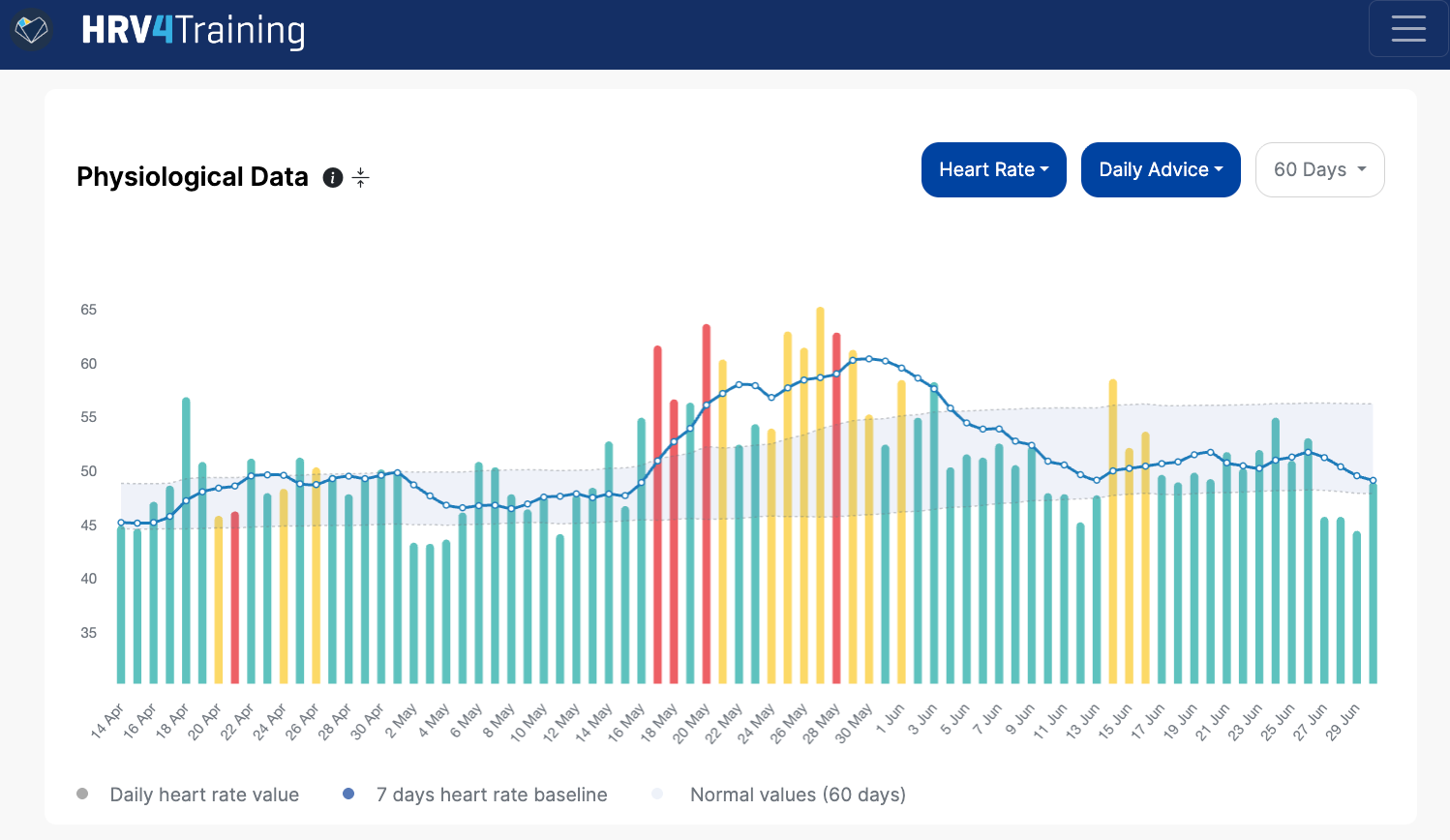
I hope you’ll find the articles useful, and I would like to take the opportunity to thank you for your support.
Please feel free to comment below or in the articles should you have any questions, and I will follow up soon.
Take care!
I had a great conversation with Dan and Owain for their podcast (The Physiology of Endurance Running, which I’d recommend checking out regardless of this interview!).
We discussed pretty much everything from the physiological basis of HRV to applied protocols and limitations of current technologies, including pros and cons of using wearables, issues with stress estimates derived from continuous data, HRV during exercise, and more.
You can find the episode here:
In this blog, we look at a preprint from a single case study of 1000 days of HRV data, published by Amin Sinichi et al. from the Vrije Universiteit Amsterdam (link here).
His analysis first assessed how 1-minute versus 2-minute recordings showed close agreement, and how nocturnal HRV appeared more blunted and less sensitive to contextual changes (something at this point we’ve stressed plenty in the past, e.g. when discussing the orthostatic stressor or recent research highlighting how night data misses important changes visible in morning data).
In the author’s words: “the current results suggest that seated post-wake-up intentional recordings, rather than passively collected nocturnal averages, align more closely with real-life stressors”.
A poster shared by Andrew Flatt on LinkedIn caught my eye (see here). The poster covers Kayla Porter’s work in evaluating the accuracy of Garmin’s spot check against ECG. In particular, as reported in the abstract, HRV was recorded simultaneously using ECG and the Forerunner 265’s optical sensor during Garmin’s 2-minute “Health Snapshot.” Measurements were obtained in three standardized positions: supine, seated, and standing. HRV values automatically generated by the Garmin application were compared with ECG-derived HRV.
The authors conclude that HRV estimates from Garmin are unsuitable for research purposes and patient or athlete monitoring based on their poor agreement with ECG, something we had seen already quite a few times in the past.
When in doubt, a good old Polar H10 is what I’d recommend for your morning measurements.
I have received the following question:
“For the first time in one of my professional athletes, I’m seeing an HRV / HR trend (nighttime measurements) that seems unusual to me and that I’ve never observed before in other athletes: HRV is decreasing, while resting HR remains stable and/or is actually decreasing further. For example, today I observed one of the lowest HRV values ever for this athlete, but at the same time one of their best resting HR values. How should I interpret this?”
I think we have at least two situations to consider here, with different outcomes: parasympathetic saturation (not a problem) and actual fatigue (a problem). Learn how to distinguish them, here.
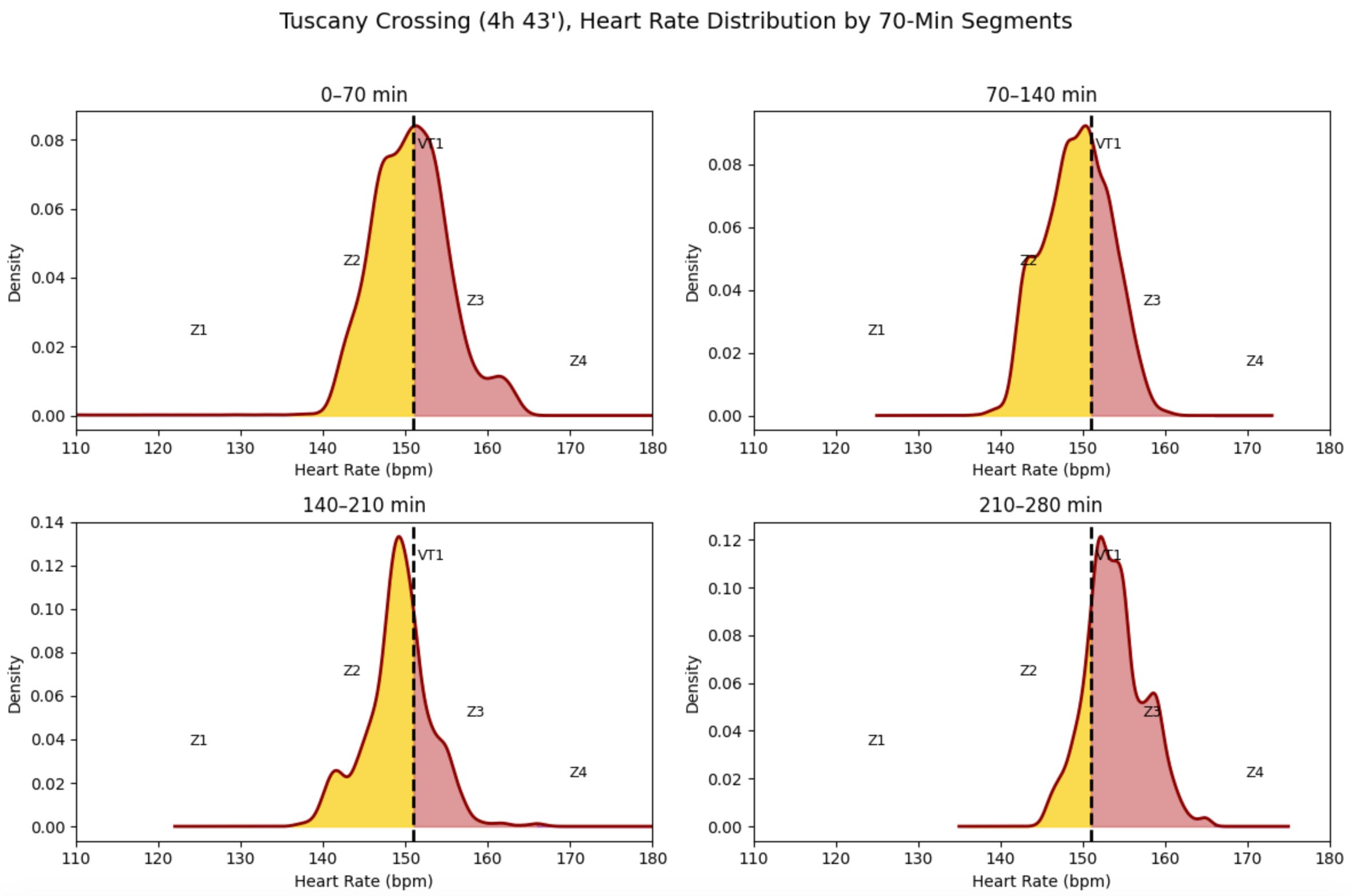
I’ve updated my training (and race) report for this past season, including the second trail race I took part in (Tuscany Crossing), here.
You’ll find the high-volume training block between Chianti and Tuscany Crossing, plus heart rate density plots for the two races, HRV and heart rate between the events (with race day nerves showing quite clearly), nutrition adjustments due to changes in environmental conditions (i.e., warmer weather) and some more.
It’s been a really good season, despite the ending (sickness and no Passatore). I’m grateful for the process and hope you’ll find some useful pointers in here.
A few weeks ago we organized a trail race here in Brisighella, something I had been working on for the past year together with Alessandra Saviotti and a few others who got us involved after we started spending part of the year back home.
It’s been wonderful to see so many old and new friends come together for a lovely morning on our trails (and some good food afterwards!).
Volunteering, directing, crewing my athletes, cheering, running around. What a day. My heart is full, and I cannot wait to start working on the next edition.
Thank you to everyone who joined us and helped make it happen.
🌼
Some more impressions from the race, here.
🌼
p.s. special thanks to Andrea Barra who captured our weekend so beautifully in the video below.
Stay in touch (and join us next year!).
That’s a wrap for today, below you can find other recent updates:
Please apply here should you be interested in working with me.
You can also learn more about my coaching, here.
Thank you!
Our book is out and available for purchase from Human Kinetics’ website, here (or on Amazon).
No paywalls here. All my content is and will remain free.
As a HRV4Training user, the best way to help is to sign up for HRV4Training Pro.
Thank you for supporting my work.
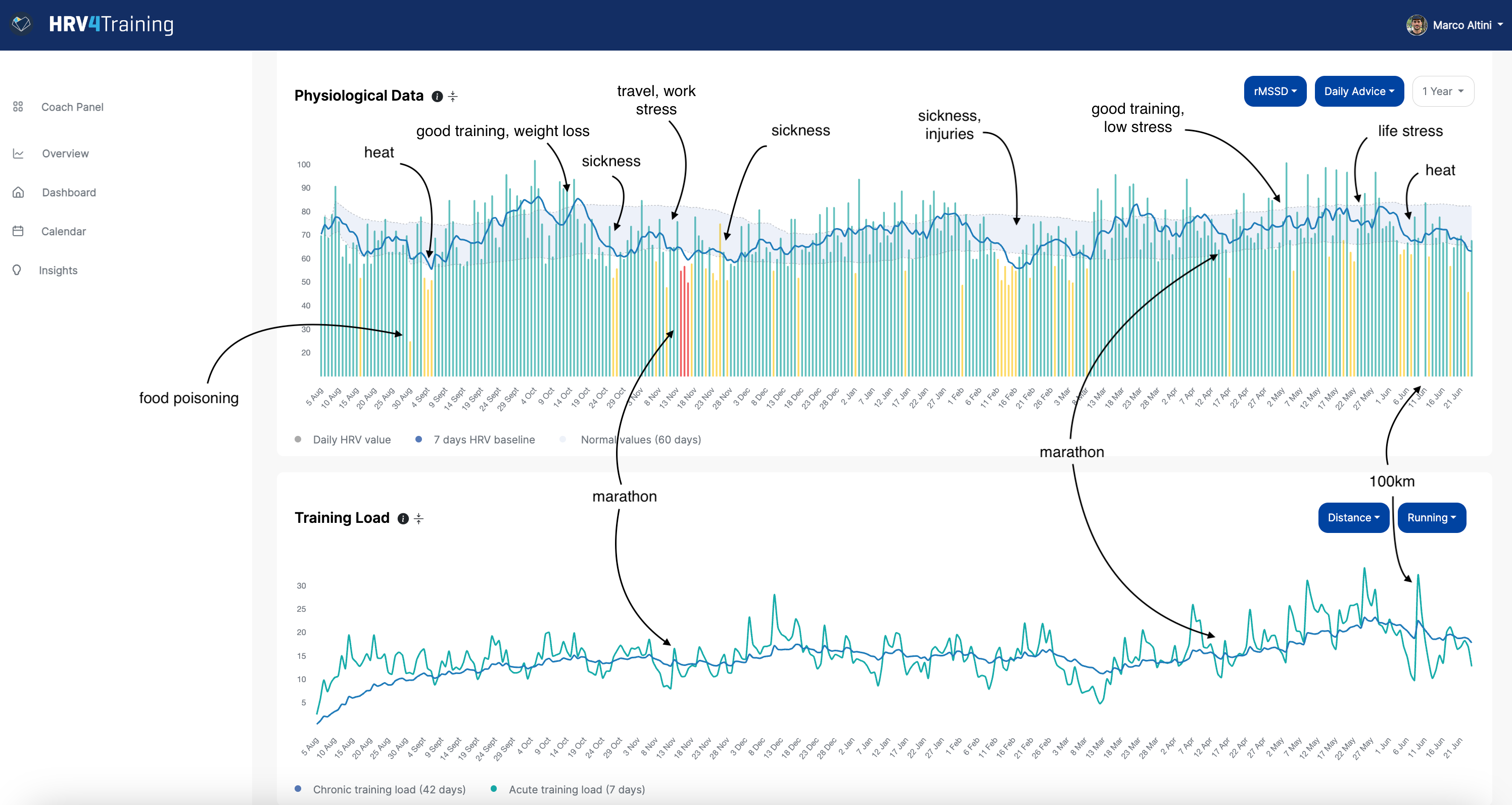

Marco holds a PhD cum laude in applied machine learning, a M.Sc. cum laude in computer science engineering, and a M.Sc. cum laude in human movement sciences and high-performance coaching. He is a certified Ultrarunning Coach.
Marco has published more than 50 papers and patents at the intersection between physiology, health, technology, and human performance.
He is co-founder of HRV4Training, Endurance Coach at Destination Unknown, advisor at Oura, guest lecturer at VU Amsterdam, and editor for IEEE Pervasive Computing Magazine. He loves running.
Social:
Personal Substack
Strava
Instagram
Comments
Nothing yet. Say the first thing.
Sign in to join the conversation.