
It remains to be seen who will win the latest microblogging battle. But I’m fascinated by what this release reveals about our online personas.
Meta launched Threads on July 5th, setting a new record for social platform adoption. The Twitter alternative received over 40 million downloads within the first 24 hours.
Recent poor experiences, including the imposition of rate limits, have increased Twitter users’ appetites for a new platform. This likely influenced the speed of adoption on Threads.
But credit is also due to the ease of the sign-up process itself. Instagram users received an instant onboarding, pulling profile info over from one channel to the other.
But one feature left users with mixed feelings: the option to import the accounts they follow on Instagram into Threads.
“Do I really want my Instagram connections to see what I’ll post here?”
It’s not uncommon for people to curate different audiences on Twitter than Instagram or Facebook. Their respective feeds focus on different content topics—and tones.
It’s hard to beat the memes on this one:
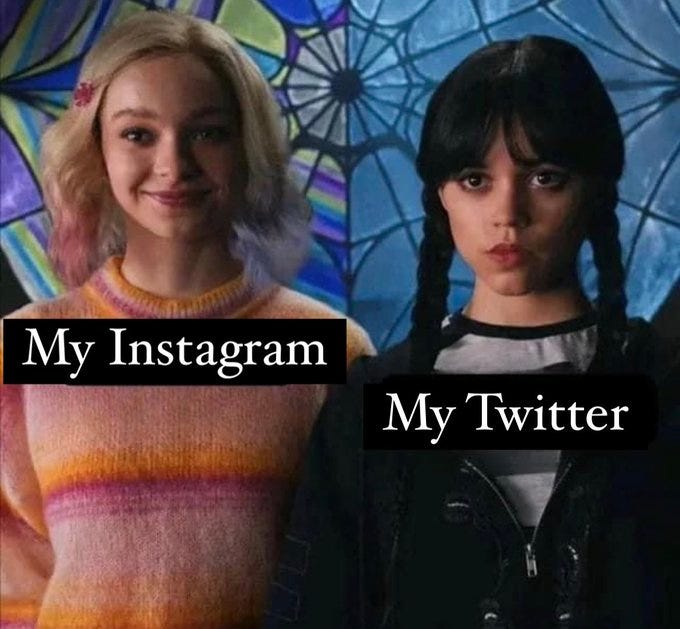
Some Twitter users were wary of their “IRL” contacts finding them on Threads. Their Twitter persona is a bit edgier than what people are familiar with in other contexts. Some even set up separate Instagram accounts before adopting Threads to keep the follower types distinct.
It’s a recurring theme on TikTok that creators show up on video for a global audience—and hope their family members and coworkers never discover it.
Not all of this comes from a place of toxic anonymity. It’s understandable that people who’ve experienced trauma in their immediate circles might desire connection outside of them. For some, it’s difficult to be fully visible when they fear rejection or animosity from those they once trusted.
But the hesitation to combine these online communities is also due to the different cultures the various platforms nurture, and how they’ve shaped our participation in them.
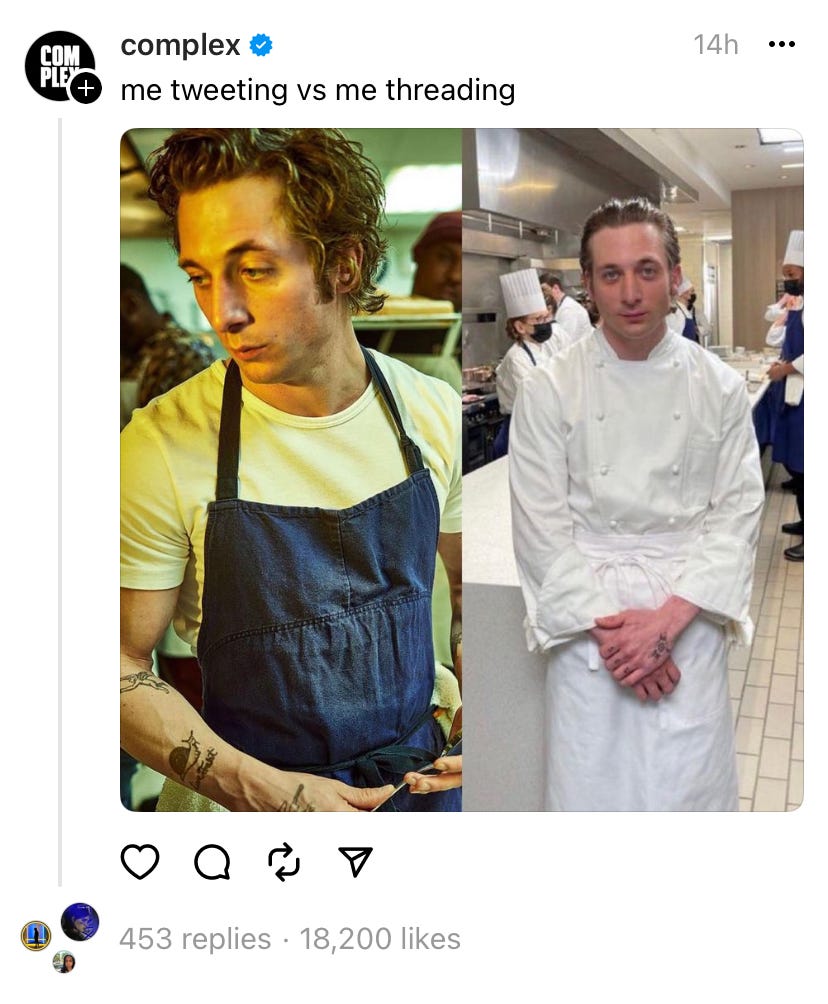
In fact, many entered Threads with the hope that it was an escape from Twitter’s toxic culture. That suddenly online discourse would be more civil and safe.
But we bring the same humanity here. We bring ourselves here. What will we present?
A new platform raises the question: who will we be on Threads?
The integration of social media and business has elevated the importance of building a personal brand.
Your online presence becomes a storyline of the distinct value you’re able to bring. Your social posts establish thought leadership or creative expertise.
But the received wisdom is to narrow that to a select number of subjects. And to keep it consistent.
Your brand should be about one main thing. Deviate sparingly.
Certain platforms reinforce this restraint. There are complaints that LinkedIn has become too much like Facebook, with the increased frequency of personal posts. This reaction is understandable. LinkedIn is primarily a career and business context, and it makes sense to target your content with relevance to your customer personas. (There’s that word: personas).
But social media gurus will recommend personal brand consistency across LinkedIn, Twitter, and Instagram. Are you a digital marketer? Post mainly about that subject on every channel. Are you in SaaS sales? Build an audience on every social site around that topic.
The result is a consistent online persona, but one that represents a single slice of your identity.
One reason I created this newsletter was out of a desire to integrate my audiences. I have a business network for whom it makes sense for me to talk about technology and work culture. And my background in church ministry leads me to probe these issues for their deeper meaning and impact.
When I set up Threads, I felt the question rise in me: Who am I on here?
Am I a business leader? gospel tweeter? social commentator? snark curator? All of the above?
Is it possible for these expressions to come from the same person? And will people tolerate all of me?
Online life has tended to divide our sense of self.
I might as well cite Sherry Turkle two articles in a row.
In her book Life on the Screen: Identity in the Age of the Internet, Turkle explores how online life can affect our identities, molding multiple versions of the self, often playing out in parallel.
Digital life creates a decentered identity—multiple personas.
And the internet is an environment for exploring these identities. Online spaces are a place to play. Who do you want to be? What personality do you want to adopt?
This doesn’t necessarily mean our digital personas are inauthentic. They could be facets of our identity that we’re not able to express in our offline lives.
One of Turkle’s key concepts is the idea of the “tethered self,” where people are always connected to their digital identities, leading to an enmeshment of online and offline selves. But this constant connection can lead to pressure to present in a certain way. The internet has not helped our social anxiety.
Turkle views online personas as a new venue for identity expression, recognizing their power in shaping our sense of self. But the more we are tethered to these digital identities, the more we feel disconnected from the real world people that no longer seem to fit them. It’s like we’re a character in the wrong story.
Creating personas is inevitable. But what if we realize that we aren’t our personas?
In 1975, philosopher and social theorist Hannah Arendt received the Sonning Prize for her contributions to European culture. She felt some discomfort with being honored as a public figure in this way. She recognized that the public role is a type of persona.
In her acceptance speech, Arendt points out that the term persona “originally referred to the actor’s mask that covered his individual face and indicated to the spectator the role and the part of the actor in the play” (Responsibility and Judgment, 12).
Mike Cosper comments on this, “We appear and perform in the world, presenting ourselves as this or that. But Arendt knew the danger of confusing these appearances and personas with our real identity” (Recapturing the Wonder: Transcendent Faith in a Disenchanted World, 81).
Our identity is not something that can be reduced to the personas we present.
“When the events for which the mask was designed are over, and I have finished using and abusing my individual right to sound through the mask, things will again snap back into place. Then I, greatly honored and deeply thankful for this moment, shall be free not only to exchange the roles and masks that the great play of the world may offer, but free even to move through that play in my naked ‘thisness,’ identifiable, I hope, but not definable and not seduced by the great temptation of recognition which, in no matter what form, can only recognize us as such and such, that is, as something which we fundamentally are not” (Arendt, 16).
We are not our personas.
The displayed version of me is not my “thisness,” which cannot be reduced to being recognized “as such and such.”
Not everything should be public, and it isn’t necessarily “authentic” to lay everything bare. Part of being human is having a private, inner life. And sometimes we serve others when we filter our communication.
We’ll never completely remove the masks online.
But I do welcome the possibility of a more integrated internet life.
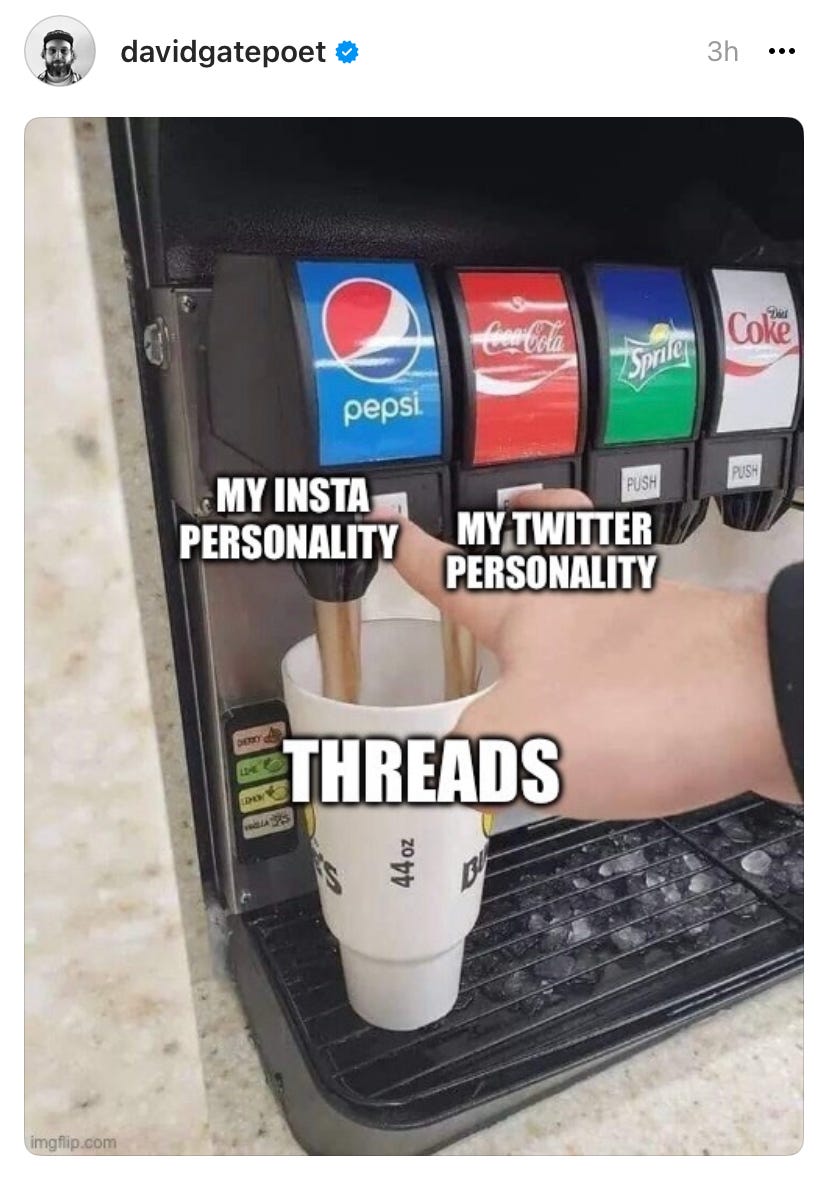
Perhaps a new social platform does offer a reset. Maybe on Threads, you can be more fully you?
One more meme for the win:
No posts
Comments
Nothing yet. Say the first thing.
Sign in to join the conversation.