
There’s the version of Elon Musk who’s successfully led companies like PayPal, Tesla, and SpaceX.
Then there’s the Elon Musk who became the internet’s main character.
This is the Extremely Online™ Elon Musk who recycles memes from Catturd. The one with a Twitter addiction so strong that he bought the company, only to rebrand it to the letter of the alphabet he seems to be obsessed with. The guy who’s threatened Mark Zuckerberg with a lawsuit and challenged him to an MMA cage-match fight.
This Elon Musk appears to be driving his new company into the ground.
I’m not a billionaire. Just a few zeros short of it. I’ve never led anything close to the scale and complexity that Musk has. But I’m not alone in thinking that his playbook since acquiring Twitter has been bizarre. Cutting vital members of the engineering team, forcing Twitter Blue (the product no one wanted), imposing rate limits, trashing brand equity, platforming Andrew Tate, and now suggesting the removal of the “ban” option as a feature. Whatever repels users and advertisers alike, that seems to be Musk’s top choice.
What happened?
There are different theories, the most plausible having to do with the blindspots of wealth and power.
But there’s one intriguing explanation for his behavior: Musk believes we are living in a computer simulation, and nothing ultimately matters.
What should we make of this?
Musk thinks we are almost certainly living in the video game of an advanced civilization. Specifically, he believes there’s a one-in-a-billion chance that we’re in “base reality.”
Here’s how he explained it at Recode’s Code Conference 2016:
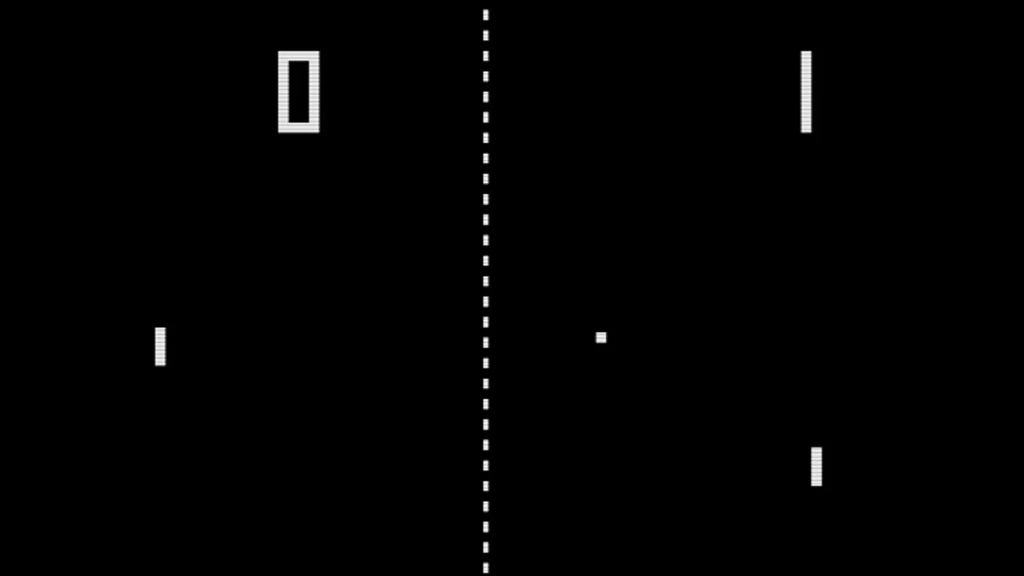
The strongest argument for us being in a simulation probably is the following. 40 years ago we had pong. Like, two rectangles and a dot. That was what games were.
Now, 40 years later, we have photorealistic, 3D simulations with millions of people playing simultaneously, and it’s getting better every year. Soon we’ll have virtual reality, augmented reality.
If you assume any rate of improvement at all, then the games will become indistinguishable from reality, even if that rate of advancement drops by a thousand from what it is now. Then you just say, okay, let’s imagine it’s 10,000 years in the future, which is nothing on the evolutionary scale.
So given that we’re clearly on a trajectory to have games that are indistinguishable from reality, and those games could be played on any set-top box or on a PC or whatever, and there would probably be billions of such computers or set-top boxes, it would seem to follow that the odds that we’re in base reality is one in billions.
Tell me what’s wrong with that argument. Is there a flaw in that argument?
Good question. We’ll consider the flaws in a moment.
But this view of reality has profound implications.
What if your dog is just essentially a Tamagotchi pet? What if the company you purchased for $44 billion is a SIM scenario?
I guess if things went too far off the rails, someone out there will just reboot the system.
Proponents of the simulation hypothesis talk about it with the tone of someone conducting an interesting thought experiment. But do they take it seriously? What is the existential payload of the idea that we live in a future nine-year-old’s glorified Minecraft world?
Hopefully, he doesn’t drop us into the lava like my nine-year-old would.
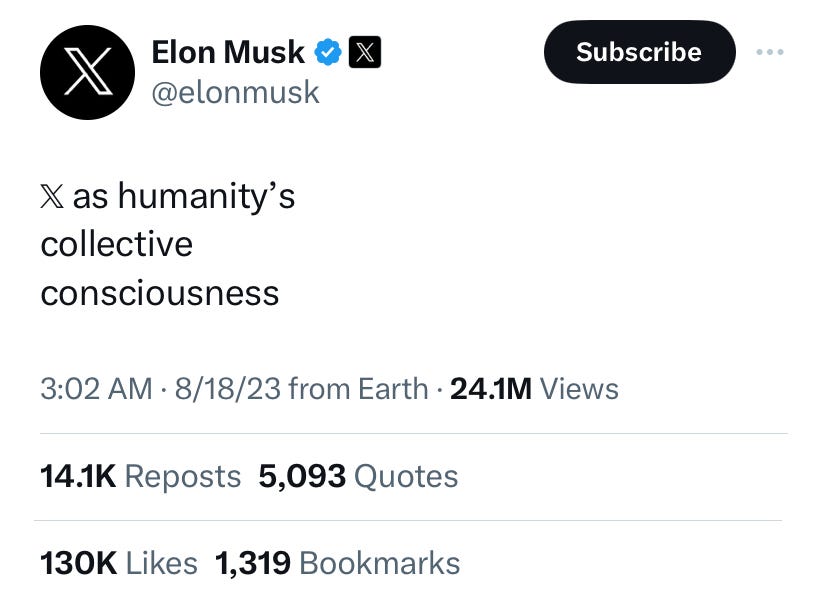
Musk doesn’t specify what exactly he has in mind by a simulation.
If all reality as we know it really were like a video game in the complete sense, then that’s just another way of saying that no one is a real person. If we’re all NPCs, then who exactly is proposing this hypothesis? (It’s like the philosophy joke about the undergrad student who bursts into his professor’s office worrying about whether he exists, and the professor responds, “Who’s asking?”).
Sadly, we are in a reality where people are paid to impersonate NPCs. Gang gang, ice cream so good. I’m starting to understand why some doubt that this is base reality…
It’s more likely that Musk believes that conscious characters exist within this framework. But that the characters themselves are the product of the simulation.
This means that a supercomputer has generated not only conscious players but self-conscious beings.
And he just takes it for granted that this is a metaphysical possibility.
This theory assumes a functionalist philosophy of mind. That mental states can be reduced to non-mental algorithms. That the subjective, first-person perceptions I have are either nonexistent or can ultimately be explained away in third-person facts or 1s and 0s.
It assumes that there is nothing more to consciousness than what can be hardwired or programmed. Put another way, it presupposes that Strong AI is possible, and that you and I are instances of it.
But there are significant challenges to this view. Musk simply sidesteps what David Chalmers has called the hard problem of consciousness.
He talks as if there is no problem, and that it’s obvious that self-aware persons could arise ad infinitum from a large enough codebase.
Yes, we’ve witnessed amazing developments in video game technology over the decades. We haven’t seen anything remotely close to creating artificial consciousness. To the extent that the experiences in a game are becoming “indistinguishable from reality,” we (sentient beings who exist outside of the game) are the ones experiencing them.
But this leads to a more fundamental issue with the simulation hypothesis.
Why should I believe something for which there is no evidence over the abundance of evidence of my own experience?
I’ve had innumerable sensations of the world around me. These experiences are immediately mine. I can’t doubt their reality, any more than I can doubt whether I’m in pain or happy or hungry—or exist.
Put another way, my belief that the external world is real is properly basic. Any evidence presented for the simulation hypothesis could not be stronger than that.
Furthermore, it’s a self-defeating hypothesis.
Musk’s argument that there’s a one-in-a-billion chance that we live in base reality relies on probabilistic reasoning.
But why should we think that probabilistic reasoning can lead us to the truth? Why would induction work in a world where anything goes? If the video game proposal is correct, then all our empirical beliefs are wrong. All our conclusions about the physical world are essentially false. And all of the scientific knowledge that enabled us to create the technology of Pong and beyond cannot be trusted.
If our thoughts are determined by a simulation, are our cognitive faculties themselves reliable? If our thoughts are reducible to non-mental states, then there need be no conceptual relationship between the premises and the conclusion of an argument. The specific content of those thoughts does not matter. We were determined to think the premises and determined to think the conclusion based on the underlying code, and it isn’t necessary for one to follow logically from the other.
But if we can’t trust our reasoning, how can we trust the reasoning processes that led us to conclude we live in a video game in the first place?
If it’s true, then it’s irrational to believe it.
I don’t know whether Musk’s cosmic-scale conspiracy theory is influencing his behavior this year. This view suffers from the same liability as the simulation hypothesis itself: it’s shaved away by Occam’s razor. There are simpler explanations for these phenomena.
But this does seem to be another instance of Musk presenting self-impressed ideas without deep enough reflection.
I hear that article headlines are next to go.
No posts
Comments
Nothing yet. Say the first thing.
Sign in to join the conversation.