
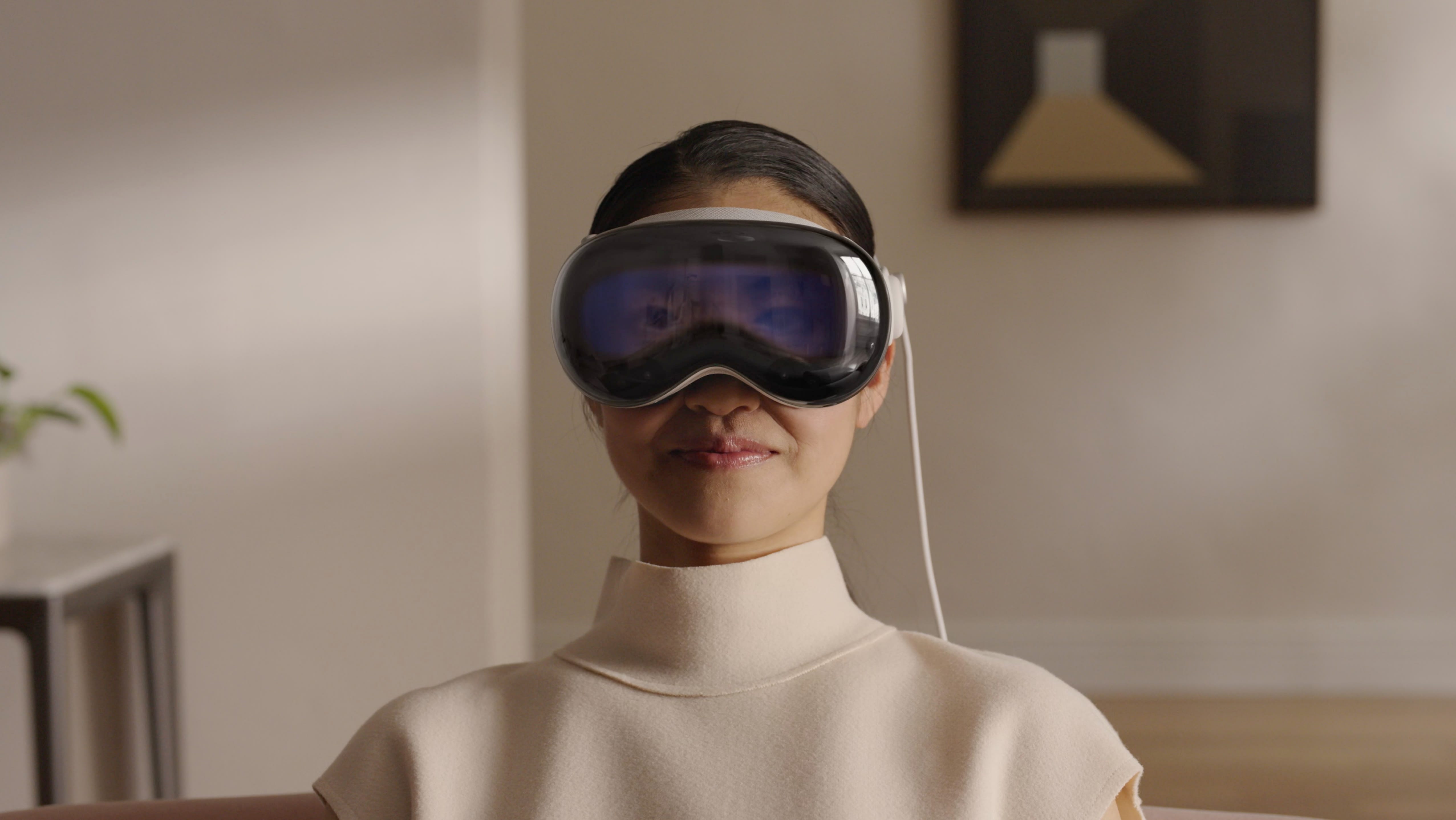
Yes, I want an Apple Vision Pro.
While not without its quirks, it’s a product and engineering marvel, and a game-changer in Mixed Reality tech. I won’t repeat all the published observations about design and marketing, and the intriguing choices made in this release. Apple once again tells a compelling story.
I want this technology. But I’m not sure I want the life it promises.
Do you see the future? It’s coming for your personal space.
Apple CEO Tim Cook said, “Just as the Mac introduced us to personal computing, and iPhone introduced us to mobile computing, Apple Vision Pro introduces us to spatial computing.”
It’s based on a spatial operating system that is both immersive and interactive. You control it with your eyes, hands, and voice. It incorporates the space around you, or you can make that space disappear into an infinite canvas.
The device exists between you and the world around you to enhance that world.
MR tech takes us one step closer to a reality that’s both exhilaratingly advanced and poignantly solitary.
Apple did its best to present a narrative of connection rather than separation. “Foundational to Apple Vision Pro is that you’re not isolated from other people. When someone else is in the room, you can see them, and they can see you.” Carry on your conversation. No need to take off the device. When your loved ones are around, you can keep wearing the computer on your face.
But this “seeing” is mediated. The headset is opaque. You see the people next to you through a camera lens, and they see a displayed projection of your eyes. They stare back, not quite at you, but at a screen.
On FaceTime, the person you’re interacting with sees not your face but your Persona—a Machine Learning representation of you—adding another layer of digital mediation between users.
Of course, these developments are much better than the alternatives (Meta Quest’s blindfolding device and cartoonish avatar). It’s an attempt to experience the benefits of the technology and overcome some of the physical limitations it creates.
But will we settle for a more mediated normalcy?
If not completely isolating, the experience, as with smart devices in general, is definitely individualized. The Apple Vision Pro doesn’t begin with i like the iPhone, but it’s designed with one user in mind.
The cinema that sat three hundred moved to the home theater for five. Now we have the prospect of an iMAX experience for one.
In 2011, Sherry Turkle published Alone Together: Why We Expect More from Technology and Less from Each Other. It followed other books highlighting the patterns of loneliness that rapid social and technological developments have brought, such as Robert Putman’s Bowling Alone and Nicholas Carr’s The Shallows.
Turkle, a psychologist and professor at MIT, focuses on how technology impacts our lives, our relationships, and our sense of self. She considers how online connectivity affects human connection. We often chose the control, convenience, and self-curation available in the digital realm over face-to-face interactions, leading to what Turkle describes as a state of being “alone together.”
She observes that we are growing accustomed to a new way of being '“alone” where we are constantly connected but lacking the depth and nuance of traditional social interaction. People tend to substitute real relationships with shallow, virtual ones. This leads to diminished empathy and understanding.
Turkle wrote this when the smartphone was in its infancy.
What happens when the whole world is a screen?
There’s a scene in Apple’s release video where a father is wearing a Vision Pro. His son walks up and tosses him a soccer ball, and the dad’s able to kick it back, while the headset presents an overlay of his e-mail. Keep an eye on the ball—and an eye on your open apps.
The point is he can still be aware of his surroundings and share a moment of interaction with his kid. Using the device doesn’t remove him from the environment around him.
But will parents with screen-covered faces be the new version of a mom and dad who can’t unglue their eyes from their phone?
There was another moment in the presentation that made me feel both excited and a bit queasy. A father experiences a 3D visualization of his kids. In the video, they’re dipping wands and blowing bubbles. (My wife and I will often scroll through our photos in Dropbox after the kids are in bed. I recently joked that I wonder how parents managed to like their kids before smartphones, without the ready reminders that they’re not always monsters!).
But this (alone, now divorced?) dad has access to these images and videos because they were recorded on the Vision Pro 3D camera. This means he was wearing the headset when these memories were first made.
It seems inescapable that our attention will be further divided between the real and digital worlds.
Most married couples know the experience of being in the same space but on separate phones engaging with different media. Who doesn’t need some time to decompress with their own feed of interest? But what conversations would be taking place if escaping to personalized devices weren’t an option? And what will this look like when both are wearing headsets?
The hybrid existence this technology fosters will likely accelerate the trend of being more connected but less present.
Tim Cook said the device “seamlessly blends the real world with the digital world.”
The Apple Vision Pro is a Mixed Reality alternative to the fully immersive Meta Quest, at least in its earlier versions. But this ability to interact with physical surroundings will surely lead to longer usage time (if they can solve the battery life issue). Users will be less inclined to remove the device if it doesn’t inhibit their ability to move around in their environment.
The blended experience blurs the distinction between VR and reality. But we have been blurring the boundaries between life and technology for a while now.
The pandemic accelerated this trend, pushing work, education, and social interactions further into the virtual realm, making a return to the “old normal” increasingly unlikely.
One of the blessings and curses of remote work is the proximity of our personal and professional lives. There’s no commute, no distance between them. But for many of us working from home, the boundaries between when we’re “on” and “off” have become very thin. The next task is just a ping notification away.
I wouldn’t complain about having a full-size display at the ready wherever I go. The Apple Vision Pro offers a customizable work setup, with the equivalent of multiple “monitors,” available to you when you travel.
It’s so convenient: join a work meeting from your hotel room! But do you really want to?
Technology is at its best when it’s a tool we use rather than something using us.
One thing that remote work has offered me is the ability to be more accessible to my immediate community. My professional network extends across the states and around the globe. But the lack of daily commute has allowed my family to build a life that is very local. Church, school, farmers market, parks, community garden, gym—they’re all within a 5-mile radius.
My generation doesn’t have an appetite for the suburban lifestyle where work and every other family activity involved driving down the highway or sitting in traffic. And when you’re life patterns are less spread out geographically, there’s more incentive to get to know your neighbors well. Certainly, this should inform the narrative around remote work. (I recognize this is a privileged life, but it’s a privilege I’m thankful for!).
Global technology has allowed local community to be more accessible again. But these communal spaces will be most meaningful when our devices are put away, or left at home.
The Apple Vision Pro is one more screen for our eyes. It’s a screen completely covering our eyes.
It may revolutionize productivity and entertainment.
If we can afford to put one on, will we be able to take it off?
Well, at least we have a two-hour time limit for now.
No posts
Comments
Nothing yet. Say the first thing.
Sign in to join the conversation.