
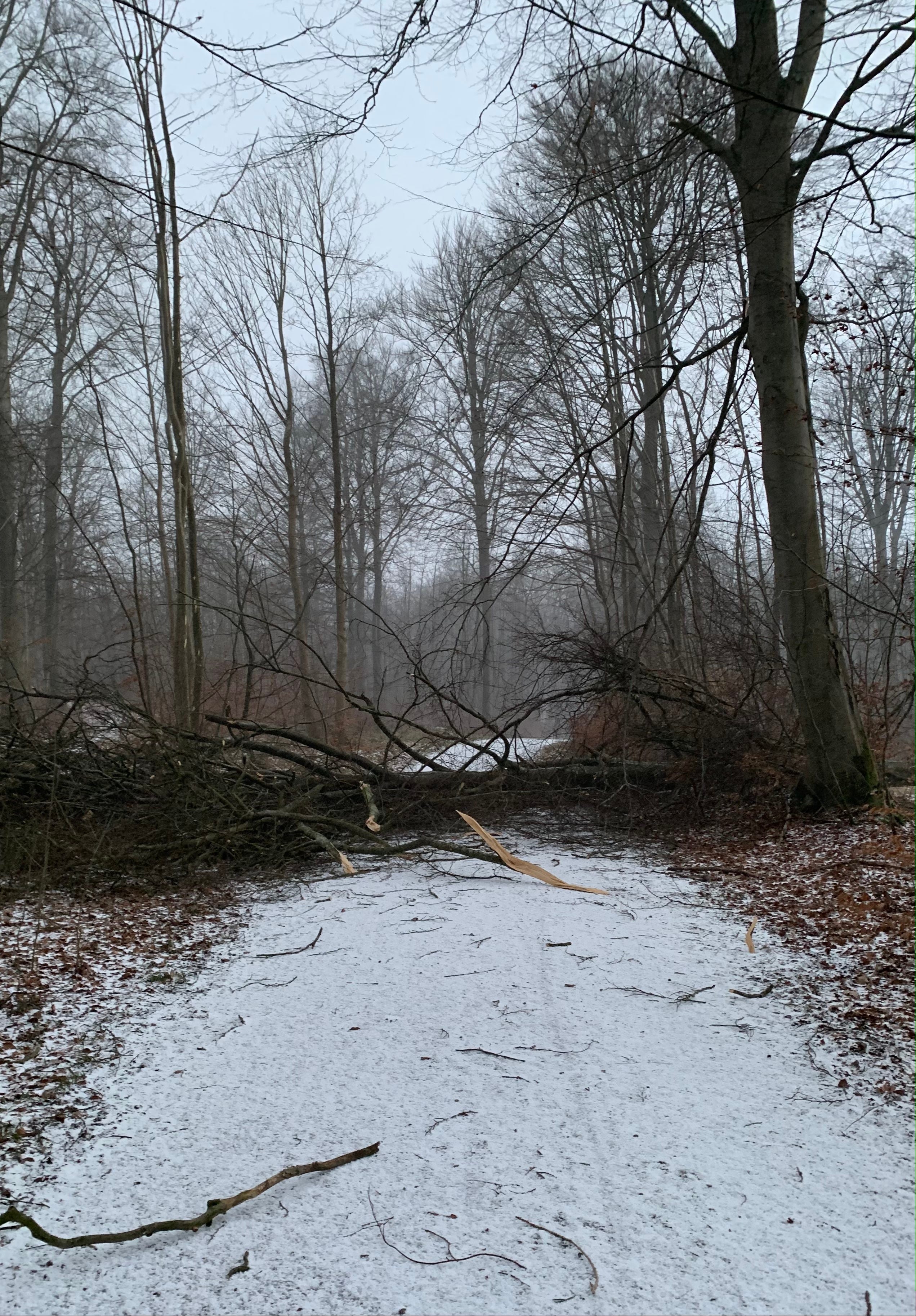
There is a beautiful red sky at 8.30a.m. after a wild and windy night. I can’t wait to get out for a walk with the dogs now it’s calm, and see how the forest looks bathed in that light, so off we go. It is truly stunning. When we are about half way round our 5k walk a fierce wind starts up again, the sky turns dark and hail begins to pelt us. We are right in the centre of the woods and visibility has dropped to zero so I can’t see the path out. I stand stock still as branches start to fall around me. Then the huge hailstones start to come down even harder, and as the sky clears for a moment I see that the new fallen hail is defining a path up and to the right of me. We make our way up, matrix-like dodging the falling branches and debris in the howling wind and whiteout. Eventually it leads us back to the main forest drag. I breathe a sigh of relief and thank all concerned for showing us the way back to the safety of the main path. The storm is still in full swing as we start to walk back towards home but I’m feeling calmer. Then, all of a sudden, I hear a huge CRAACCKKK and an enormous beech tree falls right in front of me, missing me and the dogs by a matter of inches and completely blocking the way ahead. My heart is racing, the dogs are terrified - a few seconds earlier and we’d all have been squashed flat. I can’t climb over the tree so we are forced to make a detour into the woods around it. Woodland flora is still falling around us. A swamp and a line of thick saplings stops quick access back to the path so I need to go further into the woods. I know there is a track nearby that doubles back to where I can access the main route again so we clamber over roots and branches and eventually find it. Somehow we get home in tact but the shock stays with me for a long time afterwards.
There are many falling trees to be negotiated in life. However well we try to protect ourselves trees can come crashing down around us when we least expect. Things that we regard as rock solid can tumble and fall. Wars, pandemics, and storms of loss blow through our lives upturning the routines of our daily life. In an instant, seemingly innocuous situations can turn into trials which challenge us to martial all our internal resources to live through them.
The question is: how do we cope when the storms hit, when the boughs crack and the trees fall? There have been many applications of the change curve that Elizabeth Kubler-Ross first used to describe the journey people take through grief. The curve describes the process of any change really well, but particularly when it’s dramatic and life-changing. I watched myself going through it at an accelerated pace in the moment in my particular woodland storm, and with a much bigger trauma or loss the process can take years to move through.
Stage 1 is shock and denial. This typically slows us down while we start to take in the situation. The situation in the first instance is information overload, so we freeze. When the storm first hit I stood stock still - not from any helpful instinct but because I had no idea what to do. And then comes denial. “It won’t affect me” “I’ll just stand very still here and it’ll be fine”. And “if I just continue up this path and get to the main drag it’ll all be over” It’s the adult equivalent of a child hiding their eyes in order to downplay the situation and hope it’ll go away. Then comes phase 2 - Anger and Depression. This is the hunt for the guilty and blame them even if innocent stage. For me I had called on my angels, followed the ‘signs’, got back to the path and therefore in my logic should have been safe. However that was when the greatest danger (the falling tree) happened. I jumped straight to anger “Why is this happening to me ? What are the odds? This is not fair! This wasn’t the way it was supposed to go” and “What an arse I was to go into the forest after a storm” The ‘right’ path doesn’t always lead to the beneficial outcome and this time it led to danger and more blocks and challenges.
At this point we hit rock bottom, we are at our least useful. There’s a realisation of the magnitude of the problem and as overwhelm sets in we are often ready to throw in the towel and give up. Our minds go into a worry trance, flitting from bemoaning the past (this should never have happened, what an idiot I am) past to fearing the future: “what will happen now? how will it affect …?”
The goal in any traumatic situation is to get to Stage 3 - Acceptance and integration. This is where we begin to accept what’s happened and start to work with it rather than against it. Acceptance is a word that is often used with reverence in Mindfulness circles but not so much in commonplace parlance. For a lot of people it can be seen as being synonymous with giving up or giving in. However, acceptance is not denial of the storm, or lying down in the forest and and waiting til it’s over. Acceptance is opening our eyes to what is happening and coming fully awake to the possibilities and pitfalls a situation holds. In denial people say “I can’t stand this”“This isn’t fair” “This can’t be true” and “It shouldn’t be this way.” It is as if we think refusing to accept the truth will keep it from being true. Accepting doesn’t mean agreeing or capitulating, but it is the energy of ‘yes’ rather than ‘no’. We say “we’re here” “this is what’s really happening now” “what am I actually feeling seeing hearing in this moment?” We look at how we can come to terms with the fact that we can’t get back to the people we were before or the path we were previously on. It allows us to see our real options more clearly and move forward.
A beautiful poem often quoted in Mindfulness circles is The Guest House by Rumi. The poem invites us to see the events unfolding within and outside ourselves as welcome visitors that we could choose to treat with curiosity and kindness. When difficult situations or difficult feelings arise our learnt reaction is often to want to slam the door in their face, lock them out and hide behind the sofa with a bucket of wine (my words not Rumi’s). We feel like denial helps but it often just adds an extra dimension of pain (the pain of self-blame for not dealing with the situation). Moreover the original pain doesn’t go away, it seeps out eventually in fearful and depressive thoughts. It manifests in sleeplessness, generalised anxiety and sometimes physical pain. It calls to us because what we truly seek is resolution and that can only come through looking reality in the face and bringing kindness and compassion to ourselves for our suffering. Tara brach has a lovely exercise of sitting quietly with whatever we are experiencing right now and experimenting with saying no or yes to whatever we are feeling. First say “no’ and find out what that’s like…then try saying “yes” to everything we are feeling. Bringing the energy of yes: of acceptance, can feel incredibly validating, kinder and more compassionate. It takes a great deal of energy to keep things repressed, it’s exhausting. Try stopping yourself crying when you really need to and then imagine doing that for 20 years with fear, grief or anger. Equally overthinking it won’t help either. Buddha said pain is inevitable but suffering is optional. The pain we feel in the present when something goes wrong in life is unavoidable, but we can reduce the longevity and strength of suffering by half by removing the element of though-induced suffering about the past or the future: worry it will never end, self-condemnation about what we did wrong, or anger at the suffering itself and at the self for suffering.
We typically want to get to avoid acceptance and get to the integration stage as soon as possible. We want to be done with the pain and through the other side but it can be a long haul. There needs to be a willingness to keep going and do a lot of processing along the way if we want to experience real integration instead of the denial of spiritual bypassing.
So what can we do to help ourselves when trees fall? Above all else we can respect ourselves and our process and offer ourselves the kindness we would to a best friend. Recognising that just for today getting up, getting dressed and feeding yourself may be enough …or too much. Other days will be different. Only looking one step ahead rather than to the top of the mountain is paramount. Putting one foot in front of the other and encouraging ourselves along the way will help us find a way through, over or out. Just keep going. Finding a greater purpose for getting through the day is also known to be a huge help. Viktor Frankl, who survived Auschwitz and Dachau and subsequently wrote ‘Man’s search for meaning’ believed that a sense of purpose can make the difference between life and death. His personal purpose of finishing his manuscript kept him going in the face of terrible trials. For other people taking care of, or being there for others can give meaning. If you haven’t watched the amazing film ‘Penguin Bloom’, treat yourself. It's about how a woman coming to terms with a paralysing back injury finds a purpose in taking care of a magpie. Truly inspiring. For me, I know I am always braver when I’m responsible for others. In the woods, that was the dogs, but many times in life protecting others has caused me to take steps in the face of fear I wouldn’t otherwise have taken.
It is also important to seek out people who will be there for you. Sometimes all other people can do in the face of loss or trauma is show up, sit by your side, and preferably bring pizza. This is the greatest frustration and comfort as a therapist because, in my humble, it’s also the greatest thing any person can do for another. The sense of ‘We’ll get through this together and I’ll be right here til we do’ is the most precious gift anyone can give. Seek it out and give it when times are tough for you. Most of all support yourself. The greatest acceptance is self-acceptance. Try to avoid rehashing the shoulda woulda couldas. You can learn from this later (and you will), but for now trust that you are exactly where you should be and that one day this too shall pass. You got this, and one day you will be OK, and even if you’re not OK, you will still be OK. Look for and notice the glimmers of hope that things are getting better - the pleasure you take in a flower blooming, the fact that you’ve not shouted at yourself for 2 hours. And if you feck up this acceptance stuff this time, you can be sure that life will present you with a few opportunities to try again further down the line.
Lastly I want to confirm, in case anyone was wondering, that if a tree falls in the forest it does indeed make a hell of a noise. Of course, however I was there to listen, so what do I know?
No posts
Comments
Nothing yet. Say the first thing.
Sign in to join the conversation.