
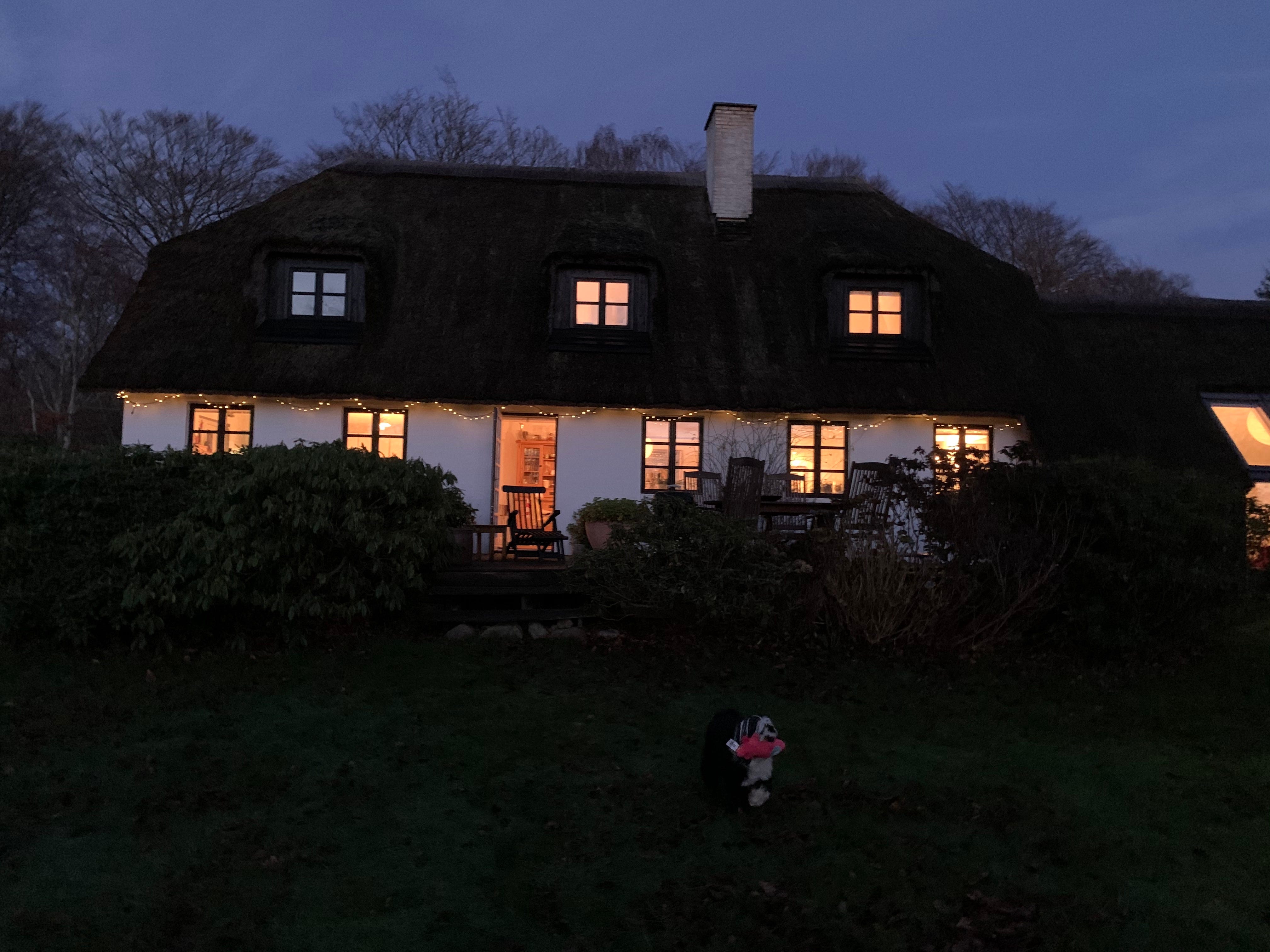
Being an earthy creature, where I live is very important to me and my well-being, but I’ve spent a lot of years in the past overriding my initially unimpressed intuition and living in houses that have been kind of OK for me rather than really great, and then working to try and make them fit. I decided that my latest house move in Denmark was going to be different. I’ve always had lots of dreams (waking and sleeping) about living in a house with a view of the woods and being surrounded by nature, and as Denmark has a lot of woodland to offer I figured this might be the place I could make that happen. We spent a lot of the first Covid lockdown in a small flat in Copenhagen with two dogs and little outside space. This gave us the impetus we needed to get out of the city, and we started to spend a lot of time exploring areas we might like in commutable distance to Copenhagen. We weren’t in agreement with the Danes that the longest possible commutable distance from Copenhagen would be 30km, so we were happy to cast the net a little further. Eventually we saw a lovely house near enough to some pleasant woodland in a place called Allerød. Dave was excited, and I was excited about the Icelandic ponies across the road, but I had the same sneaking suspicion I’d had with past houses - that it was in the vicinity of what I wanted, but not quite threre. My intuition was yelling “no!”, but reason was saying that this house ticked enough of our boxes and would be fine. We made pros and cons lists and I convinced myself to settle. So we started the process of buying it. We got ourselves a Danish solicitor, a mortgage and very quickly after, a contract. We were, in short order, ready to sign on the dotted line. The night before it was finalised I was browsing other houses on the internet and saw what could only be described as my dream house. It was in its own woodland, in our price range, and was the most picture perfect thatched house I’d ever seen, with all the space we would ever need. I fell in love and really wanted to go visit but my head was telling me “too late to pull out of Allerød now”. The next day, as our pens were poised, the vendors pulled out of the house sale in Allerød on the grounds that they’d received a higher offer. We were disappointed and not a little bit piqued at being gazumped. But my intuition was doing a dance and cheering. It meant we could immediately make an appointment to see dream house in Helsinge. We definitely had some practical reservations about cost and distance so we asked our Danish friend to come along and ask some of the tough questions to keep us rational. As soon as we walked through the door, however, rationality went out of the window for all of us. I fell in love. Dave fell in love, our rational Danish friend said “If you don’t buy it, I will.” The only naysayer was the Eeyore of a Danish estate agent, who’s anti-sales patter opened with “People aren’t usually interested in this house because it’s near to the main road”. I actually snorted in reponse to this because until that point I hadn’t even beem aware of a main road at all. And by that point he could give us any downside he wanted (and he had a good try) because I wasn’t listening to a word. All I could hear was I want this house, I WANT this house. I WANT THIS HOUSE..
We stepped off the cliff, took a leap off faith and bought the house. The sale went swimmingly, the finances worked out fine, everything slotted into place. The vendors were a dream, leaving us all the stunning light-fittings, Bose speakers and TVs we could use. They also left us all the kit for cleaning the swimming pool. Yes the swimming pool, and also furnished us with a garage stocked with every gardening and household tool known to man. We have named the garage ‘the garage of dreams’ because it seems that whatever we wish for shows up there immediately after (including our much loved, trio of black cats, but that’s another story). I am so glad that for once I followed my heart and my heart led me here. I wake up every morning with a view of the woods and a happy heart. Best decision ever.
As an upright species we pride ourselves on our rationality: the neo-cortical faculty which sets us apart from the other animals furnishes us with ability for critical analysis, which is the supposed foundation of all good decision making and logical action. When faced with a problem to solve or a decision to make we start creating lists and flow charts and discussing pros and cons. We come up with rational explanations for our actions and convince ourselves that our solutions are entirely founded on reason.
And the human neocortex is amazing at solving objective problems. It has enabled us to build the Eiffel Tower, invent the internal combustion engine, and create the internet so that we can enjoy all the benefits of a civilised society, plus Netflix. But when it comes to making subjective life decisions and solving highly complex interpersonal problems like buying houses the neo-cortex is a bit shit. In even the simplest of day to day decisions: at what point to cross the road, whether to take an umbrella, or to have the cafelatte or the machiato, there is an impossible amount of information to weigh consciously, so logic is difficult to apply. We therefore have to rely, to some extent, on our senses and feelings. In hugely important life decisions we can tie ourselves up in intractable knots if we try to find the right objective solution because there often isn’t one, and working out the odds of any of it would take the Einstein of mega-computers to fathom.
Even if there is a logical path to follow, if, for example, the advantages of leaving our job or partner radically outweigh the disadvantages, that will not make it the ‘right’ thing for us if we are not feeling it in our gut. In the years I’ve worked as a therapist I’ve seen a lot of people struggling to make big life decisions. Many times in Session 1 it was blatantly obvious (to me) that they knew (intuitively) what they needed to do (often - leave the job, leave the partner, or make the change to follow their dream) but it would typically take a tad (!) longer and a metric shit ton more struggle for them to overcome the overthinking and obstacles that would block their initial intuitive knowing.
Our ancestors knew that in order to make good decisions we have to rely on what’s inside whether we call it gut feeling, instinct or intuition. If they met a lion wandering in the Savannah they would not have whipped out an smart phone to make a list of the pros and cons of running away, they would just have bloody run (or fought or attempted to make themselves invisible) in split seconds of seeing the problem. We still have the capacity to make incredibly complex decisions incredibly quickly if we listen to what our intuition is telling us and not block it by chattering thought.
The problem is that intuition, gut feelings and feelings in general have a bad rap in our left-brain-rational world. In job interviewing, for example, we must be seen to be engaged in a rational decision-making process in order to appear fair and even-handed. And this is admirable. It’s important that interviewers, judges, doctors all aim for a lack of bias and prejudice in decision-making. Trouble is, as humans, we cannot remove our feelings from the equation. Apparently 60% of interviewers know within the first 15 minutes if the candidate they’re interviewing is suitable for the role. And, nearly 30% of interviewers have made up their mind within the first five minutes of meeting a candidate. Evidence suggests that we make a decision early doors and then retrospectively find the evidence (a cognitive rationale) to back it up.
This may be somewhat alarming, but whether we like it or not, our emotions are key in making decisions. So maybe we should just embrace this and admit it. We would struggle to make any decisions at all without our emotional intelligence. Emotions are the arbiter of our rational processes and allow us to solve complex dilemmas in double quick time. Researchers have found that people with certain types of brain damage affecting their ability to experience emotions also have a decreased ability to make good decisions. If we want to make optimal decisions we need the intelligence of the emotions at least as much as we need cognitive analysis.
You can train your intuition like any other aspect of your body-mind, if you let your body be your guide and your feelings be your compass. Next time you have a decision to make, where there is too much data to work it out rationally, tune in on the inside rather than looking outwards for solutions. Try asking your body for a ‘yes’ or ‘no’ signal (one at once) and pay attention to what you feel. (a tingling in the foot, a twinge in your belly, or maybe a twitch in your finger for example might be useful information). Then ask the right way to go “shall I do x, shall I do y” and see what comes. For some people signals are visual. One of my lovely clients had a traffic light system that he would call on to help him make decisions about people or in business. Green light go. Red light hold back. For others it’s auditory, they tune in to an inner voice telling them stop or go. What’s important is that you and your intuition come up with something that you are both comfortable with. Whatever you do here, don’t be tempted to work it out with your head. That would really defeat the point of this whole thing. Once you’ve opened a channel, use it. Get into training. Lift the weights to develop your intuition several times a day. Use it to decide about anything, start with the trivial. “Shall I go for a run or watch ‘Below Deck Med’?” “Red or white?” The more trivial the better at the start because it matters not if you get it wrong. I’m still in training with this too, and many times I forget and override the still small absolutely fecking right voice, but when I remember, put the lists down and and follow my heart, it has never let me down.
No posts
Comments
Nothing yet. Say the first thing.
Sign in to join the conversation.