
I recently re-read a paper from my previous boss at Liverpool FC, Darren Burgess.
Darren, or Burgo as most know him, is someone I’ve learnt a lot from over the years. In his 2017 paper, The Research Doesn’t Always Apply, he discusses the balance between understanding the research and applying it within the realities of elite sport.
It got me thinking about how my own views on this have changed over the years.
When I was completing my PhD back in 2010, I was researching training load monitoring and its application to periodisation in football.
A lot of the literature I read was based around periodisation theory and principles, from authors such as Tudor Bompa. There were some good training studies in football, but nothing concrete that said, “this is the best way to periodise and monitor football training.”
In reality, a lot of what we applied came from the collective experience of people working in elite football, with scientific principles adapted to our own context.
Over 15 years later, the volume of football research has increased significantly.
Yet I still regularly read papers and think, “so what?”
That’s not necessarily a criticism. Research doesn’t have to completely change practice every time a new paper is published.
But I do think there is an interesting tension between those who stick closely to the research and those who rely more heavily on experience, with most practitioners probably sitting somewhere between the two.
When we look at the hierarchy of research designs, much of the research conducted in professional football sits towards the lower end of the evidence spectrum.
Many studies are retrospective and observational. They use data that was originally collected for applied rather than research purposes. This can sometimes mean the available data drives the research question rather than the other way around.
We’ve also seen a boom in systematic reviews and meta-analyses.
Well-conducted systematic reviews can be incredibly valuable. But not all reviews are equal.
Sometimes a review starts with a large body of literature but, after applying the inclusion criteria, ends up with a small number of studies of varying quality.
The conclusions can therefore be fairly cautious.
Then those conclusions hit social media.
Suddenly a nuanced finding becomes a catchy headline telling practitioners what they should or shouldn’t be doing.
There is also the question of who we actually study.
A lot of football research isn’t conducted with elite professional players. We also see a bias towards academy players, where data can be easier to collect, and towards men’s football.
Coming back to periodisation, you’d be hard pressed to find a randomised controlled trial comparing different periodisation methods in professional football.
To do that properly, you’d potentially need to convince a head coach to let you manipulate their training programme for several weeks to satisfy the research design.
Not impossible, but probably not happening very often!
This creates another problem.
Practitioners are short on time.
They don’t have time to read dozens of research papers every week and dissect the methodology behind each one.
Ultimately, they want to know:
“What should I do?”
The acute:chronic workload ratio is a good example.
It became widely adopted in sport, partly because it gave practitioners something simple to track. Calculate a number, identify a supposed “sweet spot” and use that information to guide training.
Since then, significant methodological and mathematical limitations of the approach have been highlighted.
But I think we see this pattern regularly.
Interestingly, over the years I’ve sometimes found that papers with less research credibility, such as narrative reviews, opinion pieces and non-peer-reviewed articles, can have a bigger influence on practice.
Why?
Probably because they give practitioners something they can actually do.
Research itself is never finished. A good study with novel findings often creates more questions than answers.
As sport scientists, that’s what we’re trained to do. Keep asking questions and don’t simply accept the status quo.
But I also understand the frustration of the practitioner who looks at the literature and thinks:
“Five papers say this, five papers say something different. What the hell am I supposed to do on Monday morning?”
This is where I think experience becomes important.
Experienced practitioners accumulate a huge amount of knowledge through trial and error.
They spend thousands of hours working with players and coaches. They learn which drills work for them, which methods haven’t worked and how different players respond.
They also understand their own football environment.
I’ve had plenty of situations during my career where the research might point towards one approach, but the schedule, coach preference, players or resources in front of us meant we had to adapt it.
That doesn’t mean ignoring the science.
The best practitioners I’ve worked with have generally been open-minded, but also cautious about adopting a new method without applying some form of scientific filter first.
This feels increasingly important when research findings can be reduced to a graphic, headline or AI-generated summary on social media.
Seeing a study doesn’t mean we need to implement it on Monday.
As sport scientists, we shouldn’t lose the critical thinking developed through our undergraduate and postgraduate training.
But there has to be a balance between the rigour of research and the reality of practice.
Before implementing something I’ve taken from research, I think these five questions are useful:
How strong is the evidence?
Does the population and context resemble mine?
Does it align with what I’ve seen in practice?
Is it actually feasible in my environment?
How will I know if it’s working?
Research gives us one part of the answer.
Our job is to take that information, combine it with our experience and understanding of the environment, then make the best decision we can for the players in front of us.
And importantly, evaluate whether it actually works.
The purpose of this article isn’t to dismiss the value of research in football.
Far from it.
There are many great research studies that have changed how we prepare players, monitor training and understand football performance.
My advice is to keep your scientific filter switched on.
Read the research. Question it. Understand its limitations. Be open to trying new things. But don’t assume that because something has been published, it automatically applies to your environment.
As Burgo argued nearly 10 years ago, research should inform our decision-making, but rarely dictate it.
For me, that distinction remains as relevant as ever.
That’s all for today.
See you next Friday.
James
If you’re serious about growing your career in football, join a global community of 90+ physical performance and sport science practitioners inside the Football Performance Network.
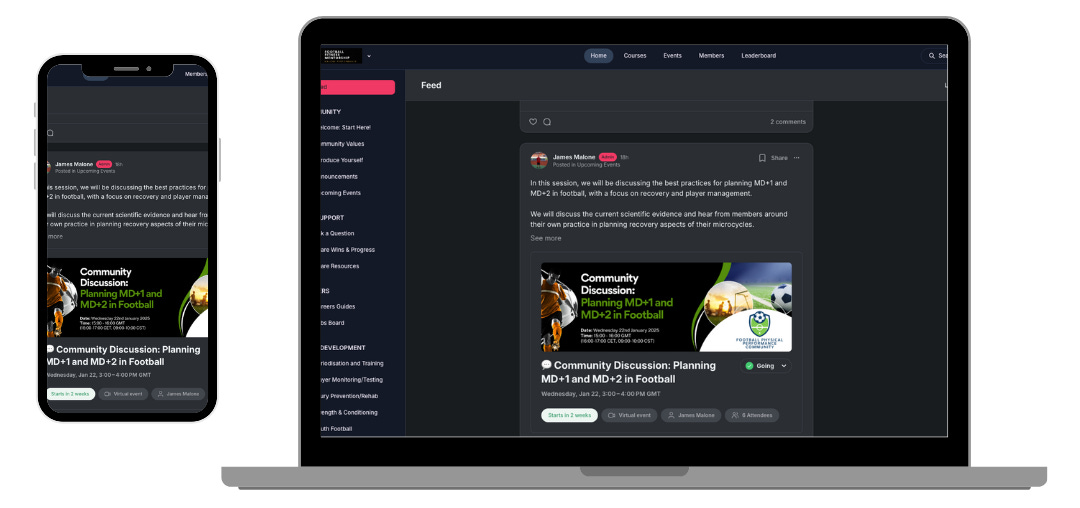
As a member, you’ll get:
✅ Direct 1:1 career support and community feedback
✅ Live events with elite-level experts
✅ Practical, research-informed learning you can use immediately
✅ A supportive network that understands your journey
⚽️ Our doors open again in 2027.
🔗 Join the waitlist today to be first in line when applications open.
No posts
Comments
Nothing yet. Say the first thing.
Sign in to join the conversation.