
There are many different types of constraints that we can apply in football training to manipulate the outcome.
One of the biggest factors in physical output during training is the amount of space players have to operate.
Commonly, this space is represented as area per player (m2) and is calculated by dividing the total playing area by the total number of players in a drill (excluding goalkeepers).
Two drills can both use the same overall pitch dimensions, but the relative area per player can substantially influence the physical output.
For example, on a 40m x 30m pitch, one drill might have 5v5 and another a 10v10 set up. This alters the available area per player from 120 m²/player to 60 m²/player.
As the relative area per player increases, so does the opportunity to reach higher running speeds, perform longer accelerations and experience different tactical and technical demands [1].
In research, there has been typically a focus on the use of area per player manipulation on game-based drills.
However, this concept can (and should) apply to all types of drills that coaches can employ as part of their weekly microcycle.
A standard football pitch size in football is 105m x 68m which gives 357 m²/player (excluding goalkeepers and not accounting for space left for holding offside line).
But does that mean our drills in the training week must regularly use this space?
Effective playing space during matches is much smaller and constantly changes depending on team organisation, ball location and phase of play.
So, we must use a combination of different area sizes across the training week linked to the coaches’ game model and physical requirements.
As an example, if we employ a standard 5v5 small-sided game on a 40 x 30 m pitch (120 m²/player) this will produce frequent mechanical (e.g. accels, decels, change of direction) and technical actions.
However, it will also simultaneously underexpose players to high-speed and sprint running.
Thus, increasing the available space can facilitate longer running actions and greater exposure to high-speed and sprint running. For example, a 10v10 large-sided game on a 90 x 60m pitch provides 270 m²/player.
One aspect that practitioners often aim to achieve is to replicate the peak physical match demands (e.g. worst-case scenario) or match load within training drills.
Previous research has attempted to link the relative playing area (m²/player) required to replicate match load depending on player position [2].
Depending on the external load metric and position, the required m²/player was shown to vary between 65 m²/player to 407 m²/player.
This of course presents a practical challenge and questions around the application of such approaches to training.
Rather than relying on exact GPS numbers, we need to think about what physical and football behaviours are we trying to prepare players for, and what space is required to create those opportunities?
Currently there is no clear cut off in terms of what we define as ‘small’, ‘medium’ and ‘large’ relative pitch sizes for players.
For practical planning purposes, rather than as established scientific thresholds, we might broadly consider:
Small = <100 m²/player; High density, more accelerations, decelerations, COD and mechanical load.
Medium = 100 to 200 m²/player; Mixed locomotor demands.
Large = >200 m²/player; More space for longer accelerations, HSR and higher velocities.
The key is not to find an optimal m²/player or simply replicate match values. Instead, practitioners can use relative pitch size as one constraint within practice design to increase or decrease the likelihood of specific physical demands emerging.
For example, if the aim of a session is to expose players to higher running speeds, the coach might increase the relative pitch size from 100 m²/player to 200 m²/player.
This does not guarantee more high-speed running, but it creates greater space for players to accelerate and reach higher velocities. Conversely, reducing the area towards 75 to 100 m²/player may be useful when the aim is to increase mechanical loading.
Relative pitch size does not tell us about pitch shape. Two practices can have exactly the same m²/player but very different length-to-width ratios.
Increasing pitch length may provide greater opportunity for longer accelerations and higher-speed running, while increasing width may create very different movement and tactical demands.
Practitioners should therefore consider m²/player alongside the absolute length and width of the practice area, particularly when targeting specific physical outputs.
It should also be noted that relative pitch size is only one constraint within practice design.
The same m²/player can produce very different demands depending on the number of players, pitch dimensions, rules and whether goalkeepers and goals are used.
For example, smaller player numbers typically increase individual involvement, while the inclusion of goalkeepers and goals can encourage more directional and vertical play.
Practitioners should therefore avoid using m²/player as a standalone prescription and instead consider how it interacts with the wider design of the practice.
Area per player provides practitioners with a simple way to quantify and manipulate the space available to players during training.
However, there is no optimal m²/player that will guarantee a specific physical output or replicate match demands. Instead, relative pitch size should be used as one constraint to increase or decrease the opportunity for certain physical actions to emerge.
The key is to consider what physical and football behaviours you want from the session, then manipulate the available space alongside player numbers, pitch dimensions, rules and the use of goals and goalkeepers.
Ultimately, it is not about matching a number, but designing the right environment for the intended training outcome.
That’s all for today.
See you next Friday.
James
References:
If you’re serious about growing your career in football, join a global community of 90+ physical performance and sport science practitioners inside the Football Performance Network.
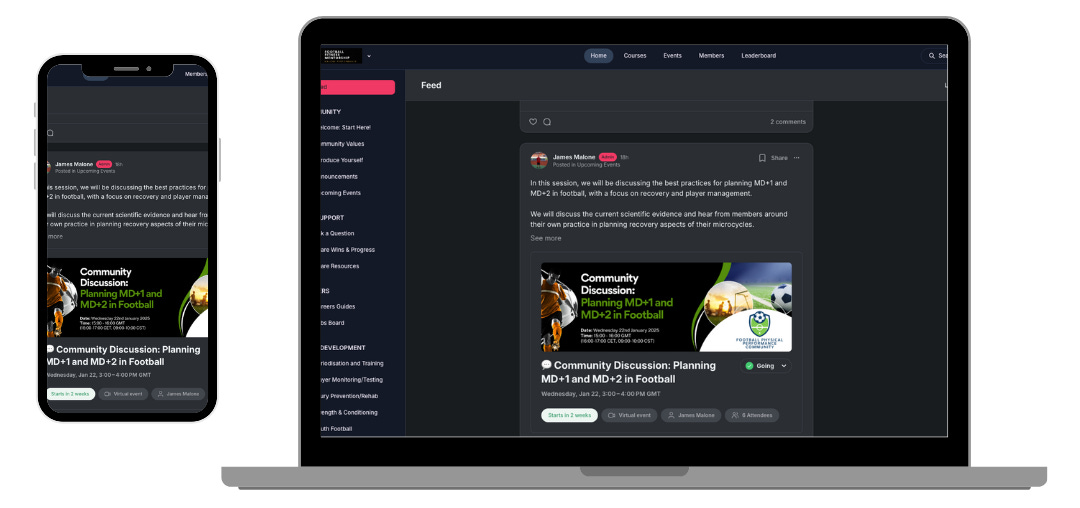
As a member, you’ll get:
✅ Direct 1:1 career support and community feedback
✅ Live events with elite-level experts
✅ Practical, research-informed learning you can use immediately
✅ A supportive network that understands your journey
⚽️ Our doors open again in 2027.
🔗 Join the waitlist today to be first in line when applications open.
No posts
Comments
Nothing yet. Say the first thing.
Sign in to join the conversation.