
Injury prevention strategies often look straightforward on paper.
Collect injury data, identify the main problems, introduce an intervention and assess whether injury rates improve.
The reality inside football is far more complex. Practitioners work within congested schedules, limited budgets, changing coaching priorities and multidisciplinary teams. Decisions often need to be made before perfect evidence is available.
Mattiussi and Shaw (2026) propose an operational framework to help practitioners move from injury data to practical action. Rather than presenting another isolated prevention programme, the framework provides a structured decision-making process built around four stages: understand, identify, prioritise and deliver.
For football practitioners, its value lies in helping departments decide which injury problems deserve attention, why they may be occurring and which interventions are realistic within their environment.
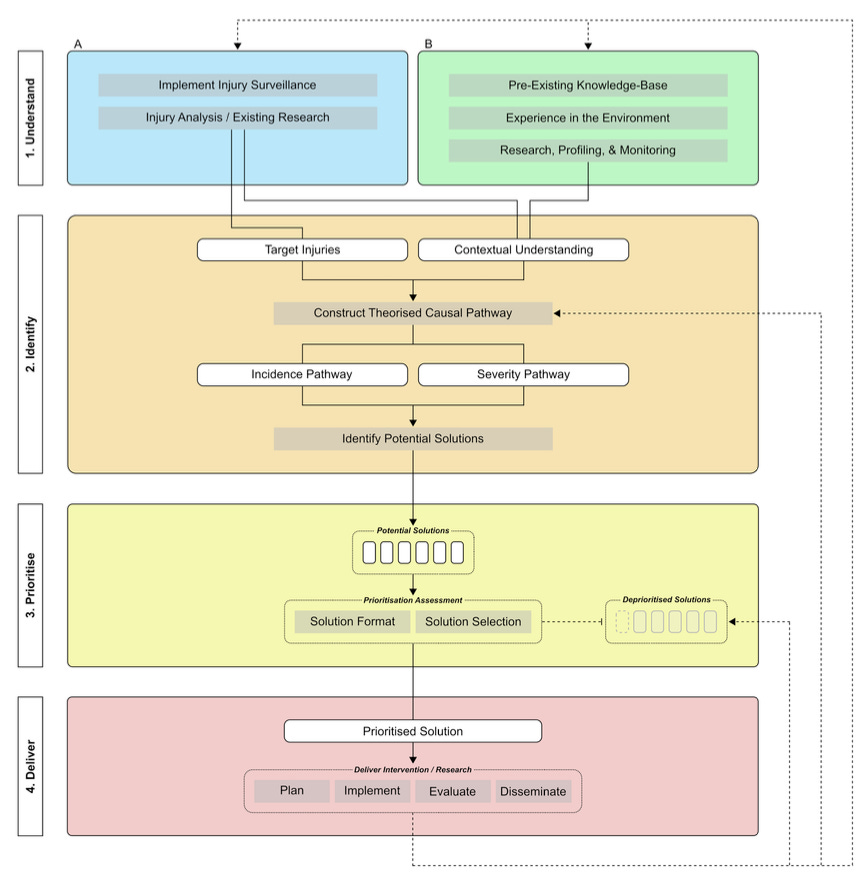
The first stage is to understand the problem before attempting to solve it.
This begins with injury burden. Looking only at injury incidence can create a misleading picture because the most frequent injury is not always the one responsible for the greatest loss of player availability.
Injury burden combines incidence with severity. A relatively uncommon injury that results in several months of absence may create a greater burden than a more frequent injury that typically causes only a few days of time loss.
This distinction also shapes the objective of an intervention. If burden is driven mainly by incidence, the priority may be reducing how often the injury occurs. If it is driven mainly by severity, improving rehabilitation outcomes and reducing return-to-play time may have a greater impact.
However, injury data cannot be separated from the environment in which those injuries occur. Fixture congestion, training practices, playing surfaces, squad depth, coaching decisions, athlete beliefs and communication between departments can all influence injury outcomes.
Practitioners should therefore combine surveillance data with observation, staff discussions, athlete feedback and knowledge of the club. The aim is not simply to identify which injuries occur, but to understand why they matter within that particular environment.
Once a priority injury has been identified, the next step is to develop a plausible explanation for how the problem occurs.
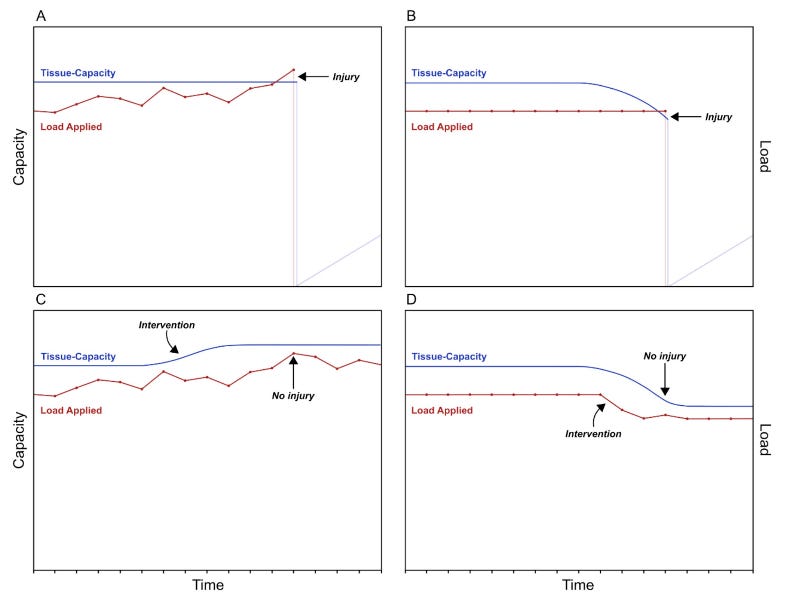
The authors suggest working backwards from the injury outcome and constructing a theorised causal pathway. For injury incidence, the central principle is the relationship between tissue load and tissue capacity. Injury occurs when the load placed on a tissue exceeds its current capacity.
This creates two broad intervention options. Practitioners can attempt to increase the capacity of the tissue or reduce the load it experiences.
For example, a club experiencing a high number of hamstring injuries might consider whether players have insufficient exposure to high-speed running, inadequate eccentric strength, poorly managed spikes in sprint load or limited recovery between matches. Each explanation would lead to a different intervention.
The framework also distinguishes between proximal and distal factors. A proximal factor may have a relatively direct relationship with injury, such as sprint exposure or tissue capacity. A distal factor may operate indirectly, such as coaching culture, fixture scheduling or player beliefs.
This is important because the most visible factor is not always the most influential. A strength programme may be scientifically appropriate, but it will have limited value if the coaching schedule provides no opportunity to complete it consistently.
The framework encourages practitioners to make their reasoning explicit. This does not prove causation, but it makes assumptions visible and allows them to be questioned by the wider multidisciplinary team.
A club may identify several plausible solutions, but it will rarely have the resources or organisational capacity to implement all of them.
The third stage assesses potential interventions according to evidence, risk, impact and feasibility.
An intervention supported by strong evidence and carrying little risk may be ready for implementation. A low-risk intervention with limited evidence could be introduced cautiously as an applied trial. A high-risk intervention with weak evidence should remain within controlled research rather than being implemented across a squad.
Practitioners must then consider the likely impact and feasibility of each option. Feasibility includes more than financial cost. It also covers staff time, equipment, expertise, compatibility with the football schedule and support from coaches and players.
A potentially effective intervention that cannot be delivered consistently may be less valuable than a slightly less sophisticated intervention that becomes part of normal practice.
This stage protects departments from chasing every new injury prevention idea. It encourages transparent decisions about where resources should be directed and why one intervention has been prioritised over another.
Selecting an intervention is only the beginning. Its effectiveness will depend on how well it is implemented.
Practitioners should determine who will lead the intervention, who needs to support it, what barriers may appear and how it will fit around existing football processes. Engagement from players, coaches, medical staff and performance staff is essential.
Evaluation should also extend beyond whether injury rates decrease. Football squads are small, injuries contain an element of randomness and multiple interventions may be introduced simultaneously. This makes it difficult to attribute changes in injury outcomes to one specific action.
Departments can therefore monitor process measures alongside injury data. These might include player adherence, completion of targeted training exposures, changes in physical capacity and whether coaches consistently provide the required time within the microcycle.
The results should then inform the next cycle of decision-making. An intervention may need to be adapted, a causal pathway reconsidered or a previously rejected solution revisited as resources and circumstances change.
The framework is therefore not a linear process with a fixed endpoint. It is an ongoing cycle of understanding, action, evaluation and refinement.
The most useful injury strategy is not necessarily the most complex or the one supported by the greatest amount of data. It is the strategy that targets a meaningful source of injury burden, follows a plausible causal pathway and can be delivered consistently within the football environment.
Mattiussi and Shaw’s framework provides practitioners with a structure for moving from injury surveillance to practical decision-making.
Understand the burden and context. Identify plausible causes. Prioritise solutions according to evidence, risk, impact and feasibility. Deliver the intervention, evaluate the process and adapt when required.
Injury prevention in football will never offer complete certainty. However, making the reasoning behind decisions more explicit can help practitioners act with greater clarity, transparency and purpose.
That’s all for today.
See you next Friday.
James
If you’re serious about growing your career in football, join a global community of 90+ physical performance and sport science practitioners inside the Football Performance Network.

As a member, you’ll get:
✅ Direct 1:1 career support and community feedback
✅ Live events with elite-level experts
✅ Practical, research-informed learning you can use immediately
✅ A supportive network that understands your journey
⚽️ Our doors open again in 2027.
🔗 Join the waitlist today to be first in line when applications open.
No posts
Comments
Nothing yet. Say the first thing.
Sign in to join the conversation.