
Physical profiling is now a common part of the performance programme in professional football.
Practitioners can assess maximal strength, explosive strength, reactive strength, jump performance, acceleration, maximal velocity and sprint mechanics.
The challenge is no longer finding something to test. It is deciding which assessments provide useful information and how the results should influence training.
A testing battery can look sophisticated without improving a single decision. Players may complete several assessments and receive detailed reports, but the findings never translate to a clear development plan.
Effective profiling should answer four questions. What does the player’s role require? What are their strengths and limitations? What should be prioritised? How will we determine whether the intervention has worked?
If profiling cannot answer these questions, it risks becoming data collection rather than performance support.
Profiling should begin with football, not the testing equipment available.
The physical requirements of a centre-back are different from those of a full-back, winger or central midfielder. Even players in the same position may perform different roles depending on the team’s tactical model.
A full-back expected to repeatedly overlap, recover defensively and defend large spaces may require a different physical profile from one who moves inside during possession.
This means a low score is not automatically a meaningful limitation.
Practitioners must consider how important the quality is to the player’s position, tactical role and likely match actions. The same physical limitation could be a priority for one player and only a maintenance consideration for another.
Individual context also matters. Injury history, training age, availability and previous exposure to structured strength or speed training will influence how the results are interpreted (Haff & Nimphius, 2012).
The process should move from football demands, to individual requirements, to assessment and interpretation. Only then should a development priority be selected.
Players are often described as strong, powerful, fast or explosive. However, these qualities cannot be accurately represented by one test or number.
Strength may refer to maximal force, rapid force production, dynamic strength or reactive strength. A player can perform well in one expression while displaying limitations in another.
Power reflects the interaction between force and velocity. Two players may achieve the same countermovement jump height using different strategies. One may rely more on force production, while the other uses a faster movement strategy (Cormie et al., 2011).
Speed is also multidimensional. Acceleration, maximal velocity and sprint mechanics are related, but they are not interchangeable (Morin et al., 2012).
A player may record a good 10-m time but possess a relatively low maximal velocity. Another may reach a high top speed but apply horizontal force inefficiently during acceleration.
Headline outcomes can therefore conceal the mechanism behind performance. Mechanical profiling and movement analysis can help practitioners distinguish between force, velocity, power and technical limitations.
The aim is not to collect every available metric. It is to understand why a player performs in a particular way and identify the characteristic most likely to respond to training.
The growing number of available assessments does not mean they should all be included.
Testing requires staff time, player effort, equipment and space within the training week. Every assessment should therefore justify its place.
A useful battery can combine core and individual assessments.
Core assessments are completed consistently across the squad. These could include a countermovement jump, an isometric strength test and acceleration or maximal-speed measures. This supports squad benchmarking and allows changes to be monitored across the season.
Individual assessments should investigate a specific performance, development or rehabilitation question. A player returning from injury may require additional reactive strength measures. A winger with limited maximal velocity may benefit from sprint profiling and video analysis.
Each test should be judged by its relevance, validity, reliability, sensitivity, feasibility and actionability (Hopkins, 2000).
The final criterion is particularly important. Could the result realistically influence a training decision?
Testing conditions must also be standardised. The warm-up, instructions, equipment, technique and position within the microcycle can all affect performance.
A change in a score does not automatically represent adaptation. Practitioners must understand the normal variation associated with each assessment and determine whether any improvement exceeds the expected measurement error (Buchheit et al., 2013).
The purpose of profiling is not to create an impressive report. It is to establish clear priorities.
A player’s lowest score should not automatically become their primary training focus. Practitioners must consider the importance of the quality, the size of the limitation, confidence in the data, previous training history and the opportunities available within the football schedule.
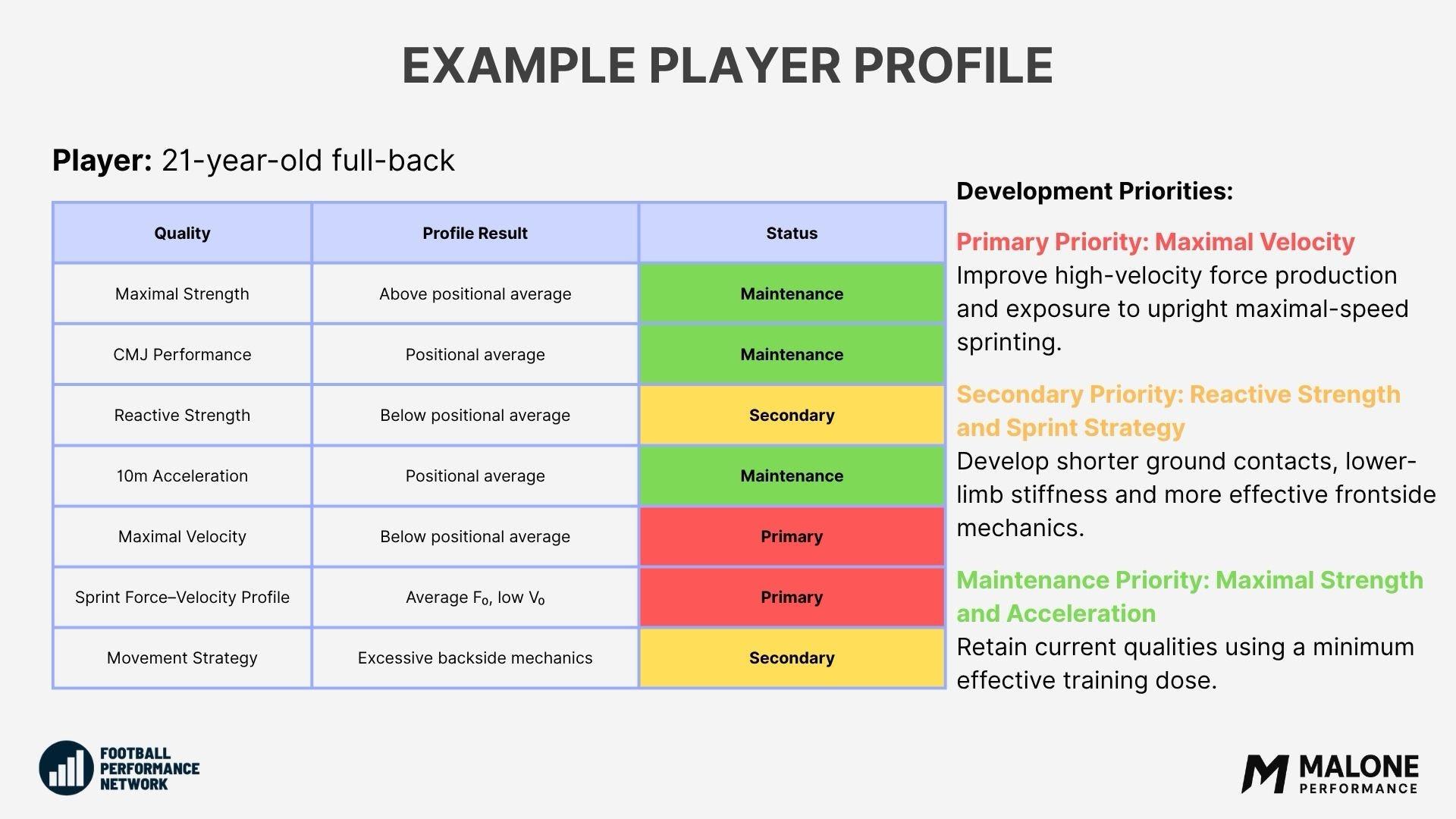
Imagine a young full-back who demonstrates good maximal strength, average acceleration and jump performance, but below-average reactive strength and maximal velocity.
Sprint profiling identifies a lower velocity capability, while video analysis shows inefficient mechanics at maximal speed.
Maximal velocity could become the primary priority because it is important to the player’s role and supported by several sources of information. Reactive strength and sprint mechanics could become secondary priorities, while maximal strength and acceleration are maintained.
This primary, secondary and maintenance structure links testing directly to programme design. It also prevents practitioners from trying to improve every quality simultaneously.
Profiling becomes valuable when it narrows the focus.
Physical profiling should begin with the demands of the player’s position and tactical role. A low score only matters when the quality is relevant to what the player needs to do on the pitch.
Strength, power and speed cannot be explained using one test. Performance outcomes may need to be supported by mechanical information and movement analysis.
Testing batteries should be focused, reliable and practical. Every assessment should provide information that could influence a training decision.
Finally, classifying qualities as primary, secondary or maintenance priorities allows practitioners to concentrate training resources on what matters most while retaining the player’s existing strengths.
That’s all for today.
See you next Friday.
James
If you’re serious about growing your career in football, join a global community of 90+ physical performance and sport science practitioners inside the Football Performance Network.

As a member, you’ll get:
✅ Direct 1:1 career support and community feedback
✅ Live events with elite-level experts
✅ Practical, research-informed learning you can use immediately
✅ A supportive network that understands your journey
⚽️ Our doors open again in 2027.
🔗 Join the waitlist today to be first in line when applications open.
No posts
Comments
Nothing yet. Say the first thing.
Sign in to join the conversation.