
United States Director of the Central Intelligence Agency (CIA), John Ratcliffe, made an unannounced visit to Moscow that lasted less than two hours, sparking a flurry of speculation. Washington made no attempts to conceal the trip.
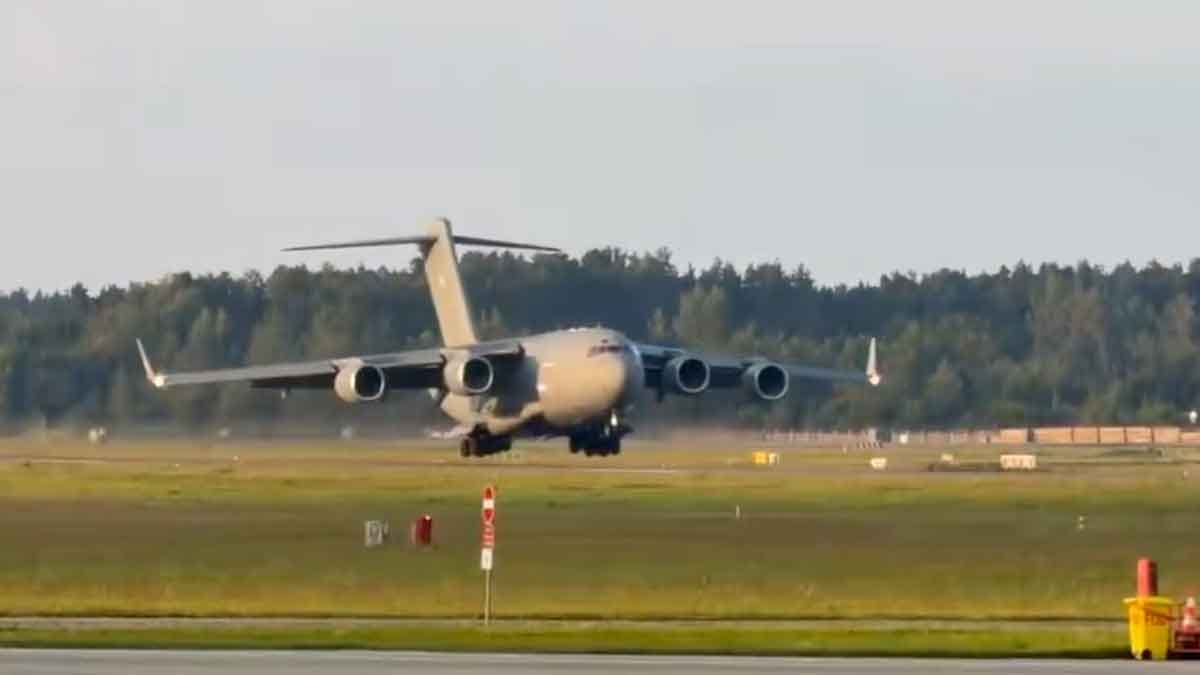
Ratcliffe flew from Riga, Latvia, in US Air Force C-17, 07-7181, landing at Moscow’s Vnukovo Airport at about 10:00 Hours Moscow Time. He was escorted by a Russian security detail to the Kremlin and left less than two hours later. The C-17 returned to Riga, and Ratcliffe departed for Bangor, Maine, on a USAF C-40 VIP transport and leadership support aircraft.
The last time a CIA director visited Moscow was in November 2021, when then Director William Burns reportedly issued an ultimatum that Washington was aware of Russia’s plan to expand its war of aggression against Ukraine.
Separate from Ratcliffe, Vatican Foreign Minister Archbishop Paul Richard Gallagher also traveled to Moscow and met with his Russian counterpart, Sergey Lavrov, urging an end to the Russia-Ukraine War. The last time the Vatican Foreign Minister and a CIA Director were in Moscow at the same time was also in November 2021.
Historically, CIA directors don’t engage in direct diplomacy. Highly public trips to a potential direct adversary typically are meant to deliver a message that Washington knows of activity that is working against the interests of the United States, gauge the response, and compile an analysis. Any unannounced visit by the CIA director to Moscow is highly unusual. Ratcliffe’s trip comes at a time when Russia has become significantly more aggressive on NATO’s Eastern flank and toward Japan.
Wait! While we have your attention, Malcontent News is an independent news agency established in 2016, and we cannot exist without your support. When you subscribe to our Substack or Patreon, you join a community of malcontents who believe that the truth still matters. We cannot continue to exist and fight in a post-truth world without support from readers, listeners, and viewers like you. Now, back to the story.
In the last 30 days, Russia has carried out a lot of provocative acts that have forced the deployment of the diplomatic deep concern brigade.
Speaking to the press on Tuesday, German Chancellor Friedrich Merz confirmed the Federal Criminal Police Office found a third military-grade drone on the edge of Leipzig/Halle Airport with 50 grams of RDX explosives on August 14. The drone was likely intended to be used during a failed attack at the airport earlier in the month.
“The drone attack in Leipzig, among other things, shows that we are also facing very real threats. Germany has come under increased scrutiny from hybrid attackers,” Merz said.
On August 4, a military-grade drone armed with 800 grams of RDX, built to evade detection and hardened against electronic warfare, struck a Ukrainian An-124 heavy lift miltary transport. The detonator disconnected from the impact, and the drone remained hovering next to the airplane. An alert bus driver noticed the drone and swatted it to the ground.
A second drone struck a DHL Boeing 757-200 cargo plane that was forced to abort its landing after a ground stop was issued at Lepizog/Halle Airport. The nose cone and rudder were damaged. Officials have ruled out a bird strike.
Investigators also found signal repeaters and other electronics equipment in Kursdorf, north of the airport. There was evidence that other electronics equipment had been destroyed in place.
Lepizog/Halle Airport is a critical NATO logistics base, where four Ukrainian An-124 transports are stationed. It is also the largest hub for the global logistics company DHL.
Merz said, “We are working intensively on that together with the security agencies, and we will present our findings and comment on them shortly,” adding that those responsible will “pay [a] price.”
On July 29, a Russian Kh-101 cruise missile entered Polish airspace and flew west for almost 100 kilometers before crashing in a field near Otrocz and exploding.
Officially, Poland says that F-16s were prepared to shoot the missile down, but determined it was going to crash in an uninhabited area seconds before firing.
Speaking with anonymous sources, Polish air defense was able to determine the missile’s final trajectory because it did a tip-up maneuver right before crashing in the field. The missile’s trajectory indicates that it was not an accidental airspace violation and had been programmed to crash in the remote area.
Subsonic cruise missiles such as Russia’s Kh-101/102 and the US Tomahawk fly using a very low trajectory, using the terrain to make tracking and interception more difficult. In its terminal phase, the Kh-101 can be programmed to tip up, climbing to about 1,500 meters and then striking the target from above. The crater found near Otrocz was consistent with a straight-down impact.
Privately, Polish officials believe the incident was meant to test NATO’s air defenses.
The Romanian Air Force has been forced to scramble fighter planes and helicopters dozens of times in the last month due to repeated airspace and territorial waters violations by Russian drones and missiles entering from Ukraine, Moldova, and the Black Sea.
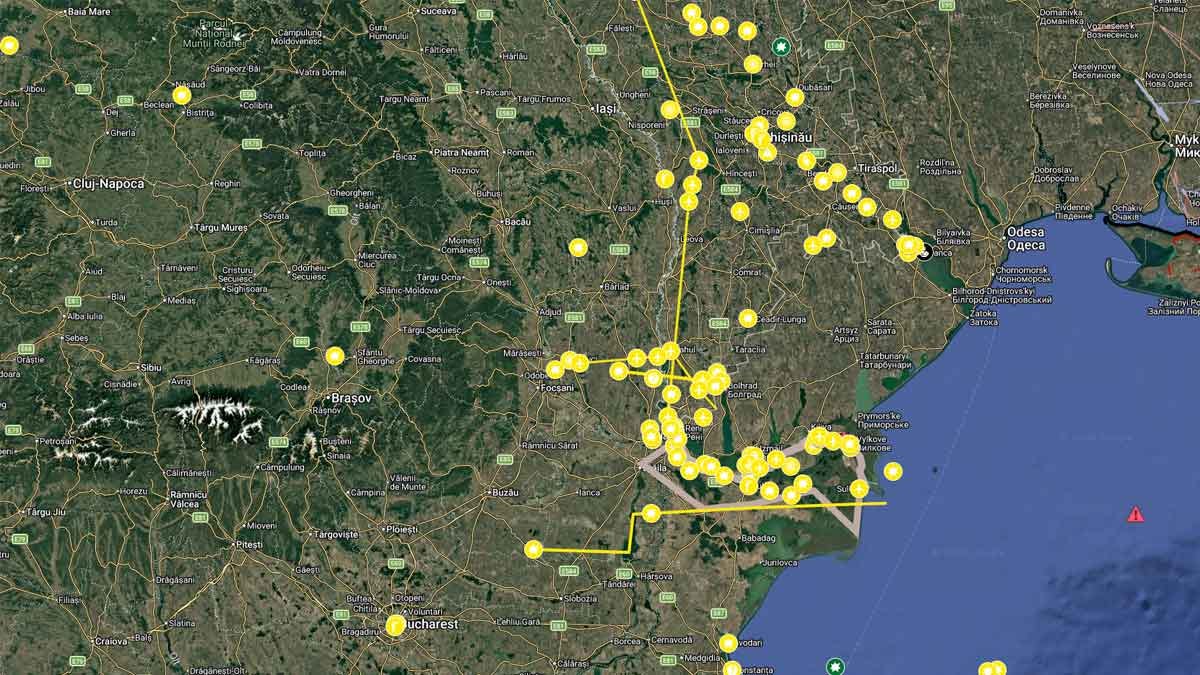
July 25: A Romanian Air Force F-16 shot down a Russian Geran drone north of Brasov, 205 kilometers west of the Ukrainian border
August 2: Russian drone debris was found near Periprava, in the Danube River Delta
August 11: Two armed Russian Gerbera drones that were adrift near Romania’s Neptun Deep Sea Drilling Site were destroyed in place
August 12: A Russian drone violated Romanian airspace for 10 minutes near Chila Veche in the Danube River Delta
August 13: A Russian drone violated Romanian airspace near Pardina on the Danube River
August 13: A second Russian drone violated Romanian airspace near Lacul cu Cotete
August 14: A Russian drone violated Romanian airspace, crashing near Rachelu
August 15: A Spanish F-18 flying combat air patrol for NATO shot down a Russian drone near Cudalbi after it entered Romanian airspace from Moldova
August 16: Debris from a Russian uncrewed surface vessel was found 1.5 kilometers from Constanta and destroyed in place
August 20: A Romanian F-16 destroyed an armed Russian uncrewed surface vessel approximately 400 meters from the Neptun Deep Sea Drilling Site
August 20: A Russian drone violated Romanian airspace and crashed near Grindu
August 20: Multiple Russian drones strike the Moldova-Ukrainian-Romanian Reni-Giurgiulesti Border Checkpoint
August 21: Multiple civilians in Foltesti reported a drone overflight
August 23: Russia conducts a second attack on the Moldova-Ukrainian-Romanian Reni-Giurgiulesti Border Checkpoint
August 24: A Russian drone violated Moldovan and Romanian airspace, flying for almost four hours before crashing near Ciuslea
August 25: Romanian F-16s were scrambled and flew to the Black Sea coast after two Russian drones were detected flying west over Snake Island
Romania’s Defense Minister Radu Miruță told reporters that from Friday to Sunday, the Romanian military responded to 18-drone related incidents. By Tuesday, the count had climbed to 21.
Miruță said that he is in constant contact with his Ukrainian counterparts and called the Russian activity “unacceptable,” adding, “Romania is not a country at war.”
While not mentioning any specific technology, he also admitted that Russian drone technology had leapfrogged NATO detection and tracking equipment. On August 24, Romanian air defenses struggled to track the Russian drone that entered the country from Moldova, eventually losing track of it. The debris was found four hours later, 15 kilometers from the UAV’s last known location.
Multiple Russian military bloggers are falsely claiming that arms for Ukraine are being transported by sea to Romanian ports to justify the overflights and border attacks. Ukraine does not receive seaborne arms shipments, which are delivered to the country through land crossings in Romania, Hungary, and Poland.
In the last nine months, over a dozen migrant tunnels dug under the borders of Poland, Lithuania, and Latvia have been discovered. Both sides of the border are militarized, indicating that Belarus and Russia and complict in the illegal migration and tunneling activity.
The most serious incident was in July, when approximately 20 migrants used a tunnel to cross into Lithuania near the Kapčiamiestis border post. A group of four border guards planned to ambush the group, but instead were attacked. Some of the migrants attempted to drag a guard into the tunnel, causing minor injuries.
Russian soldiers have used tunnels, sewage, water, and gas pipelines to get behind Ukrainian defenses. Considering that the tunnels being built along Belarus’ militarized border have to be done with the assistance of the government. The activity becomes more concerning.
Multiple intelligence agencies, including the CIA, have determined that Russia has been providing targeting information, battle damage assessment, satellite imagery, and improved electronics for drones and missiles to Iran. The activity increased after the US/Israel-Iran War started in February.
Ratcliffe wouldn’t be sent to Moscow for diplomatic talks or to request assistance in finding an off-ramp for the ongoing war. The CIA director would be sent to confront his counterparts with the evidence of Russian involvement.
Reaching out for Moscow’s assistance to end the war in Iran would more likely come from Vice President JD Vance, Secretary of State Marco Rubio, or US Special Envoy Steve Witkoff.
On August 18 and 19, up to 50 NATO aircraft conducted a high-visibility exercise near the Russian exclave of Kaliningrad at the strategically critically Suwalki Gap. The United States, Norway, Lithuania, Latvia, Estonia, and Poland participated.
Col. Martin O’Donnell, spokesman for Supreme Headquarters Allied Powers Europe, said the unannounced multinational exercise was a deterrence mission.
Aircraft involved include F-35 stealth fighters, KC-135 refueling aircraft, a NATO E-3 Sentry Airborne Warning and Control System (AWACS) aircraft, and a US Air Force EA-37B Compass Call electronic warfare airplane. The EA-37B is designed to disrupt communications, radar, and navigation systems, and it flew for two hours along the Kaliningrad border before returning to Souda Bay in Crete.
NATO and US officials refused to comment on the size of the force involved. However, most of the air missions were flown with transponders on, making them highly visible. NATO wanted the world to see its show of force.
Autocrat Vladimir Putin views concessions and compromise as weakness, and has repeatedly exploited acts of goodwill. Türkiye, Syria, the Baltics, and Ukraine have demonstrated that when faced with a strong response. Russia consistently backs down.
After multiple incidents of undersea infrastructure in the Gulf of Finland and Baltic Sea being damaged by Russian vessels, the activity stopped after NATO launched Baltic Sentry.
When Russia left the Black Sea Grain Initiative in July 2023 and declared an embargo on Ukrainian ports, the Russian Navy intercepted only one vessel. The Black Sea Fleet was forced to withdraw their warships due to repeated attacks by Ukrainian drones.
When former Syrian dictator Bashar al-Assad asked Moscow for assistance against the CMO Alliance in November 2024, Moscow refused to provide ammunition, instead giving al-Assad a ride out of the country.
In 2015, after Russian fighter planes violated Turkish airspace four times, a Turkish Air Force F-16 shot down a Russian Su-24M just 17 seconds after the plane entered the country’s airspace.
Under Secretary of War for Policy Elbridge Colby is an isolationist who hasn’t presented a coherent strategy in Europe or the Asia-Pacific. The path to NATO 3.0, along with Secretary of Defense Pete Hegseth’s unilateral decision to remove a combat brigade from Poland and disband the US Army’s only drone warfare battalion, would be viewed as an American retreat by the Kremlin. Russia is also well aware that US stocks of anti-ballistic missiles and precision weapons are depleted, and the Russian defense industry is outproducing the US.
Multiple intelligence agencies have warned that Russia has been preparing to launch a provocation in Eastern Europe as early as 2027, despite its floundering war of aggression against Ukraine. Putin’s maximalist goals have always gone beyond Ukraine. He has stated as far back as 2011 that he wants to restore the pre-World War I borders of the Russian Imperial Empire. Putin wants to be remembered as a modern tsar such as Peter the Great, who restored Russia’s rightful place in the world.
Additionally, Putin is almost certainly blinded by his inner circle, who are not providing an accurate assessment of the situation in Ukraine. Just in the Dnipropetrovsk Oblast, the Russian Ministry of Defense claims to control over 1,000 square kilometers of territory. While there are still gray zones in Dnipropetrovsk, Russia doesn’t have military control of a single square kilometer of the region.
As unthinkable as it may seem to Kremlin outsiders, Putin is not a man who accepts being lied to. The only thing he tolerates less than hearing “no” is disloyalty. It’s a toxic stew of “Russia is always advancing,” combined with area commanders to corrupt and too afraid to provide accurate assessments.
To a Western observer, Russia conducting a limited military engagement against a NATO nation seems not only impossible, but a terrible decision. Within Putin’s inner circle, Russia is not only winning the Russia-Ukraine War, but Ukraine will be defeated by the end of the year. The US is weak, NATO is divided, and Russia has a date with destiny. It is possible the Kremlin views that the time has come to test NATO resolve.
Additionally, Russia could be reaching the conclusion that a brief military engagement into NATO territory will have minimal consequences. NATO troops won’t enter Russian territory, while support for Ukraine could be dissolved, driven by Europe’s urgent need to defend against a Russian provocation.
Hours after Ratcliffe left Moscow, the US Department of Defense announced that Under Secretary Colby was traveling to Europe to discuss the “United States’ NATO 3.0 agenda.” His trip includes meetings with US European Command and US Africa Command leaders in Germany, the Supreme Headquarters Allied Powers Europe Headquarters, and NATO Headquarters to “brief NATO’s North Atlantic Council and to engage with senior leaders from across the NATO alliance.”
There wasn’t a specific meeting planned for the NATO Atlantic Council this week, indicating this is an impromptu trip.
The next scheduled NATO Military Committee Conference is on September 18-19, in Denmark.
The United States likely wouldn’t send the CIA director to negotiate the end of US intelligence sharing with Ukraine, or to kickstart Russia-Ukraine War peace talks. That’s not the role of the CIA. It’s equally unlikely that the US is further withdrawing support from Ukraine, or offering to help Russia with its fuel crisis.
The recent Senate vote for the Lindsey Graham Sanctioning Russia Act of 2026 shows that support for Ukraine remains very high in the US, despite a bot-amplified, noisy minority in the social media space.
It is also unlikely that a prisoner exchange between East and West was discussed. Exchanges of spies and political prisoners are typically conducted more covertly and involve the US State Department. Additionally, if a potential prisoner swap was imminent, there is usually chatter about the talks.
Only one thing is certain. Washington wanted the entire world to know that Director Ratcliffe visited Moscow.
Comments
Nothing yet. Say the first thing.
Sign in to join the conversation.