
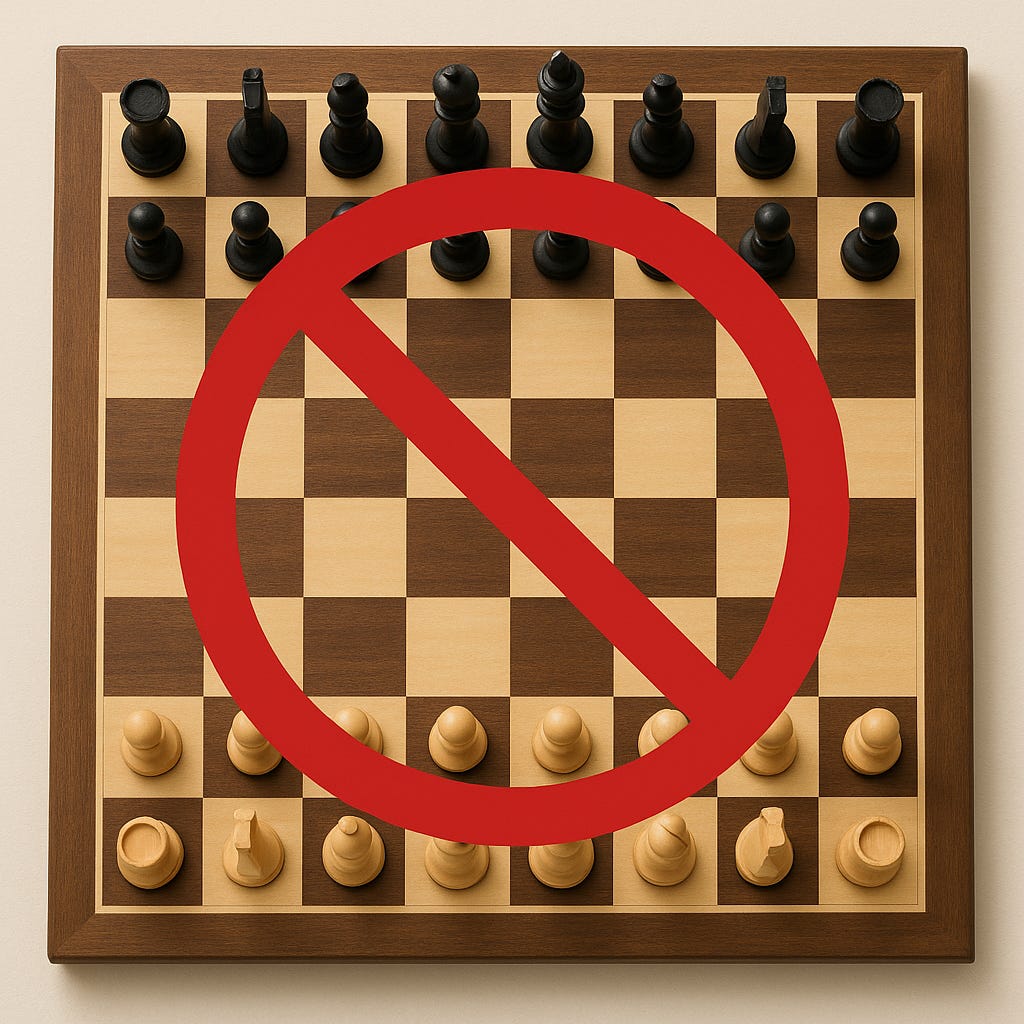
Yesterday, at 8:45 am, I sat down to work on my Big Writing Project. I felt a little scattered from spending the morning chasing my toddler around, though, so I decided that first, before I started writing, I would focus my mind with a quick game of chess.
HA.
Of course, one game turned into many frantic, unreviewed games that ended with me losing about 25 rating points, and by the time I looked up from my laptop, sweaty and addled and not feeling all that great, it was time to go to the gym and then get on with my actual work. I would have to cram my writing in during lunch time later in the day. A prime window had disappeared into the void of tilted chess, and while I still managed to get everything done over the course of the day, it could’ve been a lot less frenetic.
This happens to me more than I would like, particularly with rapid, which I have a bit of a compulsive relationship to. I always want that number to go up, and especially now that I’m within striking distance of 2000, it constantly feels tempting to get in just one more game, to see if I can’t add another eight rating points. If I lose, then, well, I need to get in just one more game so I can come out of the session even. And so on and so forth.
I’ve touched on this habit before in the newsletter, and I’ve even outlined measures that I’ve taken to try and combat it. But these measures were not enough. It’s time for a more extreme choice:
It’s time for No Rapid November.
For those of you who live in caves underground, No Rapid November is obviously a riff on No Shave November, a month in which men don’t shave and then donate money to cancer charities. I don’t really know much about No Shave November, nor does this actually have anything to do with it: the primary relationship is that the month of November begins with “no,” and the month of November is now, and now is when I’m ready to do this. (That being said, if you want to donate money to charity contingent on me not playing any rapid chess during the month of November, please do!)
The bigger priority here is that I want to change my habits. Now, playing a lot of rapid hasn’t necessarily been bad for my chess. My rapid rating has, unsurprisingly, gone up. I’m consistently above 1900 now, and 2000, which always seemed like a pipe dream, is becoming increasingly realistic.
But at the same time, my OTB rating has been going down. After the results of my last tournament, which I plan to write about a bit more next week, it’ll dip below 1600 for the first time. For most of my OTB career, my USCF rating outperformed my online rating according to the ChessDojo ratings converter. Now it’s the other way around — based on my rapid rating, I should be more like 1675-1750 USCF, and I do feel like that’s closer to my true strength.
Is my USCF rating more important than my chess.com rating? No: they’re both meaningless numbers that have only a passing relevance to my actual chess ability, or, even more importantly, the satisfaction and enjoyment that I’m deriving from my engagement with the game. The more important factor is that I can sense an overall imbalance in my pursuit of chess.
We all have different reasons for why we play chess. Some people are true students of the game; some people just think it’s fun; others are sickos who play bullet. To each their own. For me, though, the appeal of chess has always been the depth and complexity of it. It’s simultaneously a game and an intellectual discipline, a subject worthy of Ph.D-level study. And I like studying. I’ve always loved learning new things. It makes me feel connected to the world around me.
Over time, I have slowly started to notice that my enjoyment of chess tends to have a direct correlation to how deeply, rather than frequently, I’m engaging with it. It’s not that I like studying or training more than I like playing; in fact, it’s the opposite. From a pure pleasure perspective, playing is the best. Playing chess is so much fun — except when it’s not, in which case it’s not fun in a way that makes you very painfully aware of how fun it sometimes can be, which is why you keep playing, hoping it’ll go back to being fun again.
But when I study and train in a healthy relationship to playing, chess is more meaningful. That’s the key word here: chess becomes more of an art and a discipline that I’m participating in as a serious practitioner rather than a web game I play on my computer when I should be working, or a board game I play against nine-year-olds one night a week.
Meaning tends to be the north star by which I pilot my life — I’m always seeking out meaningful pursuits, meaningful art, meaningful relationships. So it makes sense that I’d want my chess habit to be the same. But meaning doesn’t necessarily prioritize itself; it’s always at war with quick satisfaction, which comes easier and cheaper and with less effort required.
This brings me back to No Rapid November. After my last tilted session, I realized that the best way to alter my chess habits would be to take the one I wanted to change and cut it out entirely. I’ve tried reviewing every game or pledging to just play one, but now I’m going cold turkey. At the same time, the month-long sabbatical means that I don’t need to feel like I’ll never play rapid again — and in the meantime, it will create space for me to prioritize the study and training I keep putting off to play rapid.
What do I want to study and train? I want to finish Chess Tactics From Scratch. I want to finally tackle Silman’s How to Reassess Your Chess and endgame book. I want to get back into studying master games, ideally with some version of solitaire chess. I want to get around to Jonathan Rowson’s Chess for Zebras, which has been on my shelf for a while and which many people have told me I in particular am going to love, and Axel Smith’s Pump Up Your Rating is also a priority.
As far as training goes, I want to make tactics a much more regular part of my life. I want to consistently do Puzzle Rush Survivals on chess.com, and I want to work on the Woodpecker Method. I also want to make quicker progress through my opening courses, which I tend to move through only when I just got my ass kicked in a rapid game and need to learn how to play the line I lost.
So does this mean I’m not going to play online at all? No, it doesn’t. I’m doing Nate Solon’s 100 Blitz Games challenge, which allows me to redirect my focus toward a weakness of mine, which is playing fast — a weakness that often costs me points in both online rapid and OTB. At the same time, because of the way Nate has structured it — a limited number of games and required review after each game — I feel like it’s tilt-proof and contained in a way that my rapid habit wasn’t.
When I do go back to rapid, I actually want to institute something similar, as best as I can: game caps per session, required review, etcetera. But that’s for down the road. Right now, my priority is everything else.
As for you: feel free to join me in No Rapid November. Or, more to the point, feel free to try and use this month to give up whatever chess habit you think is holding you back the most. The point here is to take control of our approach to the game and make it what we want it to be, rather than letting it define us.
No posts
Comments
Nothing yet. Say the first thing.
Sign in to join the conversation.