
And… welcome back to Good Moves, a newsletter about chess, performance, and other things I’m interested in!
Good Moves has been on a *checks notes* three-plus month hiatus. This wasn’t planned. Summer came, and then my son started day care and kept getting sick, and then my wife and I kept getting sick, and then my wife and I got COVID, and then I got busy working on other stuff, and so on and so forth.
I had already been feeling that my once-a-week pace with the newsletter was unsustainable, so I knew I wanted to slow down, but once I stopped, it was hard to get started again. It took THE GREATEST KNIGHT SAC OF MY LIFE™ to motivate me to pick up the pen (laptop) and spill some ink (tap some keys) once again — and I’ve also been inspired by Nate Solon’s excellent work over at Zwischenzug, where he’s posting daily. If Nate can post daily, I can post… whenever.
In the process, though, I’m planning to open up the aperture a bit. Maybe write about some subjects that are close to my heart (books, movies, writing itself) and feel less pressured to come up with a psychological takeaway from every game I play. We’ll see! I am curious, though: if you are a loyal (or disloyal) reader, what would YOU like to see me write about?
If you voted for option four, then God bless you. Go listen to the SHWEP and then send me a message and we can chat.
Anyway: let’s dive in.
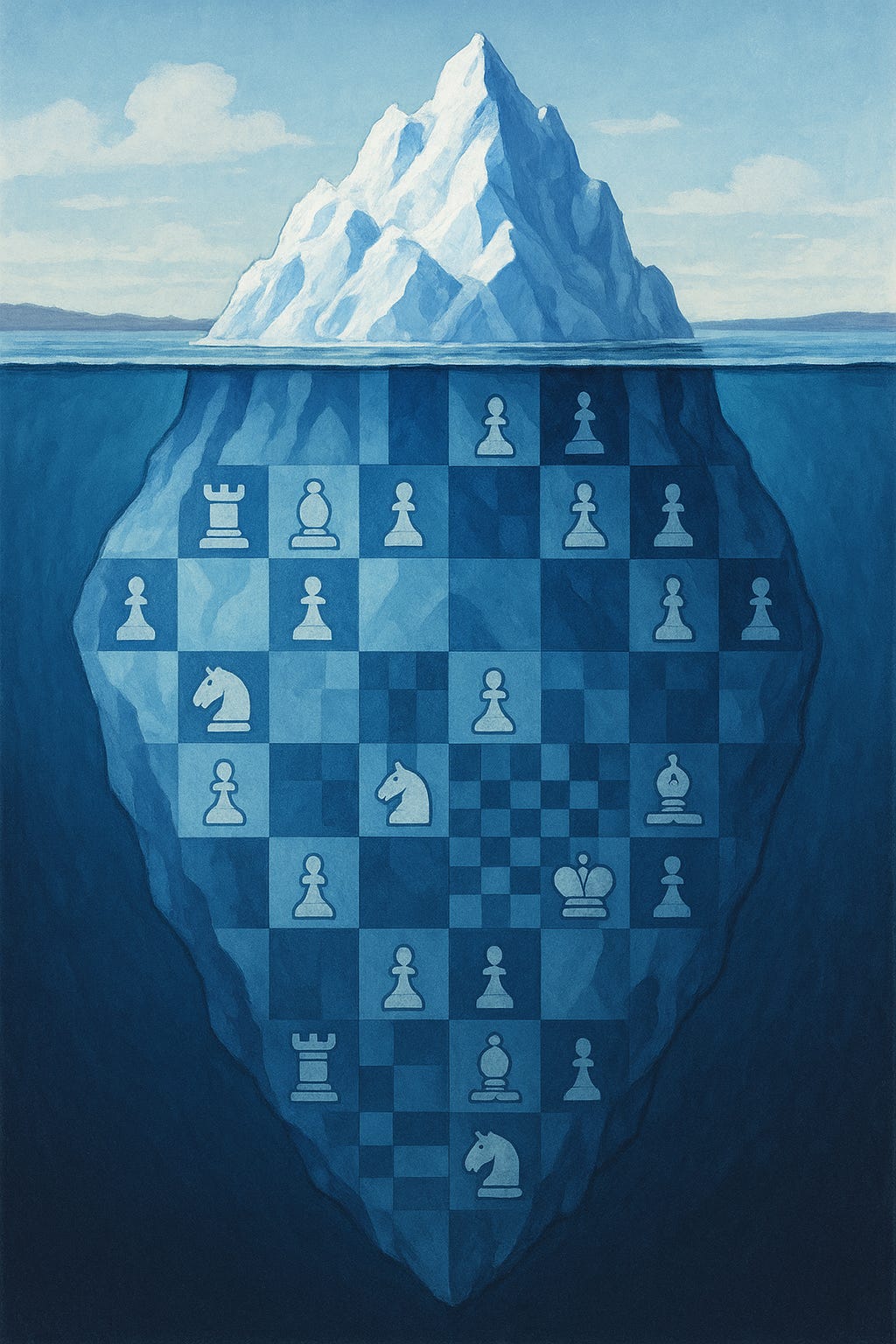
I have mentioned this before, many times, but I’ve never read a truer statement about chess than “tactics flow from a superior position,” courtesy of our favorite lunatic Bobby Fischer.1
This explained a lot to me — like, for example, why I would never see those cool tactical opportunities that I studied in my actual over-the-board games. It was because my positions sucked.
But there’s a much deeper takeaway from it. We often tend to focus on the climax of a process to the detriment of the process itself. It’s not that we don’t KNOW that the process leading up to it exists; it’s just that we conveniently forget. Because the process is hard. It’s often dull. It requires subtle adjustments and small decisions and simple commitment rather than the sexy THRILL of the ultimate destination.
Sometimes, this is because we just don’t care. The reader doesn’t necessarily care that the writer went through multiple drafts and years of laboring to produce the book. The sports fan doesn’t necessarily care that a quarterback completed 65 percent of his passes if he threw a game-losing pick-six, much less how much he practiced. The commuter doesn’t necessarily care how complicated it is to maintain the subway if the train is always late.
But for the practitioner, this process isn’t just important: it is everything. It’s the downfall of so many of us who set out to accomplish something and get deterred along the way, whether it’s getting in shape or writing a book or, I don’t know, cleaning your garage. We ignore the realities of what it will take to achieve success, and so when these realities inevitably smack us in the face, we surrender.
I’ve been thinking about this a lot lately because I have been consumed with a Big Writing Project (BWP), and that BWP has been forcing me to confront very directly just how much sheer WORK goes into arriving at the destination. Particularly for a BWP of this sort, it’s so much work that your brain can’t really comprehend it, particularly at the start. If you try to wrap your mind around the amount of effort and intention it will take to realize the goal you’ve set out to achieve, you’re doomed.
At least for me, I’ve only found one real choice, which E.L. Doctorow described thusly: “Writing is like driving at night in the fog. You can only see as far as your headlights, but you can make the whole trip that way.” You focus on what comes next, and what comes next, and what comes next, and then you eventually arrive at your destination. Once you do, you can look at the whole trip and begin to think about it in a larger sense.
It turns out that chess is similar, and I finally managed to put that into practice in my club game last week.
Our current tournament is the club championship, and I hadn’t been having a great tourney so far. I lost to a 1400 kid after I totally blanked on my opening prep and then miscalculated a tactic that should’ve won me a clean pawn. (I’m about 1600.)
At the same time, though, I’ve been playing very well online. In July, my rapid rating bottomed out at 1557. (Maybe this also had something to do with why I stopped writing about chess????? WHO CAN SAY.) Two weeks ago, it peaked at 1935. That’s an almost 400 point swing, which is… pretty bizarre, frankly. I don’t fully know how to explain it, other than that 1557 is way lower than my actual strength and 1935 might be slightly beyond it. Right now, I’m hovering around 1850, and I think that’s a reasonable description of where I belong, though I also do suspect I should be able to climb back into the 1900s and stay there pretty soon if I keep training consistently.
All of this means that, when I went into my most recent game, against another 1400, playing with the Black pieces, I was determined to go in with some confidence taken from my online success. A little swagger. I wanted to play to win, and if I lost, I would at least go down swinging.
When the game opened in an Alapin, I felt even more emboldened. I know how to play the Alapin from the Black side, at least reasonably well. I understand the general themes and strategy. I would try to push if I could.
This brings us to move 9:
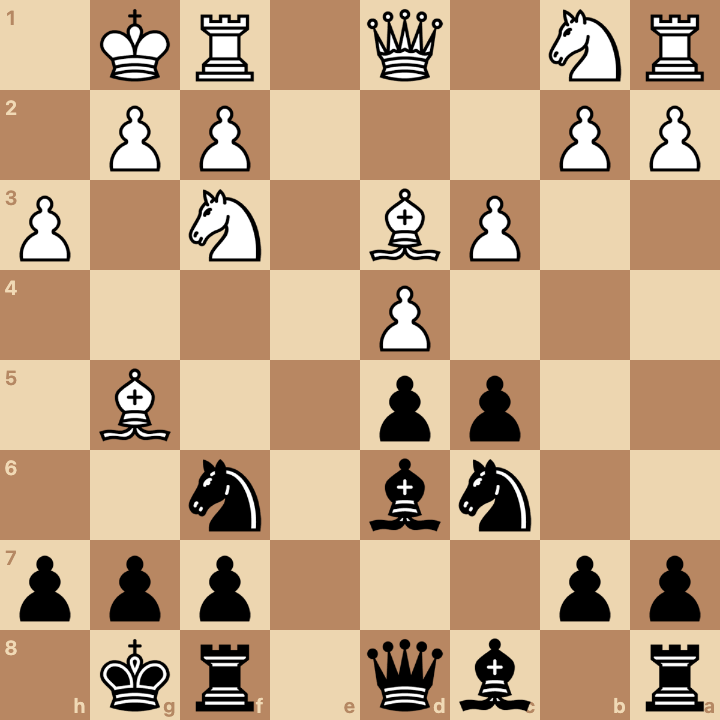
White has just played Bg5. This SEEMS like a sound move, right? The dark-squared bishop and b8 knight have already deployed, so you can pin the knight and force Black to waste a tempo if they want to defend it with a piece that isn’t their queen.
There’s only one problem: White has declined to play a very typical move in this position, which is dxc5. This would force my Black bishop to move again, costing me a tempo and removing it from the b8-h2 diagonal, which turns out to be critical if you’re planning Bg5. I realized that if I played h6, White would either have to trade the bishop for my knight — good for me — or they could retreat, and then I could play g5, and then I could trade my bishop for theirs on g3, dealing a serious blow to their king’s pawn structure.
Now, the h6-g5 pawn push is one that often gives me chills. Many a time have I tried to play like that online only to get mated after a sacrifice. But in this particular situation, the advantages seemed to outweigh the potential risks. White had made a strategic error, and if I really wanted to generate some opportunities, it would pay to punish them for it.
Fast-forward to move 12:
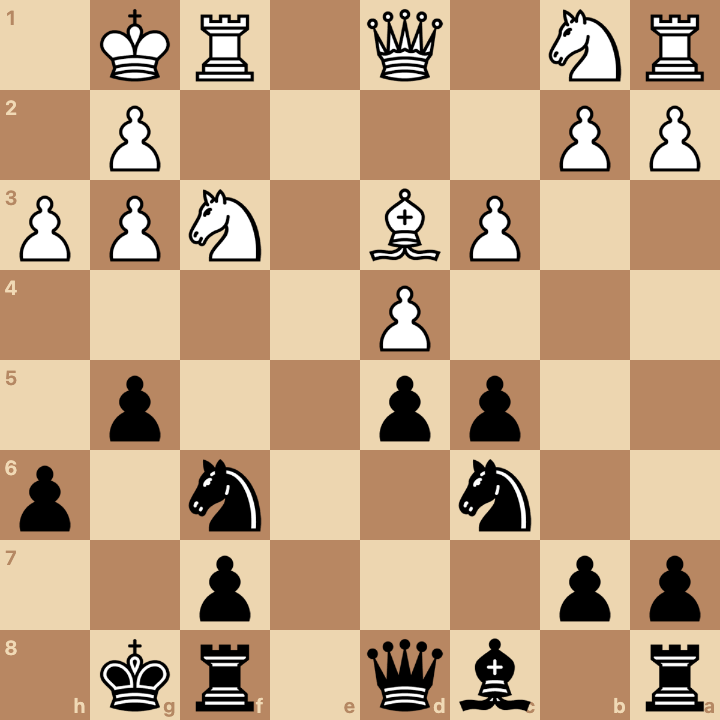
I am obviously better. More than that, my position is much easier to play. I have the space, the initiative, and a target in the g3 pawn. A few more moves unfolded, both of us playing sub-optimally — White still neglecting to show their trump card of the dxc5 trade, and me wasting some tempi by moving the wrong pieces even if I had the right idea — before I finally got my chance.
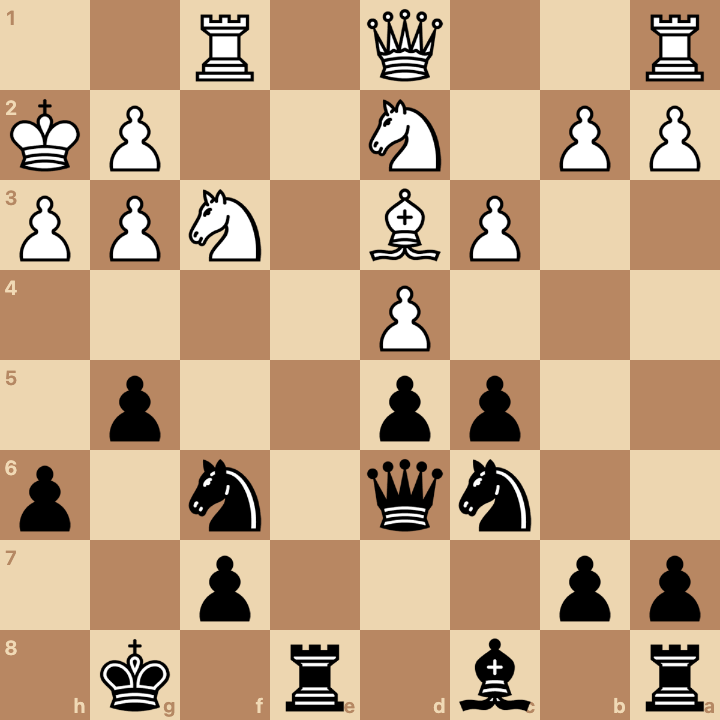
White has just played Nbd2. This is an understandable move, in that it completes development. It is also quite bad, because it doesn’t react to my threats. And this is what I mean when I say my position is easier to play: I have threats, whereas my opponent needs to both react to my threats AND generate counterplay of their own.
It doesn’t take a genius to see the move Nh5 here. But “knights on the rim are grim,” you might say. Knights on the rim are IM…pressive, at least when they can do what this one is doing. g3 is pinned — g4 would’ve been a key move earlier to relieve the pressure, even if it further weakened a bunch of squares, but it’s far too late for that. There is no way to save the pawn.
Except maybe… Ne5? This is how White responded, leaving us here — take a second to look at the position yourself and see what you would play, then keep reading.
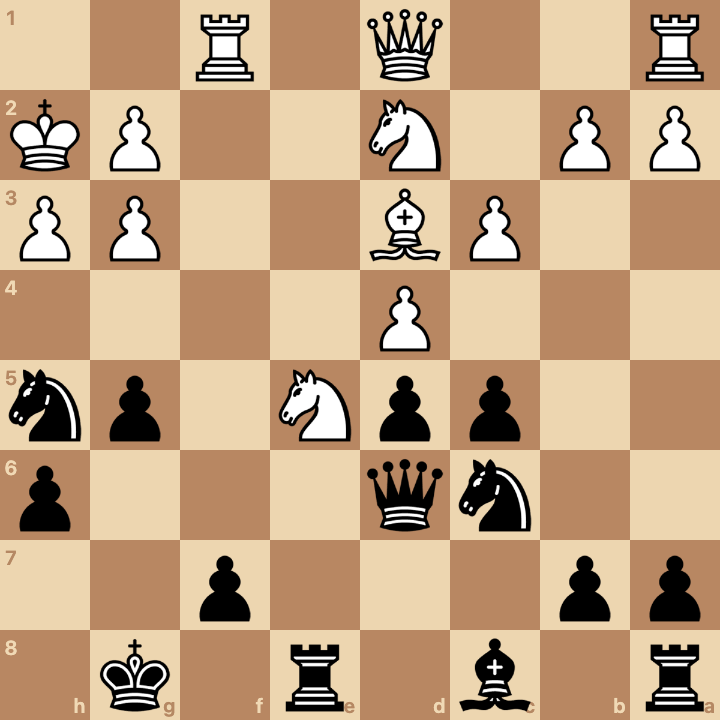
I could tell that, after he played Ne5, my opponent felt good. He’d discovered an attack on my Nh5 knight and blocked my queen, all at the same time. On top of that, he now had an attack against my f7 pawn, utilizing the rook on the semi-open f-file.
But what we’re looking at here is basically a tactical puzzle. I had arrived at it because I’d played strategically good chess (or at least better strategic chess than my opponent), and I’d obtained a superior position. Now, I had the chance to ACTUALLY put the tactics training I’ve been doing to good use.
The play here is Nxg3!!. If White takes the knight back, then it’s basically game over: once Black plays Nxe5, White’s best-case scenario is that they lose their bishop, and their worst-case scenario is mate-in-three. My opponent opted for the worst-case scenario, and the game was over in 18 moves.2
Now, if I show you that position without all of the preamble — or if you come across it in a tactical puzzle — you have one decision to make: you either find Nxg3, or you don’t find it. But in reality, to even get to the point that you’re able to play Nxg3 means that you have to 1) understand the opening, 2) navigate positional pawn play, and 3) set up tactical motifs.
For the longest time, I don’t think I understood that aspect of chess. I would see the tactical puzzles and wonder why I never got the chance to play any of those insane moves in my games, and I wouldn’t necessarily see that it was because I’d failed to create those chances myself. Most of my best results tended to be draws against higher-rated players in which I defended like a madman and refused to take any risks, which can only get you so far.
Ironically, I’d had a similar problem with my writing. For years, I’ve failed to complete my BWPs because I didn’t understand the necessity of putting in the work. Rather than recognizing it as a necessary part of the process, I would see the struggle as an indictment of the project itself, and I would bail for the shiny new object of another idea, repeating this pattern ad nauseam. It doesn’t matter how many times you read interviews with authors or filmmakers or musicians talking about how it took them years and years and drafts and drafts and countless discarded ideas to achieve the seemingly effortless-looking final result: you have to learn this yourself, feel it in your bones, before it really sinks in.
This is why I chose the iceberg metaphor. You see ten percent of the iceberg. This one-move tactic was just over five percent of our game. The final book, the finished film, the released song or album probably represents somewhere between five and ten percent of the work as well, though this can vary wildly depending on the type of creator.3
I think I’ve finally absorbed this as a writer. As a chess player, I’m starting to see it, too. And the truth is, if you want to be a sharp, tactical, attacking player, which I do, then you have to know how to attack STRATEGICALLY as well as tactically.
To be more precise: the two are inseparable, as the Fischer quote suggests. So don’t wait for those tactics to come to you — go out and create them yourself.
Sorry, Ezra Pound. You’re a close second.
In case you’re wondering, the computer’s preferred response to Nxg3 is Re1, which leaves Black two pawns up after a line you’re probably going to find if you found Nxg3: 16. …Nf5 17. Kg1 Nxe5 18. dxe5 Rxe5.
Stephen King has published 65 books by writing 2,000 words a day and generally following a three-draft approach (which he describes in On Writing, one of the best books about writing ever written). William Gass, on the other hand, spent 26 years writing The Tunnel. Both are great! These are extremes, and there is just about every possible version in between.
No posts
Comments
Nothing yet. Say the first thing.
Sign in to join the conversation.