

THE STRATEGY INSIGHT
The Problem: When most leadership teams sit down to work on strategy, the issue isn’t a lack of intelligence or effort. It’s that they have no shared picture of what they’re even discussing. The conversation drifts, people talk past each other, and the team walks out with a longer list of topics rather than a clearer strategy.
The Cause: Strategy has no shortage of analytical tools, but very few that structure the conversation itself. One structured model most teams know — the Strategy Diamond — is usually seen only in fragments, lifted out of the larger framework it was designed to fit within. Used in isolation, it gives teams pieces, not a full picture.
The Solution: A single page — the Business Strategy Canvas — that holds the complete set of strategic choices at once, adapted from Hambrick and Fredrickson’s full framework. Because the goal of business strategy is to create competitive advantage, the Canvas keeps every choice in view of that goal: it lets a team frame the discussion, hold it on point, test whether the choices actually fit together and reinforce one another into an advantage, and leave the room aligned on one strategy rather than holding several private versions of it. Not new theory. A practical way to put established thinking to work.
Over more than two decades of working with leadership teams, I’ve watched the same pattern repeat itself. Smart, experienced people gather to discuss strategy and quickly lose the thread. Each person argues from a different mental model of what strategy is and which questions matter. The discussion sprawls across goals, initiatives, market data, and pet projects without ever resolving into a coherent whole.
The cause is rarely a shortage of analysis. It’s the absence of a shared structure for the conversation. Strategy frameworks tend to be either too academic to use in a live discussion or too partial to capture the full set of choices a strategy requires.
This article introduces the Business Strategy Canvas, a tool I developed to close that gap. It adapts the complete framework laid out by Hambrick and Fredrickson in their landmark article Are You Sure You Have a Strategy? — not just the well-known Strategy Diamond, but the whole model — into a single page a team can sketch on a whiteboard and use to anchor serious strategic dialogue.
In what follows, I’ll do three things. First, walk through the complete Hambrick and Fredrickson model and how its parts fit together. Second, introduce the Business Strategy Canvas itself, element by element. Third, share what I’ve learned about putting it to work in practice. The Business Strategy Canvas isn’t a new model: it’s a visual, usable rendering of proven thinking, offered freely so that leaders can make better strategy.
Picture a leadership team two hours into a strategy offsite. One executive is pushing a new product line. Another keeps returning to a competitor’s recent move. A third wants to talk about hiring and capability gaps. The CFO is anchored on next year’s profit target. Everyone in the room is right, in the sense that each is raising something that genuinely matters. And yet the conversation is going nowhere, because no one shares a view of how these things connect — or whether they’re even discussing the same level of the same question.
I’ve sat in many versions of that room. The problem is almost never the quality of the people or the information. It’s that they’re working without three things at once.
The first is a clear view of what to discuss. Strategy is a famously slippery word. To one person it means a vision, to another a financial plan, to another a list of priorities, to another a competitive position. When a team hasn’t agreed on what belongs in a strategy conversation, every contribution feels relevant, and nothing feels resolvable.
The second is a structured framework for thinking through the strategy itself. Even teams that agree strategy is about competing rarely have a shared map of the choices involved — where to be active, how to win, how the economics work, what moves to make, what kind of organization it takes. Without that map, the discussion has no banks to keep it in its channel.
The third is, simply, a way to think it through together, in the open, where everyone can see the same picture forming. Strategy lives in the connections between choices. Those connections are hard to hold in your head and nearly impossible to hold in a room full of heads, each carrying its own version.
Take those three away, and you get the offsite I described. People talk past each other. The conversation goes everywhere and lands nowhere. The team mistakes activity for progress and leaves with a to-do list instead of a strategy.
It helps to be clear about what that conversation is ultimately for. The core issue of business strategy is creating competitive advantage — finding a way to win in your chosen market that competitors can’t easily copy. Everything else follows from that. Once the goal is competitive advantage, a business strategy becomes a set of connected choices in service of it: where to be active, how to win with customers and as a company, what moves to make, and what organization it takes to deliver. Those choices aren’t independent. A differentiator that doesn’t pay for itself, or a move the organization can’t execute, won’t produce advantage no matter how good it looks on its own. The choices have to add up. Which is exactly why where you make them, and how you connect them, matters — and why a structured surface to hold them all at once is so useful. (For more on what separates a real, advantage-creating strategy from a list of goals, see The Strategy Quality Pyramid.)
This is the gap a good Business Strategy Canvas fills. It gives the team a shared view of what’s on the table, a structure that keeps the discussion on point, and a single surface where the whole strategy becomes visible at once — so it can be examined, challenged, and tested for coherence. That last part matters as much as the first: the Business Strategy Canvas not only helps you build a strategy, but also helps you pressure test one. Are all the pieces in place? Do they fit each other? Do they reinforce each other, or quietly work against each other? Those questions are almost impossible to answer when the strategy lives scattered across slides, spreadsheets, and people’s memories. They become answerable the moment the whole thing sits on one page.
There’s a second payoff in that shared surface, and for most leadership teams it’s the one that matters most: alignment. When everyone is looking at the same page, working through the same choices in the same structure, the team converges on one strategy instead of leaving the room with five private versions of it. Alignment here isn’t a motivational outcome or a workshop afterglow. It’s the practical result of a team having seen, debated, and agreed on the same set of connected choices — and it’s far harder to reach when those choices are buried in a deck nobody reads the same way twice.
Over the years, I’ve consistently returned to one simple, powerful tool to bring structure to complex discussions: the canvas.
I’ve always been a fan of using canvases to facilitate workshops and discussions of every kind. One of my early influences was the Grove’s visual facilitation tools. Patrick van der Pijl and his colleagues later wrote a wonderful book on how to use visual tools to design businesses. And like many people, I was a keen user of the Business Model Canvas, which, at least in my view, did more than anything else to make the idea of canvases popular in the first place. Later, together with my colleagues, we developed the Art of Opportunity Canvas as part of our book of the same name and the strategic innovation approach we built around it.
I like canvases because they do a few things very well. They create clarity in complexity by structuring the discussion and keeping it on point. They drive better conversations through visual thinking and build shared understanding quickly for the same reason. And they simplify communication to stakeholders, letting readers grasp the essence and outcomes of a discussion at a glance. Done well, a canvas is intuitive enough to use without much explanation, which makes it easy to spread across teams and the organization.
A canvas is still an abstraction, of course. It isn’t a “fill in the box” exercise. A good one should spark your thinking — asking questions, pointing toward where answers might be found, and making sure there are no gaps in your logic.
When it came to strategy specifically, I was always missing a good canvas. There’s the Blue Ocean Strategy canvas, but compared with the others, that’s more of a graph than a canvas. So over the years, I developed a range of canvases for different types of strategy. For ecosystem and corporate strategy, I followed Bob de Wit’s thinking — and if you want the source, the latest edition of Bob’s Strategy: An International Perspective is now in its 8th edition. For functional, department, or team strategy, I developed my own. This article is about the one in the middle: the Business Strategy Canvas.
CONCEPT CLARIFICATION — A canvas is a thinking tool, not a template. The value of a canvas isn’t in filling every box. It’s in seeing all the choices at once so you can test whether they hold together. A neatly completed canvas with incoherent choices is worse than an unfinished one that has surfaced the real tension. Use it to provoke the conversation, not to close it.
The Business Strategy Canvas builds directly on the framework laid out by Hambrick and Fredrickson in their article Are You Sure You Have a Strategy?, originally published in Academy of Management Perspectives (2001) and reprinted in Academy of Management Executive (2005). The quotations throughout this article refer to the 2005 version unless otherwise noted.
At the time, other thinkers were circling similar ideas. Costas Markides, for instance, introduced his Who / What / How framework in All the Right Moves (2000), echoing many of the same structural components under different labels. In my view, while terminology and emphasis vary, most strategy frameworks converge on the same fundamental set of questions: where do we compete, how do we compete, what activities do we need to engage in, what tangible and intangible resources do we need to be able to perform these activities, and how do we coordinate and link them together (see de Wit).
I’ve worked across industries and organizations using every major strategy model in the field. But I’ve consistently returned to Hambrick and Fredrickson — and not just to the Strategy Diamond, but to the full framework. It remains one of the most complete and practical tools available. Its power lies in its balance: structure without rigidity, clarity without oversimplification.
And yet most people only ever see part of it.
The Strategy Diamond is well known but too often misunderstood. It isn’t a standalone tool. It’s the centerpiece of a broader system — “an integrated set of choices” that together define a coherent strategy. When teams treat it in isolation, they miss the depth and logic of the model. No surprise, then, that many walk away frustrated, convinced the Strategy Diamond didn’t work.
This article isn’t about reinventing that model. We don’t need another one. What we need is a better way to put existing strategy thinking into real, everyday use. That’s where the Business Strategy Canvas comes in. It adapts Hambrick and Fredrickson’s full framework into a simple, practical tool — easy enough to sketch on a whiteboard, but powerful enough to anchor serious strategic dialogue. It helps teams work through the essential questions together and make real, connected choices.
HISTORICAL NOTE. Donald Hambrick and James Fredrickson published Are You Sure You Have a Strategy? in the Academy of Management Perspectives in 2001, with a widely read reprint in the Academy of Management Executive in 2005. Their central contribution was to insist that a “strategy consists of an integrated set of choices,” and that the famous Strategy Diamond — Arenas, Differentiators, Economic Logic, Vehicles, Staging — sits inside a larger framework that also accounts for an organization’s guiding mission and objectives, its strategic analysis, and the supporting organization required to deliver the strategy. The Business Strategy Canvas is a faithful adaptation of that complete framework, not of the Strategy Diamond alone.
So how do you take a complete, rigorous framework and make it usable in a live conversation?
The full Hambrick and Fredrickson model includes more than the five Diamond elements. To unlock the Strategy Diamond’s real value, it has to be integrated with the rest of the original model, which also includes mission, purpose, values, and objectives as foundational drivers of strategy; strategic analysis as a critical input; and the design of a supporting organization, which the authors call a “critically important choice.”
While some of these elements may not fall strictly within the definition of strategy, they’re nevertheless essential. To design and execute a strategy that works, you have to take them into account.
The figure below illustrates the whole model.
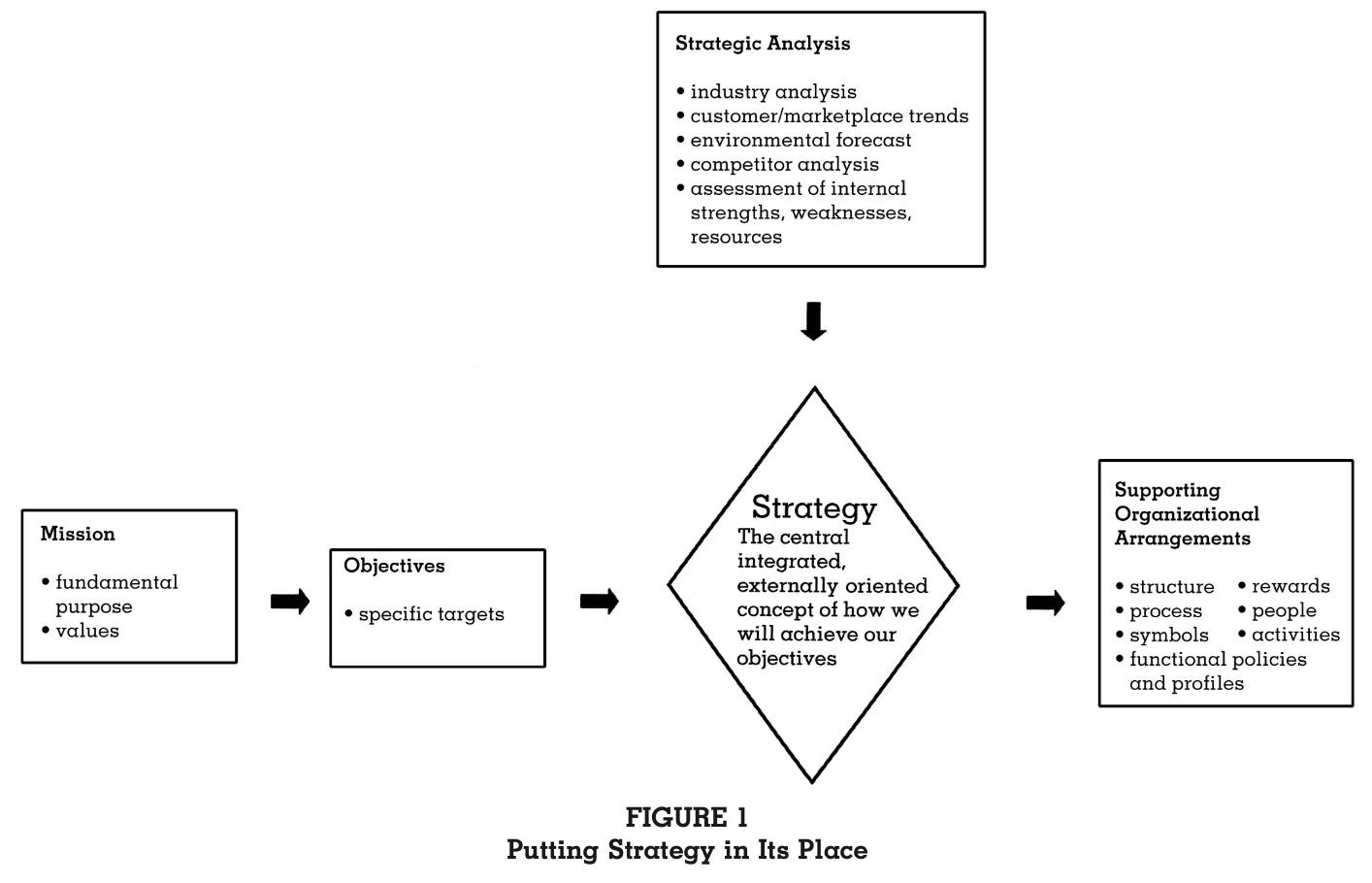
At the heart of the system is the Strategy Diamond itself, which Hambrick and Fredrickson define as “an integrated set of choices” answering five questions.
Arenas asks where the business will be active — which products, market segments, geographies, technologies, and value-creation stages, and with how much emphasis in each.
Differentiators asks how the firm will win in those arenas — how it will get customers to choose it, whether through image, customization, price, styling, reliability, service, or some combination.
Economic logic asks how the strategy will actually generate profit, which the authors trace ultimately to either premium prices or lower costs.
Vehicles asks how the firm will get there.
And staging asks about the speed and sequence of the major moves, since even the right choices can fail if they are pursued in the wrong order or at the wrong pace.
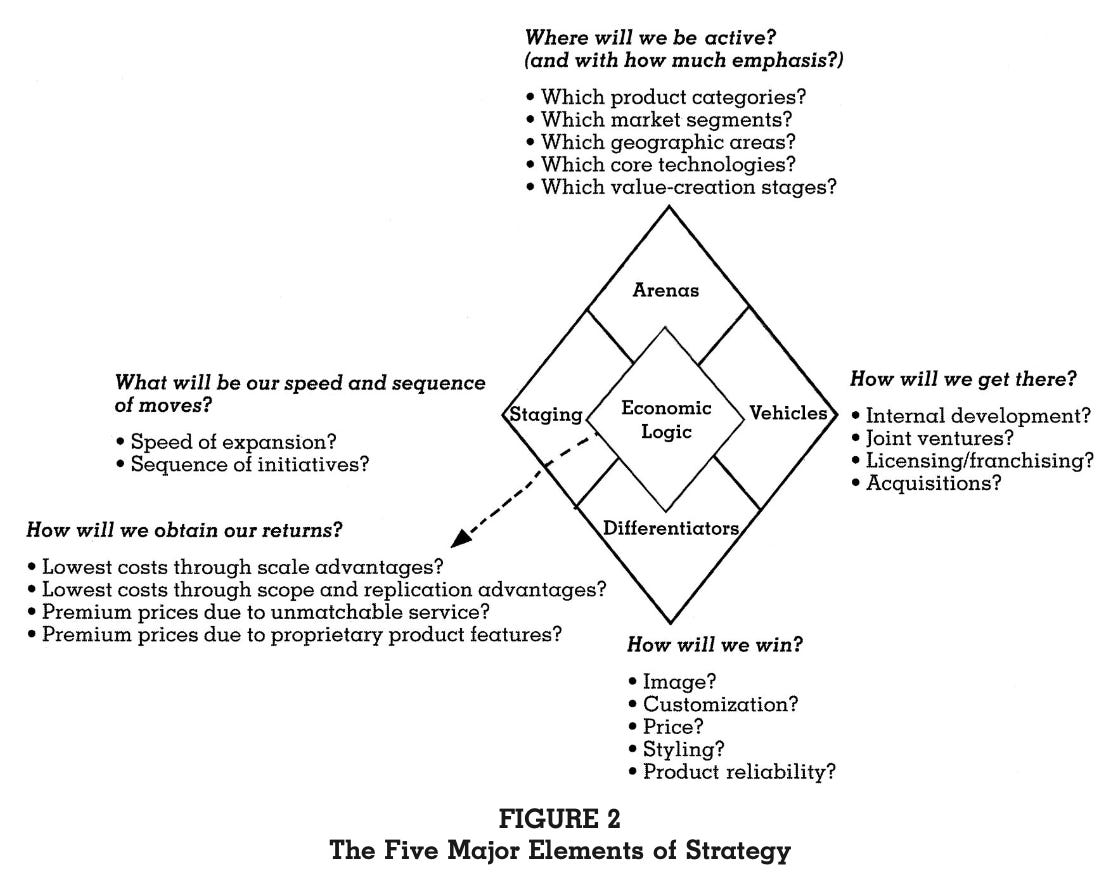
The word “integrated” is the load-bearing one: the five are not a checklist to complete separately but a set of choices that must fit and reinforce one another, which is exactly why a strategy can fail even when every individual element looks sound on its own.
In the Business Strategy Canvas, I address all of these elements, though not always as standalone components. Some questions are best tackled together. Separating vehicles and their staging into two distinct boxes, for example, is impractical — it simply makes more sense to treat them as a single element. So, rather than replicating the framework box by box, I adapted it to improve usability without sacrificing fidelity to its core ideas. The goal wasn’t another model. It was to make a proven framework more practical: a holistic approach that includes all the essential elements, simplified just enough to be usable in the real world.
The Business Strategy Canvas has evolved over the years, shaped by experience and by feedback from leadership teams around the world. Each revision has meant asking what to cut, what to sharpen, and what to borrow from other frameworks where it earns its place — always to make the canvas more intuitive and practical without sacrificing its rigor. Here is the Business Strategy Canvas in its current form.
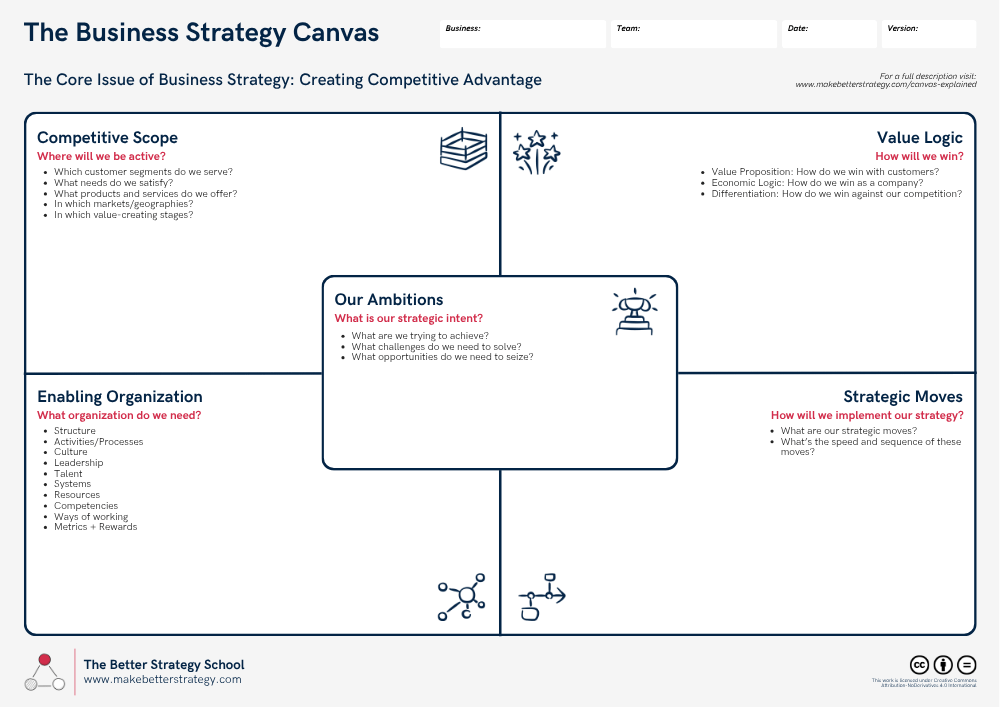
The Business Strategy Canvas organizes the framework into five working areas:
Our Ambitions (what is our strategic intent?)
Competitive Scope (where will we be active?)
Value Logic (how will we win?)
Strategic Moves (how will we implement our strategy?), and the
Enabling Organization (what organization do we need?).
The sections that follow walk through each one and show how it maps back to Hambrick and Fredrickson.
According to Hambrick and Fredrickson, mission, purpose, values, and objectives “stand apart from, and guide strategy…drive strategy, but [they are] not strategy themselves.”
In practice, it’s impossible to have a meaningful conversation about strategy without also addressing your ambitions. Without clarity on what your organization stands for and what it’s aiming to achieve, there’s no basis for judging whether a strategy is relevant or worth pursuing. That’s why these elements sit at the center of the Business Strategy Canvas — not as a separate prelude, but as the foundation. Positioning them at the core keeps them where they belong: at the heart of every strategic conversation.
Over the years, I’ve learned to stay neutral about the kinds of ambitions organizations set. They’re deeply shaped by culture. Some companies prioritize financial goals exclusively and wouldn’t consider anything else. Others articulate the value they want to create for different stakeholder groups. Some describe a future strategic position they want to reach. Others define a BHAG — a Big Hairy Audacious Goal. Still others rely on layered constructs of vision, mission, purpose, and values.
To reflect that diversity and avoid imposing a one-size-fits-all model, I labeled this central element Our Ambitions. Ambitions signal intent, direction, and a commitment to act toward a specific outcome — which might be your vision, your mission, your purpose, or something else entirely.
Because I define strategy as the act of solving strategic challenges — following Rumelt, de Wit, and Compo, among others — ambitions also include solving those challenges. The Business Strategy Canvas asks three questions here:
What are we trying to achieve?
What challenges do we need to solve?
What opportunities do we need to seize?
CONCEPT CLARIFICATION — Ambitions guide strategy; they aren’t strategy. A goal tells you where you want to go. A strategy tells you how you intend to get there, given the challenges in your way. “Double revenue in three years” is an ambition. The integrated set of choices that makes doubling revenue achievable — against real competitors, with the organization you have — is the strategy. Keeping ambitions at the center of the Business Strategy Canvas is a constant reminder of what the choices are ultimately in service of.
Hambrick and Fredrickson are direct about this: “The most fundamental choices strategists make are those of where, or in what arenas, the business will be active.”
Others have used different language for the same idea — where to compete (Porter), defining what business you’ll be in (Drucker), what game to play (Markides), where to play (Martin). The vocabulary varies; the core principle doesn’t. You’re choosing where to compete.
Hambrick and Fredrickson identify several dimensions that fall under arenas:
Product categories
Market segments
Geographic areas
Core technologies, and
Value-creation stages.
The Business Strategy Canvas foregrounds the questions teams reach for most often:
Which customer segments do we serve?
What needs do we satisfy?
What products and services do we offer?
In which markets and geographies?
In which value-creation stages?
In practice, I like to start by mapping where an organization is active today, then explore paths for new arenas, most often beginning with opportunities for new customer segments and new products. Over a series of conversations, we dive into those options and work out what each would mean for the rest of the strategy.
This area of the Business Strategy Canvas brings together two of Hambrick and Fredrickson’s Diamond elements: Differentiators and Economic Logic. I called this Value Logic, because what you’re really articulating here is the logic by which the business creates and captures value. It answers a single question with three parts: how will we win?
On differentiators, Hambrick and Fredrickson are clear: “a strategy should specify… how the firm will win in the marketplace — how it will get customers to come its way.” This is the core question of how you compete for customers. They list a range of possible choices:
Image
Customization
Price
Styling
Product reliability
After-sales service, and a couple more.
In reality, the possibilities are nearly limitless, constrained more by organizational imagination than by the market.
To get the discussion started in a structured way, I often turn to Treacy and Wiersema’s three value disciplines:
Product leadership
Customer intimacy, and
Operational excellence.
These archetypes help a team quickly identify its strategic emphasis and create a natural bridge to the second part of value logic: the economics. The clearer your differentiators, the easier it becomes to explain how the business intends to create and capture value.
On economic logic, the authors are equally direct: “At the heart of a business strategy must be a clear idea of how profits will be generated.” Hambrick and Fredrickson argue that profitability ultimately comes from one of two sources — low cost or premium price — essentially Porter’s distinction between cost leadership and differentiation.
I find that differentiators and economic logic are so intertwined that it makes little sense to treat them apart, which is why they live together in Value Logic. Your choices about how to create value for your customers inevitably shape your cost and revenue structure, and vice versa. If you aim to lead with product innovation and quality, you’ll likely carry higher costs, which makes a low-cost model untenable. A low-cost airline, conversely, has to be relentless about operational excellence to hold its margins while offering rock-bottom fares. Too often, I’ve seen organizations focus on only one side. That’s a miss. Both are essential, and both have to be explicit: how you win with customers, and how you win financially.
Following Kenichi Ohmae’s 3 Cs of strategy, both of these choices have to add up to winning against your competition. “A successful strategy is one that ensures a better or stronger matching of corporate strengths to customer needs than is provided by competitors” (The Mind of the Strategist).
Customer, company, and competition converge in the Business Strategy Canvas as three questions:
How do we win with customers? (the value proposition)
How do we win as a company? (the economic logic)
How do we win against our competition in our chosen arenas? (differentiation)
Addressed together, these form a coherent, testable logic for how the business creates defendable strategic value.
In Hambrick and Fredrickson’s framework, vehicles are the means by which a strategy gets executed, and staging addresses “the speed and sequence of major moves in order to heighten the likelihood of success.” In practice, the two are inseparable — it makes little sense to define a move without discussing its timing — so they’re grouped into a single element on the Business Strategy Canvas: Strategic Moves.
At this stage, you don’t need elaborate plans. A simple headline will do — “conduct market research to better understand customer needs,” then “develop a new product based on those insights.” What matters is that you define the major moves as part of the strategy design process, not after the fact. As the authors put it, “selection of vehicles should not be an afterthought or viewed as a mere implementation detail.”
Defining moves early pays off in three ways. It closes the dangerous gap that opens when execution is treated as an afterthought. It lets the team pressure-test feasibility and adjust while still in design mode. And it answers the question that always comes first when a strategy reaches the wider organization: how are we actually going to make this happen? A clear set of moves gives a credible, actionable answer. By making execution visible from the start, the strategy becomes not just a vision but a roadmap.
Here, Hambrick and Fredrickson draw the same kind of distinction they draw with mission and objectives: “Internal organizational arrangements are not part of strategy. These are critically important choices, which should reinforce and support strategy; but they do not make up the strategy itself.”
That conceptual clarity is useful. But in practice, separating strategy from organization is difficult to the point of being impossible. A well-crafted strategy still depends on the organization’s ability to deliver it — resources, capabilities, leadership, structure, culture, and the rest all shape whether a strategy can actually be executed. So in the Business Strategy Canvas, the organization is included: not as a core element of strategy, if that distinction makes you more comfortable, but as a necessary part of the conversation. The Business Strategy Canvas covers structure, activities and processes, culture, leadership, talent, systems, resources, competencies, ways of working, and metrics and rewards.
Hambrick and Fredrickson make the point themselves: assessing whether the organization has the resources, capabilities, and leadership to support the strategy is essential to testing the strategy’s quality. If the organization can’t support the strategy, the strategy won’t succeed. It really is that simple.
In my experience, there are three reasons the organization has to be part of the strategic conversation.
First, the organization is both a constraint and an enabler. Strategy doesn’t operate in a vacuum. The tangible and intangible dimensions of your organization — resources, structures, processes, culture, talent, systems, leadership models, ways of working — can either limit or accelerate execution. Like strategic moves, they have to be reviewed for feasibility, which is why, in client work, we begin by analyzing existing organizational dynamics alongside external factors.
Second, new strategies often demand new organizational designs. A shift in direction frequently calls for new skills, different structures, or cultural adaptation. When the organization isn’t yet equipped for the new path, building that capability becomes a critical early move — and in many cases, redesigning the organization is the first move of strategy execution.
Third, the divide between “strategy” and “execution” is outdated. Too often, organizations separate the thinkers from the doers, those who design the strategy from those expected to implement it. That divide weakens ownership and undermines alignment. In reality, strategy and execution are two sides of the same coin. Embedding organizational considerations into strategy design helps close the gap and aligns the system behind the choices being made.
STRATEGY MYTH — “First we set the strategy, then we worry about the organization.” The sequencing sounds logical and fails reliably. A strategy the organization can’t deliver isn’t a strong strategy waiting for better execution — it’s a weak strategy that hasn’t been tested against reality. Designing the strategy and the organization together is what makes the difference between a plan and a result.
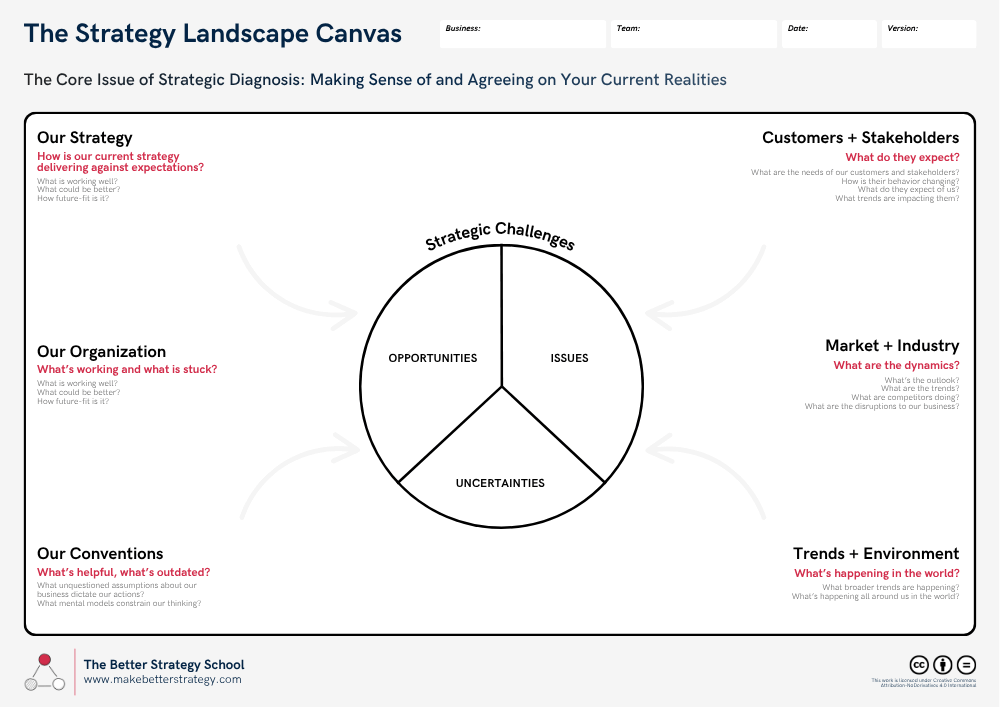
At one point, I experimented with a version of the Business Strategy Canvas that distributed the strategic analysis around the central strategy elements, the idea being to surround the core choices with the data and context informing them.
It turned out to be too much. The layout quickly became overwhelming. It blurred the line between thinking inputs and strategic choices, and instead of clarifying the conversation, it cluttered it.
These days, I use a separate canvas to summarize the main insights from the strategic analysis. That keeps a clean distinction between the landscape and the design, while still letting each inform the other. And it keeps the strategy canvas itself uncluttered.
A few closing reflections on how to use it.
The five elements have been presented here in a linear sequence, but that’s not how real strategy work happens. The elements are interdependent — they have to align and reinforce one another — and there’s no rule that you must start with any particular one. You might begin with a new product idea. You might start from a unique capability you want to leverage. You might open with a novel way to compete. Sometimes it makes sense to go through the elements in order; other times you’ll jump between them. That’s the beauty of a canvas: you can see everything at once, test for coherence, and keep adjusting until the full picture holds together.
In reality, you’ll move back and forth, revisiting earlier choices as your thinking sharpens. You may start with a vague ambition — grow the business, respond to a new competitor — and then, after mapping arenas, value logic, and moves, circle back to articulate more concrete goals. That’s not rework. That’s the work. The aim is to arrive at a unified whole.
And don’t agonize over where a particular idea belongs. Take activities: sometimes a shift in activities is the very source of competitive advantage. Dell’s early strategy is the classic example, where the way the company organized its activities was the advantage. In a case like that, it may make more sense to capture the insight under Value Logic than under the Enabling Organization. That’s fine. The objective is integration, not rigid categorization.
Use it to get the leadership team aligned. In my experience, this is where the Business Strategy Canvas earns its place. A strategy that lives in one leader’s head, or scattered across a fifty-slide deck, leaves room for every member of the team to carry a slightly different version — and those differences surface later as conflicting priorities, stalled decisions, and execution that pulls in several directions at once. Building the strategy together on a single page closes that gap while the team is still in the room. Everyone sees the same choices, argues them out against the same structure, and signs up to the same picture. The canvas becomes the shared reference the team returns to: the one-page answer to “what is our strategy?” that every member can give the same way. That alignment is not a soft benefit. It is what makes the strategy executable, because a strategy the team has genuinely agreed on is one they will actually carry out.
One more reminder: everything here applies specifically to business strategy — how a single business competes and wins in its market. Other types of strategy, such as network, corporate, or functional strategy, call for different choices, and inside the Better Strategy School, we have separate canvases for those.
Is it complete? Is every element filled with a real choice, not a placeholder — ambitions, scope, value logic, moves, and the organization to deliver them?
Does it fit? Do the choices match each other? Does your value logic actually work in the arenas you’ve chosen? Can the organization you have deliver the moves you’ve named?
Does it reinforce? Do the pieces strengthen one another into a coherent whole, or do some quietly work against the others?
I don’t claim this as my model. It’s a visual representation of Hambrick and Fredrickson’s framework — slightly adapted and packaged into a usable, visual format that teams can apply in the real world. That’s what I hope to have contributed: not new theory, not a new model, but a practical tool, rooted in established thinking, that helps leaders and organizations make better strategy.
It’s offered freely under a Creative Commons license, and anyone is welcome to use it. You can download it at → www.makebetterstrategy.com/canvas.
Enjoy — and let me know how it works for you.
— Marc
PS: An earlier version of this article can be found here.
Download the Business Strategy Canvas
Dr. Marc Sniukas is the founder of The Better Strategy School and a strategy advisor to leadership teams worldwide. Through his writing, teaching, and advisory work, he helps leaders design and execute better strategies that actually work in the real world.
The Better Strategy School helps leaders and organizations develop strategy as a core leadership capability. Through rigorous thinking, practical frameworks, and real-world application, it teaches professionals how to design, decide, and lead better strategies.
No posts
Comments
Nothing yet. Say the first thing.
Sign in to join the conversation.