
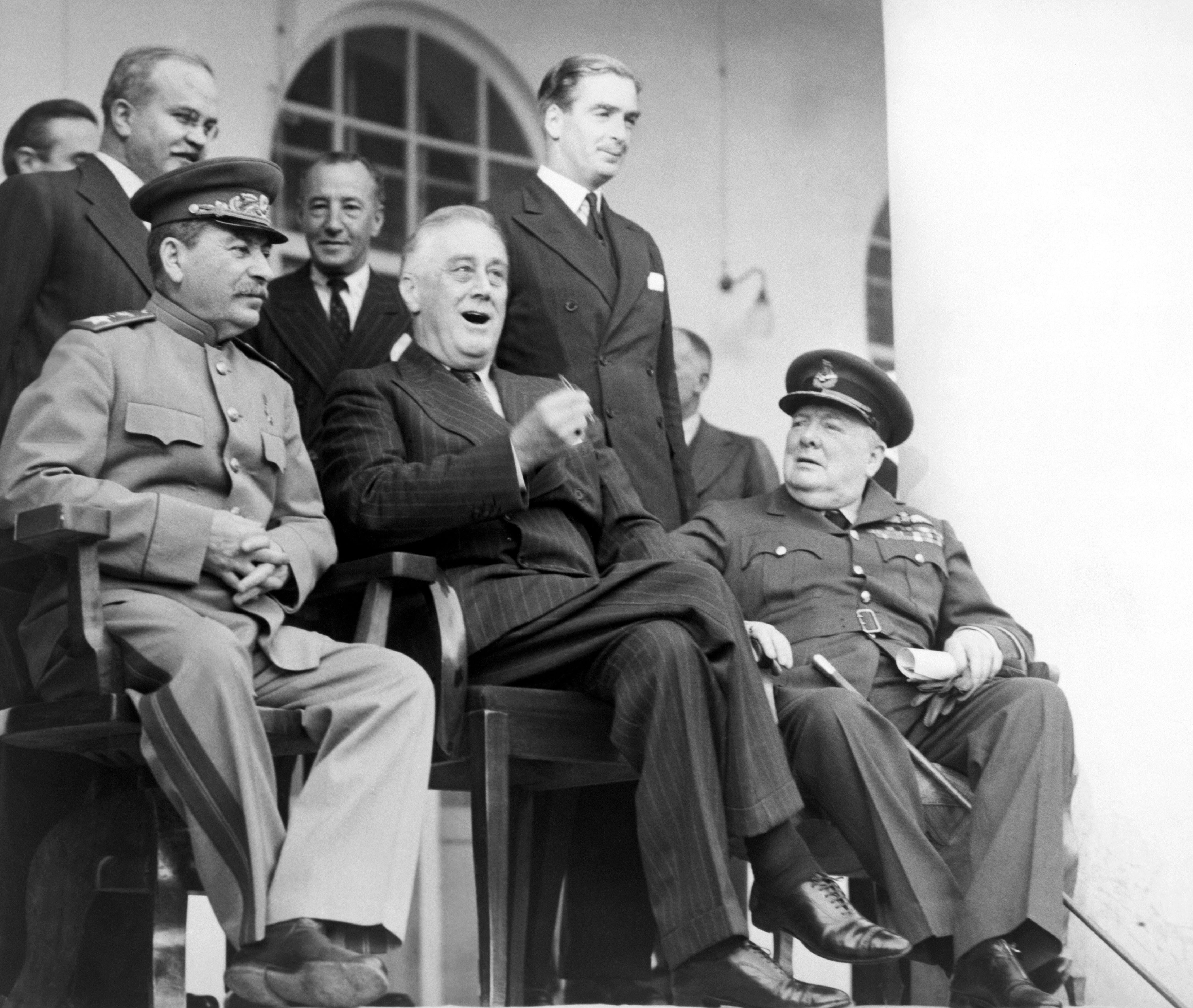
‘I could not admire the arrangements which had been made for my reception after landing in Tehran,’ noted Winston Churchill. ‘As we approached the city the road was lined with Persian cavalrymen every fifty yards, for at least three miles.’ This might have looked impressive but as far as the British Prime Minister was concerned, these mounted men merely alerted any bad elements that someone of high importance was proceeding very slowly down the road, offering almost no protection whatsoever. Soon, ever-larger crowds filled the gaps between the cavalrymen until they were at least four or five deep. ‘There was,’ Churchill wrote, ‘no kind of defence at all against two or three determined men with pistols or bomb.’
And Churchill had very good reason to be concerned. It was now late November 1943, but just over two years earlier, Iran had been decidedly pro-German. The country was led by Reza Shah Pahlavi, an authoritarian, nationalist and anti-Communist who had taken power following a coup twenty years earlier, and who had bet on Germany defeating the Soviet Union when it was invaded in June 1941.
Even before the war, Iran had developed strong economic ties with Germany. German engineers, for example, had built roads, factories and even the Trans-Iranian Railway as part of Reza Shah’s modernisation plans. As a result, by the time of Operation BARBAROSSA, Germany’s invasion of the Soviet Union, there were as many as 2,000 German nationals in Iran, including, predictably, a number of spies. Germany had already helped an insurrection against the British in Iraq, so from the British point of view, with India on one side of Iran and Iraq on the other, this German presence was a threat, as it was also to the Soviet Union. When Reza Shah rejected British and Soviet demands to expel these German nationals, the new allies launched a joint invasion, Operation COUNTENANCE, in August 1941, swiftly crushing the Iranian forces. Reza Shah was promptly deposed, replaced by his son, Mohammad Reza Pahlavi, and occupied by Allied troops. The country then became a major supply route for British aid to the Soviet Union through what was known as the Persian Corridor.
So, it was no wonder that as Churchill smiled benignly at the crowds, he was wondering whether an assassin lurked waiting for his moment to strike. Nothing happened, however. Instead, they reached the British Legation, which was almost next door to the Soviet Embassy, were swiftly enveloped by both Anglo-Indian and Soviet troops and absorbed into the kind of isolated area with all the normal precautions of wartime conferences. It didn’t mean there weren’t further concerns, however. The American Legation was about a mile away, meaning either President Roosevelt or Stalin and Churchill driving back and forth. Stalin had no intention of doing this, so Vyacheslav Molotov, the Soviet Foreign Minister, claimed they had unearthed a plot to kill one of the ‘Big Three’, as the leaders were now regarded. Whether real or imagined, it did the trick: Roosevelt, along with his personal staff and his outstanding Filipino cook from the presidential yacht, moved into a villa in the Russian diplomatic quarter. ‘Thus we were all within a circle,’ wrote Churchill, ‘and could discuss the problems of the World War without any chance of annoyance.’
The Eureka Conference, as it was called, came hot on the tails of Sextant, the codename for the Anglo-US conference in Cairo just a few days earlier. There, the guest had been the Chinese Nationalist leader, Chiang Kai-shek; now, in Tehran, it was the first time Roosevelt, Churchill and their military chiefs had met with Stalin and the Soviet leadership. The world was shrinking, but it was still a big place. Travel was fraught with danger, both from enemies and from mechanical failure, especially when in the air. It meant such conferences were comparatively few and far between but took on huge importance. Stalin loathed flying and so Roosevelt, crippled by polio and largely wheelchair bound, and Churchill, who turned sixty-nine on 30 November, the third day of the conference, pandered to his paranoia and agreed to meet in Tehran, a place both remote from the western sphere and lacking the modernities of London or Washington.
There was, though, much to discuss. The tide had turned in the war: Italy had surrendered, Japan was already on the road to defeat and so too was Nazi Germany. North Africa lay in Allied hands, so too Sicily, and Allied armies were advancing up the leg of Italy. British and American bombers were now pounding Germany’s cities, and the Red Army was pushing back German forces on the Eastern Front.
Nonetheless, there was still a long road to go; resources were stretched and priorities needed to be made. The Americans wanted to ensure the cross-Channel invasion, OVERLORD, currently scheduled for 1 May 1944, remained the overwhelming priority and to make a second landing at the same time in Southern France. The British, now the Allies, were battling in Italy, and wanted to protect the crucial airfields at Foggia now in their hands. Churchill wanted to encourage Turkey to enter the war and so dominate the Black Sea, a far less strenuous and threatening supply route into the Soviet Union.
With victory now in sight, the post-war world was now uppermost in the thoughts of all of the Big Three. For the United States, the issue at stake was to defeat Germany as quickly as possible, then finish off Japan. For Britain, it was about preserving as much of Europe for democracy as possible as well as their own influence. For the Soviet Union, Stalin wanted to extend control increasingly westwards.
Compromises were made at Tehran. The Cross-Channel invasion was pushed back to June; an invasion of southern France was also now in the planning, but the Italian campaign was placed on a firmer footing. The USA, Soviet Union and even Britain went away with gains as well as disappointments. The Soviet Union agreed to enter the war against Japan at some point but had no interest in bringing Turkey into the war, which would inevitably bring British and American involvement on his southern flank. Rather, Stalin meant to dominate south-east Europe and even Greece and Italy. By this stage of the war, British power was waning as US and Soviet strength was growing.
In between the formal discussions were more informal dinners. On 28 November, President Roosevelt was host, but afterwards, Churchill led Stalin to a sofa for a quiet chat, Mano a Mano, to discuss what might happen after the war was won and specifically how they should deal with Germany. Stalin wanted to crush Germany totally and place restraints on her manufacturing capacity as well as on her military. Churchill favoured rehabilitation. ‘We are the trustees for the peace of the world,’ Churchill told him. ‘If we fail there will be perhaps a hundred years of chaos. If we are strong we can carry out our trusteeship…The Three Powers should guide the future of the world. I do not want to enforce any system on other nations. I ask for freedom and for the right of all nations to develop as they like. We three must remain friends in order to ensure happy homes in all countries.’
Stalin did not directly reply to this post-war vision. It was remarkable, though, that while there were differences and splits in strategic vision, the Big Three did, for the most part, work well together during the war. Victory was achieved a year and a half later with the unconditional surrender of Germany and then Japan. By that time, though, co-operation had evaporated, and new battle lines were being drawn. Churchill’s vision was not fulfilled.
Today, his prediction of one hundred years of chaos looks remarkably prescient. And one of the epicentres of chaos is, of course, Tehran. Where is the spirit of wartime co-operation and compromise today?
Comments
Nothing yet. Say the first thing.
Sign in to join the conversation.