
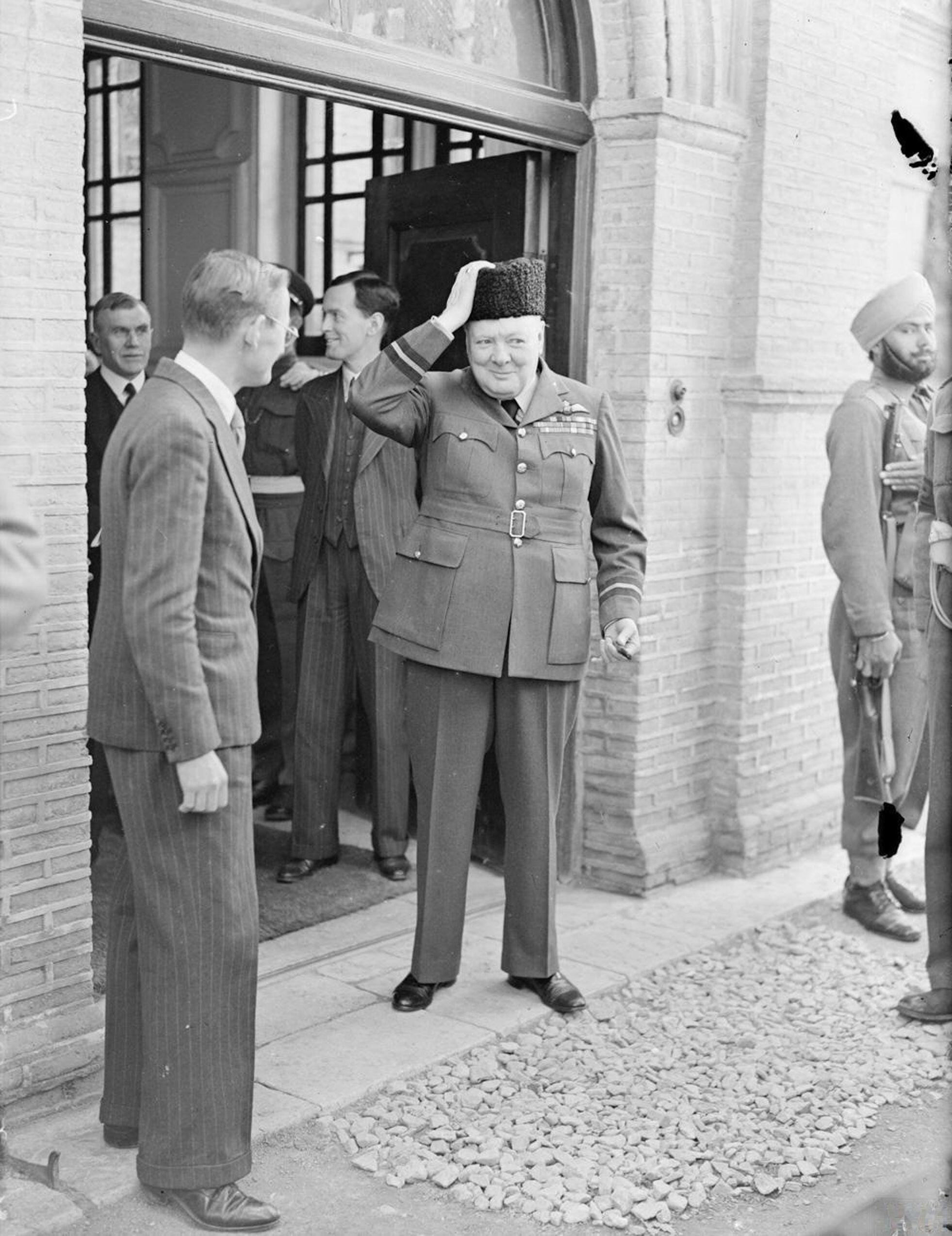
Prior to the Second World War, Churchill was never directly involved with Iran, though his influence throughout the first half of the 20th century loomed large and his impact on the Iranian imagination remains profound. In the past few years, as Iran has been rocked by social unrest and uprising, one protestor, frustrated with the lukewarm reaction, pointedly remarked that what Iranians needed from the international community was a ‘Churchill’, in other words, someone who possessed the force of moral clarity. Among ordinary Iranians, what Churchill represents has never been more popular. This does, of course, represent a reversal of fortune for the one-time British Prime Minister for whom grudging respect was perhaps the best he might have achieved. In many ways attitudes to Churchill reflected wider sentiment to Britain as a whole.
Churchill’s first encounter with Iran was indirect if enormously consequential. This was his decision in May 1914, as First Lord of the Admiralty, to buy a ‘golden share’ in the Anglo-Persian Oil Company (APOC), which had started extracting oil from south-western Iran in 1909. The decision was controversial, not least because securing a government interest in a private company contradicted the liberal belief in free enterprise, but Churchill was convinced that with the Royal Navy moving to oil, Britain needed a secure supply on favourable terms. The level of government was strictly curtailed by an Act of Parliament, but it nonetheless ensured the commercial viability of a company whose start in life had been decidedly precarious, and the chair of the APOC would later compare Churchill to Disraeli in having ‘added to the Suez Canal another great imperial interest in the Middle East.’ That war erupted two months later did much to add to Churchill’s reputation for prescience, but such judgements tell us more about the prejudice of the observer than the observed. Churchill’s domestic reputation for insight fluctuated, and he famously fell out with Curzon over greater involvement in Iran after the Great War.
As the next war approached, matters became more serious. The by-then renamed Anglo-Iranian Oil Company (AIOC) had, by the end of the 1930s, become Britain’s single most important overseas asset. With some 40,000 employees, it had become an industrial conglomerate, and with the onset of war and the increase in corporation tax, it was providing much-needed funds (as well as oil). For Britain, the threat posed by Nazi Germany to the security of this asset was real, not one might add from an invasion of Iran, but from the possibility of bombing raids from bases in Iraq and Syria (then Vichy-controlled), as well as from the Caucasus. The rapidity of the German invasion of the Soviet Union in 1941 added the further imperative of finding a suitable route to resupply the ailing Soviet war machine. It was ultimately the continued presence of German nationals that proved the ‘justification ’, if not the ‘right ’, as Churchill’s private secretary Jack Colville would note, as the Anglo-Soviet invasion was launched in August 1941. If the Soviets had no such qualms – they simply cited the 1921 Soviet-Iran Treaty – Churchill regarded it as a dubious action born of necessity, telling his son Randolph that Britain had ‘taken a leaf out of the German book’. Eden, for his part, told the Soviet ambassador that he was ‘ashamed of himself’.
The invasion itself, launched on 25 August 1941, took little more than six days to complete. The Iranian army, quite unprepared for what happened, melted away and Reza Shah was forced to abdicate. The Iranian political elite moved swiftly to have Reza Shah’s twenty-one-year-old son, Mohammad Reza, sworn in as the new monarch, as Iran settled into life under occupation, which the Americans joined in 1942. The principal aim, as Churchill stressed, was to secure supplies to the Soviet Union and to this end, Iran’s transport routes were secured and its limited railways reinforced to allow for the transport of heavy weaponry. Day-to-day running of affairs was left to the Iranian government, though Iranians bore the heavy cost of the economic dislocation of occupation.”
In early 1942 Iran signed a treaty with the Allies which confirmed their withdrawal no more than six months after the end of hostilities, and in January 1943 Iran formally declared war on Germany, effectively joining the Allies as a belligerent. In November that year Tehran hosted Stalin, Churchill and Roosevelt for their first face-to-face meeting, for what was arguably the most significant Allied conference of the war. Key strategic objectives were agreed, not least the opening of a second front with the invasion of France confirmed for the summer of 1944.
The conference coincided with Churchill’s birthday and the night before (29th November) the Allies held a dinner at the Soviet Embassy. The festivities were blunted by Stalin’s sudden suggestion that between 50,000 and 100,000 German officers should be executed after the war to prevent Germany from planning for another war. An outraged Churchill was only persuaded to return to the room when Stalin insisted he had been joking.
For all the frustrations that Iranians had with Churchill – despite his incapacity at the time, his subsequent endorsement of the coup of 1953 against Prime Minister Mosaddeq was regarded as a severe blot on his copybook – he garnered considerable respect for his statesmanship and a moral clarity that clearly escaped the likes of Stalin. Churchill was clearly not a stickler for the ‘rules’, but for many in Iran today facing the brutality of a regime that has lost its moral compass and pays scant attention to laws, Churchill’s clarity of vision and robustness against just such regimes, and his ability to think strategically, are more of a necessity than ever. His warning that appeasement only empowered the aggressor rings very true with many young Iranians, and as such, for all his flaws, (the idea of) ‘Churchill’ casts such a long shadow on the Iranian imagination.
Ali Ansari is Professor of Modern History with reference to the Middle East at the University of St Andrews in Scotland, and the founding director of the Institute for Iranian Studies.
Comments
Nothing yet. Say the first thing.
Sign in to join the conversation.