
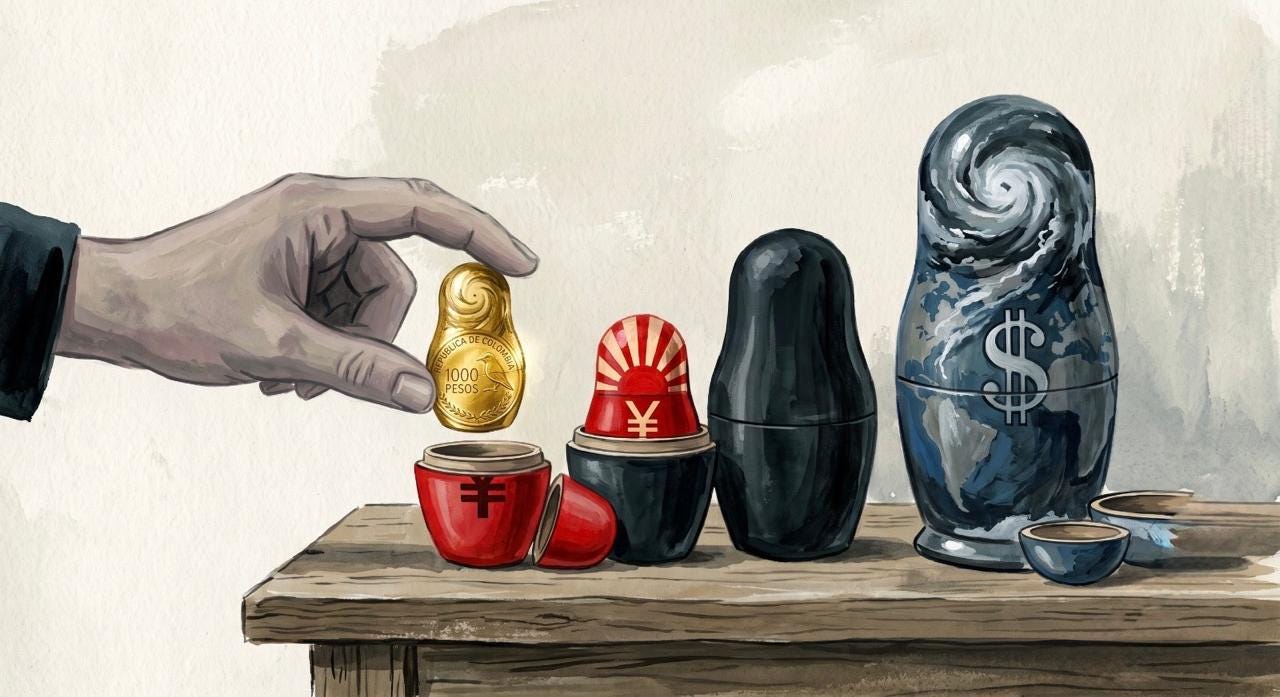
The one-line version: The peso is a crowded foreign carry trade in one of the world’s thinnest markets, dressed as a local-fundamentals story. Watch the yen, not the budget.
In December 2025, one American fund bought six billion dollars of Colombian government bonds in a single trade.
No auction. No name announced at the close. One buyer, one phone call, terms agreed in private.
A few months later, the Colombian peso was the strongest currency on the planet. And almost everyone gave the credit to Colombia.
That’s the strange part.
The story every desk tells is about Bogotá — the budget, the central bank, the election. The real story starts with who was on the other end of that phone.
When one thing on the plate behaves like nothing else around it, the cause is almost never the thing everyone can already see.
Outliers aren’t noise. They’re confessions.
Let’s make this one talk.
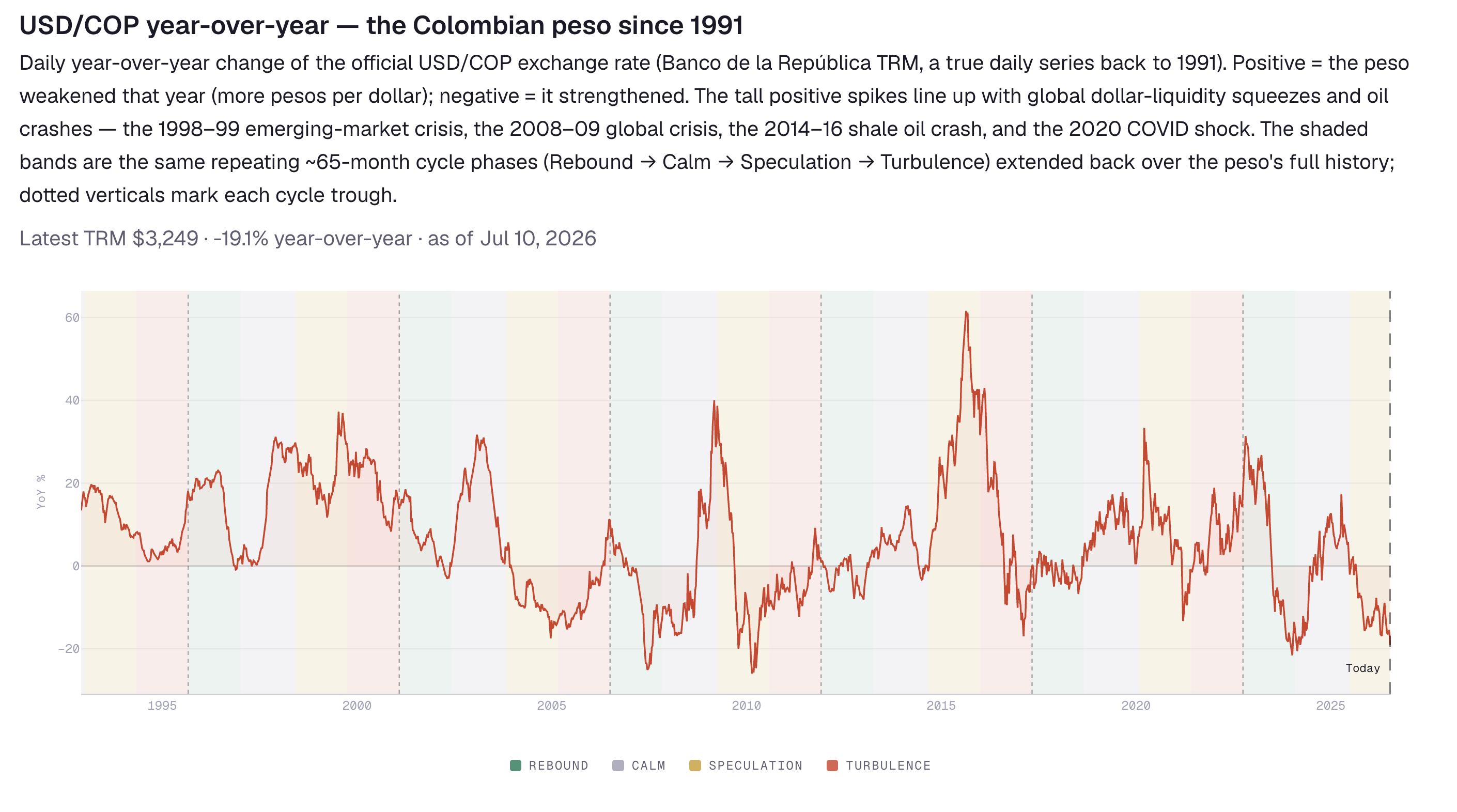
FIGURE 1 — USD/COP since 1991. The peso at a cyclical extreme of strength — deeper than the 2014 oil crash, deeper than 2020.
The dollar had a good year. Trade-weighted, it’s up about 3.2%. A hawkish Fed, sticky US inflation. Almost every currency lost ground to it.
Almost every one.
The peso went the other way — hard. Up about 23.5% against a rising dollar over twelve months. A seven-year high, 3,249 pesos per dollar (USD/COP), six percent of that earned in a single month. Not a currency drifting with a trend. The single biggest mover in the entire sample, running against it.
That is the outlier. Everything after this is the hunt for its cause.
Goldman Sachs saw the move and converted. It tore up its own forecasts — from 3,600 / 3,700 / 3,750 down to 3,350 / 3,300 / 3,200 pesos per dollar (USD/COP) over three, six and twelve months.
The case is clean. A government finally promising to cut its deficit by more than 3% of GDP. A central bank holding rates at 12% and refusing to blink. A peso that kept climbing even as oil fell — “decoupled,” they called it.
Local virtue, locally rewarded. It’s a good story.
It’s also told entirely from inside the smallest circle on the map.
Every word of it explains the peso using only Colombia. That’s the tell.
Here’s what the crowd forgets. An outlier this big is almost never explained by the things everyone can already name. When a price does something the whole market can’t, the cause has usually moved to a level nobody is watching.
Think of any market as a stack of circles.
The inner circle is the local story — fiscal, central bank, politics. The outer circle is everything bigger: the yen, global carry trades, oil, the dollar itself. Most of the time the inner circle sets the price, and the narrative writes itself. But in a regime change, the outer circle takes over — and the local story keeps talking long after it’s stopped being true.
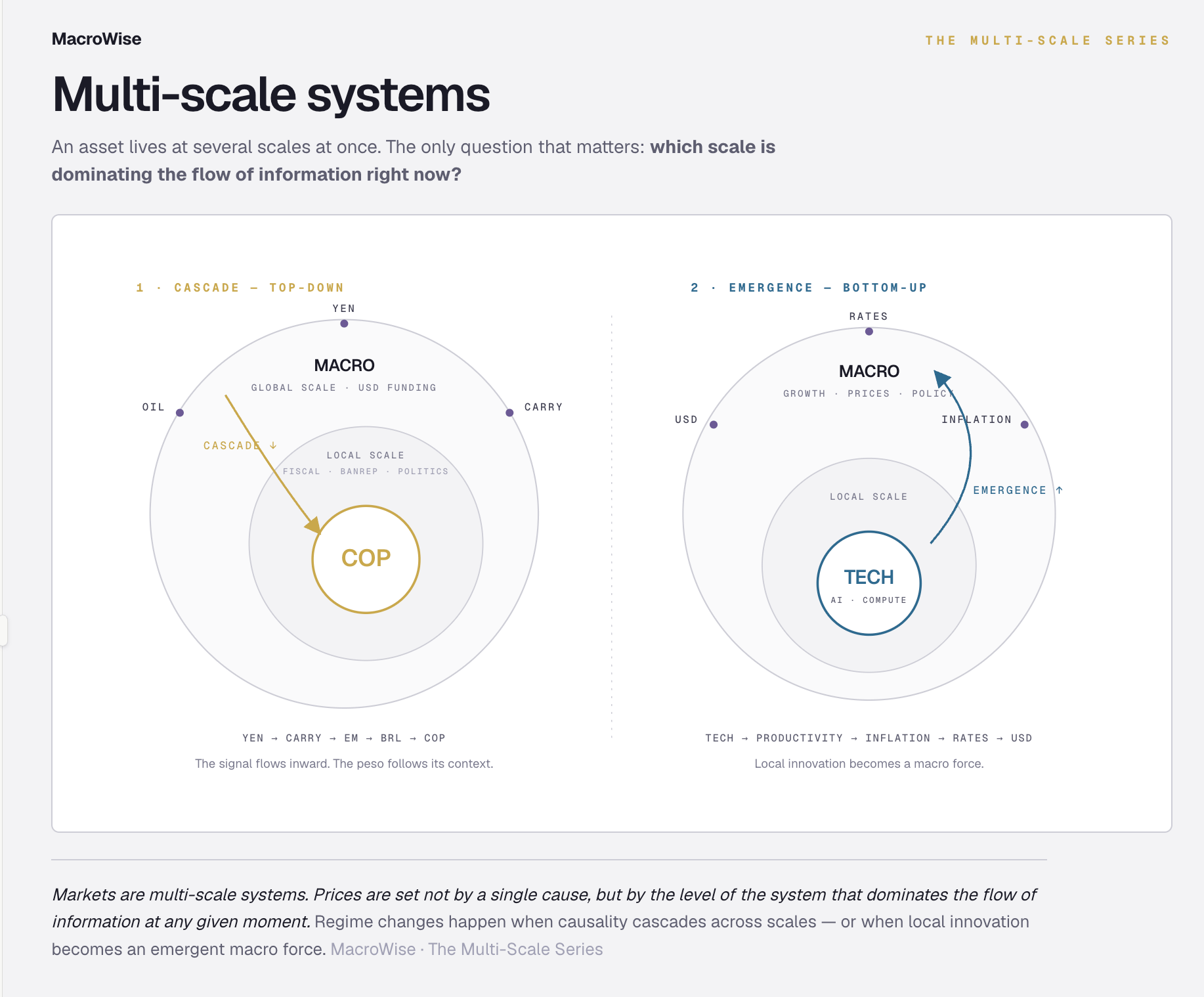
FIGURE 2 — The multi-scale map. Local COP sits inside the macro circle — yen, carry, oil. Sometimes the signal flows in; sometimes it flows out.
So we do the one thing the official story never does.
We follow the peso out of Colombia.
Rank every currency by its carry — the yield you earn just for owning it, funded in dollars.
The peso is near the top. +8.4 points, third in the world behind only Turkey (off the charts, and a trap) and Brazil. One of the highest-paying liquid currencies on Earth.
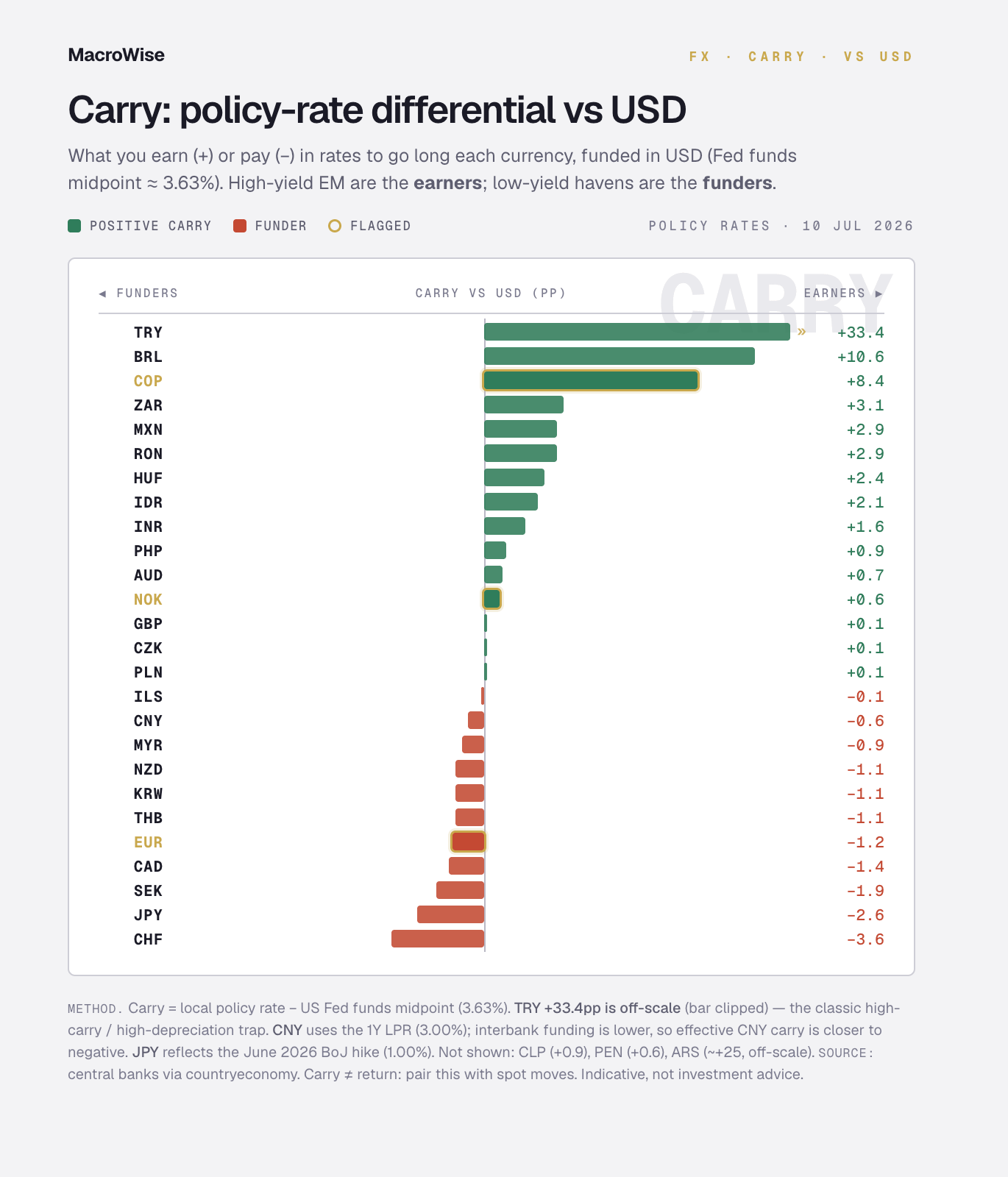
FIGURE 3 — Carry map: policy-rate differential vs USD.
High yield is a magnet. When global money feels brave, it rents exactly these currencies — not for their budgets, for their payout.
The peso’s strength and the peso’s yield are the same fact, seen twice. And that yield is priced in Tokyo and New York, not Bogotá.
You don’t take the peso’s pulse in Colombia. You take it in the yen.
There’s one chart the whole carry world watches: AUD/JPY. Borrow cheap yen, buy higher-yielding Australian dollars. It rises when the world is greedy and snaps when it’s scared. It’s the oldest risk gauge there is.
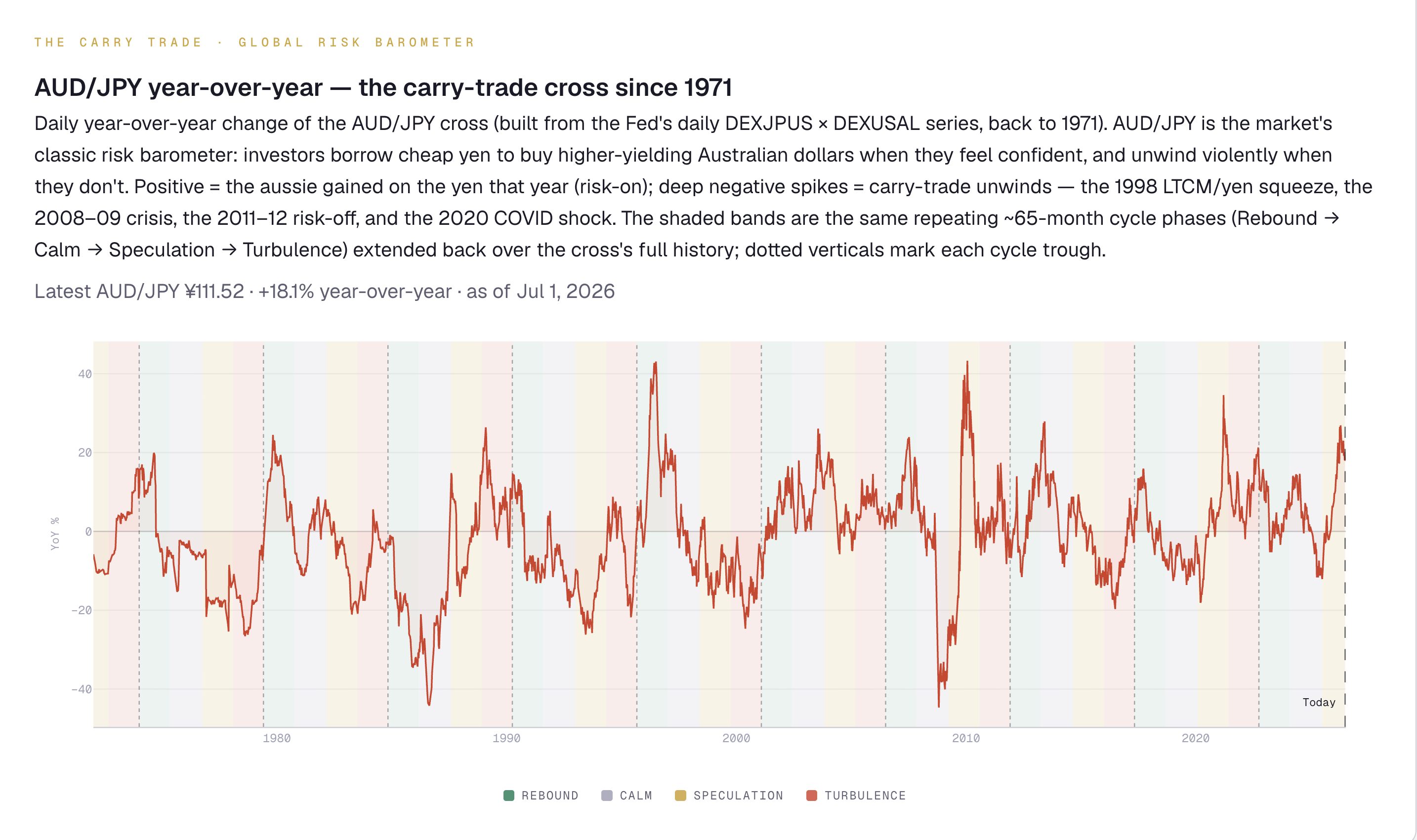
FIGURE 4 — AUD/JPY year-over-year since 1971.
Right now it reads +18.1% over the year — high, and deep into the greedy part of the cycle. The funding is cheap, the machine is running, and the whole high-yield crowd — peso included — is being bought as one trade.
A gauge running this hot is never early.
Goldman’s best point was that the peso “decoupled” from oil. Look again.
Oil didn’t disappear. It did something specific. It ran to +64% over the year — a real blow-off — and has now dropped back through the +40% line for the second time. In oil’s own history since 1950, that second touch is the fingerprint of a reversal already underway. Crude at $84.81, and falling.
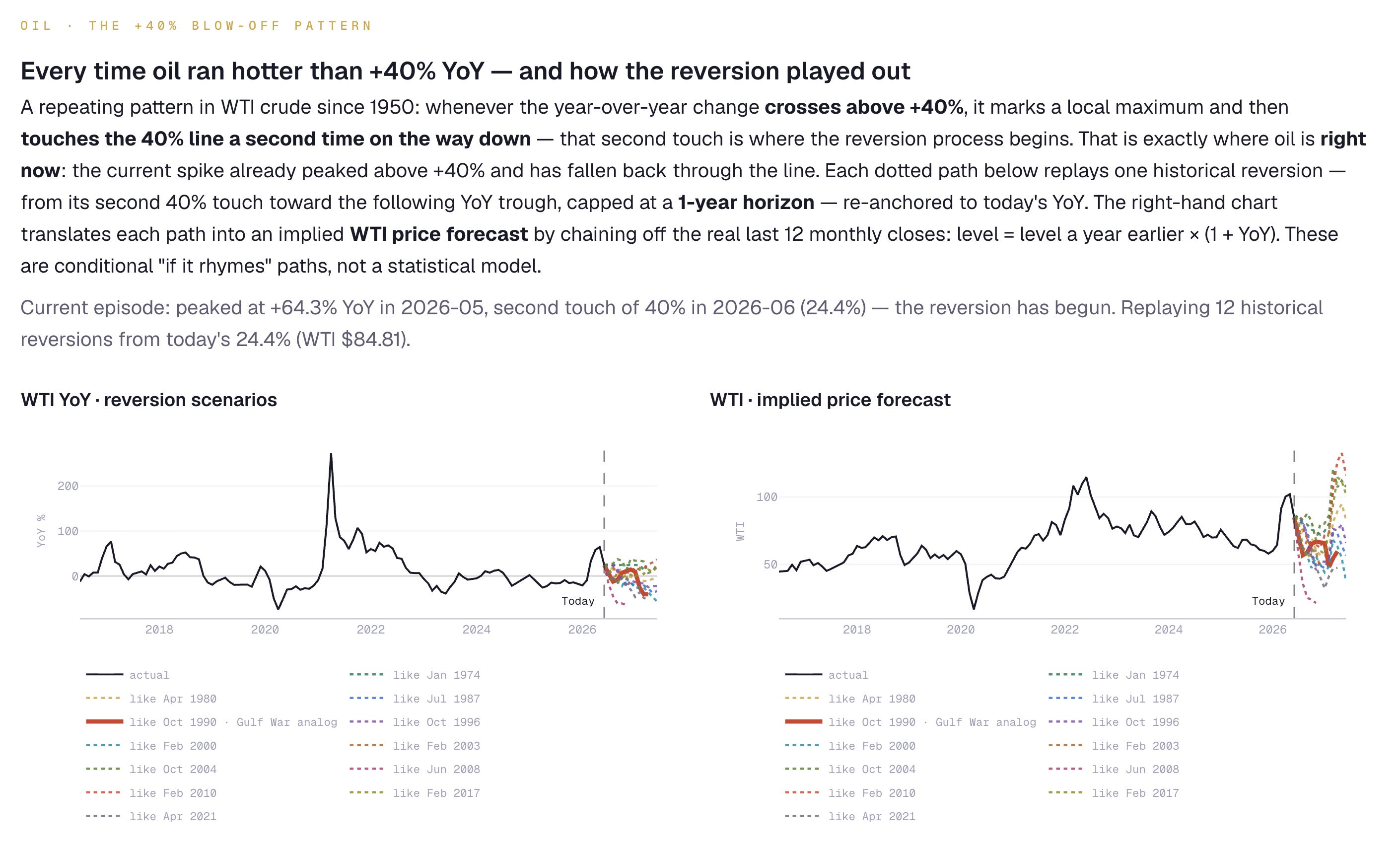
FIGURE 5 — WTI and the +40% blow-off pattern.
“Decoupled from oil” is exactly what a petro-currency looks like at the top — right before the drop starts pulling the other way.
There’s one currency big enough to move the dollar by itself: the euro. It’s more than half of what the dollar is measured against. When the euro falls, the dollar rises against everything — the peso included.
Right now the euro is stretched. It’s sitting near the top of its multi-year range, and its own reversal patterns — 1992, 1995, 2008, 2011, 2018 — mostly point the same way: down.
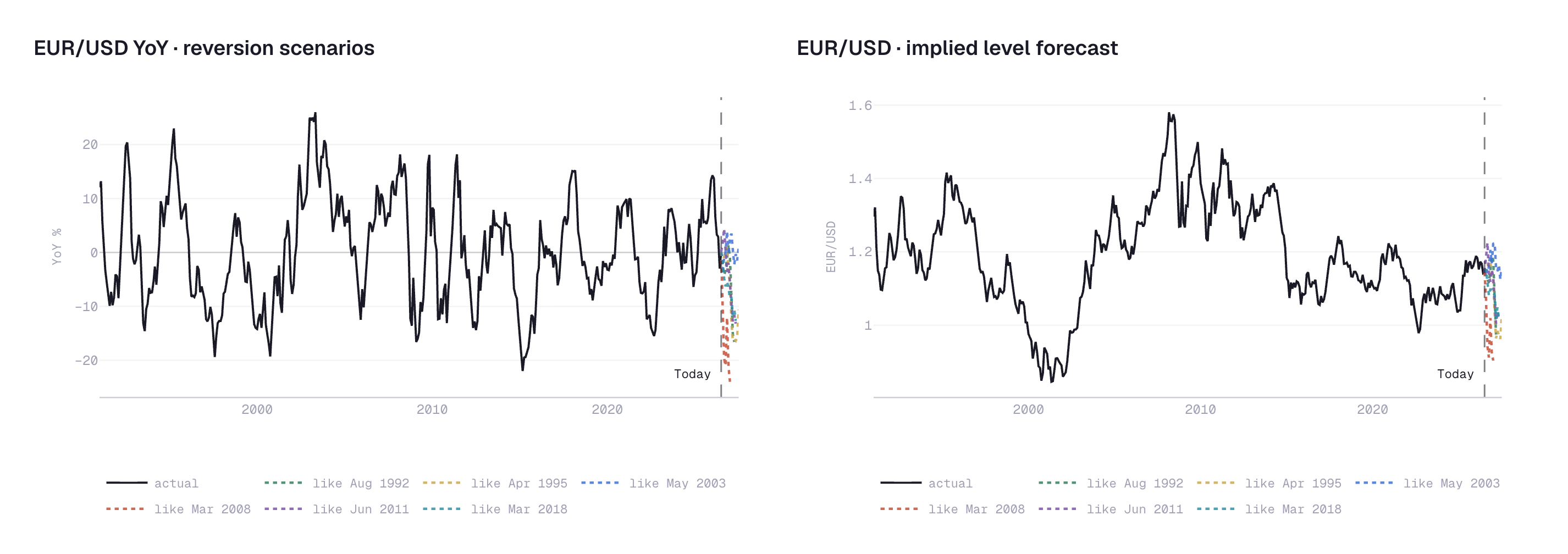
FIGURE 6 — EUR/USD reversal scenarios and implied level.
A weaker euro means a stronger dollar. And a stronger dollar is the tide that pulls every emerging-market currency out to sea — the strong ones first.
The peso didn’t just borrow the world’s risk appetite and the world’s oil. It borrowed a soft dollar. That last support is the one now set to give way.
A rising dollar doesn’t ask Bogotá for permission.
Take the peso’s past moments of extreme strength — 2010, 2014, 2021, 2023 — and lay them over today.
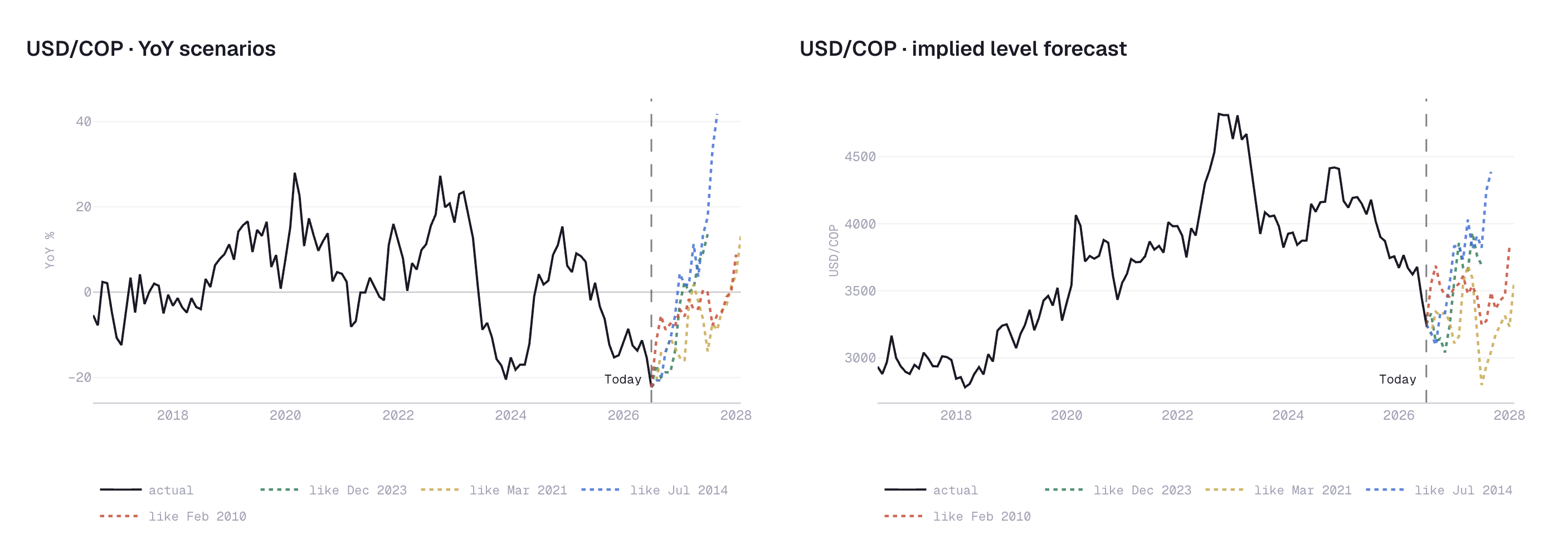
FIGURE 7 — USD/COP analog scenarios.
They don’t scatter. They lean one way: back. Not tomorrow, not in a crash, but over the next year or two the pull in every analog is toward a weaker peso.
Four echoes of the past. All pointing the same direction.
Now turn the peso over and look at who actually holds it.
Remember the phone call. That buyer was PIMCO — and it didn’t stop. One American fund now holds around $13 billion of Colombian government bonds. That’s roughly 30% of all foreign-held Colombian debt, in a single firm.
When one house is a third of the foreign float, it doesn’t follow the market. It is the market — and the dollar.
Zoom out and it’s a foreign takeover of the bid. Overseas holdings of these bonds jumped from about $32 billion to $46 billion in seven months. In 2026, foreigners passed Colombia’s own pension funds to become the biggest buyers of their government’s debt.
And much of it isn’t even real ownership. Offshore derivative bets on the peso — leverage, no delivery — exploded from around $1 billion to over $15 billion by mid-2026. A large part of the “peso bull” isn’t conviction. It’s a borrowed position.
Borrowed positions leave at the speed of a margin call.
This isn’t a “vulture fund” story — Colombia isn’t in default, and these aren’t distressed-debt raiders. It’s something worse for the local narrative: a crowded, borrowed, foreign bet wearing a Colombian costume.
Now the detail that turns all of this from a story into a structure. Ask how big the door is.
The entire Colombian peso market trades about $7.3 billion a day. It’s the 30th most-traded currency on Earth — about 0.21% of a $9.6-trillion-a-day market. For scale: the euro and the dollar trade more than a trillion dollars a day between them. The peso’s whole daily market is a rounding error.
Put the two facts together.
A price set by a few foreign whales and borrowed money — inside one of the smallest currency markets in the world.
On the way in, that’s a rocket. On the way out, it’s a keyhole.
When the outer circle turns, all of that money has to leave through the same tiny door. At once.
That isn’t a forecast. It’s a floor plan.
Here’s the part I can’t let go.
Goldman does think in circles — when it’s talking about the dollar. Its global note explains the strong dollar as something bigger than America: an AI spending boom and an energy shock lifting US inflation, dragging the Fed hawkish. Technology becoming a macro force. That’s the outer circle setting the price.
Then it turns to the peso and tells a small, local story.
Same bank. Same note. A big-picture map for the dollar, a street map for the peso.
Pick one.
This isn’t a call that the peso crashes on Monday. It’s a call about which circle is talking — and a warning that the crowd is reading the wrong one.
Today the consensus reads the inner circle: the budget, the central bank, the vote. All real. But the peso’s size, its yield, the red-lined risk gauge, the oil blow-off already turning, its own leaning history, and an ownership base that is foreign, concentrated and borrowed — all say the same thing.
The driver right now is the outer circle. And the outer circle is stretched and late.
If the peso breaks, the fingerprints won’t be in Colombia. They’ll be in the yen. In AUD/JPY rolling over. In oil’s fall biting. In the Brazilian real cracking first. In PIMCO stopping.
Colombia will be the last to know.
The local story will still be congratulating a budget while the outer circle has already moved. That’s what outliers are for. They’re the ones that tell you the cause has quietly walked from one place to another — and that the story everyone’s telling describes a world that no longer runs the show.
The yen / AUD/JPY — the funding leg. A roll-over here is the first domino, not the last.
Oil’s fall — the second 40% touch is in. Watch the trend, not the headline.
The Brazilian real — the canary. It usually cracks before the peso does.
The euro — more than half the dollar’s weight. A euro that rolls over lifts the dollar against every EM at once.
PIMCO’s bid — one fund is ~30% of the foreign float. The day the whale stops adding is the day the peso loses its biggest sponsor.
The borrowed money — the offshore peso bets. Fast money in, fast money out.
The narrative lag — the day the peso wobbles and the news still blames “fiscal risk” is the day the outer circle has already won.
Markets are stacks of contexts. A price is set not by one cause, but by the circle that controls the story at any given moment. Regimes change when the signal jumps from one circle to another — or when a local spark becomes a global fire.
Kind regards,
Guillermo Valencia A
Co-founder of MacroWise
This essay reflects the opinion of MacroWise and is provided for informational and educational purposes only. It is not investment advice and is not a recommendation to buy, sell, or hold any currency, security, or other instrument.
Nothing here is a forecast. The scenarios described are conditional “if it rhymes” historical analogs, not predictions, and the risks discussed may not materialize. The peso may keep strengthening; the outer-circle drivers may not turn on the timeline implied. Markets carry the risk of loss.
References to third parties — including Goldman Sachs and PIMCO — are based on publicly reported information believed reliable as of July 2026 and may be revised or become outdated. The December 2025 bond placement’s counterparty was officially confidential at the close and was subsequently reported to be PIMCO; PIMCO’s own December accumulation was independently reported by Bloomberg via Comptroller General data.
Figures are drawn from public sources. Peso bond and turnover figures are converted to USD at USD/COP ≈ 3,250; the “3,249 / 3,200” figures are USD/COP exchange-rate levels (pesos per dollar), not dollar amounts. Do your own research and consult a licensed professional before making any financial decision.
Sources: Banco de la República, Banco de Bogotá / Corficolombiana (TES holdings), BIS Triennial Survey April 2025 (turnover), ECB, Bloomberg, Reuters.
No posts
Comments
Nothing yet. Say the first thing.
Sign in to join the conversation.