
Every global strategist has the same chart pinned to the wall: US equity valuations versus the rest of the world. The spread is enormous. And the consensus conclusion never changes: unsustainable, rotate into what’s cheap.
They’ve been saying that since 2011.
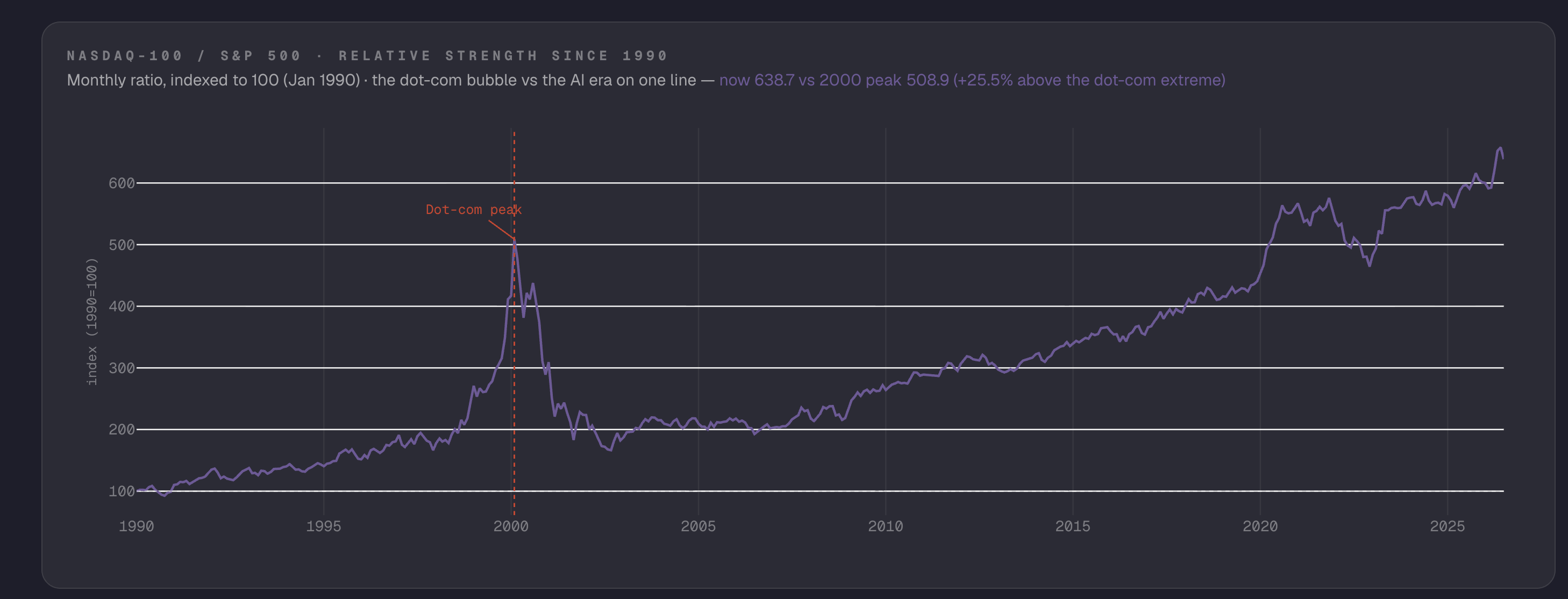
Concentration didn’t revert. It compounded. The Nasdaq-100/S&P ratio now sits 25% above the dot-com extreme. There are two ways to read that. One: this is a bigger bubble than 2000. Two: the market is discounting a regime change the consensus hasn’t processed yet.
We’re in the second camp. With caveats we’ll be honest about at the end — because a thesis without risk management is just religion.
The public AI debate is stuck at the wrong layer of the stack. Which lab is winning, which model benchmarks better, whether revenues justify the capex. None of that is the trade.
Large language models are going to be a commodity. When a technology replicates, gets cheaper, and distributes, value doesn’t accrue to the product — it transfers to whoever uses it to reorganize something bigger. Electricity did this. The internet did this. The browser never captured the value of the web; the companies that rebuilt entire industries on top of it did.
The right question is not who wins the LLM race. It’s: what economic reorganization does automated labor make possible?
And the answer is the biggest one available: the repatriation of production.
For forty years the logic was singular: production goes where labor is cheap. That arbitrage built Asia into the world’s factory and turned the US into a services economy running a chronic trade deficit.
Automation kills the arbitrage. When labor cost stops being the dominant variable — because the work is done by a robot that costs the same in Ohio as in Shenzhen — the location equation resets. The variables that take over are different ones: energy cost, depth of capital markets, rule of law, proximity to end demand.
On those four variables, the US doesn’t compete. It dominates.
This is why index concentration is neither an accident nor a mania. It’s the market pricing a production model where capital replaces labor as the scarce input. The rotation ahead is not US-to-EM. It’s a rotation within the thesis: from language models to robotics. From software that thinks to machines that produce.
Concentration since 2011 wasn’t the anomaly. Fifteen years of fading it was.
Now the macro leg. A capital- and automation-intensive production model is, before anything else, energy-intensive. And this is where the 2026 war compressed a decade of change into four months.
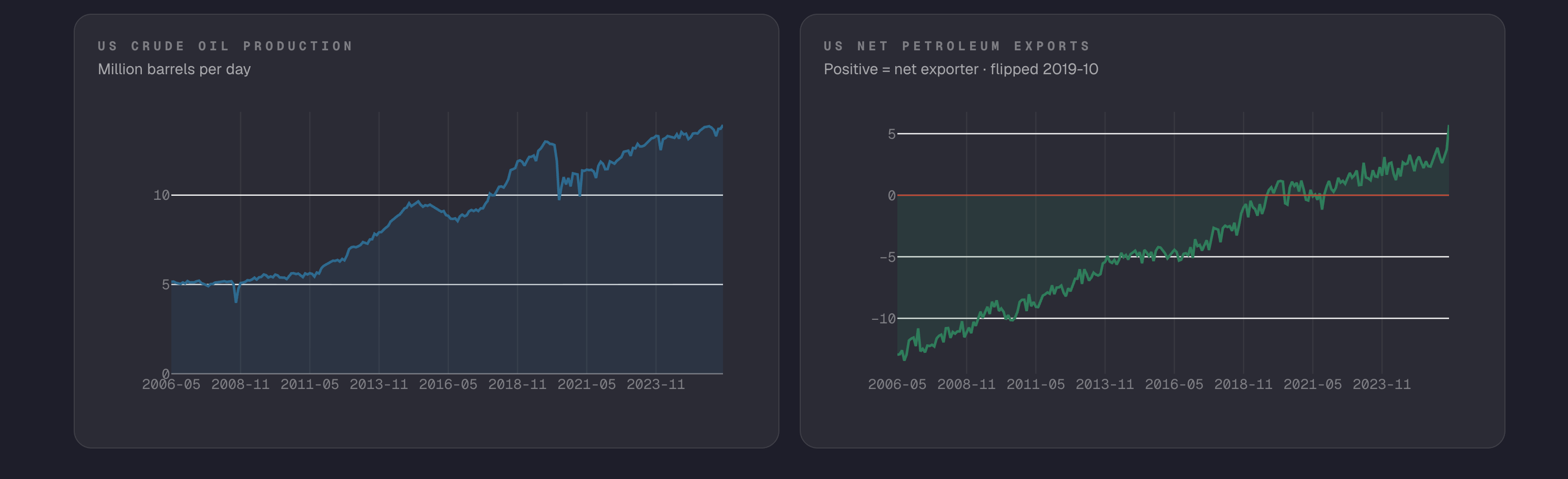
The US is the largest energy producer on earth and a net petroleum exporter since 2019. That was true before the war. What the war did was expose the asymmetry: the Hormuz shock hit Europe, hit Asia, hit every importer — and left the United States as the only energy-self-sufficient industrial bloc on the planet. That is not a data point. That is the setup.
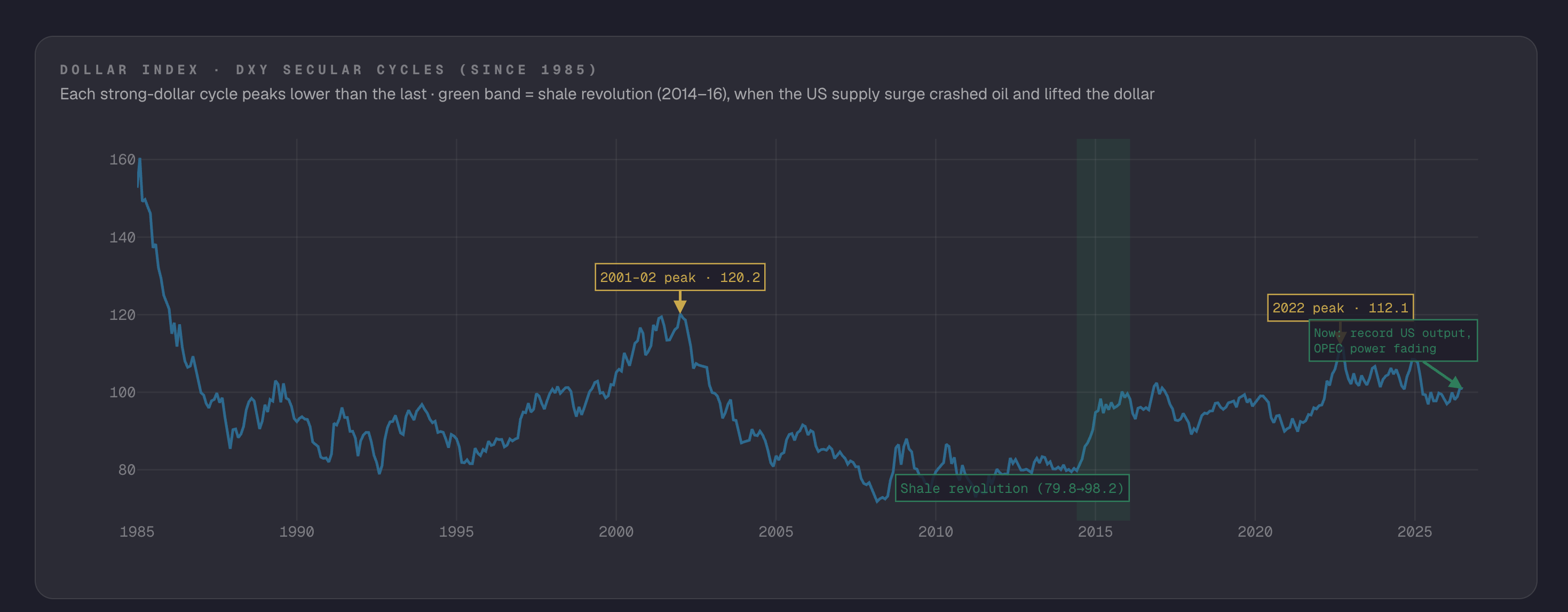
We’ve traded this movie before. The shale revolution (2014–16) crushed crude and lifted the dollar: DXY ran from 79.8 to 98.2 while OPEC tried, and failed, to break American producers by flooding the market. The lesson from that episode is the one that matters now: when US supply grows and crude falls, the dollar doesn’t weaken. It rips.
And the cartel that defended the price is dismantling itself in slow motion.
On May 1, 2026, the UAE walked out of OPEC after 59 years — the first exit by a major producer holding real spare capacity. Abu Dhabi is taking capacity toward 5 million barrels a day by 2027, unconstrained by quotas, competing for market share. When the cartel’s second-largest holder of spare capacity decides volume beats price discipline, the oligopoly that defined the oil market for sixty years enters its terminal phase.
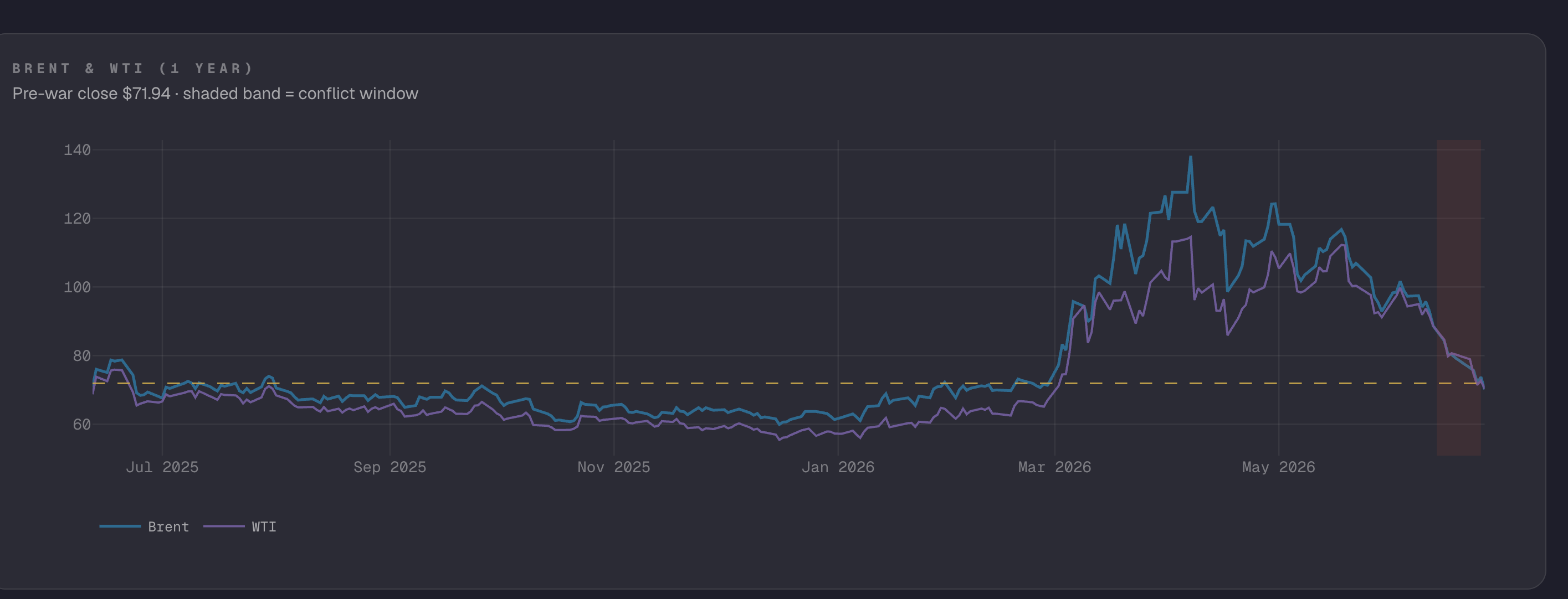
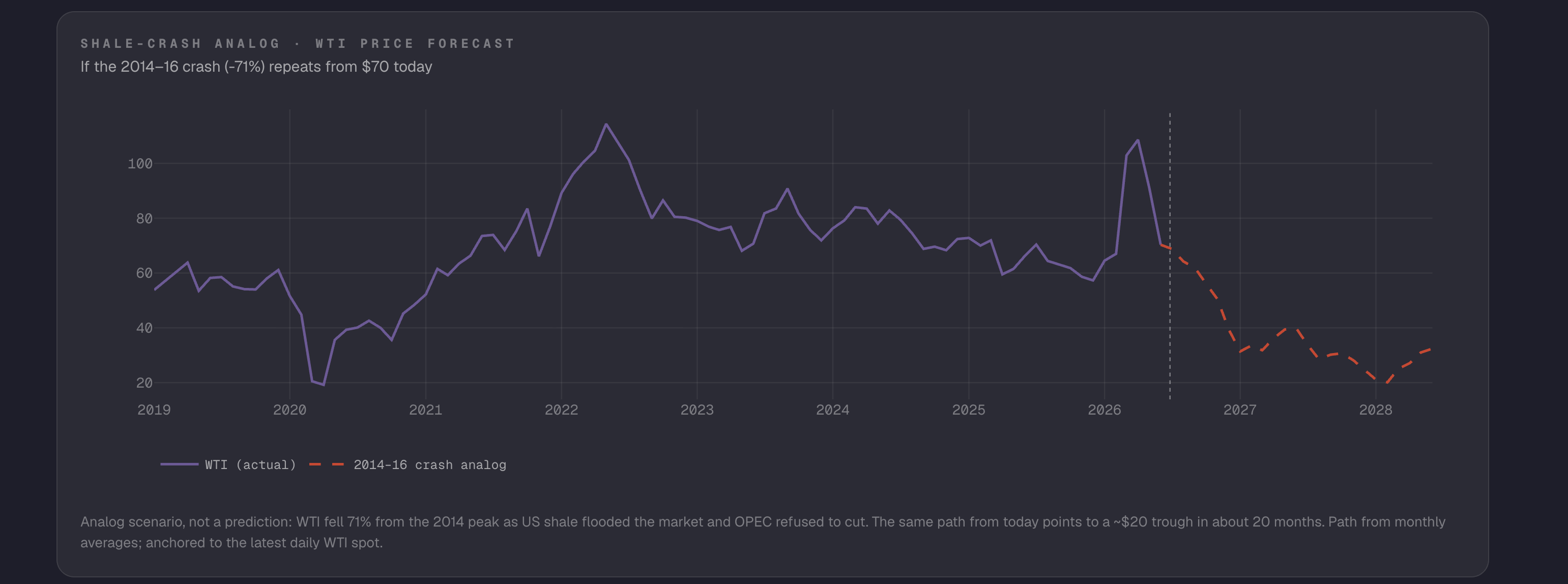
Look at the tape. Crude is back at pre-conflict levels. The entire war premium — a spike to $126 — unwound in weeks. A market that cannot hold a supply shock of that magnitude is telling you something about demand. Listen to it.
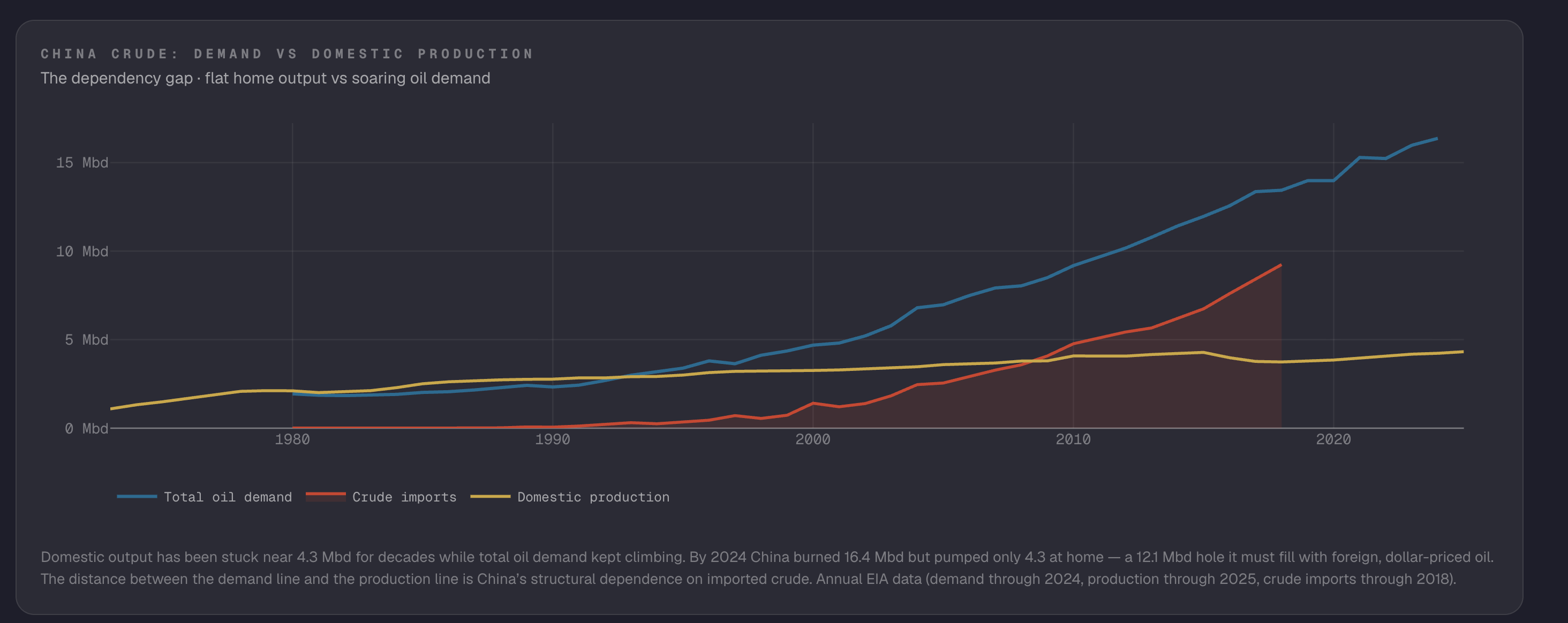
China burns 16.4 million barrels a day and pumps 4.3. That 12-million-barrel hole — paid in dollars, shipped through chokepoints it doesn’t control — is its single largest strategic vulnerability. The 2026 war made that unmistakable in Beijing.
Their response isn’t diplomatic. It’s electric.
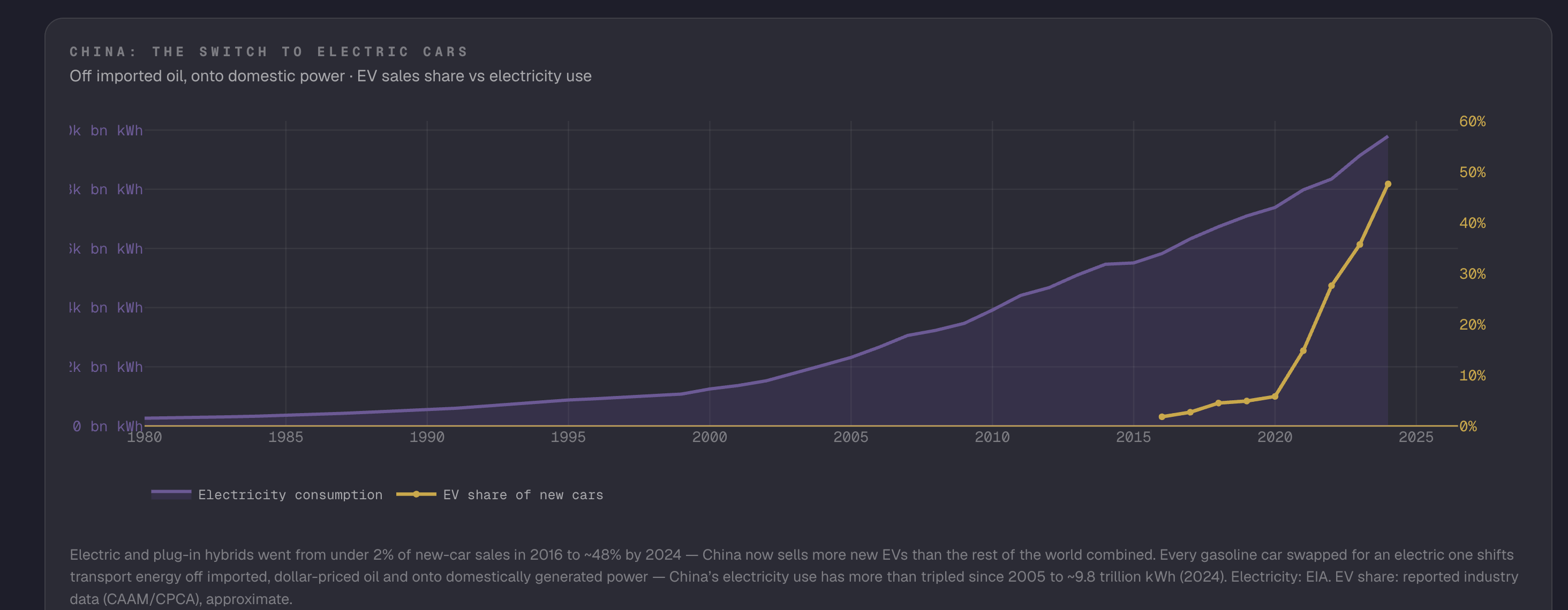
EVs and plug-ins went from under 2% of new-car sales in 2016 to roughly 48% by 2024. China sells more EVs than the rest of the world combined. Every gasoline car swapped for an electric one moves transport energy off imported, dollar-priced crude and onto domestically generated power. Chinese electricity consumption has tripled since 2005.
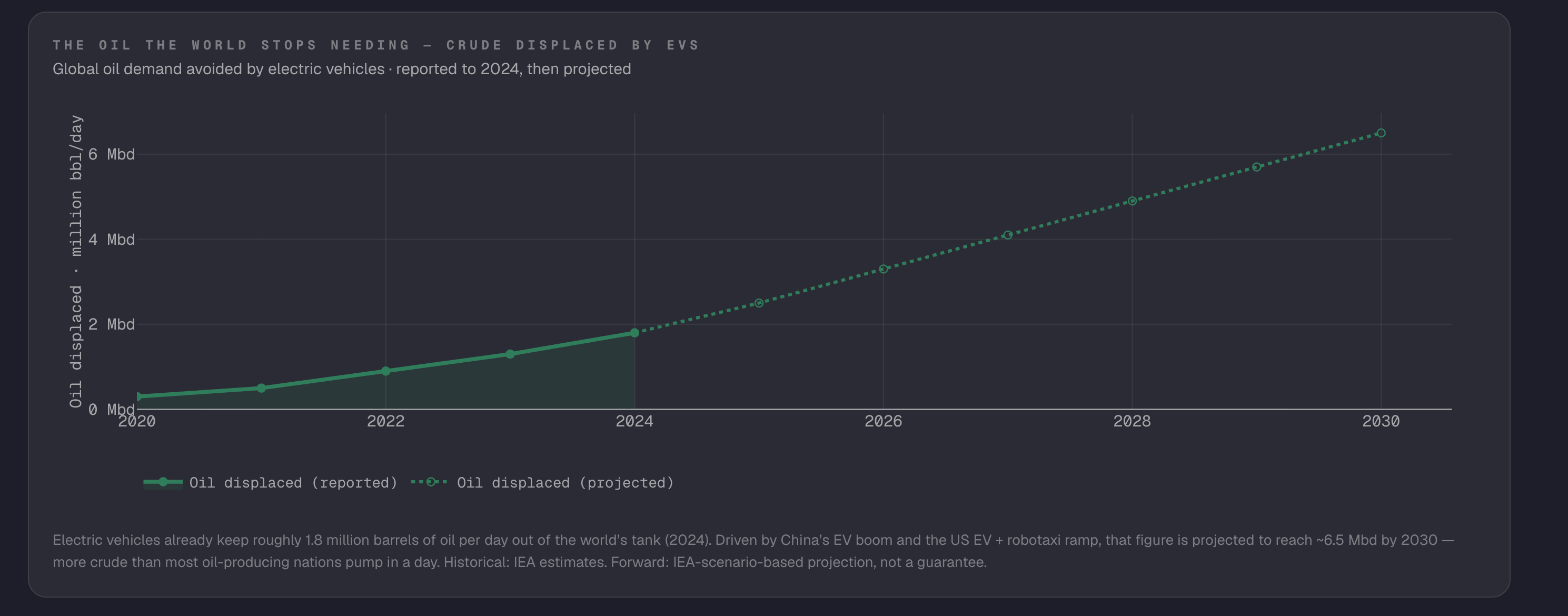
EVs already keep ~1.8 million barrels a day out of the world’s tank. The 2030 projection: ~6.5 Mbd — more crude than most producing nations pump. This is not a demand cycle. This is demand that leaves and doesn’t come back.
Now assemble the pincer: supply released from cartel discipline, meeting demand in structural retreat. That equation resolves to structurally cheaper oil.
And who wins in a cheap-energy world? Not the petrostates — for them it’s a fiscal death sentence, and for their currencies, a slow bleed. The winner is the country that is simultaneously the largest producer (its energy complex scales on volume, not price), the largest industrial consumer, and the owner of the automation platform that needs that energy to bring production home.
The US-versus-world equity gap doesn’t resolve on multiples. It resolves on this chain:
Abundant, cheap domestic energy. Automated labor that nullifies the Asian wage arbitrage. Capital markets deep enough to fund a trillion-dollar buildout. And a war that just ran a live stress test on who can operate without importing a single barrel.
That is not a valuation premium. That is the market discounting that the world’s next factory gets built in America — by robots.
The pain trade is that this continues. The consensus keeps waiting for mean reversion in a series that is trending for structural reasons, and keeps getting carried out.
Three things, no anesthesia:
Price already discounts a lot. Sitting 25% above the dot-com extreme is not a footnote. In 2000, the internet thesis was right — and the Nasdaq still fell 78%. A correct structural thesis does not protect you from buying the euphoric leg. The transition can be real and your entry can still be a disaster. Position sizing is the difference between conviction and ruin.
The capex is now debt-funded. Hyperscalers are reinvesting roughly 94% of operating cash flow and issuing debt at four times the decade’s average pace. If monetization lags the buildout, credit reprices this before equities do. Watch IG spreads, not earnings calls.
Robotics is still narrative, not margin. The rotation into automated labor is the earliest — and therefore most fragile — leg of the thesis. Reshoring is a multi-decade process marked to market against quarterly patience.
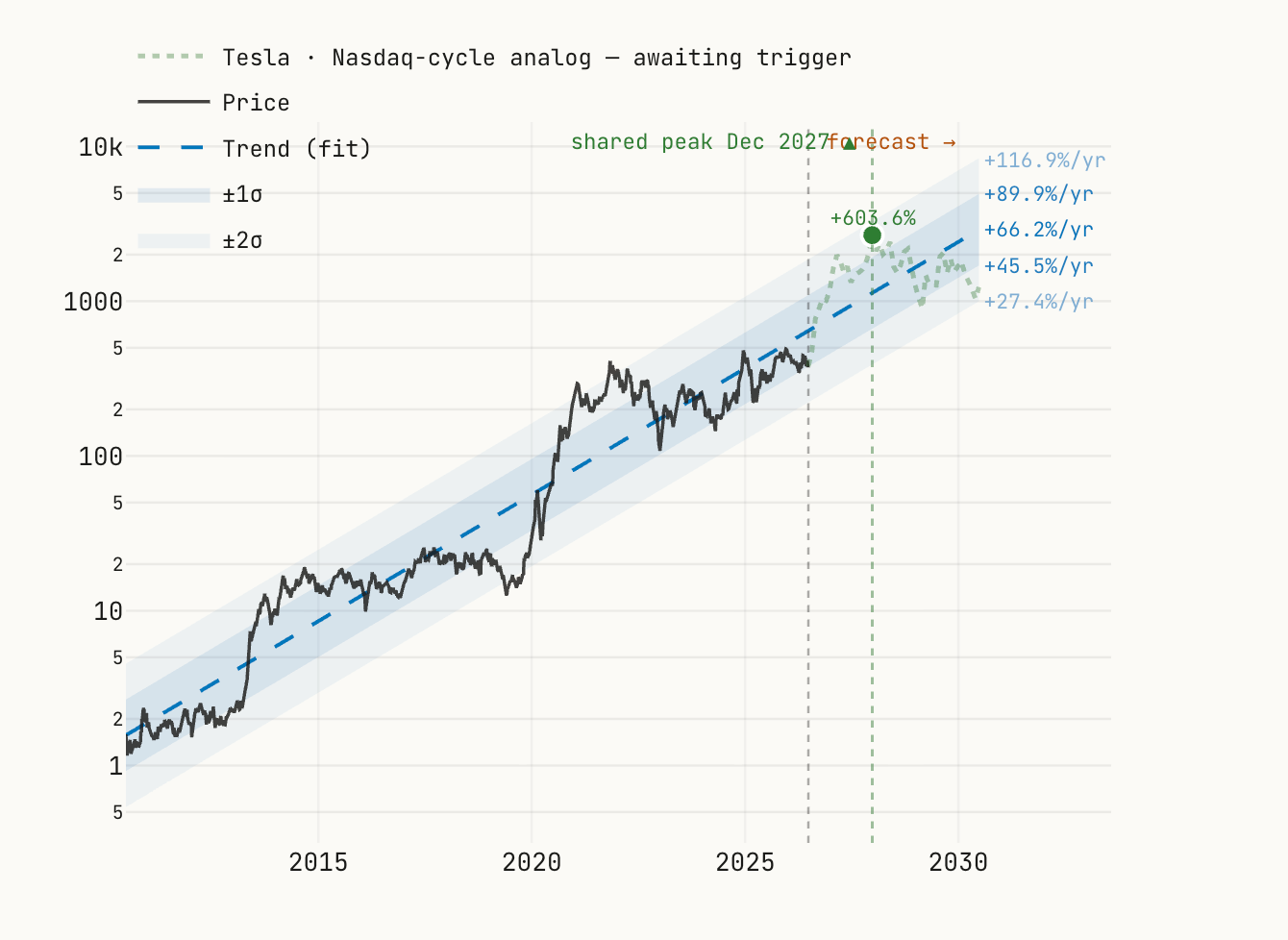
None of this invalidates the structural argument. It disciplines it.
Thanks for reading,
G
No posts
Comments
Nothing yet. Say the first thing.
Sign in to join the conversation.