
Biology has quietly abandoned the idea that life is a machine written in code. The same correction is coming for how we read markets, money, and the strange new economy now being built for machines that are not us.

On the morning of June 26, 2000, in the East Room of the White House, Bill Clinton stood between two men who could barely stand to be in the same room and announced that the human genome had been read. Tony Blair joined by satellite from London. Francis Collins, who had led the public effort, and Craig Venter, who had raced it from the private sector, arranged their faces into the expressions men wear when a rivalry is being papered over for the cameras. Clinton, who had a gift for lending scientific occasions the cadence of scripture, said that we were learning the language in which God created life. No one at the podium corrected him, and for a while no one needed to. It was, everyone agreed, the book of the species, and now we held the index.
He was wrong, though not in the way a believer or an atheist might first assume. The trouble was not God. The trouble was the word “language.” For the better part of a century, molecular biology had run on the conviction that DNA was a text—an instruction manual, a blueprint, a code awaiting its cryptographers—and the genome project was the triumphant last act of that conviction. Twenty-five years and several million sequenced genomes later, the metaphor has not delivered the understanding it promised. In certain respects it has done the opposite. We learned to read the letters and discovered that the letters were not, in any ordinary sense, a sentence.
I have come to think that this failure is not confined to biology, and that the same error—the same habit of mind—now shapes how we talk about things that seem to have nothing to do with cells: the economy, the market, the future of a technology like Bitcoin or Solana. It is a single mistake wearing two faces, and the most efficient way to see the second is to begin with the first, inside a cell.
For decades, and with serious money, researchers went looking for the gene for violence. Also the gene for fame, for infidelity, for what one paper, not entirely in jest, called sin. None of them was found, and the reason is not that the search was sloppy. It is that such genes do not exist, in roughly the way that no single brick is responsible for the soccer match being played in the stadium built partly out of it.
Some of the confusion was bequeathed by a naming convention. When a geneticist disabled a gene in a fruit fly and the fly emerged without wings, the gene was christened wingless. The logic feels airtight and is in fact a trap. Remove a screw from an airplane and the airplane falls; you do not conclude that you have located the flight screw. What breaks when a part is removed and what the part does when it is in place are different questions, and the history of genetics is in large part the history of confusing them.
The gene called wingless makes the point almost as a joke. While one group of biologists was studying its role in building the segments of the fly embryo, a separate group, working on the other side of the world and on an entirely different problem, identified a gene that caused tumors in mice. In 1987 the two were found to be the same gene—one sequence, two disciplines, two functions with no evident relation to each other. To ask what such a gene “does” turns out to be as naïve as asking what the word “of” means. It depends on the rest of the sentence.
Then came the technique that was supposed to settle everything and instead unsettled it. In the nineteen-nineties, biologists fell in love with the knockout: switch off a gene, observe what fails, infer the gene’s purpose—pulling fuses until you find the dead one. They switched off genes they believed indispensable, and the animals were born more or less intact. There was no cabinet of labeled spare parts behind the failure. There was something stranger and more interesting: the organism reorganized, improvised, routed around the damage. A gene, it emerged, is not a cause. It is a node in a network, and its meaning lives not in the part but in the connections among parts. The genome is not the cell’s brain, issuing commands; it is closer to a pantry, from which the cell—an autonomous, integrated thing—takes what it needs, when it needs it.
The most forceful recent statement of this view belongs to the physicist and science writer Philip Ball, whose book “How Life Works,” published in 2024, has the air of a quiet demolition. Life, Ball argues, is none of the machines we have built to flatter ourselves—not a clockwork, not a computer, not a robot—and to compare it to them is to shrink it. What distinguishes a living thing, in his account, is not that it replicates or metabolizes but that it generates meaning: it mines its surroundings for what matters to it. A cell does not run a program. It interprets a world.
To this Ball adds a second proposition that, joined to the first, is the most powerful thing in the book. Life is not located at a single level. It is a hierarchy, and each scale—genes, proteins, cells, tissues, organs, bodies—runs by its own rules, with none of them in charge of the others. Put the two ideas together and you arrive at a sentence Ball never quite writes but everywhere implies: that life is a kind of collective searching for meaning at many scales at once. The gene searches at its scale, the cell at its, the body at its, and from that stacked, uncoordinated, directorless search the thing we call being alive emerges.
It is worth climbing the whole ladder, because the rungs rhyme. At the level of molecules, meaning is barely more than affinity—what binds to what, a little order pulled out of thermal noise. In the immune system, meaning becomes identity: the distinction between self and not-self, the memory of an old infection, the capacity to learn from each new one, all of it accomplished by a system that recognizes and remembers without anything we would call a brain. In the nervous system, meaning becomes perception, the world converted into signal and the signal into experience. In language, meaning detaches from the body and begins to travel, leaping from one mind to another for the first time in the history of the planet. In culture, it becomes inheritance: what one generation understands, the next receives without having to learn it again. And in markets, meaning becomes price—millions of private judgments about what is worth what, compressed into a single number that no one wrote. Molecules, immunity, cognition, language, culture, markets: one search conducted at six altitudes, and at each altitude the same astonishment, which is that meaning emerges from parts that, taken one by one, mean nothing at all.
There is a detail here that ought to induce a mild vertigo. Life operates at the scale of molecules, where everything is noisy, random, and unpredictable, and yet the cell does not wage war on that noise in order to impose order. It exploits it. It thrives on chance, on fluctuation, on accident, and could not function otherwise. What an engineer would regard as a defect to be eliminated, life long ago learned to use as a resource. This is the hinge on which the rest turns. The machine metaphor compels us to see every component as a part with a fixed function and to hunt for the single cause of whatever happens. Living systems do not work that way. They have no levers; they have networks. They are not operated; they are inhabited. And it is precisely this habit of mind—the reflex to treat the living as a mechanism—that we carry, without noticing, out of the laboratory and into the market.
We speak of the economy as though it were an engine. The central bank pulls levers, taps the brakes, heats or cools the machine with its rates. The image is comforting and false. An engine has a design, parts with fixed functions, and predictable behavior; you turn the key and it starts. The economy does not start. It improvises, compensates, and overruns every blueprint drawn for it, because it is a complex adaptive system made of millions of agents who learn, imitate, and anticipate one another. It has no levers. It has tides.
The same reflex returns, with greater force, when we judge a new technology. We take a protocol’s white paper—the nine pages Satoshi Nakamoto published in 2008, or Solana’s specifications—and assume the future is written there, that it is enough to read the code to predict the organism. This is the blueprint fallacy all over again. The white paper is the technology’s genome: a pantry of capabilities, not a manual of instructions. What it becomes is decided by the living network in contact with its environment—users, developers, validators, speculators, regulators, rivals. Just as the genome does not run the cell but supplies it, a protocol’s code does not fix its value; it hands the question to a community that metabolizes the answer in its own way. To ask what Bitcoin “does” is to ask what a gene does. For an Argentine it is a hedge against inflation; for a pension fund, a long-duration uncorrelated asset; for a dissident, money that cannot be censored; for a day trader, volatility itself. One sequence, contradictory functions, depending on who is listening and when. The meaning is not in the protocol. It emerges from the network.
For forty years the Santa Fe Institute has made a science of exactly this—of systems in which the whole does what no part contains. In 1972 the physicist Philip Anderson compressed the idea into a phrase that became a discipline’s motto: more is different. Traffic is not inside any car; culture is not inside any employee; the price of an asset is not inside any order to buy. Each emerges from the interaction of the others and cannot be read off the parts, which is the same thing we found in the cell, transposed to an organism made of capital and desire. The economist W. Brian Arthur, one of the founders of complexity economics, supplied the part that matters most for technology: increasing returns. Classical economics assumes that the more you have of something, the less the next unit is worth. Network technologies invert this. Each new user makes the network more valuable to everyone already in it, which produces lock-in, path dependence, advantages that compound. The best technology does not necessarily win; the one that first crosses a threshold of adoption and lets the network work on its behalf does. QWERTY is not optimal. It is inevitable. Whether Bitcoin or Solana survives will be settled less by their isolated technical merits than by whether they lit that engine before their rivals did.
It is here that Geoffrey West changes the shape of the question.
West, a theoretical physicist and a former president of the Santa Fe Institute, spent years on a single obsession: why so much of nature obeys scaling laws. He found that an animal’s metabolism grows not in proportion to its mass but to its mass raised to roughly the three-quarter power. An elephant is millions of times the size of a mouse and yet burns far less energy per kilogram; the larger the creature, the more efficient. This is sublinear scaling, and it governs organisms. It also governs, West discovered, companies—and it carries a sentence with it. What scales sublinearly slows, matures, and dies. Firms, like bodies, have finite lives, and almost all of them end.
Then West found the exception, which is the city. Cities scale the other way. Their infrastructure—pipes, roads, cables—does economize with size, sublinearly, like a body. But their socioeconomic output—wages, patents, ideas, wealth, and crime alike—scales superlinearly, faster than population. Double a city’s size and you get more than double the innovation per person, and because that output feeds on itself, cities almost never die. Flatten New Orleans or Hiroshima and they return. They are, for practical purposes, immortal.
This is the question to put to any network technology. Does it scale like a company or like a city—sublinear and mortal, or superlinear and nearly unkillable? A blockchain aspires to be a city. Its entire thesis, dressed in the language of network effects and Metcalfe’s law, is a wager on superlinearity: that each new participant adds more than it takes, that the system’s social output—liquidity, security, applications, trust—outgrows its population. A blockchain that manages this becomes a digital settlement, hard to kill. One that does not is merely another company with good code, bending toward the sigmoid curve of maturity and decline. Bitcoin and Solana are two different bets on how to build and hold such a city.
Every living network, West insists, has a metabolism—a flow of energy that sustains it and, if cut, ends it. Here the analogy stops being figurative. Bitcoin’s metabolism can be read in terawatt-hours; its proof of work converts electricity into security, and what looks to outsiders like waste is in fact a circulatory system. Solana made the opposite metabolic choice. West noticed that in biology the larger animal lives more slowly—the elephant’s heart beats at its leisure, the mouse lives fast and dies young—whereas in cities the larger the settlement, the quicker the pace: people walk faster, transactions accelerate, everything intensifies. Solana chose the metabolism of the large city, with blocks measured in a few hundred milliseconds and a frantic throughput, which is its bet on superlinearity and also its exposure; systems that live fast are more fragile to shocks, and each of the network’s historical outages was a bill for that speed. Bitcoin chose the elephant: deliberately slow, deliberately dull, deliberately hard to change. Two survival strategies, two organisms.
So much for theory. An experiment is already running, and it confirms West’s logic with a clarity that is slightly unnerving. Call it the agentic economy.
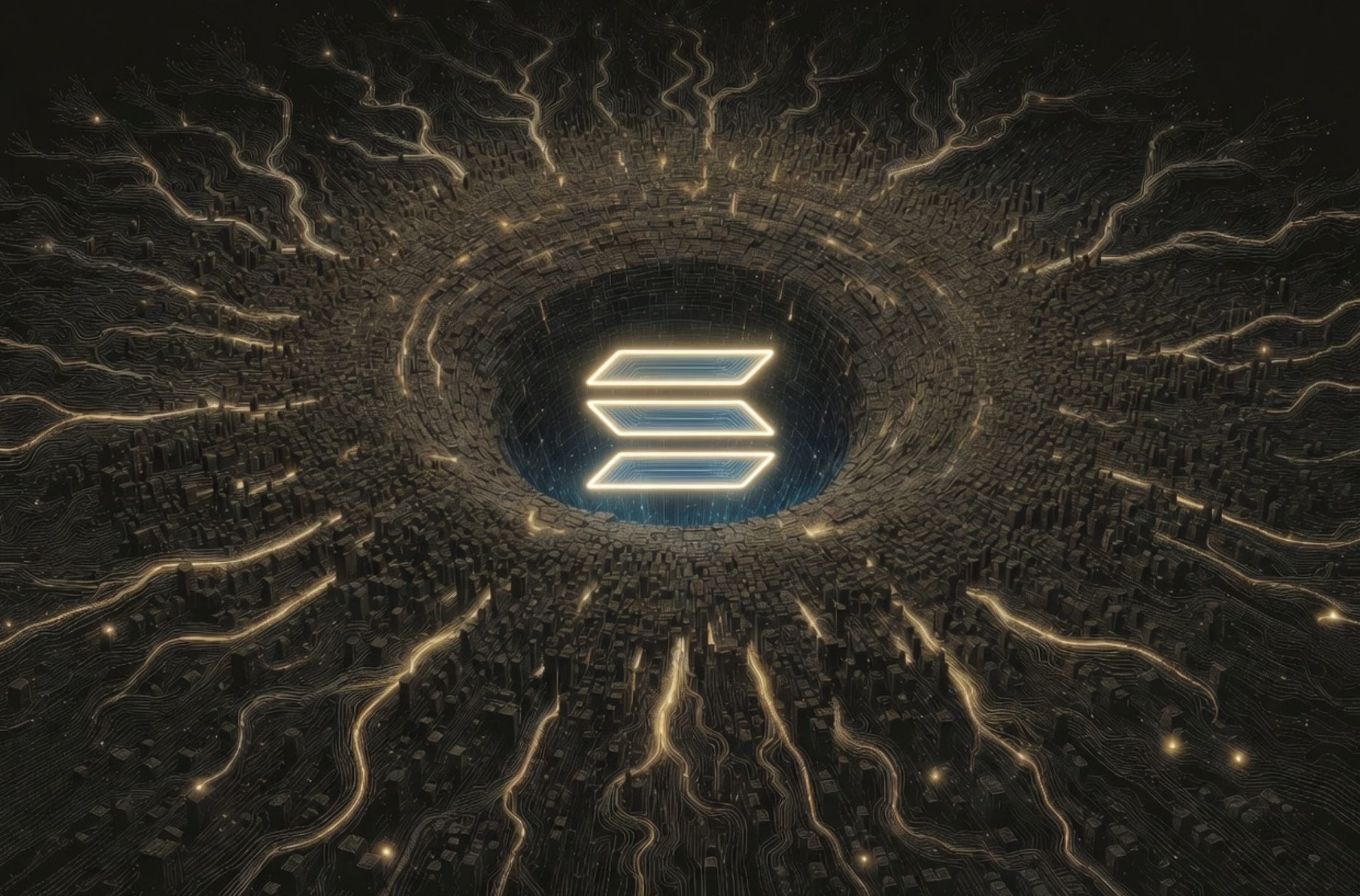
For as long as there have been economic networks, their protagonists have been people. That is beginning to change. Artificial-intelligence agents—programs that write code, query databases, rent computation, and complete tasks without pausing for permission at each step—are becoming economic actors in their own right, and to function they need something no bank can give them: the ability to pay, in real time and without a human in the loop, in amounts too small to bother a human at all. An agent buying a data lookup from another might move two-tenths of a cent; one renting a few seconds of a graphics processor, a nickel. These are the molecules of a new economy, and the lesson of the new biology returns here in its most literal form. A network can host a molecular metabolism only if its own metabolism runs at that scale. On Ethereum, where a simple transaction can cost more than a dollar, a payment of two-tenths of a cent is not expensive but impossible, the fee swallowing the sum. On Solana, where fees are a fraction of a cent and settlement takes under a second, the molecular payment actually occurs. The very speed that makes the fast city fragile turned out to be the habitat the machines required.
By early 2026, roughly two-thirds of the world’s agentic payments were running on Solana, up from about a third the previous summer—a jump, in eight months, that is complexity economics in time-lapse. It is Arthur’s increasing returns at full throttle, more agents drawing more services built for agents drawing more agents, and it is West’s superlinearity made flesh, the city that fills faster the larger it grows. The difference is that the citizens are no longer people. Machines, moreover, choose differently. A human picks a chain out of tribe, ideology, the crypto religiosity that Solana’s own engineers like to mock; an agent has no tribe. Ask it for the cheapest, fastest way to pay and it will select the fittest substrate without sentiment, which makes the agentic economy a brutally honest fitness test, a natural selection stripped of belief—and the test, for now, is going Solana’s way.
This is why the network stopped building for people and started building for machines, which want not a handsome interface but documentation, application programming interfaces, and machine-readable skills; Solana was the first major chain to place such a file at the root of its website, so that an agent could teach itself to open a wallet and sign a transaction with no human nearby. Around it an infrastructure is standardizing at speed—an open payment protocol for agents, born at Coinbase and now backed by parties as unlikely to agree on anything else as Google Cloud, the Ethereum Foundation, and the Linux Foundation; support for Stripe’s machine-to-machine protocol; an on-chain registry so that an agent can carry verifiable reputation, since in a city of machines trust must also come from somewhere. The interface, its architects say, is dissolving into language. The people building all this expect that within a couple of years most on-chain transactions will be initiated not by humans but by agents, and if they are even half right, the agentic economy will be not a feature of the crypto world but the first economy designed by and for non-human actors—in West’s terms, a city whose inhabitants are machines, with the superlinearity, the self-reinforcement, and the refusal to die that companies never had. It would be unwise to mistake an early lead for a destiny; lock-in is built but also contested, the new standards were deliberately born across chains rather than within one, and the fragility of the fast metabolism has not gone anywhere. This is a diagnosis, not a forecast. But it leaves the essay’s question turning with a new edge: if the market was already an organism no one controls, what becomes of it when most of its cells are autonomous, tireless, and not us?
The strongest evidence that Solana is a living thing and not a program running fixed code is that, at this moment, it is editing its own monetary genome. The proposal is called SIMD-550, and it is best told without ornament.
Imagine that Solana is a country that prints banknotes to pay its guards. The guards—the validators, the stakers—protect the network, and the country pays them in freshly printed notes; this is inflation. When the country was young and unknown, it had to print lavishly and pay well to lure anyone to the work, which is, in West’s vocabulary, the costly metabolism of a growing organism. But the country grew. It is now a large city, with banks and businesses and crowds, and printing at the old rate no longer attracts anyone new; it merely dilutes everyone already inside, like issuing more tickets to a stadium that is already full. SIMD-550, written by engineers at a firm called Helius, proposes slowing the press, so that the system reaches its floor of inflation in under three years rather than nearly six. The guard’s nominal wage falls; in exchange, the note you already hold stops thinning so quickly. You lower the number on the screen to protect what the number buys.
A machine does not decide to throttle its own fuel pump because it has grown up. An organism does, and we call it development. Solana’s inflation schedule was never carved into its original code; the living network, through its governance, is renegotiating the schedule because its stage of life has changed—the genome edited by the organism in response to its own maturity, exactly West’s transition from a metabolism of growth to one of maintenance. And the proposal is not yet law; it has technical endorsement but no scheduled vote, which, far from weakening the point, makes it. The genome is not rewritten by decree. It is deliberated. The network is, quite literally, arguing about who it wants to be when it grows up.
There is a subtler sign of maturity, too, which is differentiation. A young organism is a ball of similar cells; a mature one grows specialized tissues, organs with distinct jobs. Solana’s ecosystem has begun to do this. One new organ, a token called hSOL, is essentially a receipt: hand your SOL to a guard and receive a slip certifying that your coins are at work, a slip that quietly gains value as the wages accrue and that, unlike the staked coins themselves, you can move and lend in the meantime—liquidity conjured on an asset that used to sit still. Another, xSOL, is for those who want a thrill, offering leverage without the threat of liquidation, made possible because someone on the other side of the trade wants the opposite: you absorb that person’s volatility and collect, in return, the amplified upside. It is a bargain between the one who wants to sleep and the one who wants to run, and it, too, is specialized tissue—an organ that exists only to gather risk into whoever desires it.
The detail almost no one notices is that the same firm, Helius, both proposes cutting the guards’ wages and sells the receipt that lives off those wages. This looks like a contradiction and is in fact the most honest wager available: not that SOL will pay you more but that it will be worth more, purchasing power chosen over the large number, an adult’s decision rather than an adolescent’s. It is also, as it happens, a definition of risk I keep returning to. The danger is not that the visible yield falls—that is merely the volatility of a number—but that one fails to notice the structural change in how value accumulates. A healthy organism is not the one that clings to the wages of its youth; it is the one that learns to store value differently when the time comes to mature.
Here I should declare an interest, since it is the practical end of the argument. The service I run, ARCA, is a way of inhabiting this maturing organism rather than predicting its next move: buying SOL steadily and without leverage and letting the deflationary thesis work in silence over years. xSOL is, precisely, what ARCA is not—the route of adrenaline and amplification, with the decay that turbulent markets exact. They are two relationships with the same creature, and the question between them is not which yields more this quarter but which lets you remain in the game inside a system no one controls. What matters for the essay is smaller and larger than any product: that SIMD-550 and the new tissues around it are evidence that Solana’s ecosystem is evolving and not merely enlarging. To grow is to get bigger. To evolve is to grow new tissue, to correct one’s own metabolism, to choose, with deliberation, durability over dilution. Code that executes does none of this. An organism does.
If a living market metabolizes its shocks, one is obliged to ask whether there is a shock Bitcoin cannot digest, and the most conspicuous candidate has a name. Strategy, the company formerly known as MicroStrategy and animated by Michael Saylor, has accumulated more than six hundred and fifty thousand bitcoins—around three per cent of all that will ever exist—financed in large part by debt, by some fifteen billion dollars of convertible bonds and preferred shares, and for years it was the living proof of a single conviction: never sell. In 2026 the conviction cracked. The premium at which the stock traded over its own coins, once nearly fourfold, collapsed below one; the shares lost roughly seventy per cent in six months; the company reported a quarterly loss in the billions; and in the spring its executives revised the dogma, allowing that they might sell Bitcoin when it served them, with Saylor speaking, memorably, of selling in order to inoculate the market. The trouble is the shape of the thing. Rising Bitcoin justifies more debt, which buys more Bitcoin; falling Bitcoin sinks the company’s value, which can force a sale, which sinks the price further—an automatic margin call wearing the costume of conviction. Were that loop to break downward, Strategy might be compelled to pour a vast quantity of supply onto the market at the worst conceivable moment. That is fragility.
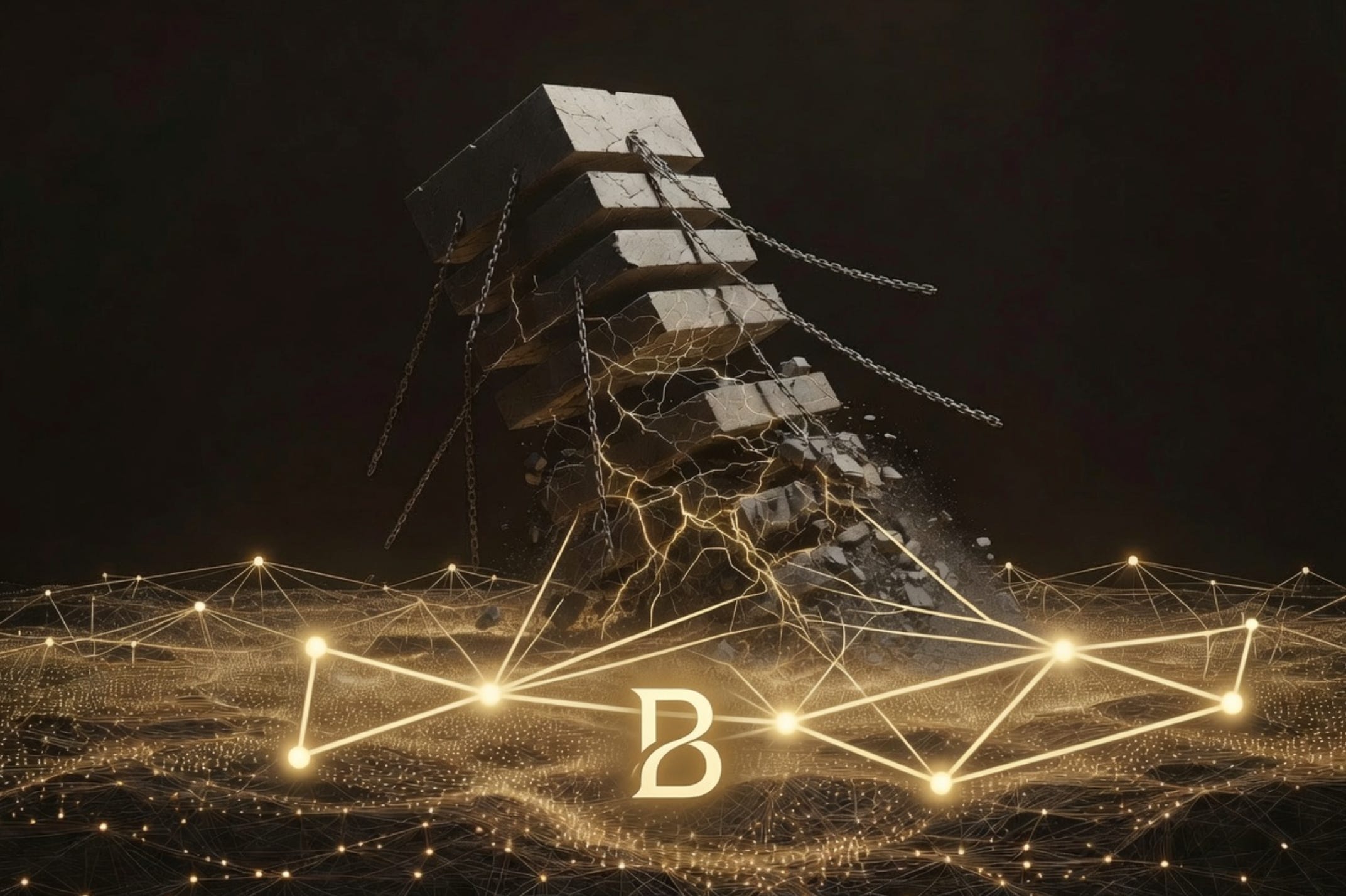
I want to be careful here, because the point is easy to mistake. I am not predicting that Strategy will collapse; I have no idea whether it will, and wagering on the bankruptcy of a particular firm is not the business of this essay. The claim is structural. Strategy is a fragility hub—the place where the system concentrates leverage, debt, and a single human will, and therefore the place where, if anything were to break, it would break. The interesting question is not whether it falls but what happens if it does, because the answer is the acid test of everything argued above. A living system is judged not by its good days but by what its structure guarantees on its worst one. So let us treat the fall of Strategy not as a prophecy but as a thought experiment, the most demanding one on offer: switch off the largest node and see what remains standing.
The answer was supplied a quarter century ago by the physicists who first measured the architecture of complex networks, and confirmed by those who later measured Bitcoin. Study after study—from early dissections of the blockchain to papers asking whether the rich get richer—found the same structure: Bitcoin’s network is scale-free, its connections distributed by a power law, almost every node holding a few links while a handful hold a great many, growing by preferential attachment in the manner of neural networks, airports, and the internet itself. Such networks have a property that physics named, decades ago, with unimprovable precision: they are robust yet fragile. They shrug off the random failure of any ordinary node and remain acutely vulnerable to the targeted destruction of their hubs. Strategy is a hub. Is this, then, the fatal vulnerability?
The distinction that almost everyone overlooks is that Bitcoin is not one network but two. There is the consensus network—the nodes, the miners, the protocol that validates and produces blocks—and there is the ownership network, which is simply the map of who holds the coins. The first is massively redundant, tens of thousands of nodes scattered across the planet, none indispensable, no single hub among them, engineered so that the loss of any participant changes precisely nothing. The second is the scale-free, concentrated one, and it is there that hubs like Strategy live. Two topologies, in other words, inhabit the same organism, and Strategy is a colossal hub of the ownership network with no power whatever over the consensus network. Were it to implode and empty its holdings onto the market, the price would suffer an earthquake—the most violent molecular noise imaginable—and the chain would not notice. It would go on producing a block every ten minutes, validated by the same redundant nodes that depend on Strategy for nothing, while the coins changed hands, passing from one leveraged, concentrated holder to thousands of new ones. The ownership network would, in the act, become more redundant rather than less.
This is, word for word, the knockout experiment with which we began. Disable a gene that seemed indispensable and the organism survives, not because a labeled spare was waiting but because of redundancy and distributed repair downstream. Strategy is the node that looks indispensable. The network, like the organism, has its patches: the price reorganizes, leverage burns off, holders redistribute, and the essential function—producing blocks, settling transactions—does not pause for a second. The market has already rehearsed the answer in miniature; other leveraged treasuries sold down their Bitcoin in 2026, and the network did not blink. None of which makes the blow free. Robust yet fragile cuts both ways, and the price layer is genuinely fragile to the fall of a hub even as the consensus layer is indestructible; if Strategy fell, the price would pay. But to confuse the fragility of a holder with the fragility of the network is the original error in modern dress—the part mistaken for the system. Strategy could fall, and Bitcoin would not need it in order to live, which is exactly the point, and which returns me to that stubborn definition of risk: what kills is not the fall but the inability to recover, and a network whose essential function has never once stopped has, by definition, the fastest recovery there is.
Two forces, as it happens, are deconcentrating that hub in real time. The spot Bitcoin exchange-traded funds are shifting ownership from a single leveraged whale toward thousands of separate holders, adding redundancy precisely where it was thin. And the legal environment is becoming legible. The CLARITY Act, which has passed the House and cleared its Senate committees, and which the White House would like to sign by the middle of 2026 though it still lacks a floor vote and a signature, would write Bitcoin into law as a digital commodity under the Commodity Futures Trading Commission—hardening into statute what is now only reversible administrative guidance. An organism cannot be understood apart from its niche; Ball says as much of genes, which impart capacities while the environment decides the rest. When the niche stops being hostile and unpredictable, more holders, and more various ones, can enter; risk spreads; the system grows, once again, more redundant. Regulatory clarity is not a catalyst for price. It is a structural reduction of fragility. And this, finally, is what redeems Bitcoin’s deliberate dullness: a network that refuses to change, that leans on no holder however large, that prints the same block every ten minutes regardless, is built for one purpose, which is to outlive the death of any of its parts, including the largest. It survives not in spite of its rigidity but because of it.
West’s most uncomfortable finding is also the most useful for thinking about what comes next. The superlinear scaling that makes cities powerful, and would make networks immortal, conceals a toxin: it accelerates everything, including the clock of its own crisis. A city growing superlinearly heads, mathematically, toward a singularity, a point at which it would require infinite resources in finite time, and the only way to avoid the wall is innovation—a major invention that resets the clock and reopens room to grow. Because each cycle is shorter than the last, one must innovate faster and faster merely to stay alive. Lewis Carroll supplied the image before the mathematics did. In “Through the Looking-Glass,” the Red Queen runs with Alice and gets nowhere, the landscape sliding beneath them, and explains that here it takes all the running you can do to keep in the same place, and twice that to get anywhere. Biologists borrowed her to describe species that must evolve without rest simply to avoid extinction, because their rivals are evolving too. You do not run to gain ground. You run so as not to fall behind and die.
This explains, better than any spreadsheet of token economics, the deep difference between the two technologies. Solana lives by resetting the clock—each protocol upgrade, each new client, each leap in throughput an attempt to reopen room before the network meets its limits, the city reinventing itself to stay alive, with all the execution risk that entails. Bitcoin made the opposite wager, of deliberate ossification, where not innovating is the innovation, the point being to become so predictable and so dull that survival depends on winning no race at all: the organism that lives slowly in order to live long. Time will say which logic was right, and the likeliest answer is both, in different niches of the same ecosystem. Stuart Kauffman, another of the Santa Fe theorists, called the relevant horizon the adjacent possible—the set of innovations a system can reach from where it already stands. A protocol’s future is neither a blank page nor a destiny encoded in its white paper; it is the space of possibilities its present keeps open. The right question is not how much a thing will be worth but which adjacent possibles it is keeping alive, and which it has closed off for good.
I have been saying that life and the market are conversations rather than codes, and the word is still not quite large enough. A language communicates; these networks do more than communicate. They remember, anticipate, and decide, and that is no longer language but something closer, and more disquieting, to a mind. A mind, after all, lives in no single neuron—no brain cell contains a thought—and emerges instead from millions of connections, exactly as a gene’s meaning lives in the network and a price emerges from the market rather than from any order within it. A mind holds memory; so does the market, encoded in prices, in the scar tissue of old crises, in the caution a system acquires after a crash. A mind anticipates; the market is a pure engine of anticipation, every agent wagering on what the others will do as they wager on it. A mind assigns meaning to its surroundings, which Ball takes to be the signature of the living; the market mines the world for what has value to it, just as a cell mines its own. Memory, anticipation, emergent meaning: this is not a loose figure of speech but a list of the very properties we would not hesitate, in another setting, to call cognitive.
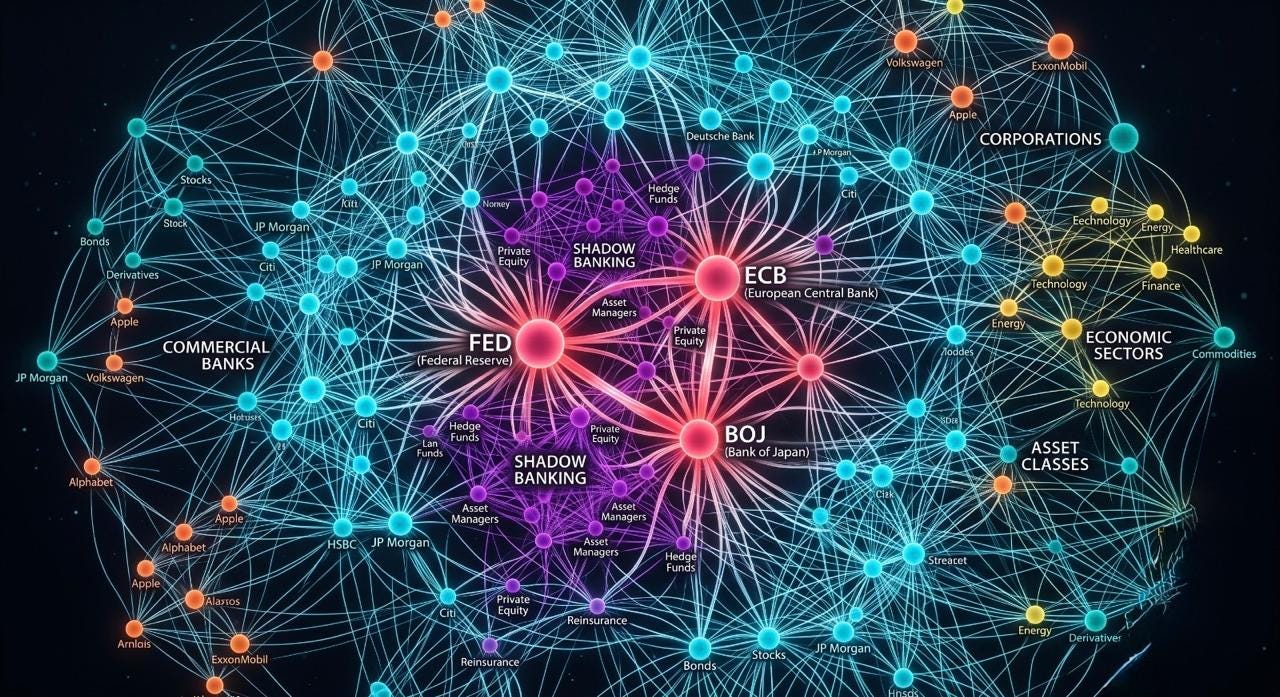
I am not claiming that the market is conscious. That is a genuinely open question, and those who study it most seriously—who argue about whether consciousness depends on the substrate or only on the organization—would tell you, rightly, that we do not know. The claim is more modest and more unsettling: that a market, a cell, a blockchain exhibit the form of a collective mind without any of them possessing a self that says “I.” They are intelligences without a center, cognitions distributed across their parts. They think without a thinker. And here Ball’s circle closes, because if life is a search for meaning conducted at many scales, the market is not an exception to the definition but another of its scales. The gene searches at its level, the cell at its, the body at its, and above them the market searches at its own—price, risk, value—mining the world as a cell mines its surroundings. The market does not resemble life. It is the same process, meaning emerging from a directorless collective search, running one storey higher. Collective consciousness does not stop at the skin.
It is the agentic economy that turns this from metaphor toward something harder to name. So long as the cells of the collective mind were human—imitating, fearing, anticipating—the word “mind” was an analogy. When the cells become artificial agents that genuinely compute and remember and decide, the analogy begins to collapse onto the thing itself. A network whose nodes literally process information does not resemble a collective mind; it begins, in some sense we lack the vocabulary for, to be one. The language of God that Clinton went looking for in the genome may never have been written. But something stranger is under construction, without anyone having agreed on what it is: a mind that belongs to no one and to everyone.
We began with a gene that does not exist and have arrived at a price that no one governs, and it turns out to have been the same problem the entire way. The cell, the economy, the blockchain: none is a machine with levers. Each is a living network in which meaning emerges from the connections, in which noise is fuel rather than fault, in which what looks indispensable can be switched off without killing the system, and in which the future is written in no single part. This changes what it means to invest. If the market were a machine, investing would be engineering—find the lever, predict the result, control. But the market is an organism, and in an organism, as we learned by switching off indispensable genes that changed nothing, one can influence and almost never control. The honest consequence is uncomfortable: no one predicts these systems, whose behavior emerges from millions of nonlinear interactions and lives near criticality. What one can do is take part, with discipline, in a living network whose fate one does not govern—entering steadily, without pretending to time the critical point, letting time and network effects do their work while one survives the fluctuations and tends to the only thing genuinely within reach, which is one’s own speed of recovery.
Clinton believed we were reading the language of God in the genome. A quarter century later we know that life is not deciphered but conversed with, and that the conversation, once there are millions of voices in it, stops being a language and begins to think. The market is no different. It is not a code that breaks or a machine that one pilots but a collective mind without a center—noisy, alive, unpredictable—that remembers its wounds, anticipates its future, and emerges, again and again, into an order that none of its parts contained. With a mind like that, one does not bargain from the outside. One enters it. One can influence it. Control, almost never.
A last door, which I would rather leave open than shut with an answer. Science learned, for good reasons, to distrust the word “divine,” because for centuries it named an author who writes life from the outside, a watchmaker dictating instructions—the very God this essay has spent its length refuting. But there is an older one, far more compatible with everything said here. Spinoza’s: Deus sive Natura, God or Nature, the two being one thing. Not a being above the world but the whole of the world searching for itself; not the one who directs the process but the process. If anything in this picture deserves the word “divine,” it is not a force or a person or a mystery behind the curtain but something plainer and more stubborn—the insistence with which meaning searches for itself at every scale, the gene insisting and the cell insisting and the organism and the market and the network, each mining its world for what makes sense to it, unbidden, without pause. That insistence, repeated across all the levels at once, is as close to the sacred as an honest gaze can come. It asks for no metaphysics. It asks for attention. And so to live—to invest, to build, to think, to love—stops being the operation of a machine and becomes the holding of a conversation, not with a god who answers from the sky but with Spinoza’s, who is nothing other than life itself, asking across infinite scales what has meaning. That, and not a language written by anyone, is what we are talking to.
Thanks for reading,
G
No posts
Comments
Nothing yet. Say the first thing.
Sign in to join the conversation.