
Markets don’t price what’s valuable. They price what’s scarce. And scarcity migrates — from software to chips to, now, the electron. Companies that sit where scarcity is heading get repriced violently; companies that sit where it used to be get buried alive, and occasionally resurrected.
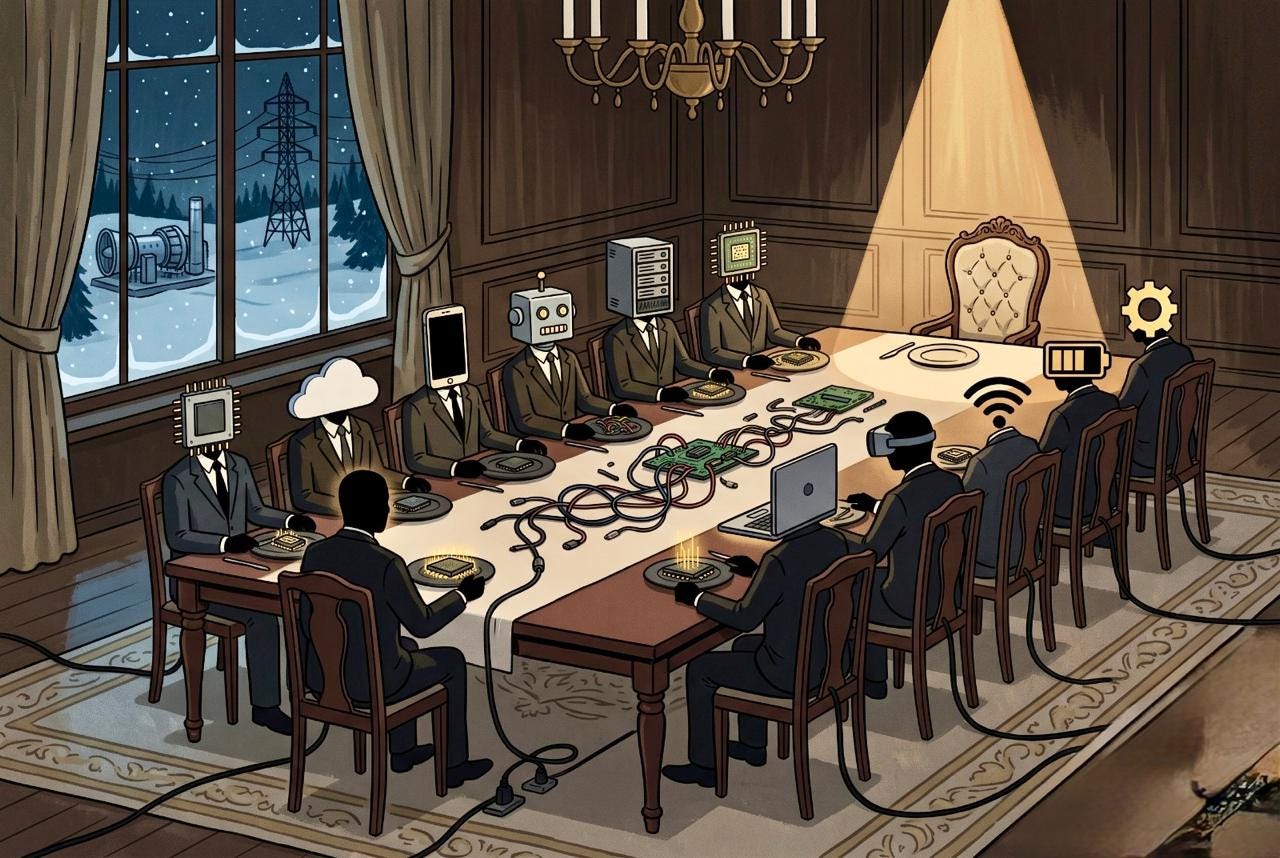
The Big Idea
Every industrial resurrection follows the same six-phase script: glory, denial, collapse, an outsider, surgery, rebirth. GE ran it in 25 years; Intel is running it in five.
Bottlenecks migrate down the stack — each wave’s constraint becomes the next wave’s bull market. The constraint has now reached electricity, and the market’s own scoreboard proves it hasn’t finished pricing that.
Eleven companies are worth over a trillion dollars. All of them consume gigawatts. None of them produce electrons. That empty chair is the trade.
Now the story.
There is a moment in the life of every great industrial empire when the market stops pricing its future and starts pricing its funeral.
For General Electric, that moment came in June 2018, when the company that Thomas Edison founded — the most valuable corporation on Earth as recently as 2000, worth some $600 billion — was expelled from the Dow Jones Industrial Average after 110 uninterrupted years. The market had rendered its verdict: GE was a zombie. A balance sheet with a logo attached.
For Intel, the moment came in 2024. A $19 billion annual loss — its first since 1986. Fifty billion dollars of debt. A CEO shown the door in December. A stock that would eventually touch $19.60, a level that priced the inventor of the microprocessor as a going-concern question rather than a going concern.
Eighteen months later, Intel traded above $140 — up roughly 490% at the peak — with the United States government as its third-largest shareholder, Nvidia and SoftBank on the cap table, its 18A process in high-volume manufacturing in Arizona, and a handshake with Elon Musk to build the most ambitious chip factory ever conceived.
Zombie to rockstar in five quarters.
I have seen this movie before. We all have. It was called General Electric, it starred Larry Culp, and it took five years to reach the same act Intel compressed into sixteen months. The plot is nearly identical. What changed is the era in which it is being filmed — and that difference is the entire investment thesis.
Before we walk the arc, a note on the map this essay is drawn on, so the piece stands on its own.
RACE is the MacroWise framework for the physical buildout of the AI age: Robotics, AI, Compute, Electricity. The four letters are not a portfolio of themes — they are four layers of the same machine, and capital rotates through them as successive waves:
R — Robotics. The demand layer: machines that act in the physical world. Humanoid robots, robotaxis, autonomous defense, drones. This is where AI stops being software and starts having a body.
A — AI. The intelligence layer: the models, and the silicon that trains and runs them. This is the wave everyone can see.
C — Compute. The manufacturing layer beneath the intelligence: the fabs, packaging, interconnects, and substrates that turn sand into reasoning. Whoever controls leading-edge fabrication controls the ceiling of the entire stack.
E — Electricity. The physical layer beneath everything: generation, turbines, transformers, grid. Every token inferred and every robot step taken is, at bottom, electrons doing work.
The organizing insight deserves a name, because it does most of the work in this essay. Call it the Law of the Migrating Bottleneck: each wave’s constraint becomes the next wave’s bull market. When models became scarce, capital flooded to AI. When chips became scarce, it flooded to compute — that is how a chipmaker became the most valuable company on Earth. The scarcity is now migrating down to the final layer: the electron. E is not the last letter of the acronym. It is the binding one — the layer that cannot be compressed by cleverness, only built with concrete, copper, and time.
Read the Intel story through this map and it stops being a stock story: Intel is the rare company that touches all four letters at once. That is the thesis. Now, the arc.
Strip away the specifics and every industrial resurrection follows the same six-phase arc. Call it the phylogeny of a turnaround.
Phase I: Glory. GE in 2000 was the management bible of an era; Jack Welch was its prophet. Intel from 1993 to 2020 was computing — “Intel Inside” a temporal monopoly on both x86 architecture and leading-edge fabrication.
Phase II: Denial. This is the phase that kills. GE Capital’s financial engineering masked the decay of the industrial core for a decade. At Intel, the rot was cultural: a bureaucracy that rewarded managers for reporting good news while TSMC quietly took the fabrication crown and the AI wave broke somewhere else entirely. This is learning atrophy at institutional scale — the organization forgetting faster than it learns, while the stock chart still looks respectable.
Phase III: Symbolic collapse. The Dow expulsion for GE. The $19 billion loss for Intel. The market needs a funeral before it permits a resurrection.
Phase IV: The outsider. GE reached outside its own bloodline for the first time in 126 years and hired Larry Culp, the Danaher operator. Intel’s board hired Lip-Bu Tan — the Malaysian-born engineer and venture capitalist who had already rebuilt Cadence Design Systems. Both men share a defining trait: they are allergic to corporate theater. Tan’s first cultural edict, delivered at Stanford this spring, could have been written by Culp: “If you tell me the bad news, that means it’s our problem. If you don’t tell me, then this is your problem.”
Phase V: Surgery. Culp cut the dividend to a penny, sold biopharma to his old firm for $21 billion, and ground down more than $100 billion in debt with Danaher-style lean discipline. Tan moved faster and cut deeper: management layers halved, 34% of the global workforce gone, Altera sold for $8.75 billion, the Mobileye impairment swallowed whole. Everything sacrificed to one altar — engineering and fabrication.
Phase VI: Rebirth. And here the scripts diverge in the most instructive way possible.
Culp’s masterstroke was fission. He split GE into three focused companies — HealthCare in 2023, Vernova in 2024, Aerospace as the remainder — and let each piece command its own multiple. The conglomerate discount became a specialization premium. GE Aerospace became the rockstar of the aviation supercycle.
Tan’s masterstroke is the opposite: fusion. Rather than breaking Intel apart, he is fusing it with the American state and the Musk industrial complex.
Consider what has attached itself to Intel in the past year. The U.S. government converted CHIPS-era support into an equity stake of roughly 10% — about $11 billion — making Washington the company’s third-largest shareholder. Nvidia and SoftBank made capital infusions. Google signed a multi-year ASIC and Xeon agreement. Apple and Tesla are reportedly in preliminary manufacturing talks. And on April 7, Intel announced it would join Terafab — Musk’s project with Tesla, SpaceX, and xAI — as the foundry partner.
Why the difference? Because Culp operated in the world of private capital and market discipline, where the job of a turnaround CEO is to repair a balance sheet. Tan operates in the era of sovereign capitalism, where a leading-edge fab is not a business unit. It is, in Tan’s own words on CNBC, “one of the key national treasures.”
Culp repaired a balance sheet. Tan is repairing a balance sheet, a 1.8-nanometer process node, and American technological sovereignty simultaneously. That is why the market paid him in sixteen months what it took GE five years to earn.
Before we get to Terafab, pause on what GE’s fission actually produced — because one of its three children turned out to be the purest expression of the thesis this entire series is built on.
When GE Vernova was spun off in April 2024, it was the unloved child of the trisection: the “problematic part” of old GE, a gas-turbine and grid-equipment business that the late-2010s consensus had left for dead, convinced that wind and solar would structurally strand it. The market priced it accordingly.
Then the market did its homework. Building AI data centers, it turned out, is not primarily a software problem or even a chip problem — it is an energy problem, and it is bigger than anything else in the stack. Hyperscalers suddenly needed astronomical amounts of immediate, reliable, around-the-clock electricity, and the world’s largest manufacturer of gas turbines — with a near-monopoly position alongside Siemens and Mitsubishi, plus the transformers and switchgear that move the power — was sitting right there.
The principle first: capital moves at the speed of a press release; energy infrastructure moves at the speed of concrete. A hyperscaler can commit $50 billion to data centers in one earnings call. A turbine takes years to build, a grid interconnection takes longer, and no amount of money compresses either. When two clocks diverge that violently, the slower one owns the cycle.
The mechanism is a queue. When demand arrives faster than physical capacity can respond, it doesn’t bid up output — there is no output to bid on. It bids up position in line. Customers are signing slot reservation agreements for turbine deliveries stretching to 2031; management expects to sell more than half of its 2031 production slots before this year ends. The queue for the machines that make electricity is now five years long.
The evidence is the scoreboard. From roughly $115 at the April 2024 separation, GEV crossed $1,000 in 2026 and touched an all-time high near $1,175 in late June — an 8x in twenty-six months, a ~$264 billion company built from the piece of GE nobody wanted. 2025 earnings tripled, and management guides them to double again between 2026 and 2028. This is the Law of the Migrating Bottleneck showing up in a stock price: the constraint reached the electron, and the market repriced the company that sells the machines that make them.
Even GEV’s July stumble confirms it. The stock fell 9% on a modest earnings miss and a $100–200 million tariff warning — while orders and backlog kept growing and revenue guidance was raised by a billion dollars. The market flinched at the accounting; the physics didn’t move.
Now look at the anomaly hiding in plain sight at the top of the market. Eleven U.S.-listed companies are worth a trillion dollars or more:
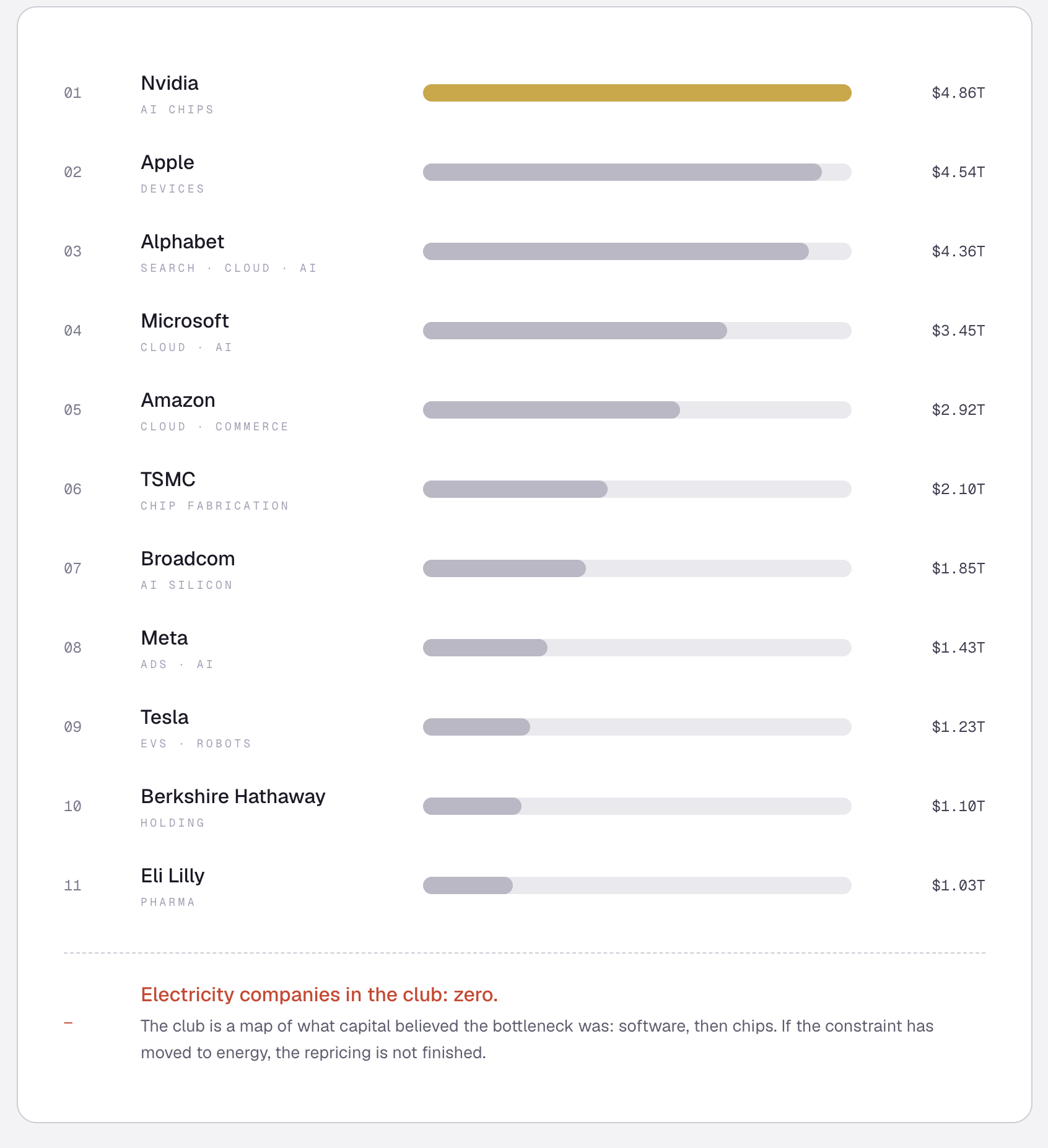
Read the list as a physicist rather than an analyst. Chips, chips, chips, clouds, clouds, ads, models, robots-to-be, a holding company, and a weight-loss molecule. Every technology company on this list is a voracious consumer of electricity — collectively they are contracting for gigawatts on a scale that resembles the electrification of a mid-sized country. And yet there is not a single company on the list that makes electrons. The club consumes terawatt-hours; it contains no one who produces them.
That is not a permanent feature of markets. It is a lag — and here the Law of the Migrating Bottleneck stops being a description and becomes a testable prediction. The trillion-dollar club is a map of what capital believed the constraint was: software, then chips. Once compute became scarce, the club seated a chipmaker at the head of the table. If the constraint has genuinely moved to energy, the club must eventually seat an electricity company. The chair is empty because the repricing is not finished.
Two candidates are converging on that chair from different directions:
GE Vernova, from the supply side. At roughly $264 billion, it is already the largest pure-play electricity-equipment company in the world — and it needs about a 4x to enter the club. That sounds aggressive until you remember it just did an 8x in twenty-six months, management expects earnings to double again by 2028, and its order book is sold out half a decade forward. Vernova entering the trillion-dollar club would be the market’s formal admission that the AI trade is an energy trade.
Intel, from the silicon side. At roughly $508 billion — the world’s 26th most valuable company — Intel needs only a 2x. The path runs through exactly what this essay describes: 18A yields, formalized foundry customers, and Terafab moving from render to wafer. If the sovereignty thesis holds, Intel would enter the club not as a comeback story but as the American answer to TSMC — which sits at $2.1 trillion, four times Intel’s size, for doing the job Intel is trying to take back.
The symmetry is the thesis in miniature: one company sells the machines that make the electrons; the other fabricates the silicon those electrons feed. The trillion-dollar club currently prices the appetite. It has not yet priced the kitchen.
Hold that five-year turbine queue in your mind. It is the single most important fact for understanding what Musk is about to do in Texas.
Now to the part of the story that matters most for the RACE framework.
The first wave of the AI cycle was digital: tokens, chatbots, data centers. The wave now forming is physical — AI that walks, drives, flies, and manipulates the world. Humanoid robots. Robotaxis. Autonomous defense. Orbital data centers. And Physical AI has a property that digital AI could politely ignore: it cannot live in an abstraction. Every Optimus, every Cybercab, every AI satellite is a physical object built around leading-edge silicon that must be fabricated somewhere on the actual surface of the Earth.
Today, that somewhere is overwhelmingly an island 130 kilometers from the Chinese coast.
Terafab is the most ambitious attempt in history to move it to Texas.
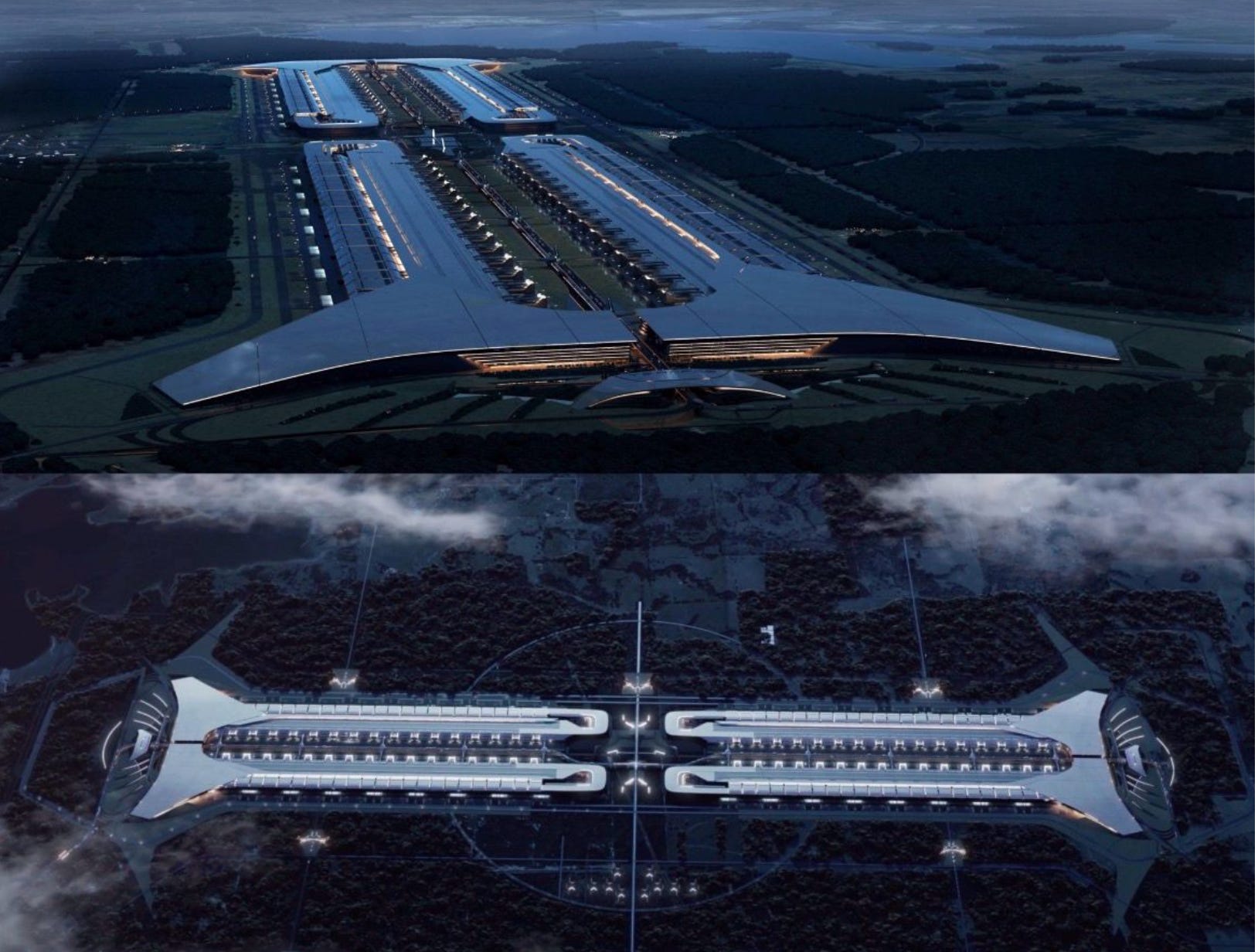
Look at the renders for a moment, because they are not incidental to the thesis — they are part of it. This does not look like a fab. TSMC’s facilities are anonymous white boxes, and that is deliberate: Taiwan’s entire strategy is discretion, the silicon shield that works best when nobody thinks about it. Terafab is the opposite grammar. The structure reads like a starship, or an aircraft carrier laid across the Texas scrubland — architecture designed to be seen. The correct comparison is not another semiconductor plant; it is the Hoover Dam renderings of the 1930s. This is infrastructure as announcement: a civilization declaring, in steel and glass, that it has decided something.
The numbers behind the image read like science fiction: a target of one terawatt of AI compute per year — roughly 70% of TSMC’s entire current global output, from a single site. A pilot facility costed at $20–25 billion; Bernstein’s estimate for the full build runs as high as $5 trillion. Two plants on the Giga Texas campus: one dedicated to automotive and humanoid-robotics silicon — Tesla’s FSD, the Cybercab, the Optimus line — and a second for AI data-center infrastructure, including SpaceX’s planned constellation of orbital compute. Tesla’s AI5 chip is targeted for pilot batches in 2026 and volume in 2027. Musk was explicit on Tesla’s earnings call about the process technology: “We plan to use Intel’s 14A.”
Three structural features separate this from every fab announcement that came before it.
The demand is captive. This is not a foundry hoping customers show up. Tesla’s AI5, the Optimus line, the Cybercab, and SpaceX’s orbital compute constitute pre-committed demand from the same consortium that owns the plant. The classic fab-killer — building capacity into uncertain demand — is partially neutralized because the customer is the owner.
The energy is co-designed. In a detail most coverage missed, SpaceX announced it will build its own power plants for a $16.8 billion chip facility. Now recall the Vernova queue: when the wait for grid-scale turbines runs to 2031, the only way to guarantee electrons on your own schedule is to own the generation yourself. Every other fab on Earth is a supplicant to a grid; Terafab treats electrons as a design input rather than a utility bill. This is the E-bottleneck internalized — the first fab conceived from day one as an energy project that happens to output silicon. Vernova proved the bottleneck exists; Terafab is the first industrial project designed around it.
The stack is vertical without precedent. Design (Tesla), process (Intel 18A/14A), energy (SpaceX), demand (all of them) — under one roof. Musk’s stated ambition to combine logic, memory, and advanced packaging in a single complex violates forty years of industry orthodoxy. Then again, so did catching a rocket booster with chopsticks.
Intel is the only company on the planet that touches all four letters:
R — a fab dedicated to the chips inside Optimus, Cybercab, and FSD.
A — Xeon 6 selected as the host CPU for Nvidia’s DGX Rubin systems; custom ASICs for Google; inference silicon for xAI. Tan’s framing is worth quoting: the CPU is reasserting itself as “the orchestration layer and critical control plane for the entire AI stack.” After years of GPU monotheism, the control plane is coming back — and Intel owns it.
C — 18A in high-volume manufacturing in Arizona; 14A as the Terafab target node. The only leading-edge logic process operated by an American company on American soil.
E — fabs co-designed with their own generation capacity.
That is not a product story. That is an infrastructure-of-civilization story.
Charlie Munger’s rule: tell me where I’m going to die, so I never go there. So invert the thesis. What would have to be true for this essay to be a trap? Start with those renders.
Civilizations announce themselves in renders before they prove themselves in yields. The Hoover Dam comparison cuts both ways: for every dam that got built, there is a graveyard of monumental architecture that never left the drawing board. Today the renders exist and the yields do not. Terafab is still more announcement than factory. First silicon is realistically a 2028 event, conditional on 18A and 14A reaching competitive yields — and Intel’s yields still trail TSMC’s. The foundry division continues to burn roughly $2.5 billion in operating losses per quarter. Not one major external foundry customer has been formalized; Apple and Tesla remain preliminary. Bloomberg’s reporting suggests some internal teams have been adjusting missed deadlines rather than recovering from them — exactly the cultural pathology Tan was hired to kill, still twitching.
The second death is in the price. At roughly $100 per share — down from June’s $140.94 high — Intel trades near 118x forward earnings. Bernstein’s warning applies to the whole complex: the real pricing risk is not Musk building his own memory; it is the capacity overshoot when all of these fabs come online in 2028–2029. Semiconductor history is a graveyard of investors who confused a capex announcement with a cash flow.
The third death is the model’s own: the Law of the Migrating Bottleneck cuts against you if you arrive after the migration is priced. Vernova at 8x is a very different entry than Vernova at the spin. Being right about where scarcity is heading and being early enough for it to matter are two separate skills.
The honest frame: the market has already paid for the resurrection. What it has not yet paid for — and cannot, until the yields exist — is the empire.
GE was resurrected because the world rediscovered its need for jet engines and gas turbines — and its unwanted child, Vernova, became an 8x monster precisely because the AI age turned out to run on electrons before it runs on tokens. Intel is being resurrected because the world — the American state, Nvidia, Google, and Musk — cannot afford to let it die.
That is the difference between a turnaround and a sovereignty thesis, and it changes what kind of risk you own. A turnaround can fail quietly, in the accounting. A sovereignty thesis fails loudly, in the geopolitics — which is precisely why so much sovereign and strategic capital has wrapped itself around this company. When your shareholders include the U.S. Treasury and your anchor customer is building his own power plants in Texas, bad news stops being a corporate-culture problem. It becomes a matter of state.
Larry Culp taught the market that a dead empire can be reborn by division. Lip-Bu Tan is teaching it that in the age of Physical AI, an empire is reborn by fusion — with the state, with energy, and with the machines that are about to walk among us.
The zombie is gone. Whether the rockstar can play the instruments is a question for the yields of 2027.
But the tool you should take from this essay is bigger than Intel. It is a question you can ask of any market, in any era: what does the top of the market consume that it does not contain? In 2000, the most valuable companies consumed software and contained none of it. In 2015, they consumed chips and contained one chipmaker. Today, eleven trillion-dollar companies consume gigawatts and contain zero electron-makers. The empty chair is never empty for long — and finding it before the market does is the whole game.
Thanks for reading ,
G
No posts
Comments
Nothing yet. Say the first thing.
Sign in to join the conversation.