
Five things this essay will convince you of:
The singularity has a math problem. Nothing that grows this fast ever reaches infinity — not bubbles, not populations, not empires. The physics says AI’s curve doesn’t go vertical around 2050. It forks.
Intelligence is not compute. It’s a gap. A system is intelligent when its ideas grow faster than its energy bill. Your brain does it on 20 watts. Today’s AI doubles its power bill to double its output — all engine, no gap.
Wealth is stored network density. No head and no company can build a jet engine — only a network can. And over the long run, a country’s income converges to the complexity of its network. Intelligence and prosperity are the same variable.
The AI industry just confessed — twice. A 264-page report from twenty institutions admits today’s models are structurally incomplete. And Dario Amodei admits scaling structurally concentrates power. Both point to the same fix: architecture and institutions, not more scale.
The market bought the engine at 79 cents on the dollar. Models and chips are 79% of a $31 trillion stack; energy is three cents, the maps two cents. Jensen’s $100 trillion is real — it just lives in the rest of the car.
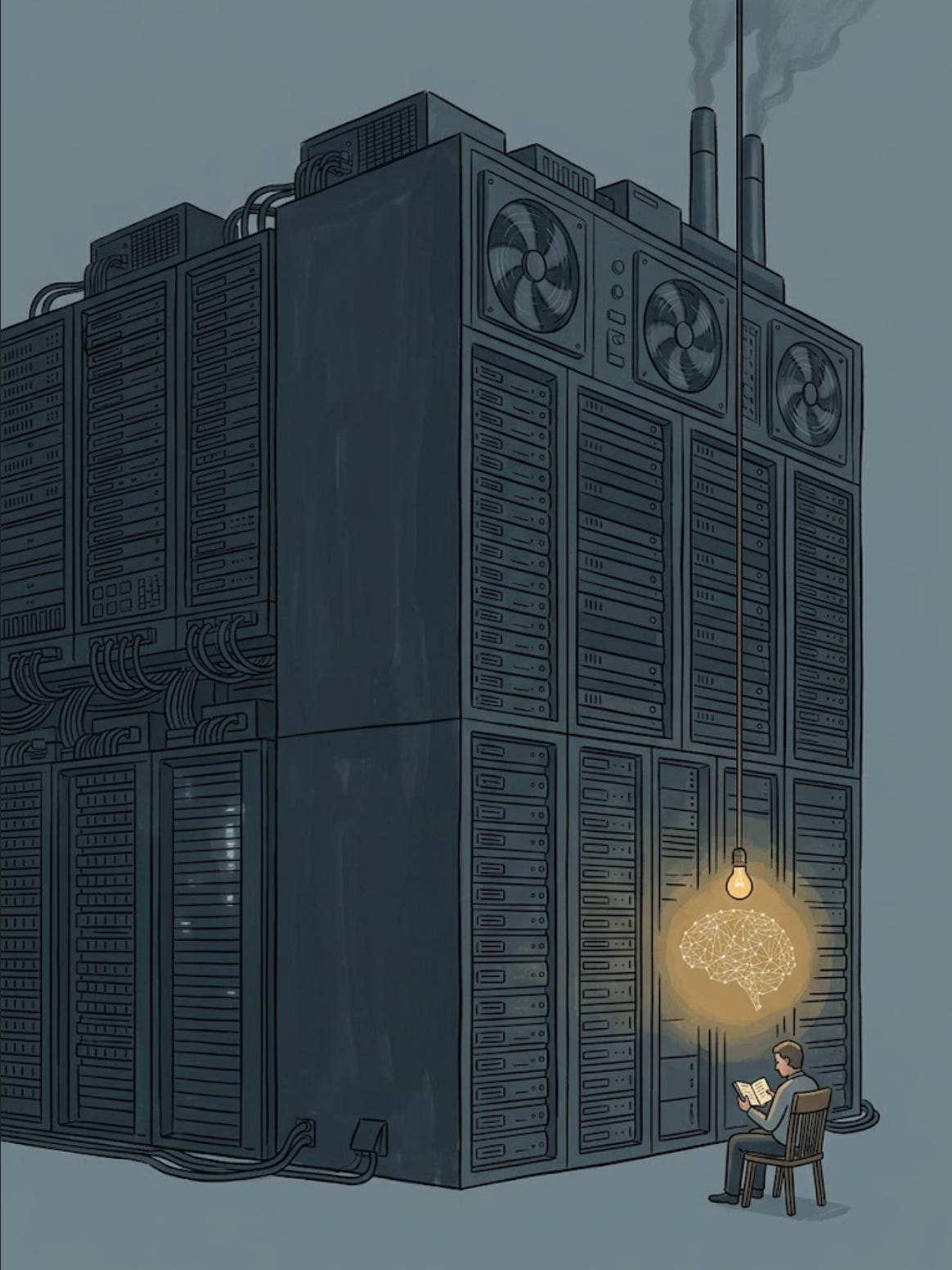
Your brain runs on twenty watts.
Less than the bulb in your refrigerator. On that budget, it holds a hundred trillion connections, rewires itself every night, and occasionally produces a symphony, a theorem, or a decent joke.
The most advanced AI datacenter on Earth burns a hundred million watts. It cannot tie a shoelace.
Sit with that for a second. Because everything the smartest people in the world are telling you about intelligence — the charts, the timelines, the singularity — quietly ignores it.
There’s a famous chart. Ray Kurzweil drew it. It shows one number — calculations per second per $1,000 — getting cheaper, decade after decade, in one smooth exponential line. Follow the line far enough and it goes vertical. Kurzweil gave that moment a name — the singularity — and a date: around 2045.
The whole AI industry runs on some version of this faith. More chips, more data, more scale. The line goes up. Intelligence falls out. The metric of the era is tokens per watt: how many words the machine produces per unit of electricity.
But look closer at the chart. That “one smooth line” is actually drawn through five completely different machines: gears, then relays, then vacuum tubes, then transistors, then chips. Nobody got from gears to chips by building bigger gears. Every leap came from throwing the old architecture away.
The chart’s own history refutes the chart’s message. Progress didn’t come from more. It came from different.
Here’s what a physicist sees when he looks at that same acceleration.
Didier Sornette spent his career studying how things break — bridges, markets, seizures. He found a signature: when something grows faster and faster, feeding on its own growth, the math points to a moment when it should hit infinity.
And here’s the thing every physicist knows: it never gets there.
Bubbles don’t reach infinity. They pop. Populations don’t reach infinity. They level off. Empires don’t reach infinity. They fall or they transform. The approach to the vertical line isn’t a promise of transcendence. It’s the warning that the whole system is about to change shape.
Sornette ran the numbers on human population and the world economy. Both have grown faster than exponentially for most of recorded history — and the critical point lands around 2050. But the world’s population growth rate already peaked. In 1970. Read that again. We are not waiting for the great transition.
We are already inside it.
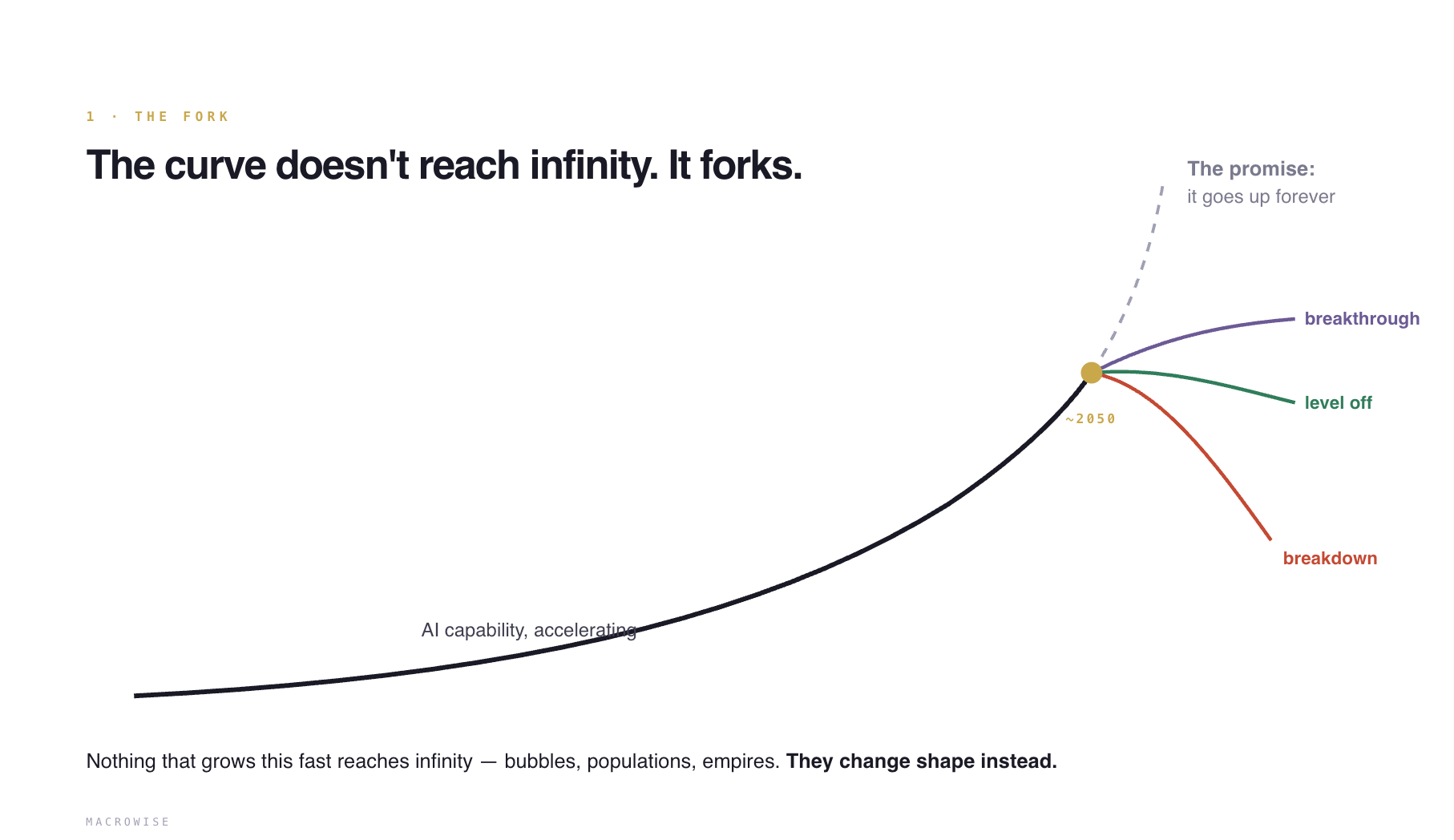
The question was never when does the line go vertical. The question is: when the system changes shape, what survives?
A physicist named Geoffrey West left particle physics to study living things — and found something strange. Double an animal’s size, and it doesn’t need double the energy. It needs about 75% more. Nature gives a discount for scale. Every creature on Earth, across twenty-one orders of magnitude, gets roughly the same deal — because every creature is built on the same trick: efficient networks for moving energy around.
Then West measured cities, and found the miracle. Double a city, and it saves about 15% on pipes and roads per person — and produces 15% more ideas per person. Wages, patents, inventions. All up.
Same energy discount as biology. Plus a bonus biology never earned.
Where does the bonus come from? Not from bigger pipes. From more conversations. From density of connection. A city is a machine for making people collide.
So here is a better definition of intelligence than anything on Kurzweil’s chart: a system is intelligent when its ideas grow faster than its energy bill. Ideas up 15% per person, infrastructure down 15% per person, at every doubling. That widening gap is the whole game.
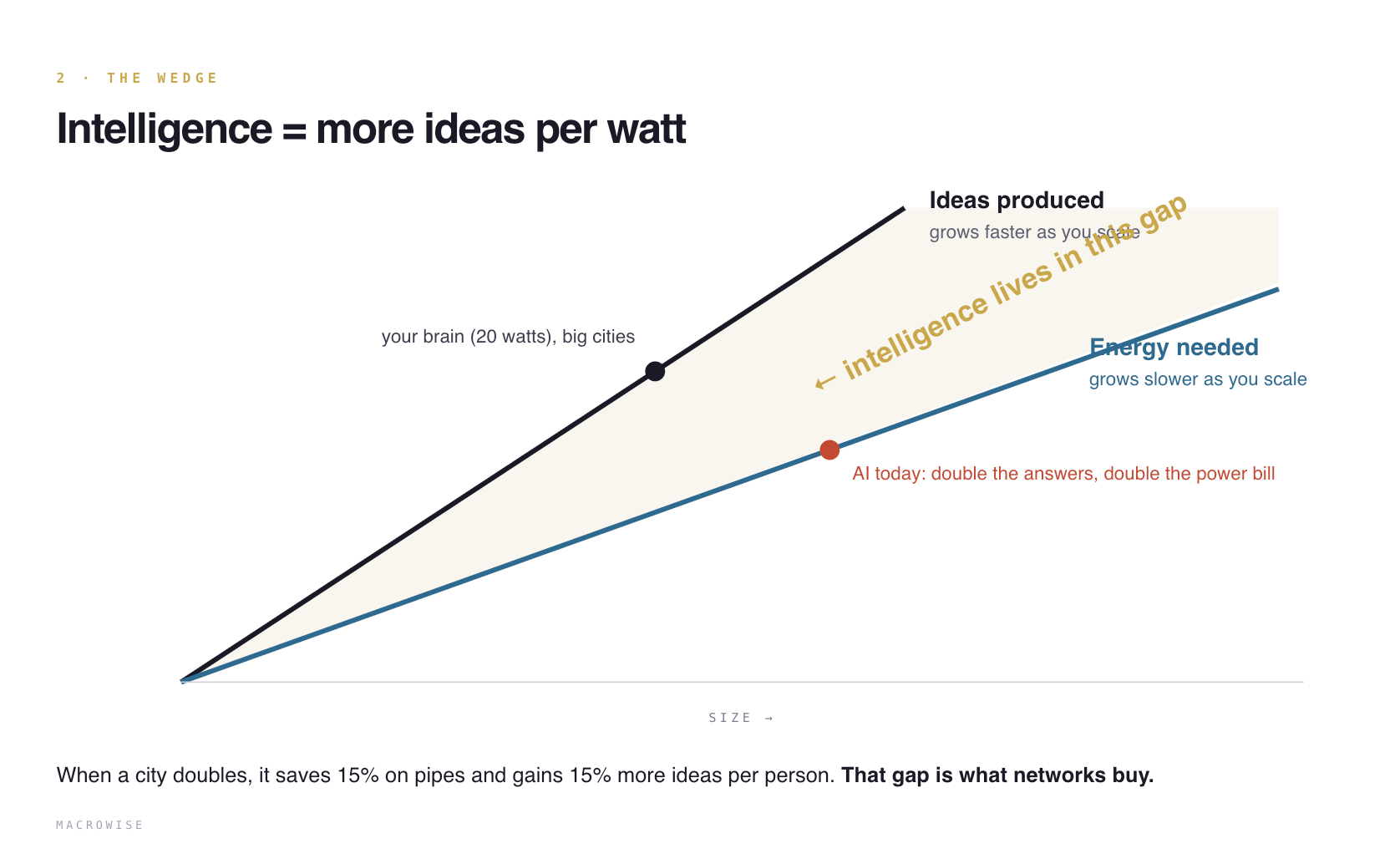
Your brain lives in the gap, and it’s worth understanding why, because the reason is the AI industry’s deepest problem. In a computer, memory and processor are separate devices, and moving data between them costs far more energy than computing on it. Every thought pays a shipping fee. In your brain, there is no shipping. The synapse is the memory, the processor, and the wire — one device. Run the numbers: twenty watts across a hundred trillion connections, versus a hundred megawatts across a trillion parameters. Per connection maintained, biology is roughly a billion times more efficient.
That’s not a gap Moore’s Law closes. That is a gap only architecture closes.
And it explains the deepest design principle in nature: it is better to have maps than massive processors. A map is computation you did once and stored where you’ll need it. The animal that remembers the territory doesn’t have to recompute the territory every time it crosses it. Memory, well organized, is the cheapest form of intelligence ever invented.
Today’s AI has none of this. Double the answers, double the power bill. All engine, no gap.
Now zoom out. Because the law that runs your brain also runs the economy — and a physicist-turned-economist named César Hidalgo proved it with one observation.
There’s a limit to how much knowhow fits in one head. He called it a personbyte. Nobody — nobody — knows how to build a jet engine alone. Not the metallurgy and the aerodynamics and the software and the supply chain. A jet engine doesn’t live in a person. It doesn’t even live in a company. It lives in a network — thousands of people, wired together by trust and trade, each holding a piece.
The complexity of anything you make is the size of the network it takes to make it.
Then Hidalgo did what economists rarely do: he measured it. With Ricardo Hausmann, he ranked every country by two things — how many different products it can make, and how rare those products are. Diverse and rare means dense knowhow. They called it economic complexity, and their studies found it predicts long-run growth better than education levels, institutions, or capital.
And the punchline, in Hidalgo’s own words: over the long run, a country’s income approaches the complexity of its economy. Not its oil. Not its slogans. Its network.
Wealth is stored network density. Intelligence and prosperity are the same thing, at different sizes.
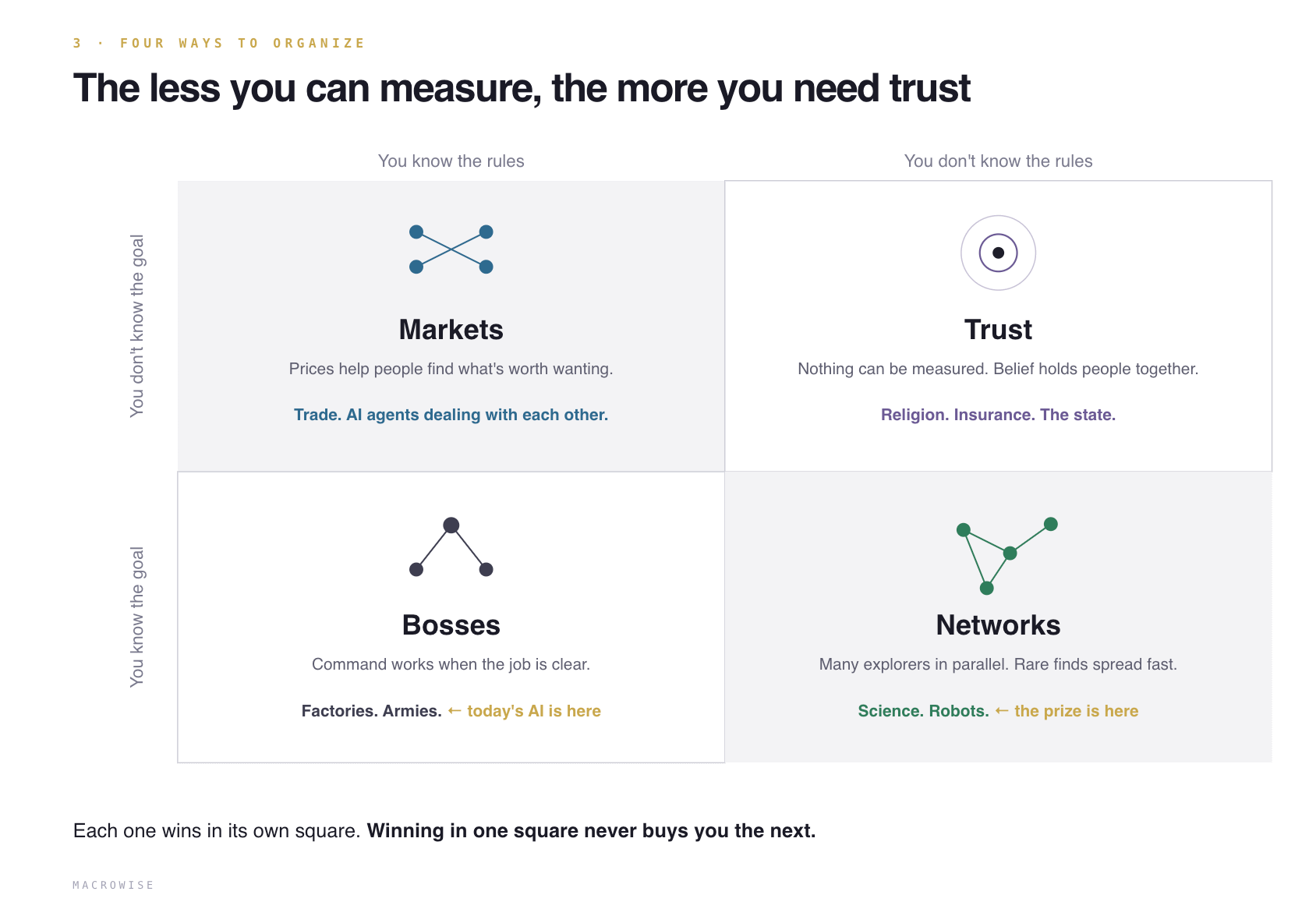
So if the network is the asset, how do you build the right one? An economist named Ronald Coase found the rule ninety years ago, and it’s brutally simple: the right structure depends on what you can measure. Picture it as a board with four squares.
When you know the goal and the rules — a factory, an army — bosses win. Command is fast when the job is clear. And notice something: this is the only square where “tokens per watt” even means anything. You can only optimize a score when the game is defined. Today’s AI lives here — one clear goal, predict the next word — which is why it’s run by a handful of giant, top-down companies. Right structure, right square.
When the rules are clear but nobody knows what’s worth wanting — that’s what markets are for. Prices let a million strangers figure it out together. The next wave of AI lives here: agents trading ideas, services, and verifications with each other. Silicon rediscovering commerce.
When you know what you want but not how the world works — a cure, a material, a discovery — networks win. Many explorers, in parallel. Most fail. One find changes everything, and the network spreads it fast while pruning the dead ends. Science works this way. So will the AI that matters: robots, sensors, machines that touch the real world. This square is the prize.
And when you can measure nothing — no goal, no rules, no odds — humanity never invented an algorithm. It invented trust. An economist named William Ouchi proved it in 1980: when performance can’t be measured, neither prices nor rules work, and groups fall back on the oldest technology — shared belief, ritual, belonging. Religion. Insurance. The state. Structures that don’t solve the unknown. They make it survivable.
Bosses, prices, links, trust. As certainty falls, coordination changes hands. Each wins on its own ground. And here’s the trap almost everyone falls into: winning in one square never buys you the next. You cannot command your way to discovery. You cannot scale your way to trust.
People’s real beliefs are revealed not by what they preach, but by what they hedge.
So watch what just happened.
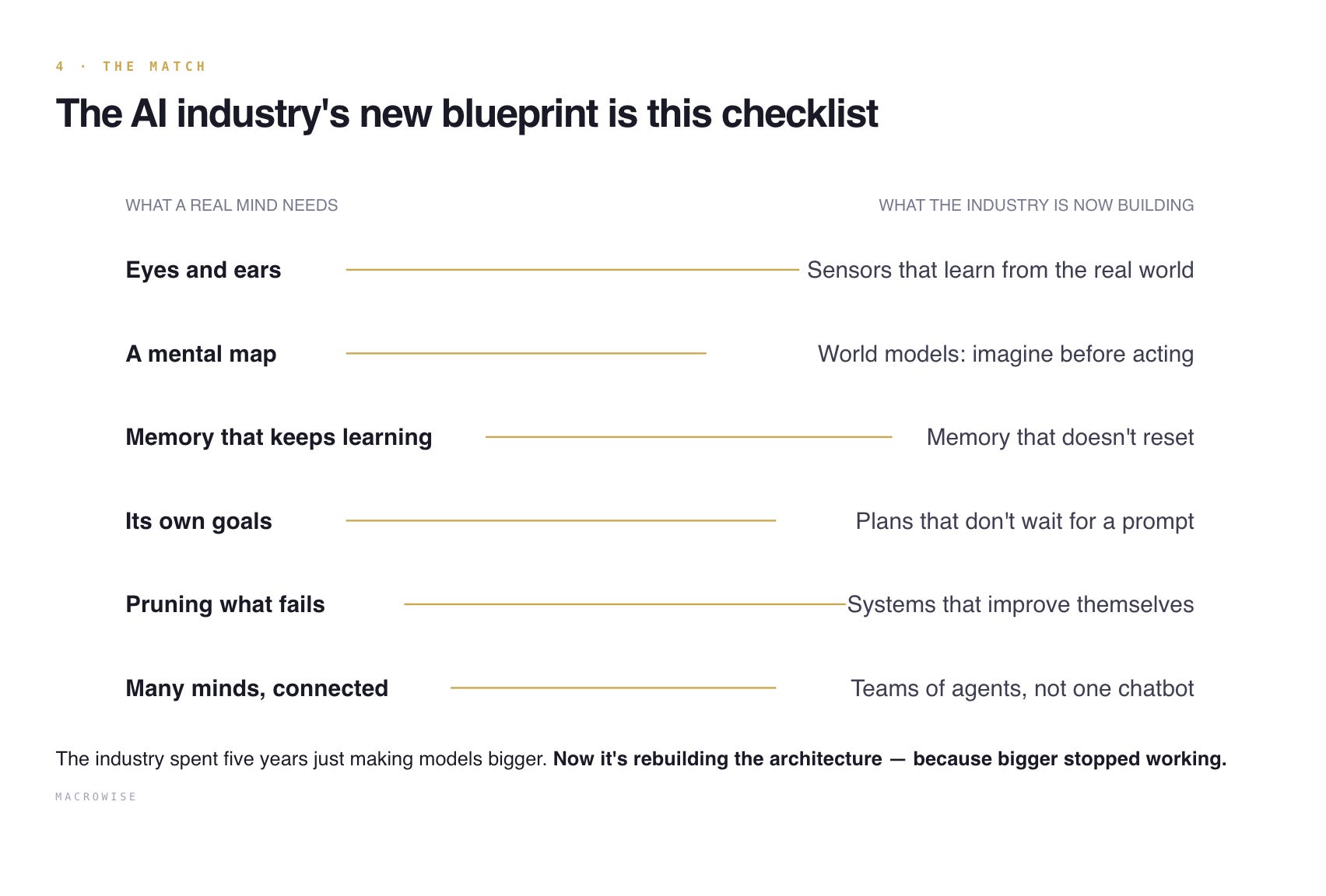
In 2025, forty-seven researchers — from Google DeepMind, Microsoft, Stanford, Yale, twenty institutions in all — published a 264-page report on the future of AI. Strip away the careful academic language and it reads like a confession: the models we have are extraordinary, and structurally incomplete. No eyes. No lasting memory. No mental map of the world. No goals of their own. No each other.
And their blueprint for what comes next? Sensors. World models. Memory that doesn’t reset. Systems that prune their own failures. Teams of agents. Stop making the engine bigger. Build the rest of the car.
That was the engineering confession. The political one cuts deeper.
No one on Earth has more riding on the gospel of scale than Dario Amodei. He runs a frontier lab. His entire position rests on the line going up. And yet, pressed in a public debate, he wrote it plainly: AI is “structurally a technology that tends to concentrate power.” Not because of bad regulation. Because of the scaling laws themselves. Bigger models mean power pools with whoever owns the chips and the electricity.
He even dismantled the industry’s favorite escape hatch. Open-source the models, people say, and the power spreads. No, he argued — it just moves to whoever holds the most compute. And of course it does. Think about what a model actually is: information. Information is the one thing in the universe you can copy for free. Chips and gigawatts, you cannot. Free the software and the power simply pools around the hardware and the electricity. Copying the map doesn’t give you the territory.
His solution? Not more scale. Rules. Referees. Courts. Institutions that “vest power in ideas rather than people.”
Understand what you just witnessed. The man at the top of the pyramid is reaching for the one tool a pyramid cannot produce: trust. Because he knows what the cheerleaders don’t — a company can be captured. A fair rule is much harder to capture.
When the high priest starts hedging, pay attention to which god he’s hedging on.
The network wins again.
Here’s where it gets practical.
Add up the entire AI capital stack — every layer, from the power plants at the bottom to the chatbots at the top. Call it $31 trillion.
Now sort it by square.
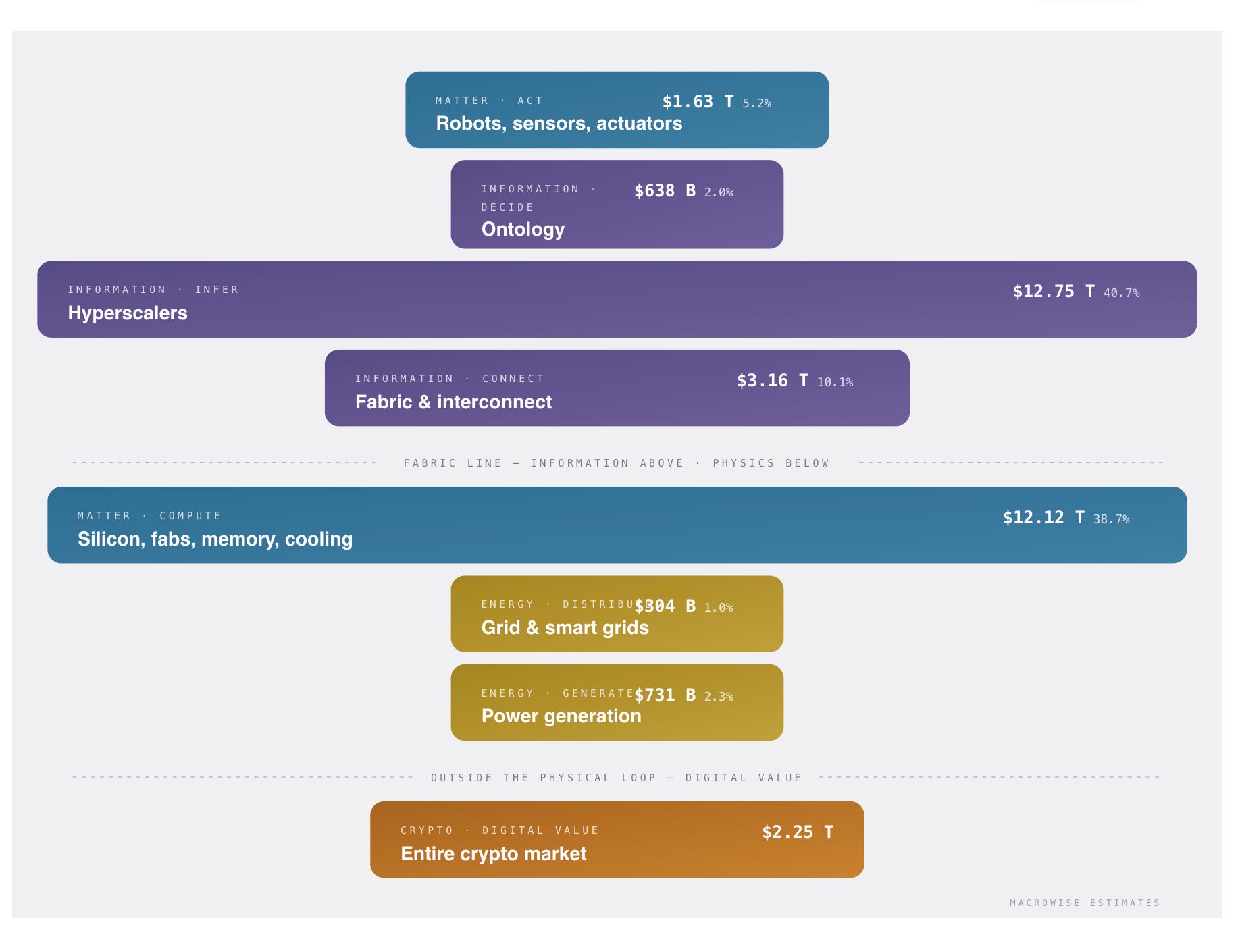
The command square — the giant models and the chips that feed them — is worth $25 trillion of it. Seventy-nine cents of every dollar. The market has priced one square of the board as if it were the whole board. Priced, in other words, for the line that goes vertical.
And the layers that build the gap? The cables and switches that connect everything: ten cents. The robots and sensors — the eyes and hands: five cents. The mental maps: two cents. And energy — the thing every metric in this debate is divided by, the hard physical constraint on all of it, the one input that cannot be copied: three cents.
Three cents.
The market is pricing intelligence as if electricity were a rounding error. Everything in this essay says electricity is the denominator of the whole thing.
Now listen to Jensen Huang — the man selling the shovels. He keeps calling AI a $100 trillion opportunity: the size of the world’s industries. Lately he goes further — that global GDP isn’t capped at $100 trillion at all, that AI takes it to two, three, five hundred. People hear salesmanship. Run it through this essay and it’s arithmetic, with one correction.
To touch $100 trillion of industry, intelligence has to leave the datacenter. It needs a mental map of every factory, hospital, port, and farm — the knowhow of the entire economy, translated into something a machine can act on. It needs eyes and hands on every floor. It needs power everywhere, and cables between everything. Jensen is right about the size of the prize. He’s just quiet about its location. The engine doesn’t get you to $100 trillion.
The rest of the car does.
Which makes the maps — priced at two cents — maybe the most mispriced layer of all. The map is where a prediction becomes a decision, and a decision becomes money. Two cents on the dollar, for the memory of the entire economy.
Even crypto tells the story. Today it sits outside the physical loop entirely — $2 trillion priced as digital gold and speculation. But look back at the markets square. If millions of AI agents are going to trade with each other, they’ll need something no bank was built for: machine-native identity, property, and settlement. Will open crypto rails win that job? Nobody knows. That’s exactly the point — the current price assumes they won’t. You are being paid to own the maybe. Small position, bounded loss, unbounded if it hits. That’s not a bet. That’s an option.
So the trade writes itself. Fade the square priced for infinity. Own the squares priced for irrelevance.
The market bought the engine at 79 cents on the dollar — and left the rest of the car on sale for 21.
So forget the vertical line. Nobody is going to hand you a date for the future. Here is what the evidence actually says:
The curve forks around 2050. Position for the fork, not the fantasy.
The winners of a regime change are the systems in the gap — more ideas per watt. Own what feeds networks: energy, sensors, the physical layer that can’t be copied.
Watch complexity, not headlines. A country whose network is densifying — making more things, rarer things — is getting rich, whether or not anyone has noticed yet. And watch which countries build fair rules and referees fastest, because that’s the speed at which a society can rewire its trust — and the societies that rewire fastest keep their networks open through the turn.
And in your own life, the same law holds. You are not your engine. You are your network — what you can sense, what you remember, who you trust, and how fast you prune what no longer works.
Twenty watts built everything you love.
It didn’t do it with scale. It did it with connection.
Thanks for reading,
Guillermo
No posts
Comments
Nothing yet. Say the first thing.
Sign in to join the conversation.