
Start with the number that should bother you.
Combined hyperscaler capital expenditure in 2026 runs past $600 billion. Alphabet alone raised guidance to $205 billion, posted negative free cash flow of nearly $6 billion in the quarter, and is drawing down a $242 billion cash pile to do it. Analysts have warned that free cash flow across the largest four could fall by as much as 90% this year as spending outruns revenue.
The consensus reading is that this is a race for compute. Whoever stacks the most accelerators trains the biggest model, and the biggest model wins.
That reading is wrong, and the evidence is inside the spending itself.
About 40% of Alphabet’s technical infrastructure budget goes to data centres and networking equipment rather than accelerators. The flagship product of that spending isn’t a chip. It’s the Virgo Network, which links 134,000 TPUs into a single fabric inside one building, and more than a million accelerators across multiple sites into one training cluster. The same fabric is offered for GPUs, supporting up to 960,000 across sites.
Read that as a claim about intelligence rather than procurement. Google is not buying the biggest brain. It’s building the biggest connectome — and spending $205 billion to say that the wiring, not the chip, is the scarce asset.
Most portfolios are positioned for the other thesis.
Intelligence is a property of networks, not of processors. That is not a philosophical position — it’s a measured result that shows up in biology, in cities, and now in capital expenditure. Which means the value in the AI build-out goes to the layers that create and govern connection, not to the layers that create raw computation. Compute is already priced. Connection, at both ends of the stack — physical interconnect and energy below, decision structure and actuation above — is not.
The rest of this piece does two things. First, it shows you where that puts the capital. Second, it teaches you the framework the argument comes from, because the framework will still be useful when these specific companies aren’t.
Every AI investment map you’ve seen is made of information layers: chips, models, data, applications. That’s a third of the system.
Complex systems studies networks that move energy, matter and information — and the interaction between all three. An information-only map of AI is describing an organism by its nervous system and forgetting it has a metabolism and a body.
This isn’t a metaphor, and there’s a hard physical result behind it. In 1961 Rolf Landauer proved that erasing one bit of information dissipates at least kT·ln2 of energy as heat — about 3 × 10⁻²¹ joules at room temperature. Not an engineering limitation; thermodynamics. Confirmed experimentally in 2012. Computation always costs energy. You cannot design that cost away. The AI build-out is a thermodynamics problem dressed up as a software problem, and that’s a physical bound, not a rhetorical flourish.
Put the missing flows back and the map changes shape.
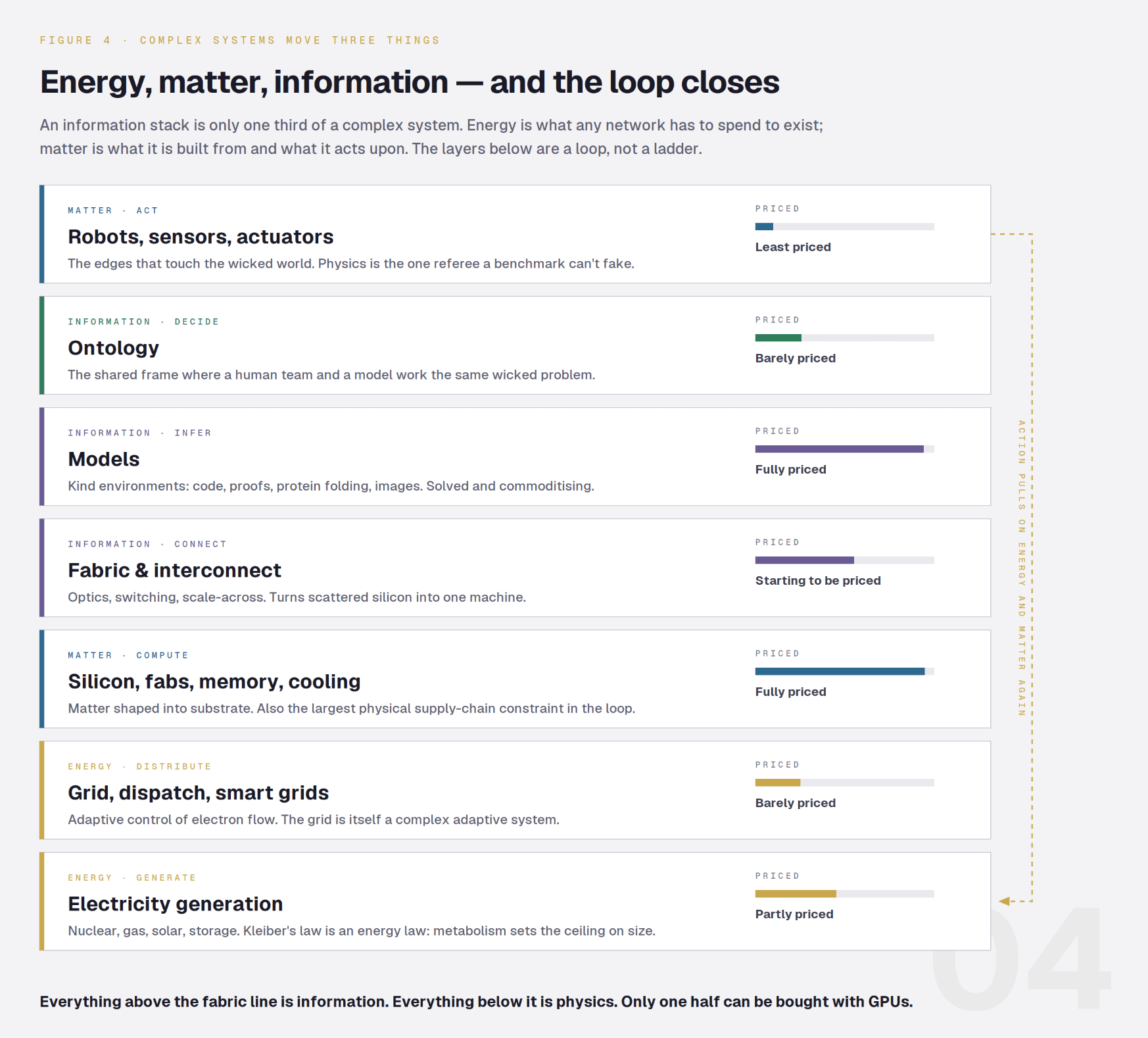
Seven layers, and it closes into a loop rather than terminating at the top:
Generate (energy). Not a cost line — the limit that binds everything else, the same way metabolic rate binds an organism. Nuclear restarts, gas turbines with multi-year lead times, solar plus storage, behind-the-meter generation. Partly priced.
Distribute (energy). The grid, dispatch, smart grids. And note: the grid is itself a complex adaptive system, absorbing intermittent supply plus enormous spiky interruptible AI load. Feedback loops, delays, congestion, cascade risk. Barely priced.
Compute (matter). Silicon, fabs, memory, cooling. The largest physical supply-chain constraint in the loop. Fully priced.
Connect (information). Optics, switching, scale-across fabric. Turns scattered silicon into one machine. Starting to be priced.
Infer (information). The models. Kind-environment work: code, proofs, protein folding, images. Solved and becoming a commodity. Fully priced.
Decide (information). The shared structure where a human team and a model work the same problem — objects, relations, and staged consequences rather than retrieved text. Barely priced, and thinly represented: one expensive pure play does not price a category.
Act (matter). Robots, sensors, actuators, vehicles, production lines. The edges that touch the physical world. Least priced of the seven. Most of the visible enthusiasm sits in private rounds. In public markets the actuator complex — industrial robotics, motion control, sensing — still trades like ordinary capital goods, on multiples that assume no change in what these machines can do.
Then the loop closes: every action changes the world, which changes what energy and matter the system needs next. Decisions pull on electrons.
The two fully-priced layers are the two that are closest to pure information — and they are the two turning into commodities fastest. The four barely-priced layers are generation, dispatch, decision structure and actuation. Three of those four are physical.
And the least priced of all is the one that closes the loop. Physical AI is where the system stops reading and starts acting — which is the moment its feedback becomes honest. Markets are paying most for the layers with the weakest feedback, and least for the layer with the strongest.
Read as a shopping list, Robotics–AI–Compute–Electricity is four sectors. Read as a loop, it’s one organism whose layers constrain each other, and the constraint is usually below where people are looking.
The reason this isn’t just a contrarian preference is that the exponent is measurable, and it’s been measured three times in three unrelated systems.
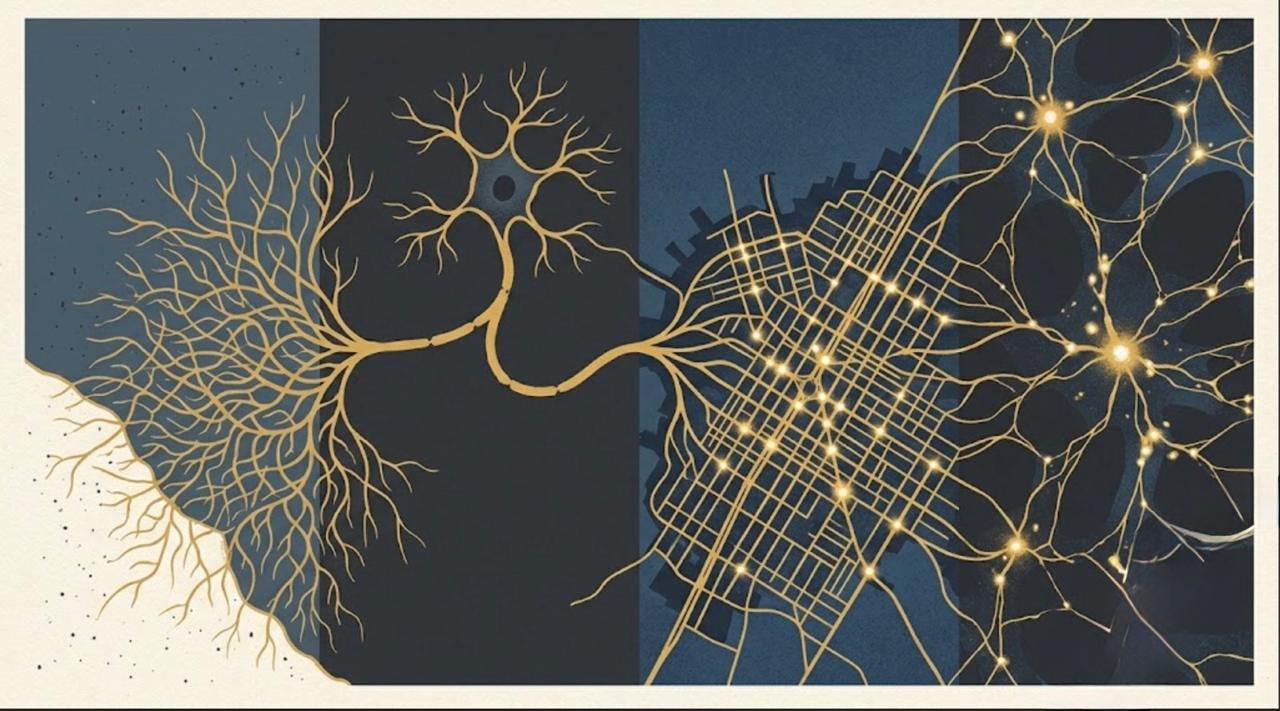
In biology. Geoffrey West and colleagues showed that metabolic rate scales with body mass to the power of 3/4. The result holds across 27 orders of magnitude. And the exponent comes from the geometry of branching networks — not from chemistry. From topology.
In cities. West and Luis Bettencourt found the exponent splits. Infrastructure grows more slowly than population — an exponent of about 0.85 — double the population, need only 85% more road and cable. But output — wages, patents, GDP, count of inventive people — grows faster than population — an exponent of about 1.15. Double the city and you get 15% more invention per person.
That 1.15 doesn’t come from geography. It comes from the topology of the social network: interactions per person rise with size, and ideas are combinations of interactions. A city isn’t a box that holds brains. It’s a fabric that connects them, and the superlinearity lives entirely in the wiring.
In brains. Roughly 20 watts, beating every data centre on Earth at unstructured reasoning — not because neurons are fast (they’re catastrophically slow) but because of wiring density and adaptivity.
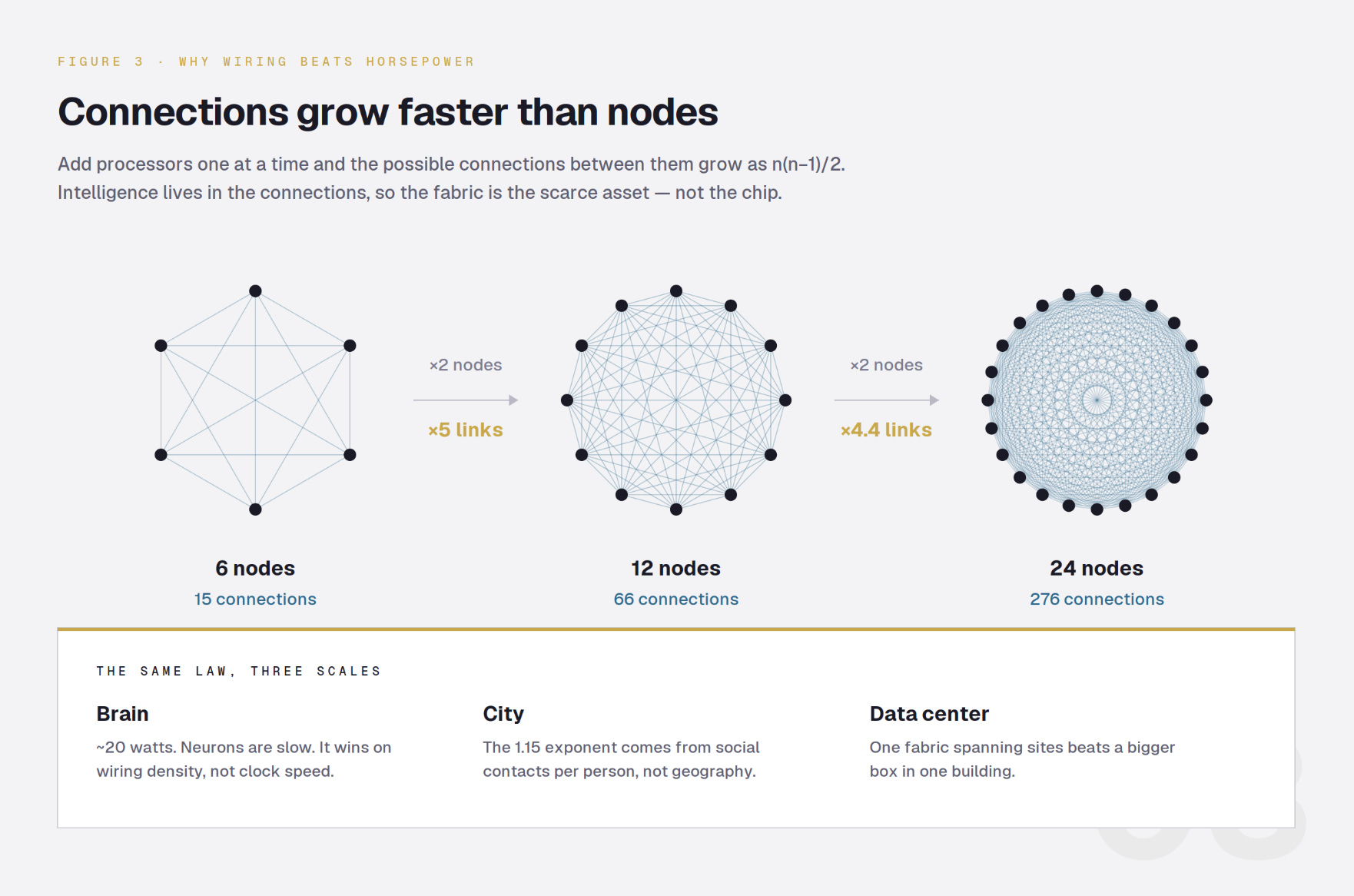
Three systems, one result: connection grows faster than size; substrate grows more slowly. Google is the fourth data point, and it’s spending $205 billion to generate it.
The investable form of this: any company whose growth adds connections faster than it adds nodes is on the right side of 1. Any company where growth adds coordination faster than it adds capability has crossed to the wrong side.
West’s group analyzed roughly 28,000 American public companies over sixty years. Half die within about a decade, on a survival curve resembling a mammal’s far more than a city’s.
The mechanism is the crossing. Companies start superlinear — headcount buys disproportionate invention. As they grow they cross into sublinear — headcount buys disproportionate coordination. Bureaucracy isn’t a moral failure; it’s an exponent shift, and it’s close to a law.
Cities almost never die because they never make that crossing. Firms almost always do.
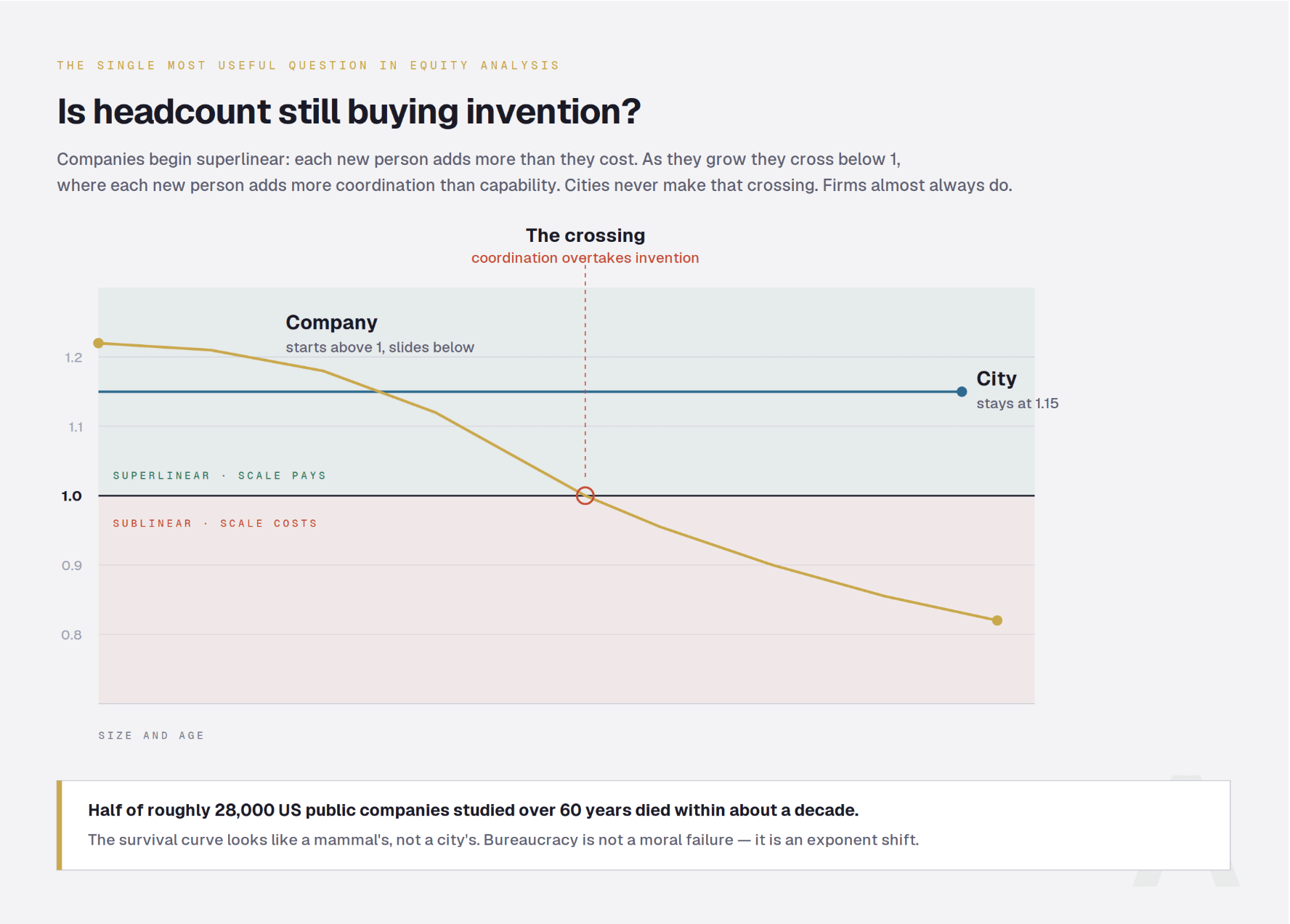
So the single most useful question in AI equity analysis is not about TAM or model benchmarks. It’s: is headcount still buying invention here, or is it buying meetings?
1. What’s flowing — energy, matter, or information? Usually all three, and the failures happen where they couple. A data centre is an information business with an energy bottleneck. A robotics company is a matter business with an information bottleneck. Name the flows before you value anything.
2. What’s the exponent? Is scale buying more than it costs, or less? Above 1 or below?
3. Is the landscape moving? If the terrain is still, optimization works and a moat is a moat. If the terrain is made of competitors who react to you, “moat” is the wrong noun — what you have is a position on a surface that deforms when you move. More on this in case file 6.
Those three questions are the whole framework, applied. The rest of this piece is where they come from.
Newton and Leibniz did not solve a hard problem in physics. They built the language in which physics became a solvable subject. Before calculus, change was a philosophical embarrassment. After, it was an operation you performed.
Be careful with the dates, because the popular version is wrong. Calculus did not cause the first Industrial Revolution — Watt and Arkwright were tinkerers, and thermodynamics arrived after the steam engine, Carnot in 1824, decades after the machines were already turning. Historians of science have a line about it: science owed more to the steam engine than the steam engine owed to science.
Where calculus actually took over was the second wave, from about 1870 — electrification, industrial chemistry, precision engineering, structural steel. Maxwell’s equations. Stress analysis. Control theory. That’s when industry started running on differential equations, and it never stopped. Neoclassical economics is calculus. Black-Scholes is a diffusion equation, the identical mathematics that describes heat moving along an iron bar.
Calculus defined the machine age — not because engineers used derivatives, but because it installed a picture of what a system is:
Systems are smooth — small changes, small effects.
Systems are decomposable — understand the parts, sum them, done.
Systems are deterministic — same inputs, same outputs.
Systems seek equilibrium.
Effects are proportional to causes.
That picture is what a machine is. For two centuries the most valuable thing you could do was build one, so the picture was right about everything that mattered.
The clean way to see the shift is in the question each era organizes around.
The machine age asked: how do I build something that reliably does X? An engineering question. It rewards specification, decomposition, tolerance control, optimization. Calculus is the perfect language for it, because a machine is exactly the kind of system calculus describes.
The discovery age asks: how do I search a space too large to enumerate? Not an engineering question at all. Nobody specifies the answer in advance because nobody knows what’s in the space. It rewards exploration, recombination, knowing when to prune, and recognizing a good region on arrival.
That second question is what complex systems has studied for fifty years — fitness landscapes, the adjacent possible, criticality, coevolution — without being able to answer it at scale. It’s also precisely what an AI system does. A model searching combinatorial space at inhuman speed is a search process, and search over rugged landscapes is the one thing this field has a real theory of.
Calculus was the generalist language of the machine age. Complex systems is the generalist language of the discovery age. Not because it’s more elegant. Because it matches the shape of the problem.
The psychologist Robin Hogarth drew a line between two kinds of learning environment. David Epstein built his book Range around it.
A kind environment has fixed rules, lots of repetition, and feedback that comes back fast and honest. Chess is kind. Golf is kind. Reading a scan is fairly kind. Practice works here. Ten thousand hours does what the story says it does.
A wicked environment is the opposite. The rules move while you play. Feedback comes late, or noisy, or wrong. Sometimes yesterday’s pattern reverses. Markets are wicked. Geopolitics is wicked. Starting a company is wicked. Raising a child is wicked.
Epstein’s uncomfortable finding, drawn from Philip Tetlock’s twenty-year study of forecasters, is that in wicked environments deep single-field expertise stops helping. Sometimes it hurts. Tetlock’s narrow experts — the ones who ran everything through one big framework — forecast worse than generalists who used several rough ones at once.
The reason is simple. A deep specialist doesn’t just know more. He knows in one shape. When the problem changes shape, that depth becomes a cost he can’t write off.
Now put the machines on that map.
Kind environments are exactly where AI won first, and won clearly. Go. Protein folding. Code. Medical imaging. Competition maths. The pattern is not that AI is good at hard things and bad at easy things. It is good at kind things, however hard, and unreliable at wicked things, however simple they look. A model can write you a working compiler and then be useless on whether your company should exist.
I sort learning into four modes:
Imitation — copy a pattern that already works.
Optimization — tune a solution inside known rules.
Cross-pollination — carry a structure into a field that never expected it.
Representation — build the frame the problem is posed in.
The first two are kind-environment work. They are gone. A language model trained on everything ever written is an imitation machine at planetary scale. Gradient descent is an optimizer that never gets tired, never defends its ego, and searches in more dimensions than you can picture. These were not fair fights.
The last two are where the next decade happens. And they are not vague creative virtues. They have a science.
Three consequences follow, and they are the reason to learn this now rather than eventually.
It tells you when to trust the machine. Kind and wicked is the distinction that maps onto model reliability, and nothing in the interface marks which one you’re in. Hand a model a kind problem and it beats you, often by a lot. Hand it a wicked one and it produces something fluent, confident and structurally unreliable — and you cannot tell from the output. Most AI failure in practice isn’t the model being bad. It’s someone treating a wicked problem as kind.
Your remaining edge is this field’s subject. Cross-pollination and representation aren’t personality traits. Complex systems is the only discipline whose entire subject matter is structure that transfers between domains — which is to say, it is the study of the two modes you have left.
AI is itself a complex system, and almost everyone models it as a machine. Listen to the vocabulary: prompt engineering, instructions, commands, getting the model to follow them. That’s a code model — symbols with stable meanings, composed by rules, producing determinate output. It’s wrong in exactly the way “the genetic code” was wrong, and case 7 below is the proof.
If the field is fifty years old, why is it becoming central now?
Because for most of those fifty years it described beautifully and predicted badly. The systems it studies are impossible to shortcut — no closed form, no shortcut, no way to know what they do except to run them. Calculus hands you an equation you solve on paper. Complex systems hands you a system you must simulate. Without enormous compute, the field produced deep intuitions and few usable answers.
That constraint is lifting right now. The generalist science has just been handed the instrument it was missing, the way astronomy was handed the telescope. Galileo didn’t invent the questions; he got the thing that let existing questions be answered.
This is the tutorial. Seven cases, each teaching one formal object you can carry into any system. Same shape each time: the case (what happened, with the source), the object (the concept), the transfer (markets), the mistake (the standard error). Each ends with one line worth keeping.
One promise: everything here is measurable. That’s the entire difference between this field and the mysticism that circulates under similar branding.
The case. In 1932 a Swiss chemist named Max Kleiber measured how much energy farm animals burn at rest. It was practical work. Farmers wanted to know how much feed to buy. He plotted energy use against body weight on log axes and got a straight line. The slope was three-quarters. Double an animal’s mass and it needs about 75% more energy, not 100%. The line has since held across 27 orders of magnitude.
Sixty years later West, Brown and Enquist showed why. Every large organism must move resources from one pump to every cell. The solutions converge on branching networks that fill space, terminate in fixed-size units, and minimise pumping energy. Impose those three constraints and 3/4 is a theorem, not a fit.
The object: the scaling exponent. Below 1, you get less than you paid for and growth is bounded — the organism grows, slows, stops, dies. Above 1, you get more than you paid for and growth heads for a singularity in finite time, which must be reset by innovation, faster and faster.
The transfer. The company-versus-city diagnostic in Part 1. It’s the highest-yield question in the piece.
The mistake. Assuming the exponent is fixed. It’s a consequence of internal structure, and structure can change. That’s what a real reorganization attempts. Most fail.
Carry this: the exponent is a property of structure, not of industry. Structure can be changed. Almost nobody does it in time.
The case. Physarum polycephalum is a slime mould — not a fungus, not an animal, a single enormous multi-nucleate cell that forages by extending tubes. No brain, no neurons, no central anything.
In 2010, Atsushi Tero, Toshiyuki Nakagaki and colleagues published the result of a simple experiment in Science. They placed oat flakes in a pattern matching the cities around Tokyo, and let the mold grow outward from the center. Because the mold avoids bright light, they used light to stand in for mountains and water — the terrain a real engineer has to route around. The mould flooded the space with tubes, then pruned. The mold first flooded the space with tubes. Then it pruned. The network it settled on matched the real Tokyo rail system on efficiency, fault tolerance and cost. And it did this with no central control, which is what makes the method scale in a way a planner’s solution does not.
The algorithm is almost insulting: tubes carrying more flow thicken, tubes carrying less shrink and vanish. That’s all of it. No model of Tokyo exists anywhere in the organism.
The object: distributed optimization without a controller. Positive feedback on used paths, negative feedback on unused ones, parallel search across everything at once. Note the order — explore first, prune second. The mould wastes enormous energy covering ground it will abandon, and that waste is what buys it a good network.
The transfer. Nobody sets the price of copper. Price is what the network settles on after local reinforcement and pruning run everywhere in parallel. It’s also the honest description of how capital finds new industries: flood, then prune. Venture portfolios are Physarum with a fee structure.
For your own positioning: prune too early and you converge fast on a network connecting the wrong cities.
The mistake. Reading this as “decentralisation always wins.” Physarum’s method is wasteful and slow, and works only when exploration is cheap relative to the value of the right answer. When exploration is expensive or the answer is known, a planner wins easily.
Carry this: the waste is the mechanism. A system that cut away dead or unwanted branches before it has explored converges quickly on a network connecting the wrong cities.
The case. Matter isn’t spread evenly. It sits in the cosmic web — dense nodes joined by filaments, wrapped around near-empty voids. That structure grew from a universe smooth to about one part in 100,000, through the simplest possible positive feedback: a denser region pulls in more matter, becomes denser, pulls harder.
In 2020 the astrophysicist Franco Vazza and the neurosurgeon Alberto Feletti published a comparison in Frontiers in Physics between the cosmic web and the neuronal network. The two systems differ in scale by more than 27 orders of magnitude: roughly 69 billion neurons against at least 100 billion galaxies. Their analysis suggested that very different physical processes can build structures with similar levels of complexity.
The object: positive feedback turns noise into structure — and the limits of analogy.
The second half matters more. The Vazza–Feletti result is real and weaker than the headlines said: the authors are explicit that they used an approximation of neural connectivity based on simple proximity, not true connectivity. So the correct reading is similar network statistics from unrelated mechanisms — interesting, and not evidence the universe is thinking.
The transfer. Wealth, market caps, city sizes and word frequencies all follow power laws, and it’s tempting to infer a shared cause. Don’t. Power laws arise from at least half a dozen unrelated mechanisms. Seeing one tells you the shape of a distribution, not the process — and only the process lets you predict.
The mistake. Analogy-hopping, the failure mode of every popular complexity book. Apply this test hard, including to this essay: shared mechanism, or only shared shape? Shared mechanism is science. Shared shape is a coincidence that feels profound.
Carry this: a shared shape tells you what a distribution looks like. Only a shared mechanism tells you what happens next — and only the second one is tradeable.
The case. Shannon’s 1948 paper created information theory nearly complete. His central move was stripping meaning out: information is reduction of uncertainty, and a message telling you what you knew carries none. He proved every channel has a capacity, below which you can transmit with arbitrarily small error by adding redundancy, and above which you cannot.
Landauer’s 1961 result supplies the bridge to physics, as described in Part 1.
The object: redundancy is the price of robustness, and information rides on energy.
Shannon showed reliability is bought with redundancy — extra bits carrying no new information, existing only to survive noise. A maximally efficient code is maximally fragile: flip one bit and the message is gone. Slack isn’t waste; slack is error correction. Every efficiency drive in a supply chain spends redundancy, whether or not anyone says so.
The transfer. A market is a channel. Prices are messages. Signal is the new information inside a price move. Noise is most of what you see over short periods. And capacity is how much information a market can take in per unit of time. When information arrives faster than the market can price it, you get gaps and cascades instead of smooth adjustment. A perfectly efficient market carries maximal information and zero redundancy, which also makes it maximally fragile. That’s a sharper statement of the efficiency/stability trade-off than most finance writing manages.
The mistake. Confusing information with meaning. Entropy measures surprise, not importance. A random number generator is maximal-entropy and tells you nothing. In markets: mistaking volatility for information.
Carry this: redundancy is not waste, it is error correction. Every efficiency programme is a decision to spend robustness, whether or not anyone says so out loud.
The case. In 1972 the condensed-matter physicist Philip Anderson published More Is Different in Science. He later won a Nobel and, twelve years on, co-founded the Santa Fe Institute. That essay is the field’s actual founding document.
His target was the belief that science is a ladder — understand particles, derive chemistry, derive biology. His counterexample came from his own field. Superconductivity is a quantum phenomenon, but you cannot derive it from the Schrödinger equation for one electron, or a thousand. It requires an enormous number of electrons pairing collectively into a single coherent state. The property exists nowhere in the parts.
The object: emergence, defined strictly. A property is emergent when three things are true. It exists at one level. It is absent at the level below. And it needs its own laws, which nobody can derive in practice from the level underneath. Temperature is emergent: one molecule has none. Liquidity is emergent: one trader has none.
The practical consequence is a licence: you may study a level on its own terms. You don’t need particle physics to do chemistry, or neuroscience to do economics. This is what makes a generalist science possible at all.
The transfer, and a warning. Quantum mechanics has a real connection to complex systems. It is the level chemistry emerges from. And quantum error correction is Shannon’s redundancy result applied to a much noisier channel. It has no relationship to markets, consciousness, or “quantum thinking.” Quantum effects decohere far below any scale relevant to a trading floor. A price is not in superposition. Anderson’s argument actually cuts against quantum mysticism: you don’t need quantum mechanics to explain markets precisely because markets are a higher emergent level with their own laws.
The mistake. Using “emergent” to mean “complicated,” or as a way to avoid explanation. If you can’t state the new level’s laws, you’ve found something you don’t understand yet — not emergence.
Carry this: you are allowed to study a level on its own terms. That licence is what makes a generalist science possible — and it is also why markets need no quantum mechanics.
The case. El Farol is a real bar in Santa Fe with Irish music on Thursdays. In 1994 W. Brian Arthur turned it into the cleanest problem in the field. A hundred people want to go, but only if fewer than sixty show up. Everyone decides independently from attendance history.
Try to reason it out. Conclude it’ll be crowded and stay home — if that reasoning is good, everyone does it, the bar is empty, you were wrong. Conclude it’ll be quiet and go — so does everyone, it’s packed, wrong again. No deductively rational solution exists, because any shared reasoning process invalidates its own conclusion.
Arthur’s resolution: give agents competing hypotheses, let them use whichever has been working and discard what fails. Simulated, attendance converges around 60. No agent knows the answer. The population computes it.
The object: coevolution, and induction over deduction. Your fitness landscape is made of other agents who are also climbing. When you move you deform their terrain; when they move they deform yours. You can climb hard and lose altitude because the ground is sinking.
The biological version is the Red Queen, named by Leigh Van Valen in 1973. He’d found something odd in the fossil record: a lineage’s extinction probability is roughly constant regardless of how long it has already survived. Two hundred million years of refinement buys no durable safety, because everything you compete against refines too.
The transfer. This is why alpha decays, and the mechanism is more specific than usually stated. Your edge is a peak on a landscape made of other people’s positions. Find it, trade it, and the terrain flattens — not because you were wrong but because you were right and others arrived. Decay is the landscape responding to you.
This is also why backtests look better than reality. A backtest assumes the ground stays still. It tests your strategy against a world that would have reacted to it.
A durable edge, then, isn’t a better hypothesis. It’s a faster loop between hypothesis, test and replacement.
The mistake. Treating a strategy as a fact rather than a position on a moving surface. The tell is having no answer to “what would make me abandon this?” In a coevolving system that isn’t a risk-management formality — it’s the method.
Carry this: a durable edge is not a better hypothesis. It is a faster loop between hypothesis, test and replacement.
The case. For fifty years biology ran on a metaphor. DNA was the blueprint, the genome was the program, and once sequenced we’d read an organism like source code.
The Human Genome Project finished in 2003 and the metaphor came apart. Pre-sequencing estimates ran to 100,000 genes or more; the actual count of protein-coding genes came in around 20,000 — roughly what a millimetre-long roundworm has, and fewer than a grain of rice. Then: one gene does not make one protein, since alternative splicing yields many products depending on cellular conditions. And finally, the fact that should end the argument. Every cell in your body carries the same genome. A neuron and a liver cell run identical code and are nothing alike.
The difference isn’t in the sequence. It’s in the state of the system reading it.
Philip Ball’s How Life Works states the conclusion directly: gene-as-instruction isn’t a simplification of the truth, it’s a misdescription. Causation is spread across levels, and the same molecule means different things at different times because meaning is assigned by context.
The object: context-dependence and downward causation.
In a code, symbols have stable meanings and the whole is their sum. In a complex system, the state of the whole decides what the parts mean. A gene in a neuron and the same gene in a liver cell are not the same causal object. The network reading them is in a different state.
There is no minimal unit carrying the meaning. Interaction has meaning. State has meaning. Context has meaning. The unit is just what’s participating. Meaning is topological — it lives in the links.
The transfer. This is why the same information moves markets differently on different days. A jobs number isn’t a signal with fixed meaning: in one regime strong employment reads as growth and equities rally; in another the identical number reads as inflationary and equities fall. Nothing about the data changed. The state of the system reading it changed.
Anyone who has built a factor model has hit this and usually calls it regime instability or parameter drift. It isn’t drift. It is the same structural fact biology hit in 2003. You cannot give a variable a fixed meaning inside a system whose state decides what things mean. A model that maps inputs to outputs with stable coefficients is a code model. It works until the context moves.
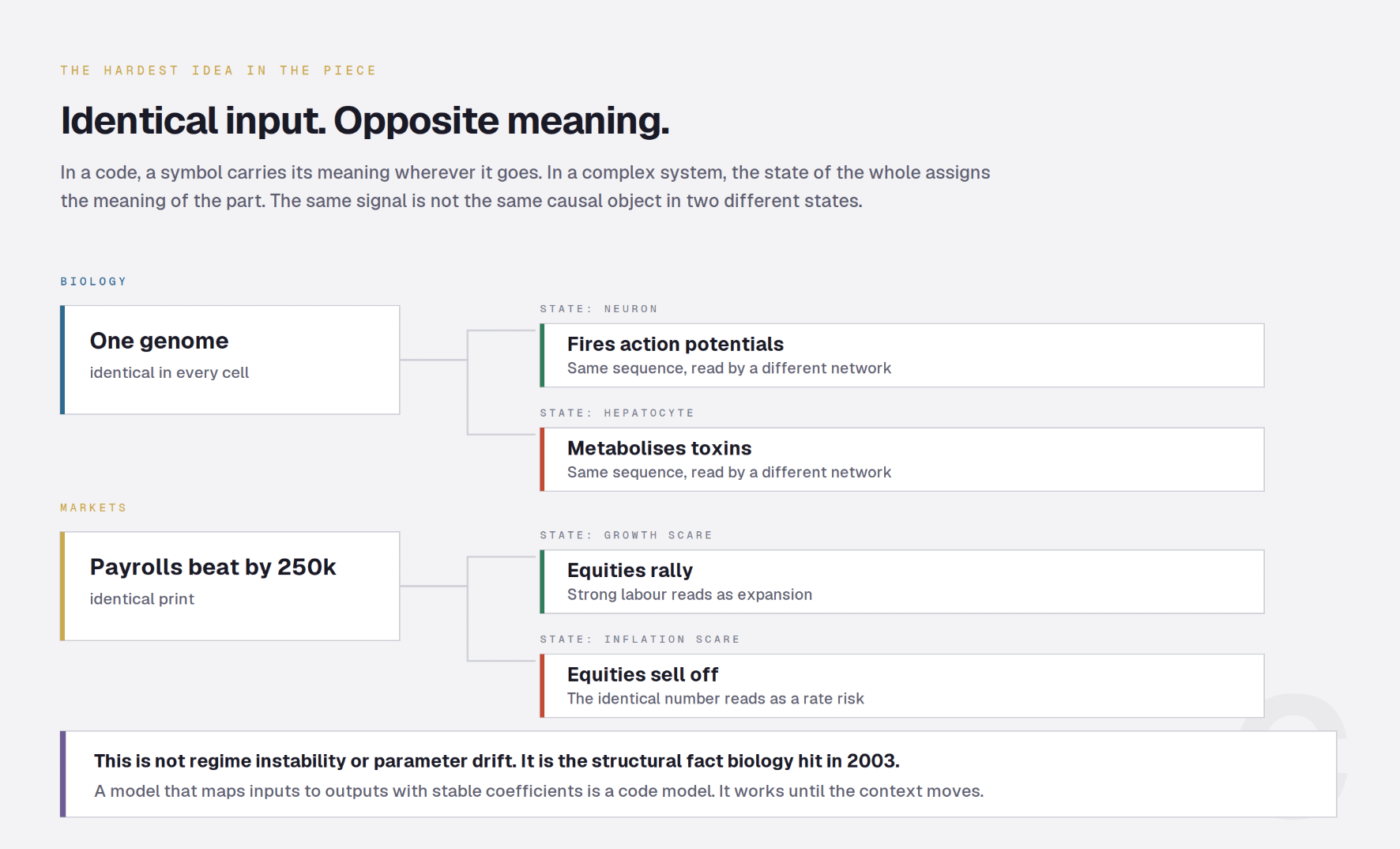
The practical version: stop asking what an indicator means. Ask what state the system is in, then what the indicator means in that state.
The mistake. Reaching for the blueprint metaphor anywhere — genome as code, brain as computer, market as machine, prompt as program. Each one is tempting because it promises that if you find the right minimal unit, meaning will be sitting inside it. It never is.
Carry this: stop asking what the signal means. Ask what state the system is in, then ask what the signal means in that state. Only the second question has an answer.
Learn the objects, not the anecdotes. Anecdotes are how this field gets sold; objects are what it is.
But a definition sits on the page and a question travels into your next meeting. So here are the twenty as questions. Run any system past them and the ones that bite will tell you what kind of system you’re holding.
Structure — how it’s put together
Network topology. Who is actually wired to whom — and is that the same as the org chart?
Modularity. If this part fails, does the failure stay local, or does it take the neighbours?
Hierarchy. Am I trying to explain this level using the vocabulary of the level below it?
Bottleneck. What single constraint sets the rate here — and am I optimizing something else?
Scale — how behavior changes with size
Power law. Is there a typical size here, or am I averaging things that have no middle?
Scaling exponent. Does the next unit of scale buy me more than it costs, or less?
Fat tails. Am I treating the extreme as an anomaly when it’s the same process running?
Emergence. Does this property exist at all in the parts, or only in the assembly?
Dynamics — how it moves
Nonlinearity. If I double the input, do I actually get double the output — or have I just assumed it?
Positive feedback. What here feeds itself? Where does the runaway end?
Negative feedback. What’s damping this — and what happens on the day that damping stops?
Delay. How long between action and consequence, and am I reacting to a signal that is already out of date?
State — how it sits and how it jumps
Attractor. What regime is this system in right now, and what would it take to leave?
Phase transition. Is the next increment a change of degree, or a change of kind?
Criticality. Is this system tuned to the edge — where the trigger will look trivial and the response won’t?
Path dependence. How much of the current state is history that cannot be undone?
Adaptation — how it changes itself
Fitness landscape. How coupled are the parts — and does that make local improvement enough, or a trap?
Adjacent possible. What becomes reachable only after I take the next step?
Coevolution. Does the thing I’m optimizing against optimize back?
Robustness vs. fragility. What redundancy am I about to remove in the name of efficiency?
David Krakauer, the Santa Fe Institute’s president, draws the distinction that matters most this decade.
A complementary cognitive tool leaves you more capable when it’s removed — the abacus teaches an arithmetic structure that outlives it, and practised users end up calculating on an imagined one. A competitive cognitive tool leaves you less capable when removed — GPS delivers you to the address and dismantles your mental map of your own city.
AI can be either. The difference isn’t the model; it’s whether you use it to produce output or to explore structure. Let it traverse the adjacent possible — that’s what it’s extraordinary at. You keep the representation. The test at the end of a session: could you rebuild the argument without it? If not, you didn’t learn. You consumed.
Almost everyone is using it the first way, which is also why the returns to using it the second way are going to be large.
The systems that matter now don’t decompose. The average describes nothing. Small causes and large causes come from the same distribution. And the value in the largest capital cycle in history is accruing to the links rather than the nodes, because in a complex system it always does.
Meaning is topological. So is money.
Beautiful Sunday !
Guillermo Valencia A
No posts
Comments
Nothing yet. Say the first thing.
Sign in to join the conversation.