
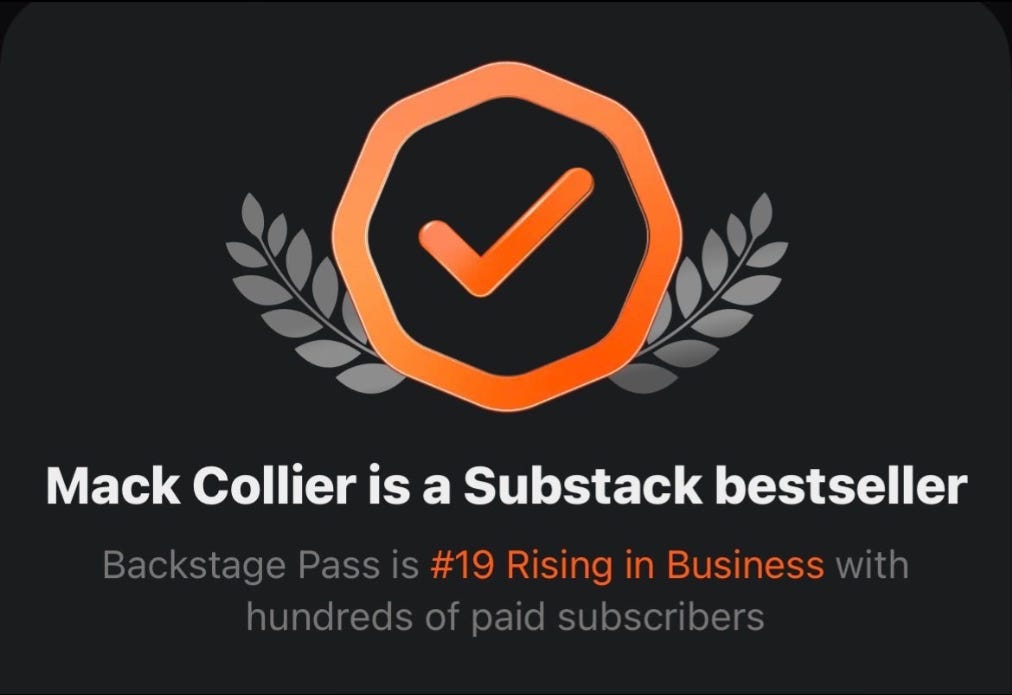
Boy that looks good!
On June 1st, 2024, I began publishing on Substack.
When I started, I had a very vague plan. I wanted to turn Substack into a revenue channel. That was pretty much all I had at the start in terms of a strategy.
What attracted me to Substack was it had native monetization options. Plus, it had a social layer (Notes) on top of it. This addressed the two biggest issues I had with trying to build a newsletter: It was hard to directly monetize, and it was hard to build engagement. Substack, at least on paper, solved both those problems.
So I joined Substack in May of 2024. I did a couple of weeks of research here, then decided that on June 1st, I would launch Backstage Pass.
Almost 26 months to the day later, it became a Bestseller. Although the true amount of time it took to become a Bestseller was a year. More on that later.
Here are 10 lessons I learned along the way to Bestseller:
In August of last year, I got serious about Substack. The month before, Substack had announced a huge $100M funding round. That was the kick in the pants I needed to get serious about Substack.
Up until that point, I really didn’t have a dedicated Substack strategy. I hadn’t defined my audience yet, at least not clearly. I hadn’t set goals and timelines. I had no way at all to measure my progress. I was tracking my number of new subscribers and views as my only KPIs. Those metrics are useful, but if they are all you track, it doesn’t tell you much.
My plan was ‘keep writing and eventually something will happen’.
In August I had a ‘come to Jesus’ moment. Literally. More on that at the end of the post.
I then designed a comprehensive plan with timelines, goals, KPIs to track, a robust 3-stage strategy, the works.
Overnight, the needle began to move. As soon as I got serious about Substack, I started to get serious results. Again, I will go into this a LOT more at the end of the post. Just understand for now that if you treat Substack like a hobby, you will get hobby like results. If you treat it like a business, it will perform like one.
A lot of creators here struggle with when to turn on Paid. My advice is the sooner, the better.
Here’s my rationale: It will take time to define your Paid tier. You will need to fine-tune your offerings, the benefits you provide. That means you will be making a lot of changes, a lot of tweaks.
There’s two reasons why I think it’s better to launch your Paid tier earlier rather than later:
1 - Launching early means you make corrections with a smaller subscriber base. If you launch Paid when you have just a few subscribers, then they won’t be as affected by all the changes and tweaks you will need to make in your Paid tier. On the other hand, if you wait till you get say 1,000 subscribers then launch Paid, you will have to make those changes and tweaks in front of an audience. It may be a bit unsettling for your 1,000 subscribers to see you making constant changes.
If you are going to make mistakes, it’s better to make them in front of fewer people :)
2 - Launching early lets you incorporate feedback from your first subscribers, who are more likely to be your biggest supporters. To be fair, you can collect feedback from your subscribers any time you launch your Paid tier. But I feel it will be more useful to you when you first start out. As your first Paid subscribers come in, you can talk to them, ask them what they like or dislike about the experience, then adjust.
For instance, Shannon Bindler was one of my first dozen or so Paid subscribers. One day she asked me “Do you provide one-on-one mentoring?” I did not, but as soon as she asked that question I realized I could, and should! I immediately started offering personalized mentoring and coaching via DM to my Paid subscribers, and it has become the most popular feature of my Paid tier. All from one conversation and bit of feedback from a current Paid subscriber.
Having said all of this, every creator and audience is different. My advice is launch your Paid tier earlier rather than later. But if you would rather wait till later, go with that. You being comfortable with the process is very important. If you simply don’t feel comfortable launching Paid early, then wait till you are.
This is a valuable lesson that’s hard to stick with sometimes. In tracking your progress toward making Bestseller (hitting 100 Paid subscribers), there will naturally be lulls. You may go days, even weeks with no new Paid subscribers.
On July 1st, I picked up a new Paid subscriber. I was pretty excited, hey month is only a day old and I already have a new Paid! That gave my reason to think July was going to be a big month!
16 days later on July 17th, I am still sitting at 1 new Paid in July. All that excitement from the first one is gone, now I am wondering if something was wrong.
Summer lull? Did I offend everyone? Did Substack tweak something under the hood?
Then from July 18th-August 7th, I would pick up 25 Paid subscribers in 21 days.
Here’s something I finally figured out: Monthly and Annual subscribers behave differently.
Monthly subscribers are often very ‘spur of the moment’. They will read a Note you write, think “Hey I like this guy/gal’s style’, and immediately upgrade to Paid. You get no advance warning, hell they didn’t know they were going to upgrade until they did.
Annual subscribers are far more deliberate. They do their research and basically sell themselves on upgrading. It makes sense, an Annual upgrade typically costs much more than monthly, they view it as an investment, and are slower to commit.
The point is, if you are pursuing Annual subscribers, it will take a while to convert them. Which is another reason why consistency is so important. Just because you can’t see it, you are still creating momentum. You are still moving deliberate subscribers closer to an update.
This is what I love about Substack. I genuinely love connecting with people and celebrating them. I love seeing a friend hit a milestone, I love restacking that and helping them feel good about themselves. I love it when I discover that two friends cover the same space, or that one friend has a problem and another friend has the solution.
I love helping other people, I truly do. And all that helps build relationships. And these relationships lead to trust, which leads to upgrades.
Additionally, Substack’s algo is trained to boost people who are good community managers! If you actively engage with others, if you promote other people’s content, comment on their Notes and posts, and push your audience towards them, Substack will boost your content. Substack sees that as you helping generate new subscriptions, so it boosts YOU as a result.
This post for Paid subscribers explains it more:
So up until December of last year, I had a good system going on my way to 100 Paid subscribers. At this point, I had about 18-20 Paid subscribers. Still small. I knew everyone who had upgraded, I had been engaging and talking to them for weeks or months, then they upgraded. It took time, trust was built, and they joined.
In December, all that changed.
I picked up 15 new Paid subscribers in December, and another 18 in January.
For the first time, people started upgrading who I hadn’t talked to yet! I started getting new Paid subscribers coming in who were complete strangers to me!
3 in December joined as Monthly subs, another 3 joined in January.
And all 6 unsubscribed almost immediately. THAT was a gut punch.
All 6 were people who decided to upgrade on the spur of the moment, and left almost as quickly.
Ladies and gentlemen, I now had to deal with churn for the first time on Substack.
I started by looking at the 6 people who had unsubscribed. I soon realize that I hadn’t personally engaged with any of them before they left. All had upgraded at Monthly, stayed for a week or so, received no engagement, then they left.
I made some changes to make sure I had a way to engage with new upgrades in particular. Since January, I’ve had I believe 3 churns total in 7 months. Much better than the 3 a month I got in December and January.
One of the best ways to establish your expertise here (and create helpful content) is to share what you learn, as you learn it.
For instance, as I was getting closer to Bestseller status, I was constantly experimenting with my content, conversion and engagement efforts. When I would hit on something that works, I immediately post it in the private chat for the Paid community, or I write it up in a post here for Paid subscribers. Often I would do both.
This is a great idea for several reasons:
1 - It creates content that your Paid subscribers can immediately use.
2 - It helps you establish expertise, you are literally showing your work.
3 - It’s social proof. Many times I would write a post on how to get more Paid subscribers, what triggers to use, how to structure your CTA, etc. And those posts usually converted Paid subscribers! Instant proof of concept. “Hey I just wrote this post on how to get more Paid subscribers, it has so far generated 3 Paid subscribers. Read what works here…”
This one caught me by surprise. As my Paid community grew, it became a wonderful support group and a great learning source. All the time spent helping members with their questions and ideas became wonderful feedback that actually helped me with my own Substack.
I’ve talked about this before, but one of the things that really held me back at first was I didn’t have a group of peers that I could connect with and bounce around ideas and compare notes. The Backstage Pass Paid community became that over time for me.
If you have Paid tier, investing time into growing and cultivating your Paid community is one of the best investments you can make. For them, and yourself.
This one seems counter-intuitive, but it works. We are told to cast a wide net with our content, to chase getting as many free subscribers as possible, and the growth will take care of itself.
I found out that the more specific I became about who I want to work with, the faster I grew. Instead of trying to attract everyone, I started trying to repel the wrong people.
Unsubscribes shot up. And so did upgrades to Paid.
When I started being intentional about who I am and who I want to work with, the ‘wrong’ people started leaving, and the ‘right’ people began to lean in.
BTW if you are wanting to get started with this, your bio on your profile is the perfect starting point. Clearly explain in 1-2 sentences who you are, who you want to work with, and how you can help them.
🇮🇹 Katarzyna Ciszewska has the best bio I have ever seen:
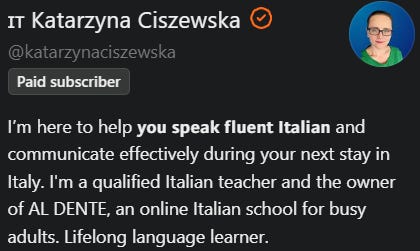
Two sentences. The first one tells the change, and who it is for. The second tells you how Katarzyna is the one who can help you. Isn’t it a thing of beauty? :)
Your current, happy Paid subscribers are your best source of new ones.
What that means is you can promote me better to your network than I can.
Let’s say I write a Note: “Guys, I am awesome, You should upgrade to Paid immediately.”
Then you see your friend’s note: “Guys, Mack Collier is awesome. You should upgrade to Paid immediately.”
Who will you listen to, me or your friend? Your friend wins out every time.
So the more attention and support you give your Paid community, the more they will go out of their way to return the favor. I would suspect about 25% of my Paid community members came from existing members who promoted me to others.
I go out of my way to communicate to my Paid community that I appreciate them. And they appreciate my efforts, so they tell their friends to join.
Love the people who love you. Don’t chase new subscribers, do amazing things for your current Paid members, and let them acquire new members for you.
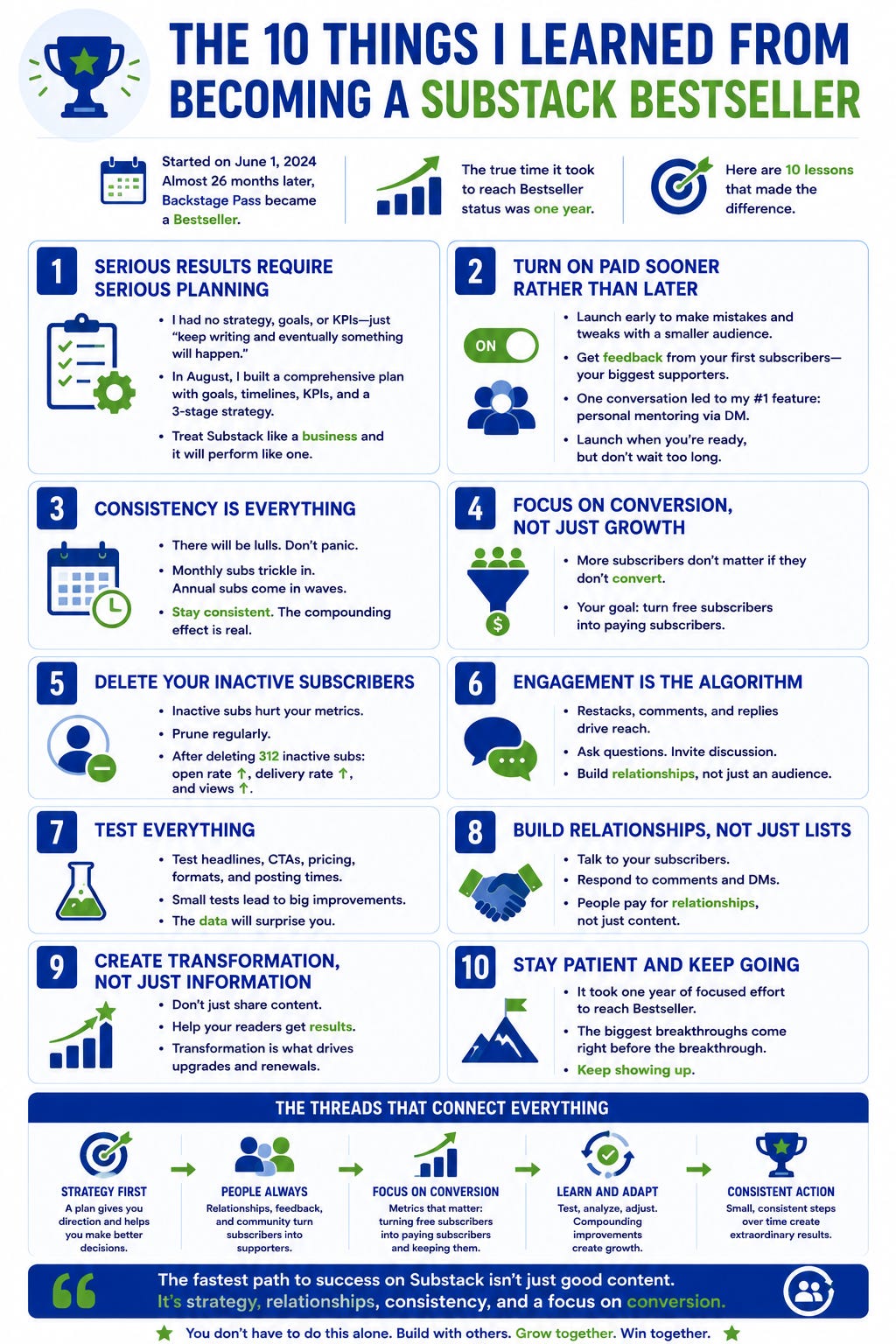
This is actually the point that is the foundation of everything else in the post and what has happened over the last year.
Around 2011 or so, I started hearing over and over again how newsletters were the future. Industry friends and peers like Ann Handley and Joe Pulizzi kept banging the drum of the value of building your email list.
I bought in. But I just couldn’t make it work for me. For years I tried to get my email list off the ground. Over a decade spent starting and stopping. It would seem to get traction for a few months, then noting, I would lose interest. Then I would pick it back up and go full bore into it for another 3-4 months.
When I say it would get no traction, I mean nothing. No revenue, no replies. Nothing. I kept trying to figure it out, and never could.
So when I came to Substack, I still had all those failures in the back of my mind about trying to grow my email list. The first year here, it was the same story. It would seem to be getting traction, then stall.
In July of last year, when Substack got their $100M funding round, I knew it was time to make this work, or dump it. But I knew I had to try something new, the same ole same ole hadn’t worked in 14 years.
Around this time, I heard pastor Johnny Enlow say something that opened my eyes. He said Christians are tested by God twice in their lives: When they Have, and when they Have Not.
He said that most of us can pass the test when we Have Not. We will get desperate, and turn to God and ask Him to take over our problems, and He will.
But Enlow then explained that we usually fail to turn to God when we Have. When things are going good, we tend to give ourselves the credit. We tend to believe we can solve the problem, we are responsible for the growth, and we don’t need God.
As soon as I heard him say this, I realized this was precisely what I had been doing for years of trying to build a successful newsletter. I always viewed it as a problem that I could solve. All I had to do was figure it out, and it would take off.
Then I realized, I never once asked God to help me with it. I always viewed the newsletter and its growth and a problem I could solve. That was my pride talking.
So I decided from that point on, I would ask God first what He wanted me to do.
Immediately, everything clicked into place.
In August, God showed me to focus on my content, conversion and engagement strategies in that order. It all fell into place perfectly.
In August of 2025, I had 7 total Paid subscribers. After 14 months.
6 months later, I was at 31. 12 months later I was at 104.
From 7 to 104 Paid subscribers in 1 year. As soon as I asked God to help, He responded.
So many times over the last year, the answer to a problem I had been struggling with for years with my newsletter would suddenly come to me. I would immediately think “How did I never see this before? It was right there the whole time!”
Because I never asked God to show me. I told Him I was smart enough to figure it out on my own.
What’s that famous saying? Want to make God laugh? Tell Him your plans.
From now on, when I Have, I am going to remember that I still need help. In fact, I probably need it more than ever then.
Finally, I wanted to call out a few very special friends who made this all possible. These are my family and nothing would make me happier than to find a way to repay all their support here. This list isn’t ranked in any way possible because they all are priceless to me.
Joyce Sullivan - A dear friend I have known for over 15 years. She was one of my first Paid subscribers, has been an Annual subscriber for over 2 years. When she renewed last year, I emailed her to thank her and she told me that 15 years ago I wrote a blog post that helped her with her consulting business and she hadn’t forgotten than and wanted to support me now. That says it all about Joyce.
Neela 🌶️ - Books could be written about everything Neela has done for me over the last 2 years. She is truly the best friend I could ask for and honestly one of the most caring and compassionate people I have ever met.
Mia Kiraki 🎭 I have started calling Neela and Mia sisters, which is about the highest compliment I could pay either of them. Mia is a wonderfully supportive friend who came into my life and a time when I needed her the most and I will always appreciate everything she has done for me.
Shannon Bindler is my cheerleader. Actually she is everyone’s cheerleader. I try to be supportive of others, but even I have to take a backseat to Shannon. Always supportive, always optimistic, she is literally a ray of sunshine in every room she enters.
Amy Canada and Victor Canada. I have known the Canadas for….I think almost 20 years? We first met at South by Southwest in 2011, and they have been great friends before and since. Amy was my very first Paid subscriber, she joined almost as soon as I opened my Paid tier in July of 2024. Vic then joined as well that November. Amy just renewed for the third time. I am really looking forward to Vic starting his own Substack soon so I can do all I can to help him grow it as quickly as possible.
Melissa S. Kerley, Ph.D. is a dear friend I have known, along with her sister CK, for almost 20 years. Melissa upgraded to Paid in August of 2024 as an Annual subscriber and since that time she has purchased a total of SIX annual subscriptions for herself and others. Her current subscription ends at the end of the month and she’s already contacted me to make sure it will renew.
All of these dear friends gave me the financial support to get this idea off the ground, and the emotional support to see it through. What’s amusing to me is two of the people on this list told me, independently “Mack when I make it, I am taking you with me!” That speaks to what good and caring people this group is.
Thank you to them, thank you to everyone that has helped me reach Bestseller. I couldn’t have done it alone. Looking forward to sharing what I have learned with the Paid community, will have a free gift for you guys soon :)
Most paid newsletters sell you a content library and move on to the next subscriber.
Backstage Pass works differently.
When you upgrade, that’s when I start paying attention. I’ll answer your questions. I’ll engage with your work. I’ll spotlight what you’re building. Everything I teach here, I do, and I do it alongside you, not from a distance.
The upgrade isn't the end of our relationship. It's the start.
Comments
Nothing yet. Say the first thing.
Sign in to join the conversation.