
A couple of weeks ago, a journalist posted an article suggesting that Substack’s model was collapsing. His rationale for this claim was that his revenue had collapsed, and it was Substack’s fault.
I checked his Paid tier, and found that when you upgraded, your benefits were that you get access to more content.
That’s it.
His model was the one collapsing, not Substack’s. He was basically running the ‘support my work’ model. This model doesn’t work. I know, because I ran it for the first year I was here. That was when I seriously considered quitting Substack, as well.
I saw this post early on from Neela 🌶️ bringing it to my attention. At first I wasn’t going to address it, but I saw some people in my subscriber chat discussing it, so I wanted to talk about some of the discussion around it.
In the course of the discussion around this article, people started brainstorming ideas for how Substack could offer them more ways to make money.
One of the ideas that these people loved was offering ‘bundle’ subscriptions. Basically, the Medium model. You know, the site that everyone is leaving cause they can’t make any money there.
So I thought this would be a good time to discuss how you should set your prices.
There are two schools of thought on pricing I wanted to address:
1 - Set your prices low to drive demand
2 - Set your prices at a reasonable rate, then offer more benefits to drive demand
At first glance, setting prices low to drive demand can seem like a brilliant idea. I even saw one creator who said she was dropping her monthly price from $5 to $1. And she was thrilled that subscriptions had increased 6 times previous rates!
Which would mean she sold 6 subscriptions to make $6, versus one subscription to make $5. So while her revenue technically increased by 20%, I’m not sure this a smart move.
Another popular idea among commenters was that Substack needs to add a ‘tip jar’ feature to posts. Someone may not want to pay $5 for a monthly fee, but if they like a particular post, they can ‘tip’ the author a dollar.
As my friend Tracy Friedlander told me, this is simply a race to the bottom. If we start charging a dollar for a piece of content, our audiences will believe that all our content is worth is a dollar.
That’s not how you make more money on Substack. That’s not how you build a sustainable model for Substack or its authors. That’s how you take a model that is currently working, and you bankrupt it.
The other school of thought on pricing is that you set your prices at a reasonable rate, then offer more benefits to drive demand.
This is the model that almost every successful Substack creator runs. Here’s how it typically progresses:
Creator starts out charging say $5 a month, and $50 a year. They have low visibility, and as a result, little or no demand from Paid subscribers.
Over time, they add a benefit to the Paid tier other than “Upgrade to get more content”. Demand trickles higher.
A bit later, they add another benefit. Demand sees another marginal increase.
As the Paid tier becomes more rounded, it becomes a better value. Growth on the free side in particular begins to accelerate. As the subscriber count increases, it becomes social proof, that leads to more Paid subscribers.
At some point, normally around 30-40 Paid subscribers, the creator is in a position where it makes sense to raise rates marginally.
Let’s say the creator is at their original rates of $5 monthly and $50 annual. Since the creator has now demonstrated they are creating value for their readers, I would advise a modest rate increase, mostly on the monthly side. New rates could be $7-8 a month, and $60 for Annual.
This increase typically won’t impact sales on the monthly side. But it will give a slight boost to sales on the Annual side. The problem with starting your rates at $5 a month and $50 Annual is this: Annual doesn’t have enough of a discount to justify paying for it. But when you charge $7 a month and $60 annual, that’s about a 30% discount if you go Annual.
And most creators want Annual subscribers more than paid. The average Substack is thought to have a breakdown of around 40% Annual and 60% monthly. The problem with having the majority of your subscribers at the monthly rate is that churn will be a bigger issue. Annual subscribers typically take longer to commit to an upgrade, but they are more likely to stick with it when they do, and they are more likely to get better results from the upgrade. Plus the Annual upgrade gives you all the cash upfront, so you can invest it back into your Substack or whatever else you need it for. Having immediate access to the cash gives you more flexibility.
Ask yourself this question:
“What changes for the reader if they upgrade?”
If your answer is “They get access to all my posts!”, then you need a better offer.
The reality is that people aren’t going to pay $8 a month for more content. That is true of 99.9% of the publications here.
But people WILL pay for transformation. If you can sell them a change that they value, they will pull out a credit card for that.
Paying for more content is seen as an expense.
Paying for transformation is seen as an investment.
People will justify continuing an investment before they will justify continuing to pay an expense.
There’s two ways:
1 - Charge less
2 - Add more to your offer.
My advice is make your offer better by adding more benefits.
Remember that monthly subscribers tend to view monthly as an expense. That’s because it’s typically less than $10.
Annual is viewed as being an investment. Because it typically costs $50 or higher.
Which brings up an interesting point about converting free subscribers to annual: It takes longer. From my experience, it typically takes 3-6 months to convert the average subscriber to annual.
Often, the annual will sell themselves over time. But it will still take several weeks before they reach a point where they feel comfortable enough with you and your content to upgrade to annual.
But when they do, they tend to spend more time working on the benefits you provide. Because they view annual as an investment, not an expense.
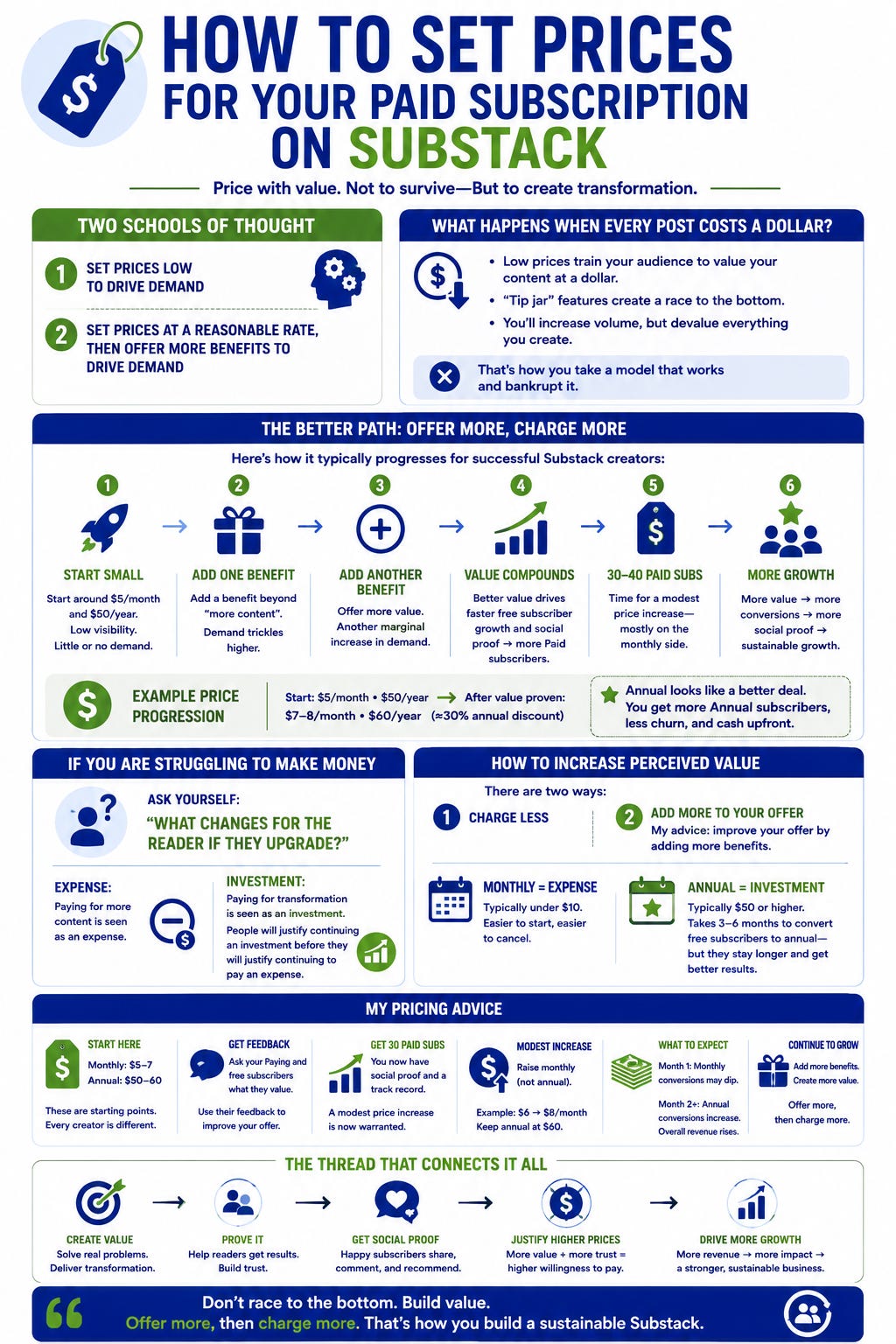
Set your monthly at $5-7, and your annual at $50-60.
This is just to start. As you get more free and paid subscribers, get feedback from them on your paid offer, and improve it using their feedback.
This will accelerate conversions.
Once you reach 30 Paid subscribers, consider a modest price increase. This price increase should mostly by on your monthly rate. The goal is to make annual look like a better deal by comparison.
For instance, let’s say you start off with monthly at $6 and annual at $60. I would raise monthly to $8, and leave annual at $60.
Once you have at least 30 Paid subscribers, you then have a track record you can point to. That’s at least 30 people who decided that your Paid tier is worth purchasing. So a modest increase to monthly is warranted.
Note: Increasing monthly slightly and not increasing annual may lead to fewer monthly conversions in the first month. But starting in the second month, you should start to see a slight increase in annual conversions. The overall increase in revenue will work in your favor.
As you continue to grow and add more benefits, you can let the value of your overall paid package decide what you charge.
Offer more, then charge more. Create demonstrable value, this will lead to an increase in conversions. This creates social proof, which leads to justification for price increase.
Hope that helps. If you have any specific questions or want some advice on your existing prices, either leave a comment here, or shoot me a DM and I’ll take a look.
Most paid newsletters sell you a content library and move on to the next subscriber.
Backstage Pass works differently.
When you upgrade, that’s when I start paying attention. I’ll answer your questions. I’ll engage with your work. I’ll spotlight what you’re building. Everything I teach here, I do, and I do it alongside you, not from a distance.
The upgrade isn't the end of our relationship. It's the start.
Comments
Nothing yet. Say the first thing.
Sign in to join the conversation.