
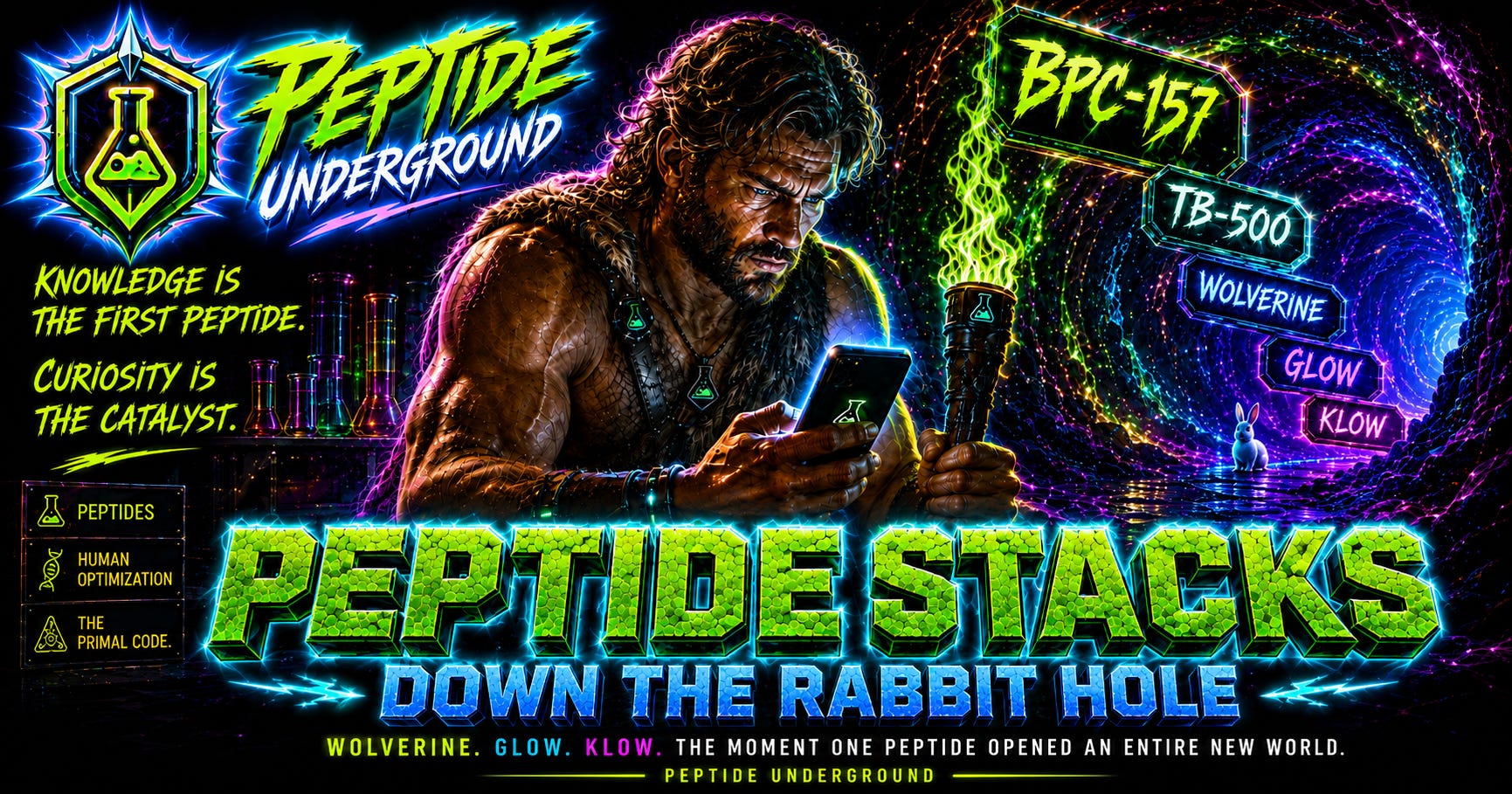
It started late one night with the blue white glow of my phone lighting up a dark room.
I was doing what most people do when they should probably be asleep, scrolling TikTok with no real destination, when a name came across the screen that made me stop.
BPC-157.
I had never heard of it.
I watched the video.
Then another.
Then I searched the name.
A few minutes later I wasn’t scrolling anymore. I was reading.
Articles. Forums. Studies. Podcasts. Comments from people talking about injuries, recovery, tendons, gut health, healing.
Every answer seemed to open another door.
Then another name started appearing.
TB-500.
Now I was wide awake.
Two compounds. Different mechanisms. Similar conversations.
And somewhere deep into that late night rabbit hole, I came across three words that pulled me in even further:
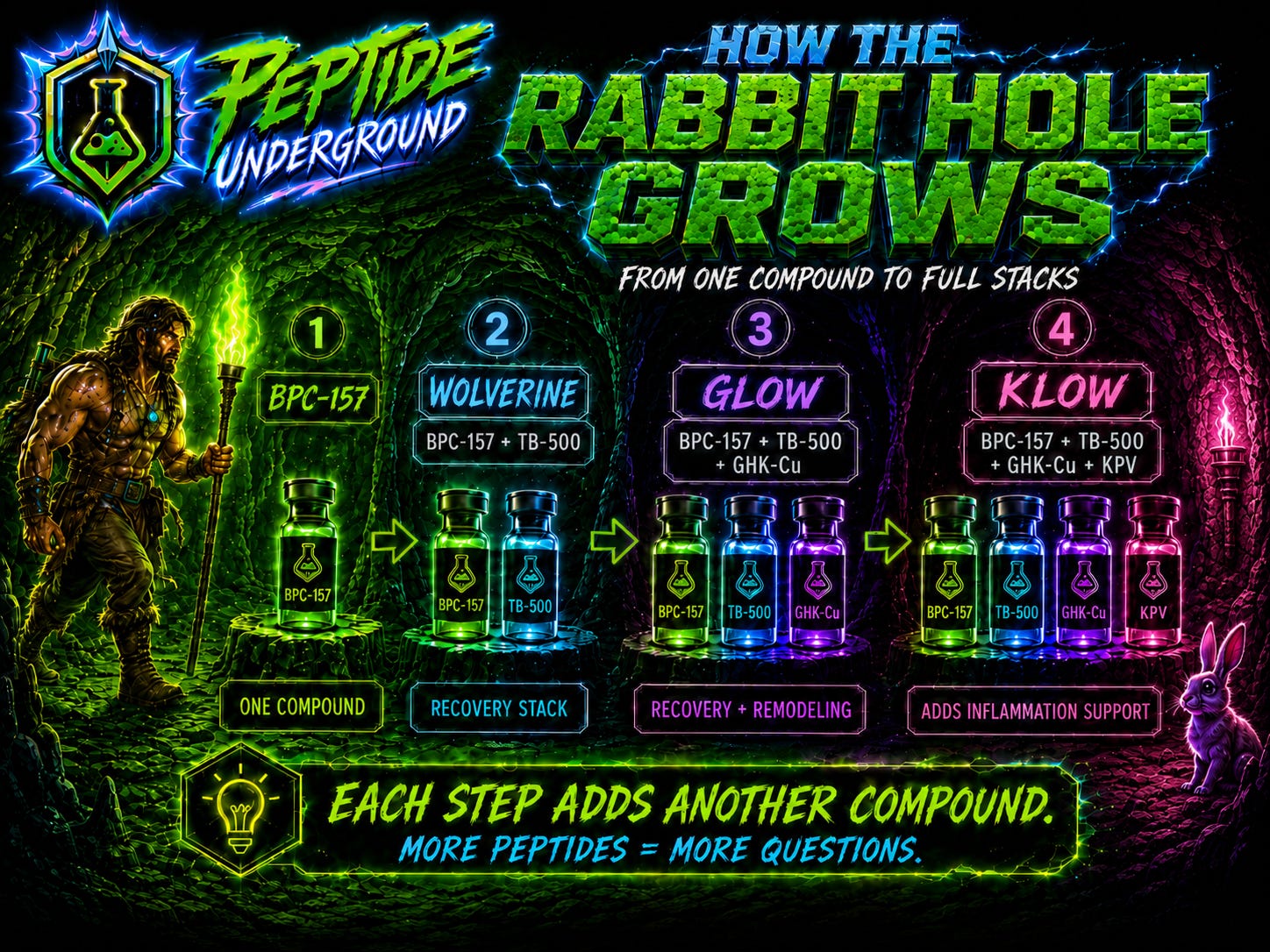
THE WOLVERINE STACK
BPC-157 and TB-500 together.
That stopped me again.
There were stacks?
People weren’t just researching these compounds one by one. They were combining them, grouping them around specific goals, and giving the combinations names.
That was the moment the whole world got bigger.
One compound had led me to another.
Two compounds had led me to a stack.
And before I knew it, the night was nearly gone and I was still reading.
That was the beginning of a fascination that never really left.
If you’re discovering this world for the first time right now, I know that feeling.
One question turns into five.
One compound turns into ten.
And suddenly you realize you’ve only scratched the surface.
You’re in the rabbit hole now.
Good thing my torch can light the way.
---
SO WHAT IS A STACK?
At its simplest, a stack is two or more compounds used together around a shared goal.
Maybe recovery.
Inflammation.
Skin.
Body composition.
Sleep.
The thinking is pretty straightforward:
One compound may approach the problem one way.
Another may approach it from somewhere else.
Put them together and maybe you cover more ground.
That was how I understood it at first.
And honestly, it sounds logical.
But this was one of the first distinctions I had to learn:
Something can make sense on paper without ever being proven in people.
That matters.
A lot.
---
WOLVERINE
BPC-157 + TB-500
For a lot of people, this is the first stack they hear about.
It was for me.
BPC-157 is commonly discussed around tissue repair, tendons, ligaments, gut research and wound healing pathways.
TB-500 shows up in many of the same conversations through research involving tissue repair, cell migration and recovery.
Then somebody gave the combination the perfect name:
WOLVERINE
If you know the Marvel character, you get the reference immediately.
One of Wolverine’s defining abilities is his accelerated healing factor.
So the name fits the idea perfectly:
Recover. Repair. Get back up.
At the time, that was enough to make the whole concept click for me.
But this is where Professor Caveman taps the brakes.
The individual compounds have their own research.
The Wolverine Stack itself has not been established in controlled human trials as a proven superior healing combination.
That doesn’t make the idea worthless.
It just means the evidence for the stack is much thinner than the popularity of the name might make you think.
That lesson comes up again.
---
THEN CAME GLOW
BPC-157 + TB-500 + GHK-Cu
Once Wolverine had my attention, the next name I started seeing was Glow.
Take the general recovery idea behind Wolverine and add GHK-Cu.
GHK-Cu is a copper peptide with research involving skin, collagen, tissue remodeling, wound healing and hair biology.
Now the idea shifts.
Wolverine is mostly framed around recovery.
Glow widens the target toward:
Recovery + remodeling + aesthetics.
And the name practically explains itself.
Glow.
This was the point where I started seeing how quickly stack culture could grow.
Take an existing combination.
Add another compound.
Give it a new name.
Now it feels like its own thing.
But I had to learn not to confuse three interesting compounds with evidence for one proven three compound therapy.
Those are not the same thing.
---
THEN CAME KLOW
KPV + GHK-Cu + BPC-157 + TB-500
Then I started hearing about KLOW.
Take Glow.
Add KPV.
KPV is commonly discussed because of preclinical research involving inflammatory signaling and mucosal tissue.
Now the idea gets broader:
Repair. Recovery. Inflammation. Remodeling.
At first glance, it sounds like an upgrade.
And this is where the trap starts.
Because once you understand stacks, it’s easy to think:
If two compounds are interesting, four must be better.
Maybe.
Maybe not.
Every compound you add creates another variable and makes it harder to know what’s helping, what isn’t, and what might be causing a problem.
Complexity can look impressive.
That doesn’t make it better.
---
CAVEMAN EXPLAINS
Caveman finds hammer.
Useful.
Then knife.
Useful too.
Then rope.
Spear.
Axe.
Soon caveman carrying every tool in cave.
Now caveman can barely move.
Lesson:
More tools only help if you actually need them.
Same with stacks.
---
THE WORD YOU’LL HEAR EVERYWHERE
SYNERGY
Once I got deeper into this world, I started hearing this word constantly.
“These compounds are synergistic.”
Maybe.
But two compounds affecting different pathways does not automatically prove synergy.
There’s a big difference between:
“These could complement each other.”
and
“These have been shown to work better together.”
The first is a theory.
The second requires evidence.
At the beginning, I didn’t know there was much of a difference.
There is.
A mechanism gives us a reason to ask the question.
It does not answer it.
---
LOOK PAST THE NAME
Wolverine.
Glow.
KLOW.
The names are memorable.
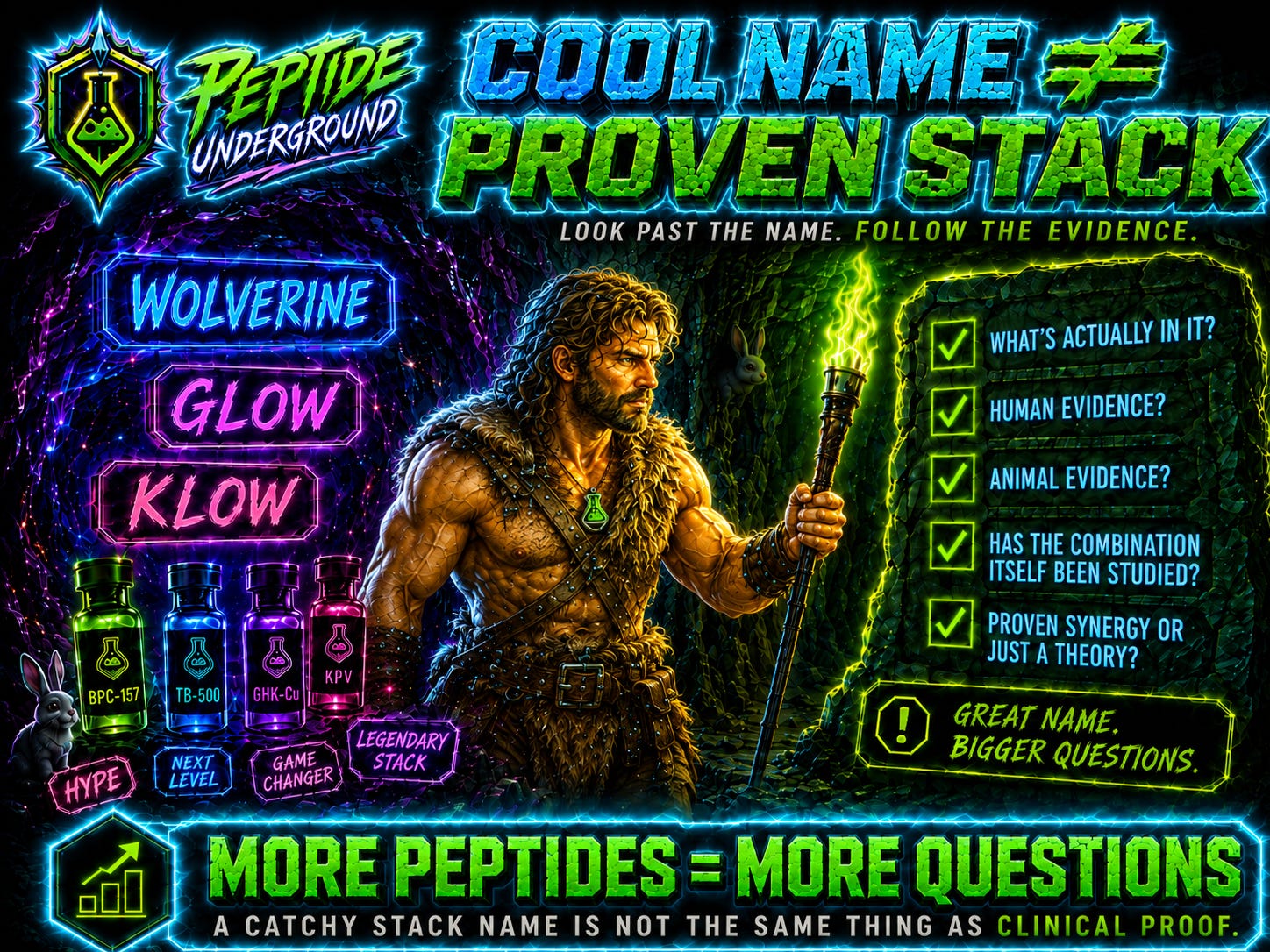
But they’re community shorthand, not official pharmacological classifications.
And depending on who is using the name, the exact formulation may not always be identical.
So now, whenever I hear about a new stack, I strip the name away first.
I want to know:
What’s actually in it?
Then:
What evidence exists for each compound?
Human?
Animal?
Cell study?
Anecdote?
And finally:
Has anyone actually studied the combination?
That one question cuts through a lot of noise.
---
WHY STACKS ARE SO EASY TO GET EXCITED ABOUT
I understand why people get pulled into this part of the peptide world.
I did.
There’s something fascinating about seeing the pieces start to connect.
One compound affects one pathway.
Another affects something different.
Then somebody asks:
What happens if we put them together?
That question is how real research begins.
It’s also how internet speculation begins.
The difference is what happens next.
Research tests the idea.
Internet culture often names it first.
That’s worth remembering.
---
THE RULE THAT STUCK WITH ME
The deeper I went, the more one idea kept coming back:
MORE PEPTIDES = MORE QUESTIONS.
Not automatically more benefit.
Not automatically stronger results.
Not automatically synergy.
More questions.
What does each compound actually contribute?
What’s been studied in humans?
What’s still animal research?
What’s theory?
What’s assumption?
Does adding another compound actually solve a problem?
That mindset matters more than memorizing stack names.
Because the names will keep changing.
The questions shouldn’t.
---
THE RABBIT HOLE NEVER REALLY ENDS
That first night started with BPC-157.
Then TB-500.
Then Wolverine.
After that came Glow.
Then KLOW.
Each answer opened another door.
A few nights ago, I was back in that same blue white phone glow when another peptide video popped up.
Then I saw a stack name I hadn’t heard before.
I stopped.
Read it again.
What is that?
I looked at the time.
I should probably go to bed.
Instead, I opened the video.
Then another.

Looks like Professor Caveman is heading back down the rabbit hole.
Torch in hand.
PEPTIDE UNDERGROUND
Learn. Research. Question the hype.
© 2026 Peptide Underground. Educational content only. Not medical advice.
No posts
Comments
Nothing yet. Say the first thing.
Sign in to join the conversation.