
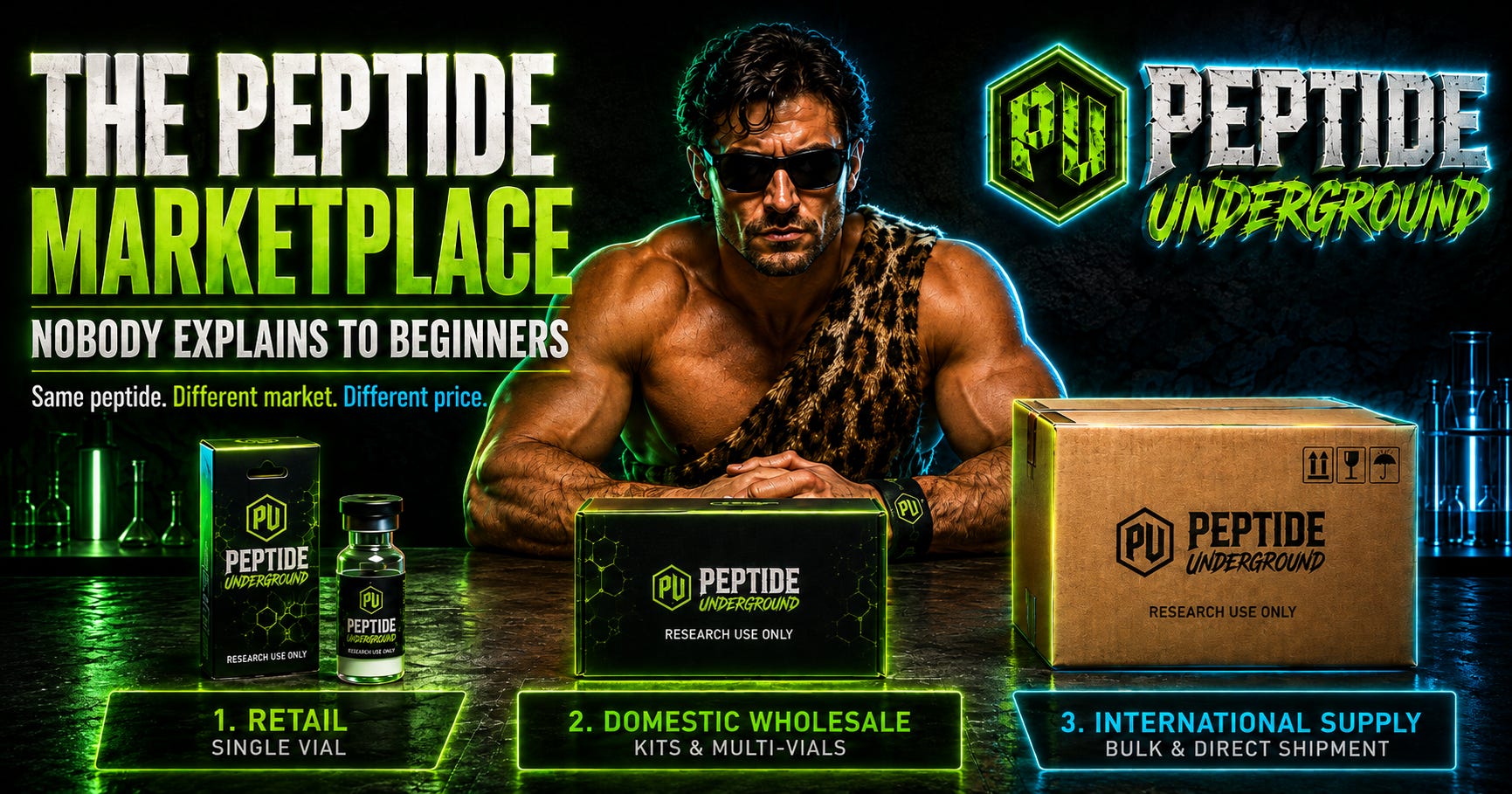
Same peptide.
Three very different prices.
One person sees a single vial selling at a premium.
Another sees full kits priced much lower per vial.
Then somebody online claims the same compound is available internationally for even less.
So what’s really going on?
Simple.
They’re not looking at the same part of the market.
That’s the piece beginners usually aren’t taught.
The peptide research marketplace has layers.
Different sellers handle different parts of the supply chain, and every layer changes the economics.
It also changes the uncertainty.
The accountability.
And the amount of information you need to make sense of what you’re looking at.
This article is not sourcing guidance or instructions for purchasing research products.
We’re not going to tell you where to buy.
We’re not going to tell you which market to choose.
We’re just going to show you the terrain.
Because once you understand the terrain, those wildly different prices start making a lot more sense.
---
First, One Important Distinction
We’re talking about the research marketplace.
FDA-approved drugs, legitimate pharmacy channels, and appropriately compounded medications operate in a different regulatory environment.
Different market.
Different rules.
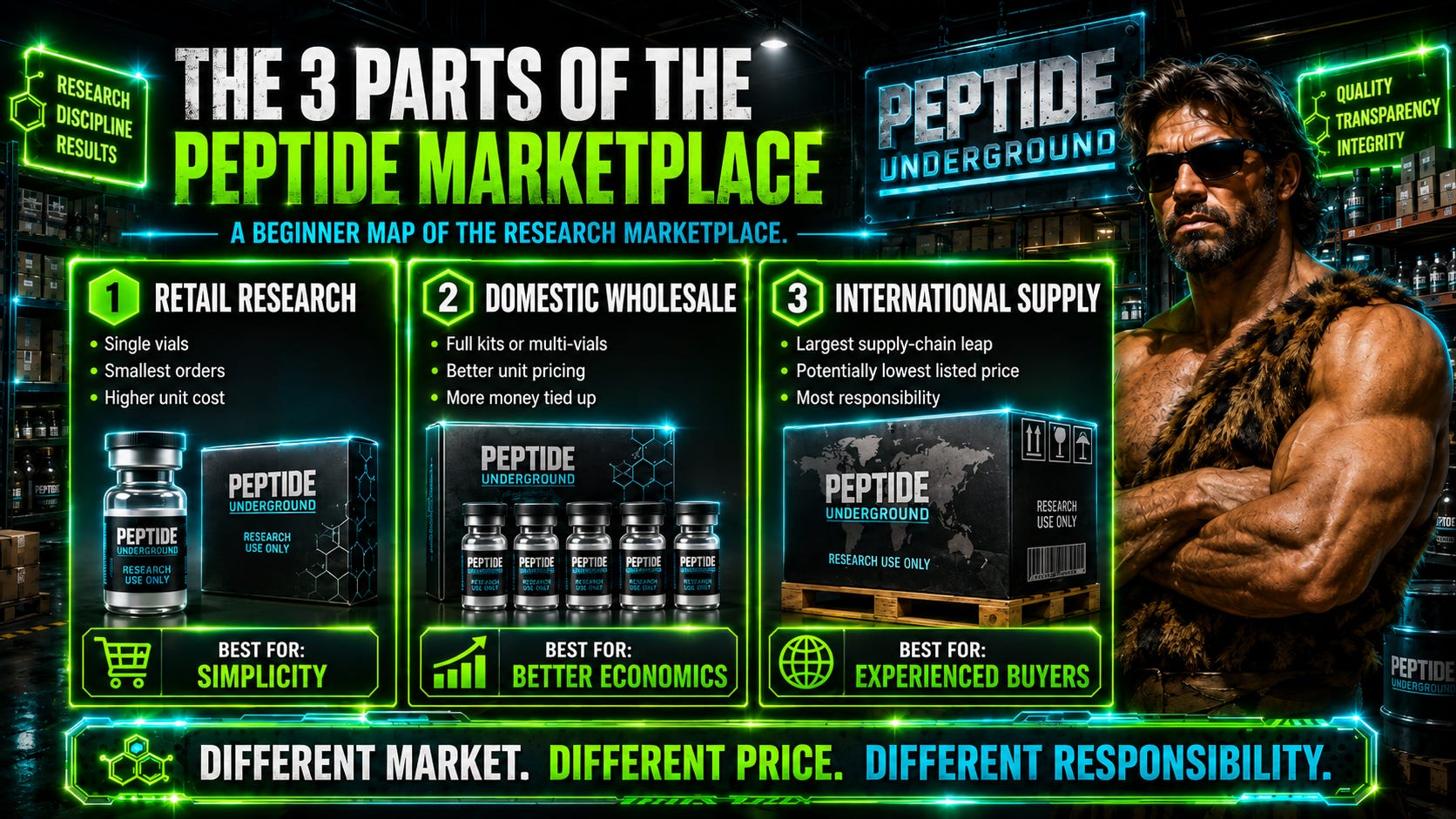
Now let’s look at the three parts of the research marketplace that beginners commonly encounter.
---
LEVEL 1: RETAIL RESEARCH SELLERS
This is usually the first part of the market people notice.
Individual vials.
Domestic-facing websites.
Small quantities.
A familiar online shopping experience.
The biggest thing retail provides is convenience.
Smaller transactions.
Domestic fulfillment.
Customer service.
Packaging.
Communication.
Sometimes access to testing documentation.
And all of that can get built into the price.
Caveman Version
Caveman wants one banana.
Store sells one banana.
Banana expensive.
But Caveman doesn’t need whole crate.
Easy.
That’s retail.
You’re generally looking at a higher price per unit in exchange for less friction.
But here’s the first lesson worth remembering:
Convenience is not verification.
A polished website does not prove quality.
A fancy label does not prove quality.
A higher price does not prove quality.
And a laboratory report sitting on a product page does not automatically answer every question about what’s actually represented by the product.
Those are separate issues.
---
LEVEL 2: DOMESTIC WHOLESALE
Then you discover the kit market.
Instead of individual vials, larger quantities are sold together.
And suddenly the per-vial economics look very different.
That isn’t mysterious.
It’s wholesale.
More units move in a single transaction.
Less retail handling is required.
The cost per unit can come down.
Caveman Version
Caveman buys one banana.
Expensive.
Caveman buys whole box.
Cheaper.
Good.
But if bananas are bad...
Now Caveman has a whole box of bad bananas.
That’s wholesale.
The lower unit price comes with a different set of tradeoffs.
More inventory is concentrated in one lot.
More money may be tied to one transaction.
And if there’s a quality problem, it can affect more than a single vial.
There’s also an important distinction beginners miss:
Domestic does not mean domestically manufactured.
A seller can operate domestically while the underlying material originated somewhere else.
There may be manufacturers, exporters, brokers, wholesalers, or other intermediaries further back in the chain.
So domestic fulfillment tells you where a package was sent from.
It does not necessarily tell you where the material originated.
Big difference.
---
LEVEL 3: INTERNATIONAL SUPPLIERS AND BROKERS
This is the part of the market that tends to generate the biggest price claims — and the most confusion.
You’ll hear phrases like:
“Direct from the factory.”
Maybe.
Maybe not.
International supply chains can contain multiple businesses between manufacturing and the eventual customer.
A manufacturer might sell through a trading company.
That company may work through brokers.
Inventory may move through wholesalers or importers.
And some businesses may perform more than one of those roles.
The important lesson here isn’t how to get around those layers.
It’s understanding why those layers exist in the first place.
An intermediary may be handling communication.
Logistics.
Inventory.
Customer problems.
Documentation.
Supplier relationships.
Or other parts of the transaction.
Sometimes that service has real value.
Sometimes the markup may be difficult to justify.
But the word middleman by itself doesn’t tell you enough.
The better question is:
What role is this business actually performing in the supply chain?
That tells you much more.
---
THE RULE THAT EXPLAINS THE WHOLE MARKETPLACE
If you remember one thing from this article, remember this:
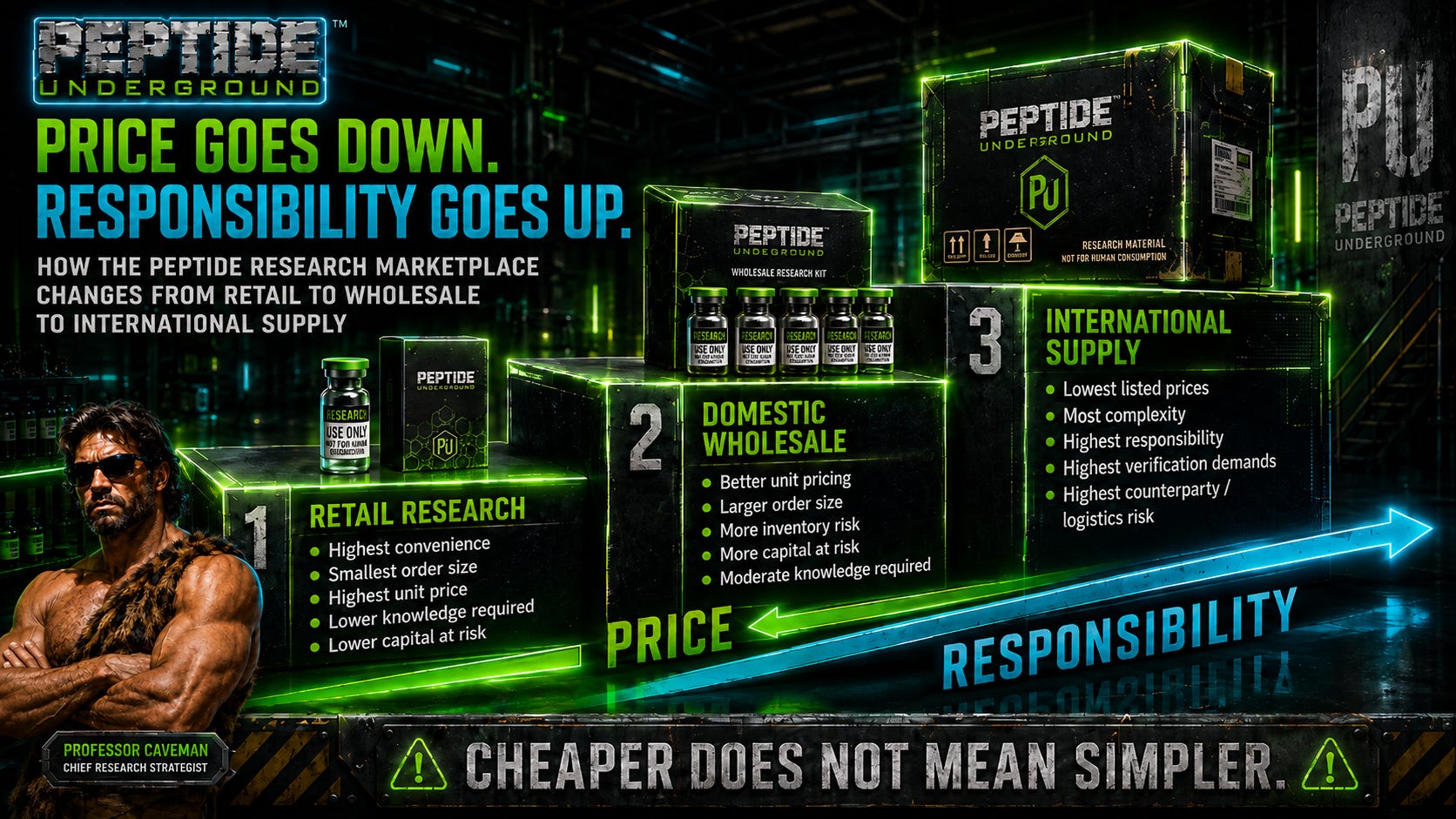
Price Goes Down. Responsibility Goes Up.
That’s the basic pattern.
Retail tends to cost more because more of the friction is being handled before the product reaches the customer.
Wholesale may lower unit cost while concentrating more inventory and financial exposure into one transaction.
International supply can look cheaper still because fewer domestic layers may be involved.
But lower price does not make uncertainty disappear.
It can simply move more of that uncertainty somewhere else.
And that leads to the part that matters:
When a layer disappears, understand what function disappeared with it.
---
WHAT YOU’RE ACTUALLY PAYING FOR
This is where beginners often oversimplify the math.
They see:
Retail: expensive.
Wholesale: cheaper.
International: cheapest.
So the brain says:
Cheapest = best deal.
Not necessarily.
The sticker price is only one part of the economics.
There can also be shipping.
Testing.
Inventory risk.
Lost or unusable product.
Time.
Administrative friction.
And uncertainty about who actually stands behind the transaction.
That changes the picture.
The cheapest listed vial is not automatically the cheapest overall transaction.
And the most expensive vial is not automatically the highest quality.
Price alone tells you surprisingly little.
---
THREE SHORTCUTS THAT GET BEGINNERS IN TROUBLE
“It costs more, so it must be better.”
Maybe.
Maybe not.
Price can reflect testing, service, branding, marketing, overhead, or simply margin.
High price does not prove quality.
“It ships domestically, so it must be safer.”
Again, not necessarily.
Domestic fulfillment may reduce certain logistical complications.
But it doesn’t automatically tell you where material originated or what happened before it reached the domestic seller.
“They said they’re the factory.”
That statement alone doesn’t establish much.
Maybe they are the manufacturer.
Maybe they represent one.
Maybe they’re a broker.
Maybe they’re a trading company.
Maybe they’re another reseller.
Confidence is not verification.
That rule applies everywhere.
---
THE COA PROBLEM
Sooner or later, every beginner learns one phrase:
“Do they have a COA?”
A Certificate of Analysis can provide useful information.
But people often make the leap:
COA = good product.
Too simple.
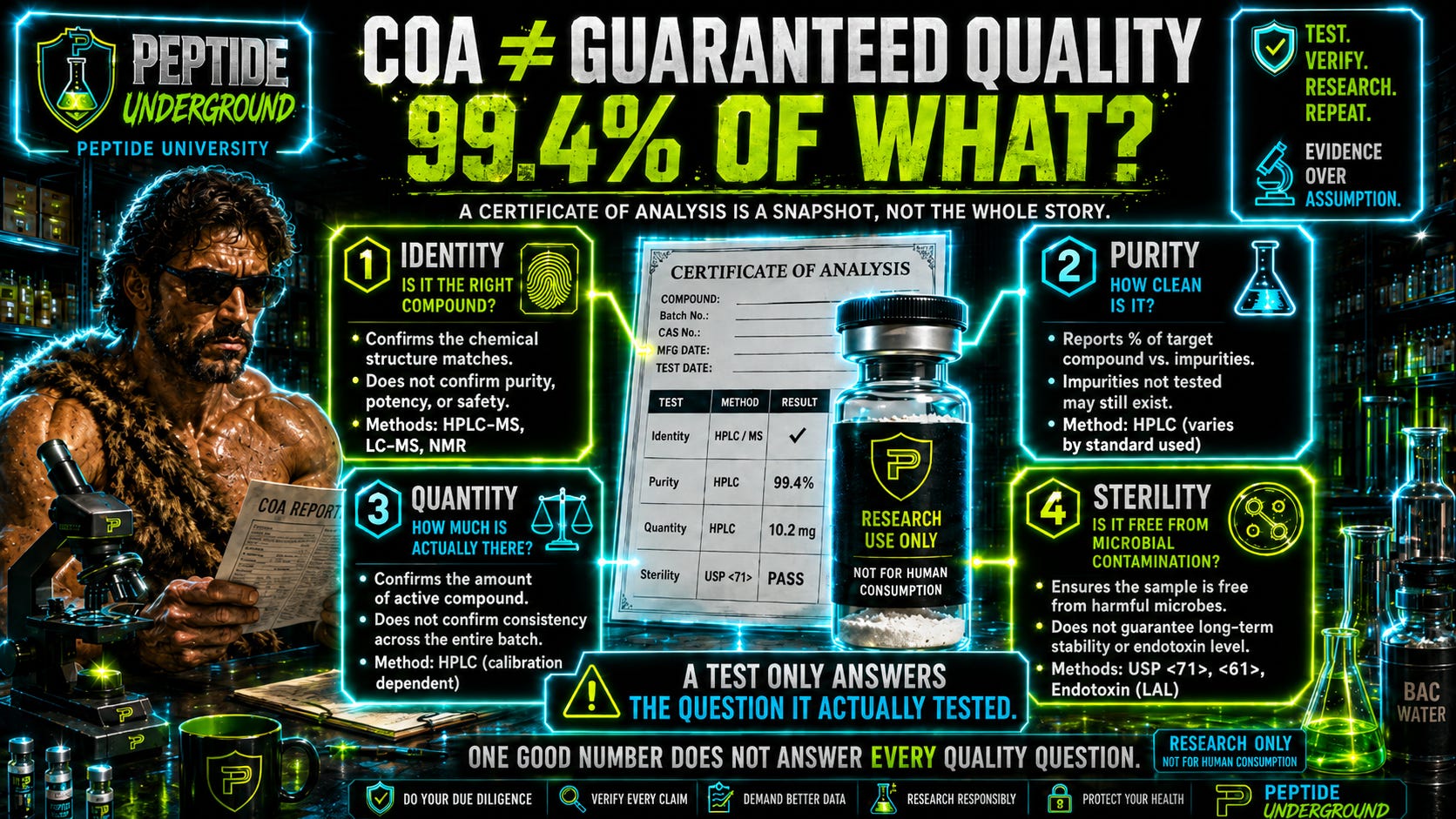
A test only answers the question it actually tested.
Purity is not sterility.
Sterility is not identity.
Identity is not quantity.
And a report does not automatically establish that the sample tested is representative of every unit being offered.
Professor Caveman
Caveman sees:
99.4% PURITY
Caveman happy.
Professor Caveman asks:
99.4% of what?
That’s the better mindset.
What did the analysis actually measure?
Who performed it?
Does the documentation correspond to the relevant lot?
And perhaps most importantly:
What does this report not tell me?
That’s how testing becomes information instead of decoration.
---
THE REAL BEGINNER MISTAKE
This article is not saying one market is good and another is bad.
It’s saying they have different tradeoffs.
Retail.
Domestic wholesale.
International supply.
None of those labels automatically tells you whether a particular product is good, bad, safe, unsafe, legitimate, or unreliable.
The beginner mistake is thinking that moving from one part of the market to another is simply about finding a cheaper price.
It isn’t.
The structure around the transaction changes too.
So instead of asking:
“Why is this one cheaper?”
Ask the bigger question:
“What changed in the supply chain to make it cheaper?”
That one question makes the entire marketplace easier to understand.
---
THE 30-SECOND VERDICT
Retail Research Market
Best feature: Simplicity.
Main tradeoff: Higher unit prices.
Knowledge required: Lower, but verification still matters.
---
Domestic Wholesale Market
Best feature: Better unit economics without international logistics.
Main tradeoff: More inventory and capital at risk.
Knowledge required: Moderate.
---
International Supplier Market
Best feature: Potentially the lowest unit economics and greater supply-chain access.
Main tradeoff: Significantly more responsibility, logistics, counterparty risk, and verification requirements.
Knowledge required: Highest.
---
FINAL THOUGHT
This isn’t a buyer’s guide.
It’s a map.
And once you understand the map, the pricing starts making sense.
Different parts of the market remove different layers.
Every layer has a cost.
But some of those layers are also doing work.
That’s the piece worth understanding.
So when you see two supposedly similar products sitting at wildly different prices, don’t automatically assume one is a bargain and the other is a rip-off.
Ask what sits behind the price.
Who handled the inventory?
Who handled the logistics?
What has actually been verified?
What remains unknown?
That’s where the real education starts.
Professor Caveman’s Rule
Don’t mistake a cheaper price for a simpler decision.
---
Educational Disclaimer
This article is for educational and informational purposes only. It is not medical advice, diagnosis, treatment guidance, prescribing guidance, or a recommendation to purchase, use, administer, or source any drug, peptide, research chemical, or other compound.
Research products may not be approved for human use, and product quality, legality, regulatory status, and safety can vary by jurisdiction and supplier. Always consult a qualified healthcare professional regarding medical decisions and follow applicable laws and regulations.
© 2026 Peptide Underground. All rights reserved.
No posts
Comments
Nothing yet. Say the first thing.
Sign in to join the conversation.